
The International Chiropractors Association says a diagnosis based on function, plus tools that put a number on dysfunction, can show a patient's progress and current condition apart from how the patient feels the pain. For range of motion, its table lists visual estimation, then inclinometer and goniometer measures in degrees. For muscle strength, it lists muscle testing (graded 0-5) and a dynamometer in kg or lbs. For muscle endurance, it lists muscle testing (graded 0-5) and the Biering-Sorensen Test, timed in seconds. For pain, disability and function, it lists the patient's own description next to outcome assessment instruments that give a number compared to normal values.
Why Pain Reports Alone Can't Show Whether Care Is Working
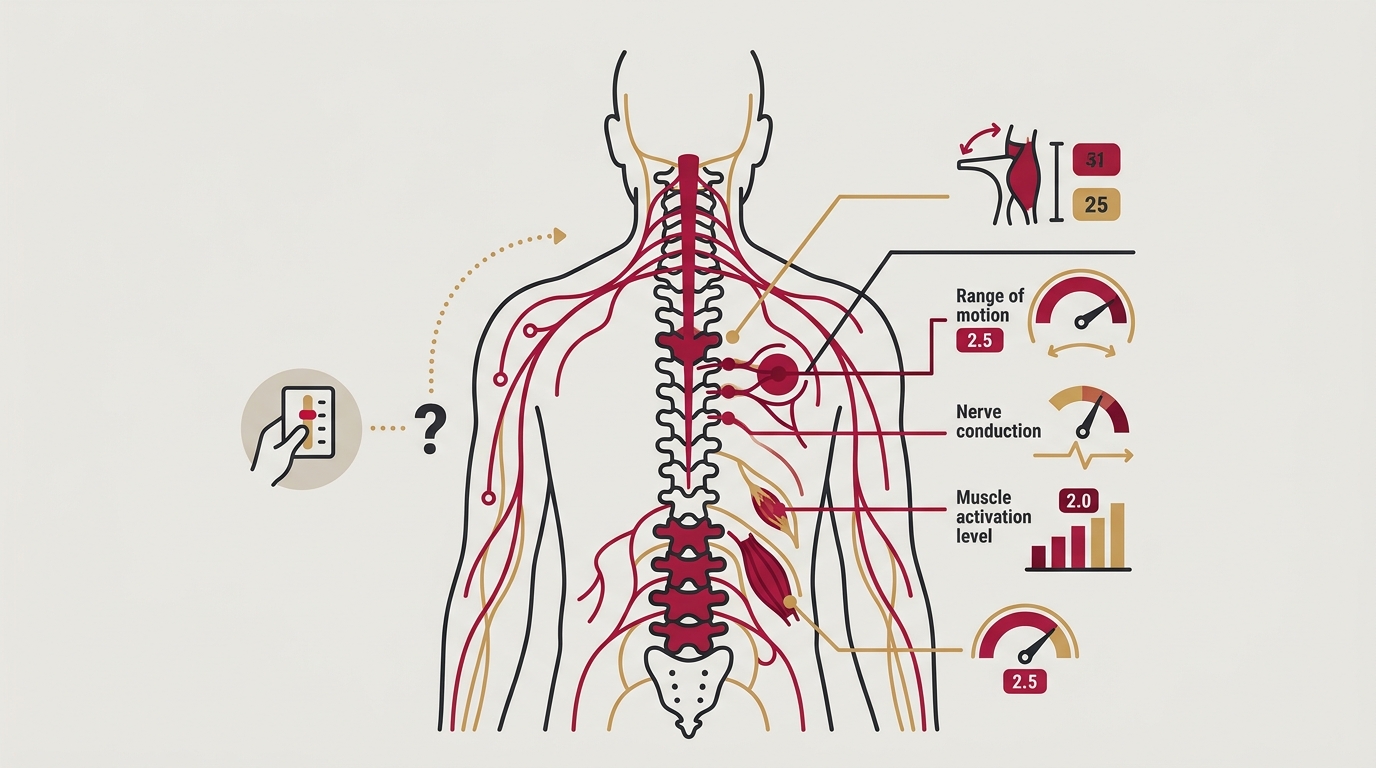
The International Chiropractors Association (ICA) says a diagnosis based on function, plus tools that put a number on dysfunction, gives a way to check your progress and current condition. That check is separate from how you feel the pain. You can read the whole chapter at Chapter 7: Outcome Assessment Measures in Chiropractic.
That same chapter says there's a poor association between objective measures of physical pathology and the amount of pain and disability a patient may express.
Disc protrusion is a good example. It is a common finding in people who have no symptoms. Because of that, the sensitivity of disc protrusion in back pain patients is low.
I judge care by whether you respond to it. If a therapy shows no results, I don't keep going. I change course. To see whether you're responding, I look at measured function, not only at how you say you feel.
I also believe you. If your pain doesn't show up on one test, I still treat it as real, and I would never hint that it's in your head.
Want to know what happens next in a stalled case? Read Reassessing Care Plans When Pain Does Not Improve: A Complete Guide. You can also read Why Repeating the Same Adjustment Plan Without Progress Is a Red Flag.
Why Repeat X-Rays Aren't Used to Judge Progress
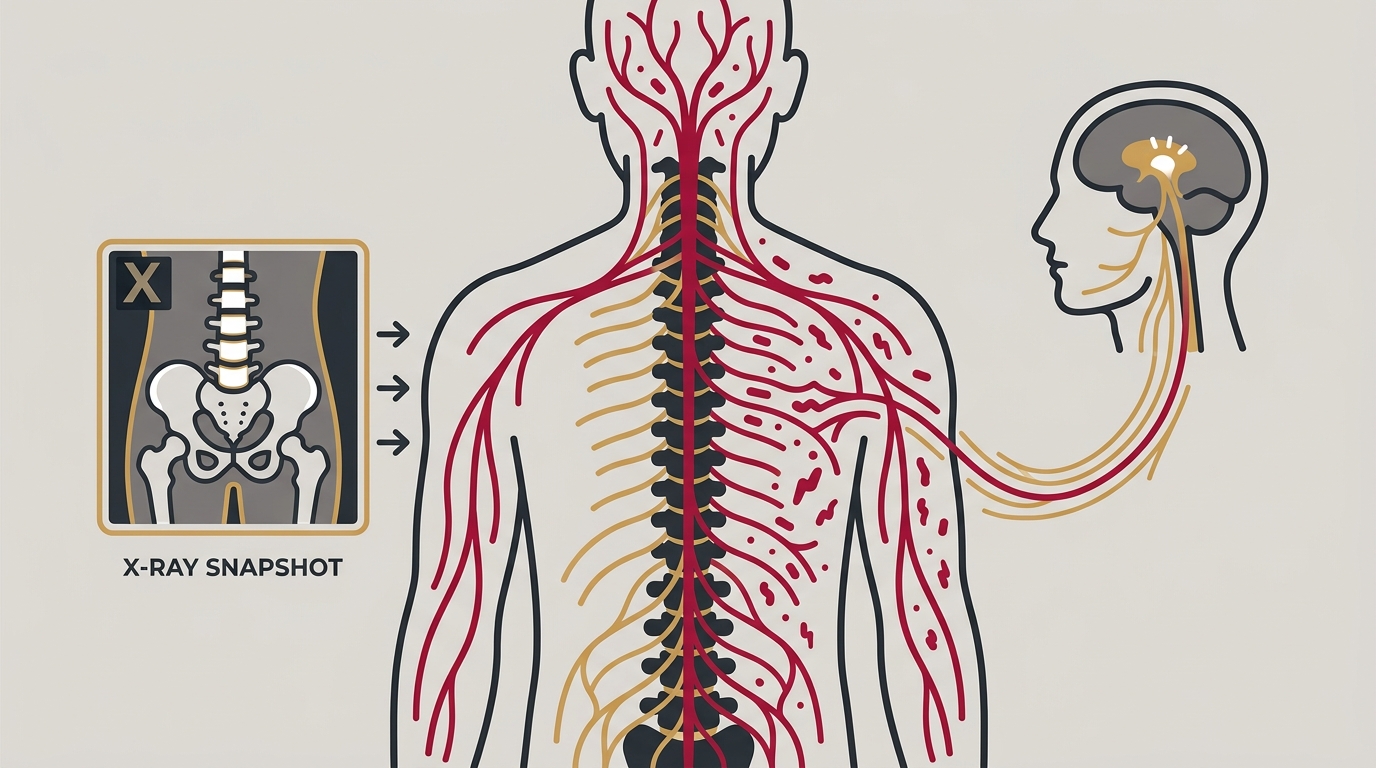
An X-ray is a "snapshot." It shows how your spine is built and how it looks at one moment. A National Library of Medicine source says it gives no indication of how your spine works right now.
A second National Library of Medicine source found that no studies have checked whether findings on repeat X-rays are valid signs of results that matter to patients. That's true whether the findings are about how the spine works or how it's built.
The same source reports that the American Chiropractic Association also recommended that repeat imaging must not be used to track how patients are progressing.
The American Chiropractic Association's own guidance goes a step further. With few exceptions, X-ray findings should not be used as outcome measures for low back pain. Its example of an exception is the long-term management of idiopathic scoliosis, a curved spine with no known cause. Right now, no data support a link between changes in alignment or other structural features and patient improvement.
Why Visual Posture Checks Alone Aren't Reliable
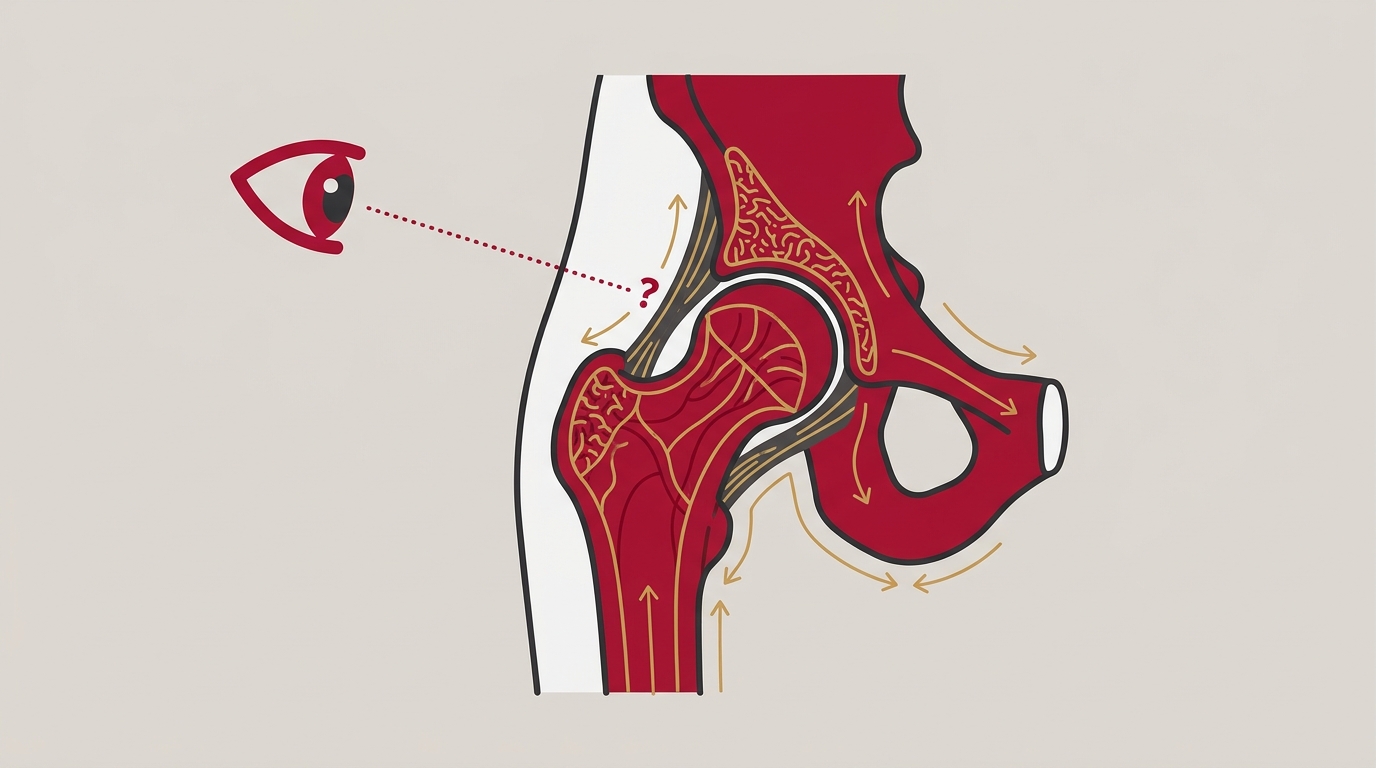
In one National Library of Medicine study, interrater reliability for visual inspection was no better than chance. Interrater reliability just means how well different raters agree with each other. The agreement scores ranged from -0.013 to 0.011 on one scale (Light's kappa), and they were -0.002 on a second scale (iota).
Academic circles have not set one agreed-upon standard for judging how much posture is impaired in patients with low back pain.
Another National Library of Medicine source found that, in general, results agree more when the same person measures twice (intra-rater) than when different people measure (inter-rater). Inclinometers, the tools that measure angles, were more reliable than the other tools.
The strongest levels of evidence for reliability support classic photogrammetry, which means measuring from photographs. Its intrarater and interrater reliability ran from moderate to excellent. One score, the intraclass correlation coefficient 2,1, was 0.502 to 0.995. A second version, 2,2, was 0.564 to 0.996.
Functional Tests That Can Be Re-Run, and How They're Measured
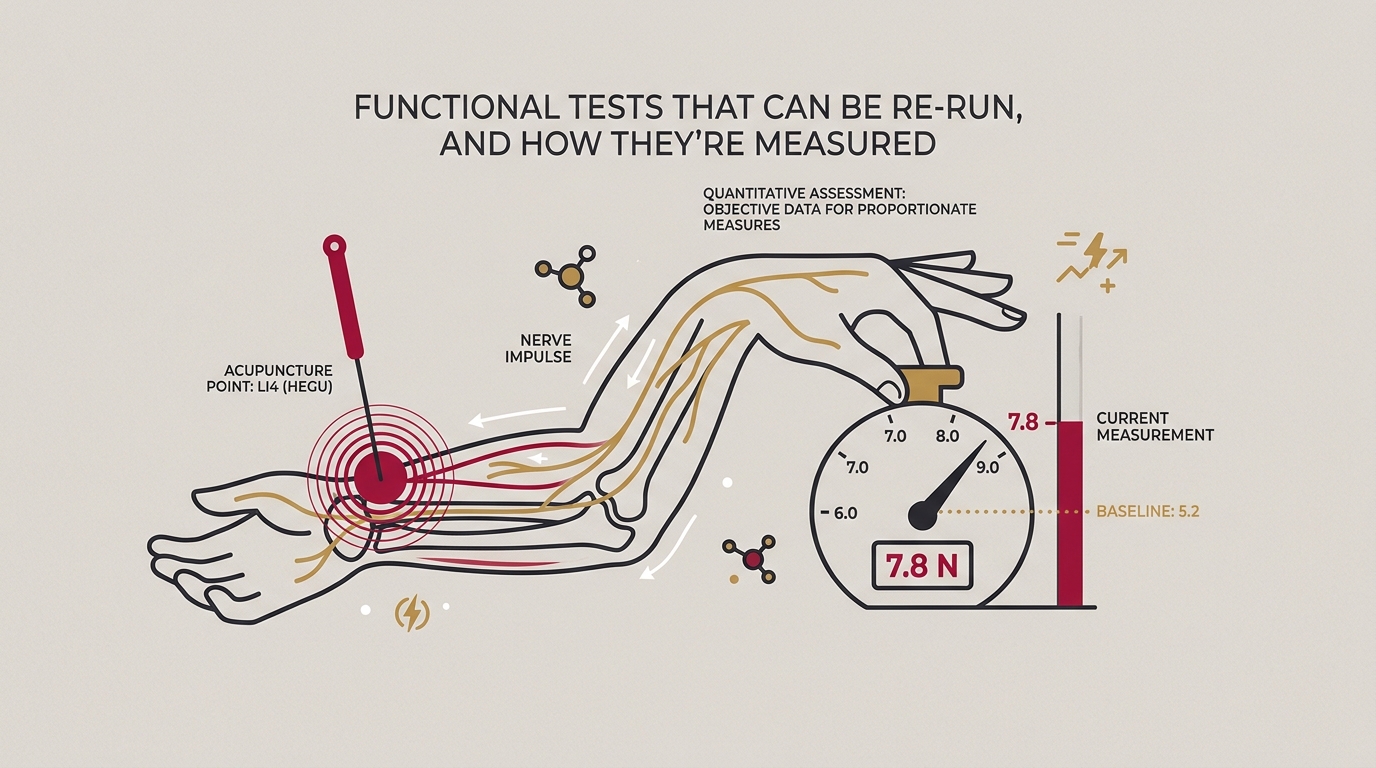
A quantitative assessment gives you a number, and that number relates to the proportionate amounts of a test or measure. For the spine, range of motion can be given in degrees, and spinal displacements can be given in inches or centimeters. These ideas come from Chapter 7: Outcome Assessment Measures in Chiropractic.
Reliability is how stable a measurement stays when it's repeated under identical conditions, and the error of the tool matters here. Say an inclinometer system, which measures range of motion, has a standard error of five degrees. Then a difference has to be significantly greater than five degrees before you can judge what it means.
Responsivity, also called response stability, is a test's ability to give consistent measures with repeated use over time. Day-to-day change matters too. If a measure was found to vary among days of the week, and a test wasn't done on the same day, that variation has to be taken into account when the results are compared.
I pick the re-tests that fit the person in front of me. I won't run one fixed routine for every complaint, because that treats people like units on a line. I don't use a single set of tests for every patient.
This table lines up the hands-on or visual method with the measured method for each kind of check.
| What is tested | Hands-on or visual method | Measured method |
|---|---|---|
| Range of motion | Visual estimation | Inclinometric or goniometric measurement, in degrees |
| Muscle strength | Muscle testing graded 0-5 | Dynamometric measurement, in kg or lbs |
| Muscle endurance | Muscle testing graded 0-5 | Biering-Sorensen Test, time in seconds |
| Pain threshold or tolerance | Palpation for pain | Pressure algometry |
| Pain, disability and function | Patient's own description | Outcome assessment instruments, numerical score compared to normative values |
Range of Motion, Strength and Endurance
For range of motion, the ICA table lists visual estimation first. That means looking for restricted movement and for pain that shows up or comes back. Next come inclinometric and goniometric measurement, in degrees.
For muscle strength, the table lists muscle testing, graded 0-5, and dynamometric measurement, in kg or lbs.
For muscle endurance, it lists muscle testing, graded 0-5, with the Biering-Sorensen Test next to it. That test is measured as time, in seconds, of task performance.
Pain Threshold and Patient-Reported Function
For pain threshold or pain tolerance, the ICA table lists palpation for pain, which means checking tenderness and grading trigger points. The measured version is pressure algometry, given in psi, kg/cm2, or Pa.
For how much pain, disability or function you report, the table lists your own description. Next to it are outcome assessment instruments, which give a numerical score that's compared to normative values.
How the Oswestry Disability Index Is Scored
The Oswestry Disability Index looks at your symptoms and how bad your low back pain is, in terms of how much it disables you. It also looks at how much back or leg pain gets in the way of your daily activities. You can read about it at Oswestry Disability Index.
Each question has six statements, scored 0 through 5. You pick the one that matches your ability.
A study in BMC Musculoskeletal Disorders describes the scoring this way. Each item is scored from 0 to 5, and the total is then converted to a scale of 0 to 100.
The questionnaire takes 3.5 to 5 minutes to fill out and 1 minute to score. It's free to access for students, physicians, clinical practice and non-funded academic users.
How Much Change on the Oswestry Counts as Real
A repeat score only helps if you know how big a change counts, and studies give different answers. After a review of the research, Advocate Health Care recommends a minimal clinically important difference (the smallest change that matters) of 12% for the Oswestry. It also required that this number be greater than the minimal detectable change (the smallest change the test can pick up). The full paper is MCID Recommendations for Oswestry.
Other studies landed on other numbers:
- Hung and co-authors cited earlier studies where the minimal clinically important difference ranged from a 6 to 10 point change.
- Vanti and co-authors studied low back pain with lumbar spondylolisthesis treated conservatively. The minimal detectable change, the smallest change the test can detect, was 4.23 points. The minimal clinically important difference was 7.5 points.
- A 2016 study by Copay and co-authors put the minimal clinically important difference at 12 to 15 points in sacroiliac joint disorders.
- Copay and co-authors (2008) reported a threshold of 12.8. Their different calculation methods gave widely different values, from 2.92 to 15.36.
- Monticone and co-authors (2012) found a threshold of 9.5 in people with sub-acute or chronic low back pain. They took it as the point on the curve closest to the upper left corner of the figure. At that point, the area score was 0.71 on the study's own scale, sensitivity was 76% and specificity was 63%.
- Food and Drug Administration standards for good to excellent surgery results include a 15 point improvement, plus keeping or improving a second health score, the SF-36. Older studies say a 4 or 10 point decrease might mark a significant improvement.
This table puts the study, the group studied and the threshold side by side.
| Study or source | Population | Threshold |
|---|---|---|
| Advocate Health Care recommendation | Oswestry use at Advocate Health Care | 12% minimal clinically important difference |
| Studies cited by Hung et al. | Earlier referenced studies | 6-10 point change |
| Vanti et al. | Conservatively treated low back pain with lumbar spondylolisthesis | Minimal detectable change 4.23; minimal clinically important difference 7.5 points |
| Copay et al. 2016 | Sacroiliac joint disorders | 12-15 points |
| Copay et al. 2008 | Not stated | 12.8 (2.92-15.36 by calculation method) |
| Monticone et al. 2012 | Sub-acute or chronic low back pain | 9.5 |
| FDA standard | Good to excellent operative outcomes | 15 point improvement, plus maintained or improved SF-36 score |
For people with chronic low back pain, Monticone and co-authors found a minimal detectable change of 12.72. Don't mix that up with their 9.5, which is a minimal clinically important difference. They're two different measures.
The Oswestry gave excellent test-retest reliability, meaning the same test gave steady results when it was given twice. That held when the gap between tests was 1 week. The score was 0.83 on the study's own scale, in people with chronic low back pain.
I'd rather give you an honest line for real change than hand you comfort that explains nothing. If your score moved less than the error, I'll say so, even if it's not what you hoped to hear. Then we plan the next step together. You can see what that can look like in What a New Care Plan Looks Like After Re-Evaluation.
What a Re-Test Study Showed About Measuring Change
A Danish low back pain study in BMC Musculoskeletal Disorders re-tested patients over time. All patients got a questionnaire booklet at baseline, at one week and at eight weeks. It held sociodemographic data, medical status and outcome measures. You can read it at Responsiveness and MCID for pain and disability instruments in low back pain patients.
Here's how the study worked out change. Raw change was the baseline score minus the eight-week score. Percent change was the raw change divided by the baseline score, times 100.
The Roland Morris questionnaire has 23 items. Each one is yes or no, scored 1 and 0. The scale runs from 0 (no disability) to 23 (extremely severe disability).
The MCID for percent change stayed constant at 51% for the ODI and 38% for the Roland Morris. It differed in the subgroups of patients.
The Roland Morris is suitable for measuring change in patients with low back pain only. Both the ODI and the Roland Morris are suitable for leg pain patients, no matter the patient entry point.
Responsiveness is the ability of a tool to detect clinically relevant change over time. The study says it's equally or even more important when you choose a tool to judge change.
What Surveyed Chiropractors Routinely Measure
A survey of chiropractors in Saskatchewan, published in the Journal of the Canadian Chiropractic Association, is in Outcome measures and their everyday use in chiropractic practice. It asked how often they used standard paper-and-pencil forms and hands-on chiropractic, orthopaedic and nerve tests, including at the first intake assessment.
- Three out of four (75%) used a pain diagram routinely, meaning "always" or "commonly." It was the most common subjective outcome measure.
- Numerical rating scales were less popular, routinely used by 59%. Visual analogue scales, which are pain scales you mark, were routinely used by 42%.
- Most (84% to 95%, depending on the test) said they continually monitored neurological status. They used skin-area (dermatomal) tests, hand-tested muscle strength and deep tendon reflex tests.
- Range of motion was routinely measured by 95%, usually by eye (96%). A goniometer, which is an angle-measuring tool, or another specialized device was used by 7%.
If you want to know how we do our own work, you can read about it on our Chiropractic Care page.
Frequently Asked Questions
Is a single test result enough to judge whether I'm improving?
No. It is a common mistake to think a single measurement shows your real performance capacity. Test results should be read along with what the doctor sees while the test is done. So ask for the test to be repeated, and ask what the doctor noticed.
Do most chiropractors use formal disability questionnaires?
Not in one survey. Most surveyed Saskatchewan chiropractors (80%) seldom used disability indices like the Low Back Revised Oswestry, the Neck Disability Index or the Roland-Morris Questionnaire. Here, seldom means "occasionally" or "never." You can ask your own chiropractor if they use one.
Can a standard nerve exam show what is causing my pain?
Not always. A standard nerve exam may help confirm that a nerve root is involved. But that same exam is poor at telling apart patients who have somatic pain. If your pain is still there, ask what other checks can add to the picture.
Can surface muscle readings show whether rehab is working?
They may. Surface electromyography is a way to check how active the muscles along your spine are. It may be used to help diagnose low back pain and to judge whether rehabilitation is working. Ask your doctor if it fits your case.
Book a Re-Evaluation When Pain Has Stalled
Measured re-testing, read alongside what the doctor sees, helps decide whether a stalled case needs a new plan. A diagnosis based on function, plus tools that put a number on dysfunction, shows your progress apart from how you feel the pain. One measurement doesn't show your real capacity, so results should be read along with what the doctor sees during the test.
When your pain has no clear cause yet, I won't tell you nothing can be done. I keep re-testing, and I keep looking at the options still ahead of you.
Touch of Wellness Chiropractic in Morton, IL provides Chiropractic Care, Shockwave Therapy, Neuropathy Care, Acupuncture, Cold Laser Therapy, Massage Therapy and DOT Physicals.
If you have a sudden severe headache, numbness or weakness in an arm or leg, trouble speaking or seeing, or loss of bladder or bowel control, call 911 or your doctor right away.
Ready to have your stalled pain re-tested? Book Appointment
Results may vary.