
After a re-examination, a treatment plan can be changed from time to time, based on how the patient responds and on changing goals or needs, says the American Chiropractic Association. At Touch of Wellness Chiropractic, care plans are built from what the patient actually reports, not from a set protocol applied to a diagnosis code. When a treatment approach is not producing results, it is changed. Dr. Hannah works from what she calls a Clinical Response standard: she adjusts treatment plans based on what the patient's body actually does, not on what a protocol predicts it should do.
What changes when a care plan is revised
At Touch of Wellness Chiropractic, care plans are built from what you actually report. They are not built from a set protocol applied to a diagnosis code. When a treatment approach is not producing results, it is changed.
Dr. Hannah calls her way of working a Clinical Response standard. She adjusts your treatment plan based on what your body actually does, not on what a protocol predicts it should do.
The American Chiropractic Association says that after a re-examination, the treatment plan can be changed from time to time. Those changes are based on how you respond and on your changing goals or needs.
My rule is simple: if a therapy shows no results, keeping on with it is the failure. I judge care by whether you respond, and if you don't, I change course.
For more, read Reassessing Care Plans When Pain Does Not Improve: A Complete Guide and Reassessment vs. Routine Adjustment Visits: What Is Different.
How a stalled low back pain plan changes, step by step
NEJM Group and the Massachusetts Medical Society publish a set of steps for low back pain, the Diagnosis & Treatment of Low Back Pain algorithm. Here are its check points.
At 4 to 6 weeks
If your low back pain doesn't get better in 4 to 6 weeks, the algorithm says to send you to physical therapy. It also says to keep using non-invasive treatments that don't use drugs: exercise, rehabilitation with a team of different providers, acupuncture and cognitive behavioral therapy. Cognitive behavioral therapy is a talk therapy that works on thoughts and habits.
At 12 weeks
Imaging comes up next. The algorithm says to think about it if your pain is getting worse or is severe, or if it isn't improving after 12 weeks of conservative treatment.
When imaging is normal
When imaging is normal or shows only degenerative joint disease (wear and tear in the joints), the algorithm says to keep up a supervised or independent exercise program. It also says to focus on approaches that do not use drugs, such as rehabilitation with a team of providers, acupuncture, mindfulness-based stress reduction, tai chi, yoga, cognitive behavioral therapy or what it calls spinal manipulation.
Treatments that may be added or adjusted
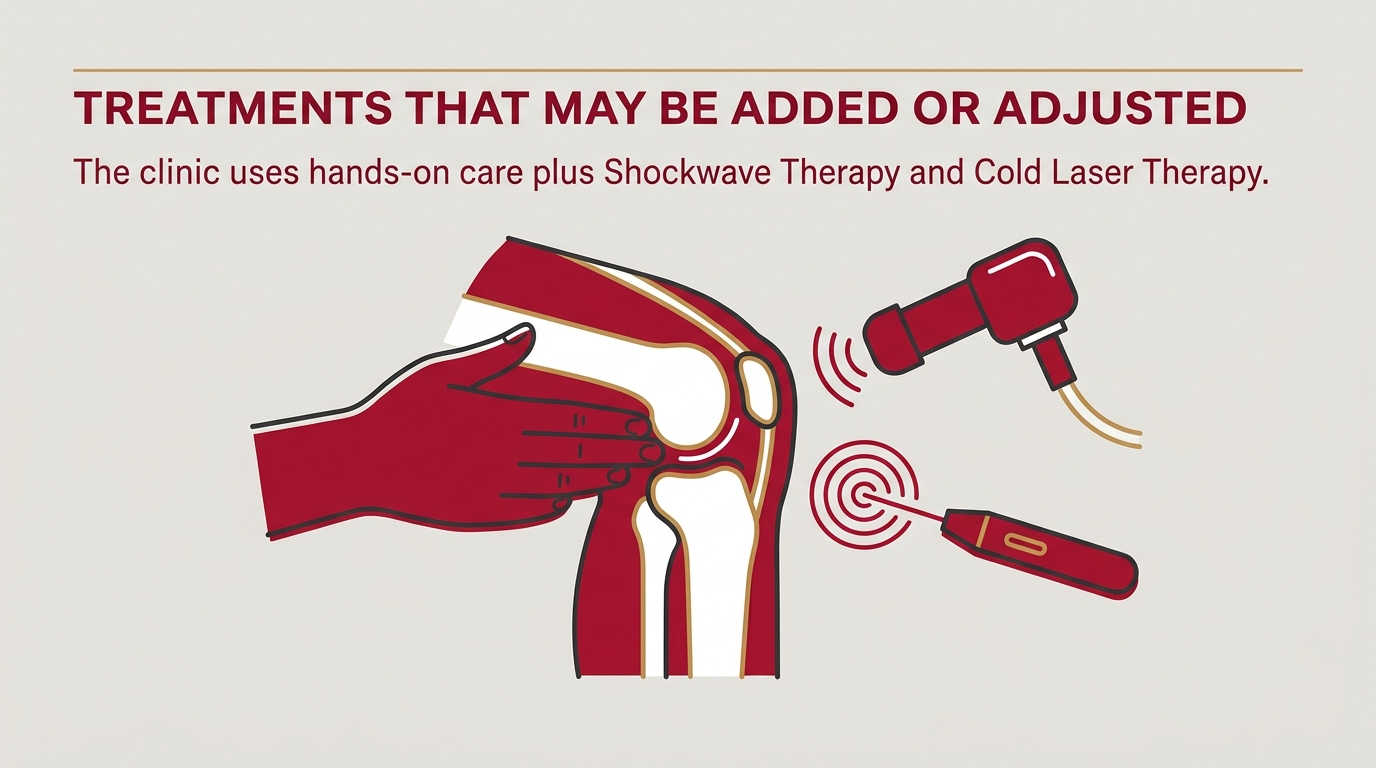
The clinic uses hands-on care plus Shockwave Therapy and Cold Laser Therapy. Your revised plan can draw on these and on other therapies. Several of the evidence notes below come from the VA/DoD Clinical Practice Guideline for Low Back Pain – Patient Summary (2022).
I won't run one set routine for everyone. To me that treats people like units on a line, not real care, so I fit the mix of therapies to the person in front of me rather than to a set package.
I'd rather name each therapy and what is known about it than lean on how warm our staff is. I don't count warmth as what sets a practice apart; I count substance.
Each therapy, what it is used for and a note on the evidence:
| Therapy | What it's used for | Evidence note |
|---|---|---|
| Chiropractic adjustment | Low back disorders | The most robust manual-therapy research for low back disorders is based primarily on HVLA techniques and mobilization (such as flexion-distraction) |
| Spinal mobilization | Joint movement within its natural range, no thrust | VA/DoD suggests spinal mobilization/manipulation for chronic low back pain |
| Cold Laser Therapy | Adjunct modality | Five studies: VAS pain scores after treatment significantly lower than placebo |
| Acupuncture, by post-doctorate certified Dr. Karen Hannah | Chronic low back pain | Low-quality evidence of a moderate effect on musculoskeletal pain |
| Shockwave Therapy | Used at the clinic alongside hands-on care | No source cited |
| Massage Therapy | Adjunct; not positioned on its own | No source cited |
| Clinician-directed exercise | Low back pain (e.g., strengthening, motor control, Pilates, tai chi) | VA/DoD suggests a structured clinician-directed program for low back pain |
Hands-on care: adjustment and mobilization
The American Chiropractic Association says the strongest research on hands-on care for low back disorders is mostly about two things. One is high-velocity, low-amplitude (HVLA) techniques, which are fast, small movements. The other is mobilization, such as flexion-distraction.
The NIH says spinal manipulation is different from spinal mobilization. Mobilization does not use a thrust, stays within the joint's natural range of motion, and can be controlled by the patient.
For chronic low back pain, the VA/DoD guideline suggests spinal mobilization or hands-on spinal adjustment.
Cold Laser Therapy, Shockwave Therapy and Acupuncture
The clinic offers Shockwave Therapy. It also offers Cold Laser Therapy, whose clinical name is low-level laser. Cold Laser Therapy is an adjunct modality, which means a supporting treatment used along with other care.
A review indexed by the National Library of Medicine looked at low-level laser therapy. It was based on five studies. Pain scores on the visual analog scale (VAS) after treatment were significantly lower with the laser than with a placebo, a fake treatment. The weighted mean difference was 13.57 points lower. The 95% confidence interval, the range the true value likely falls in, was 9.72 to 17.42 points lower. A further statistic the review reports, I(2), was 0%.
Dr. Karen Hannah is post-doctorate certified in acupuncture. For chronic low back pain, the VA/DoD guideline suggests acupuncture. A review on nature.com found low-quality evidence that real acupuncture has a moderate effect on muscle and bone pain. The effect was about a 12-point drop on a 100-millimeter visual analogue scale, a line on which a person marks their pain.
The VA/DoD patient summary says complementary medical treatments help many people. It says these can include acupuncture, spinal mobilization therapy and hands-on spinal adjustment therapy.
Exercise, Massage Therapy and behavioral care
The practice offers Massage Therapy. It is an adjunct, a supporting treatment used along with other care. It is not positioned on its own.
For low back pain, the VA/DoD guideline suggests a structured exercise program led by a clinician. The examples it gives are:
- aerobic exercise
- water exercise
- mechanical diagnosis and therapy
- mobility work
- motor control exercises
- Pilates
- strengthening exercises
- a structured walking program
- tai chi
For chronic low back pain, the guideline suggests cognitive behavioral therapy. The VA/DoD patient summary says behavioral therapies can help you lower your pain and learn to react to pain in ways that help you function better.
When the revised plan points to imaging or another doctor
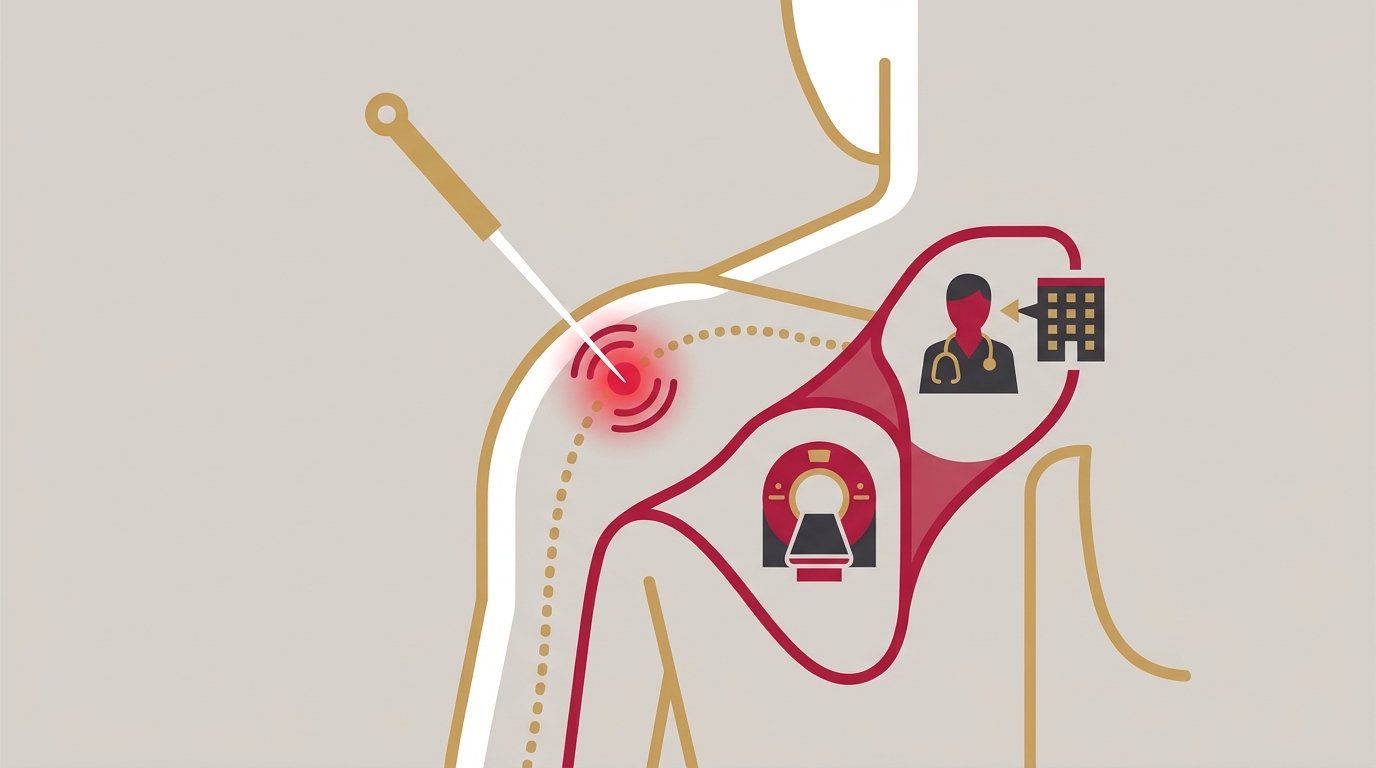
Sometimes a new plan means a new test or a new provider. The guideline from the VA/DoD (Department of Veterans Affairs and Department of Defense) recommends imaging and the right lab tests when nerve problems are getting worse or are otherwise serious. It says the same when other red flags are present, such as signs, symptoms or history. The VA/DoD CPG 2022 Low Back Pain – Clinician Summary lays this out.
If you have deficits in how you function, the VA/DoD algorithm says to consider a multidisciplinary or interdisciplinary program. That means care from a team of different kinds of providers. It also says to consider a referral to a specialist.
For chronic low back pain, these programs should have at least one physical part. They should also have at least one other part from the biopsychosocial model, which means a mind, social or work part. The parts have to be clearly coordinated with each other.
The NEJM Group algorithm says opioids should be considered only if the other therapies it lists fail and the possible benefits of opioids are greater than the risks.
I would rather tell you something hard and true than give you comfort that explains nothing. If the signs point to imaging or to another doctor, I say so plainly.
Matching the new plan to your risk level
The VA/DoD guideline suggests assessing psychosocial factors, which are mind and life-situation factors. It also suggests using predictive screening tools to help plan your treatment, such as STarT Back or the Orebro Musculoskeletal Pain Screening Questionnaire.
The Advancing practice for back pain through stratified care (STarT Back) paper explains how STarT Back works. The tool has nine items. Together they check for eight physical and mind-related predictors that low back pain will last and keep disabling a person six months later.
STarT Back results can't stand alone. Your clinician needs to read them along with a standard low back pain assessment, and that assessment should include a screen for serious disease (red flags) and a nerve examination.
Medium risk
In the STarT Back model, the treatment matched to medium-risk patients is a course of evidence-based physiotherapy (physical therapy). The course includes advice, explanation, reassurance, education and exercise, which can be specific or general. If it fits, hands-on therapy is part of it too. Bed rest, traction, massage and electrotherapy are generally not recommended.
High risk
For high-risk patients, those physical approaches are combined with mind-based (psychological) approaches to treatment.
Pain that lasts
Some patients still had pain after trying sensible treatments. For them, the therapists in the model were expected to move away from more treatment aimed at lowering pain. Instead they focused on improving quality of life and daily functioning, with the pain.
The physiotherapist also found and worked on obstacles to staying at work or going back to work, such as making and carrying out a return-to-work plan. They gave simple, evidence-based advice and information to improve sleep pattern, quality and amount.
I don't accept that pain with no known cause can't be helped. I don't treat "no answer yet" as "no options." If you've been told nothing can be done, I still work toward better function with you.
You can read how this work is done on the Chiropractic Care page.
Frequently Asked Questions
Will the clinic just keep me on the same treatment longer?
Not if care stalls. The VA/DoD algorithm points toward change. When a check on how you're responding shows the pain hasn't improved, it says to consider changing your medication treatments, your non-medication treatments, or both. If you're on opioids, it points to the VA/DoD opioid guideline.
Is chiropractic adjustment recommended for new, acute back pain?
The VA/DoD guideline does not take a side. For acute low back pain, which is new and short-term, it says there is not enough evidence to recommend for or against spinal mobilization or manipulation.
Does a revised plan mean I need imaging?
Not as a routine step. For acute low back pain with no nerve problems or other red flags, the VA/DoD guideline recommends against routinely getting imaging studies or doing invasive tests.
Is the guideline a rulebook every patient must follow?
No. The VA/DoD guideline says its recommendations are not meant to set a standard of care and should not be read as one. I don't run one standard routine for every complaint. I haven't seen a single approach that works for every patient, so I leave room to fit care to you.
Bring your plan in for a fresh look
Touch of Wellness Chiropractic provides chiropractic care, and it can bring hands-on care, Shockwave Therapy and Cold Laser Therapy into your revised plan. Dr. Karen Hannah is also post-doctorate certified in acupuncture.
If you have a sudden severe headache, numbness or weakness in an arm or leg, trouble speaking or seeing, or loss of bladder or bowel control, call 911 or your doctor right away.
Would you like a re-evaluation visit to see what a new plan could look like? Book Appointment
Results may vary.