
Routine adjustments and individualized plans differ in one core way: diagnosis. Routine adjustments apply the same spinal correction to every patient, regardless of the underlying cause. An individualized plan first identifies the specific postural, ergonomic, and habitual stressors behind a person's chronic desk pain. It then builds a targeted course of care around those stressors. Chronic desk pain typically develops from sustained forward head posture, prolonged hip flexion, and repetitive low-grade strain. That strain falls mainly on the thoracic and cervical spine. These stressors differ from one person's workstation and daily routine to the next. A personalized plan begins with a case history and physical examination. This step identifies which structures are compromised and why, rather than assuming every patient needs an identical adjustment pattern. Any X-rays or MRIs a patient already has can be reviewed alongside the exam. The resulting plan generally combines chiropractic adjustment targeted to the specific segments involved with corrective exercise for posture and mobility deficits. Ergonomic guidance for the person's actual workstation setup completes the core plan. Soft tissue therapy may be layered in where muscular tension is driving the pain pattern. Because the plan is built around the person's unique physiology and work environment, it treats the mechanism producing the pain. It does not target only the symptom reported at the appointment. Routine, repeatable adjustments applied without this diagnostic step may relieve discomfort temporarily. They do not address the specific postural or ergonomic drivers that cause the pain to return. An individualized approach also depends on the patient's own participation. Adherence to prescribed exercises and ergonomic changes outside the office determines how durable the results are. Precise diagnosis, targeted in-office care, and at-home follow-through together separate a generic adjustment from a plan built for the individual.
What Chronic Desk Pain Actually Is — And Why One Label Hides Many Problems
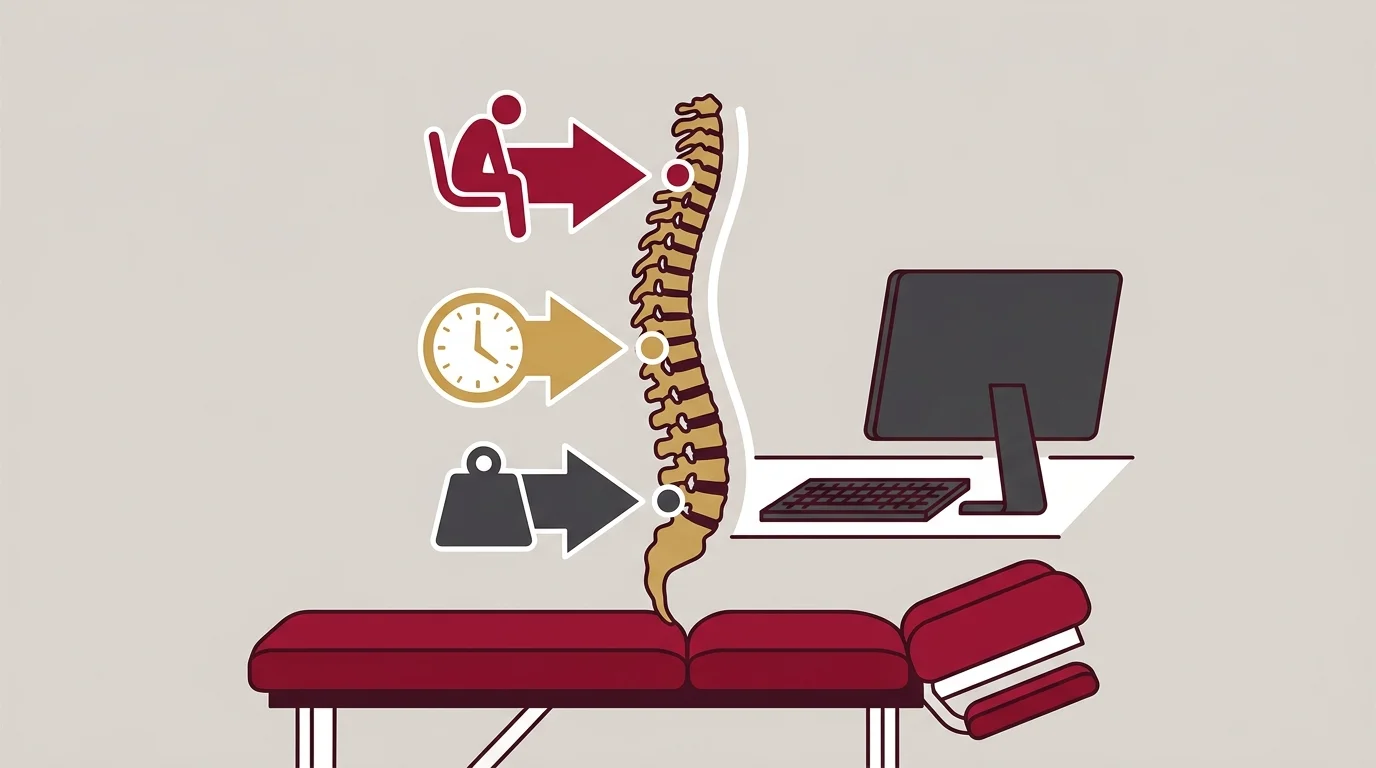
Call it "chronic desk pain" and it sounds like one diagnosis. It isn't.
Chronic pain from a desk job isn't a single problem, but a collection of specific stresses on an individual's unique physiology. Two people with the same job title can be carrying entirely different injuries under the same label.
The Physical Stresses Hiding Inside a Single Diagnosis
Start with the neck. Sustained forward head posture loads the cervical spine in one direction, while prolonged hip flexion loads the lumbar spine in another.
Then low-grade repetitive strain on the thoracic spine piles onto both over months at a keyboard. Each of these mechanisms produces pain that feels similar. But each one starts in a different structure entirely.
Why Posture, Load, and Repetition Don't Affect Every Body the Same Way
And a workstation isn't a fixed variable. Chair height, monitor distance, and keyboard reach change from desk to desk. So does the strain pattern they create.
That means the same posture does different damage in different bodies, shaped by prior injury, flexibility, and daily routine. Any real overview of personalized chiropractic care planning starts right here, with the specific mechanism instead of the generic label.
Why the Routine Adjustment Became the Default Answer
A chiropractor's job is not to run the same proven protocol on every presenting condition. No protocol is proven for every patient, because no two desk setups produce the same injury. Once the condition is defined as multi-causal, the industry's habit of treating it with one repeatable method stops making sense.
Why Most Chiropractic Visits Still Follow the Same Repeatable Script
Look, the traditional approach to chiropractic care often defaults to routine, repeatable adjustments for nearly every patient who walks in the door. That default exists for one reason: it's faster to deliver than a diagnostic workup.
So the script survives on efficiency, not on matching the method to the mechanism. Here's a closer look at how posture shapes care plans for desk workers and what that mismatch costs a desk worker specifically.
The Problem With Treating Every Spine Like It's the Same Spine
Chiropractic has long been sold as a generalist family guide, covering newborn to senior under one umbrella. But spinal care for a desk worker's chronic pain is a specialized diagnostic problem. It's not a family-practice checklist item.
Why a Fixed Protocol Breaks Down Against a Variable Problem
A fixed protocol assumes the injury is fixed too. It isn't. Many people assume any chiropractic visit will solve their problem, without understanding the difference between a generic adjustment and a targeted care plan. Before choosing, it's worth reading what a tailored chiropractic plan costs compared to routine visits.
What Gets Missed When a Generalist Script Replaces an Individual Exam
So a generalist script skips the one step that matters most: finding the specific structure that's compromised. The exam meant to isolate cause gets swapped for a routine aimed at wherever it hurts. What's missed is the mechanism itself, the real driver sitting under the pain a patient reports.
What the Research Actually Shows About Targeted Movement and Adjustment
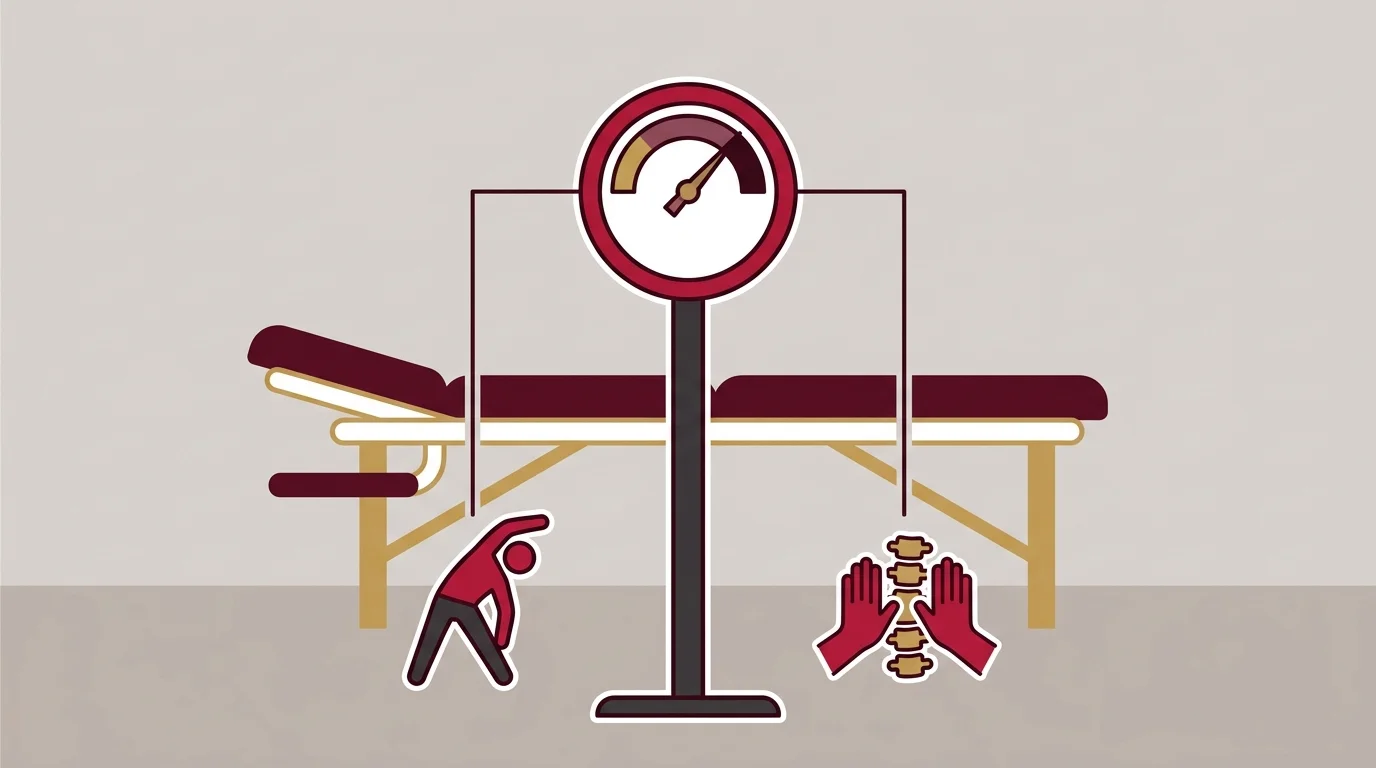
So what does the evidence actually say about targeted movement versus a generic adjustment? It points one direction: match the method to the mechanism instead of reaching for one default technique. That's why the practice's chiropractic treatment approach is built on this evidence base, not on a single repeatable routine.
| Study Population | Intervention Compared | Measured Outcome |
|---|---|---|
| Office workers with non-specific chronic neck pain | Thoracic spine mobility exercise vs. thoracic spine chiropractic adjustment | Similar effects on pain and disability |
| Older adults with chronic low back pain | Home exercise adherence over a 12-week period | 56.3% exercised at least 4 days per week by week 12 |
Thoracic Mobility Versus Thoracic Adjustment in Office Workers
A 2022 trial by Seo, Song and Shin in Medical Science Monitor found that thoracic spine mobility exercise and thoracic spine chiropractic adjustment had similar effects in improving pain and disability in office workers with non-specific chronic neck pain. Neither one won outright, so neither belongs as the default for every patient.
What Sustained Home Exercise Adherence Reveals About Long-Term Outcomes
But the best in-office technique only counts if the patient keeps going at home. A 2025 study by Maiers and Forte in the Journal of Manipulative and Physiological Therapeutics reported that just over half of older adults with chronic low back pain (56.3%) did their rehabilitative home exercises at least 4 times a week at 12 weeks. That's why the at-home piece gets written into a plan instead of left to chance.
How a Routine-Only Approach Fails Under the Conditions of a Desk-Bound Body
A routine-only approach breaks down under sedentary postural stress because it skips the diagnostic step that identifies which structure is actually compromised. Unexplained does not mean untreatable; it means the exam stopped too early to find the mechanism.
A protocol applied before the case history is finished is a guess wearing the shape of a diagnosis. So the failure isn't the adjustment technique itself; it's the sequence that skips straight past the question of why the pain exists.
What Goes Into Building a Plan Around One Spine, One History, One Set of Habits

So what actually goes into an individualized plan? Three inputs: a diagnostic workup, an audit of habits and workspace, and a week-by-week care structure built around whatever those two turn up.
| Build Component | What It Gathers or Addresses | Why Routine Adjustment Skips It |
|---|---|---|
| Case History and Physical Exam | Prior injury, symptom timeline, movement limits, and which structures are compromised | A routine adjustment pattern gets applied before this step finishes, so the actual driver is never identified |
| Habits and Environment Audit | Chair height, monitor distance, keyboard reach, and the daily posture pattern those create | A fixed protocol treats every desk as the same desk, so the specific load pattern goes unexamined |
| Targeted Adjustment Plan | Chiropractic adjustment focused on the specific segments the exam identified as compromised | A generalist script applies the same adjustment pattern regardless of which segment is actually involved |
| Corrective Exercise and Follow-Through | Mobility and strength deficits found on exam, paired with home adherence expectations | A one-visit routine has no mechanism for tracking whether the patient follows through outside the office |
Diagnostic Inputs: Case History and Exam Findings
Case history and physical exam findings come first. That sequencing isn't a formality. If a patient already has X-rays or MRIs, they get read alongside what the exam turns up.
Where Posture, Ergonomics, and Daily Habits Get Folded Into the Plan
An individualized plan moves beyond addressing the immediate symptom to analyzing the root cause. For a desk worker, that root cause is usually some combination of posture, ergonomics, and daily habits layered on top of each other. The plan has to name which combination is driving this particular case, not assume it matches the last one.
What a Desk Worker's Plan Looks Like in Practice, Week by Week
In practice, it comes down to three pieces: an adjustment aimed at the compromised segment, corrective exercise for the exact mobility deficit the exam found, and ergonomic changes sized to the person's real desk. None of them stands in for the other two.
Frequently Asked Questions
A few questions come up every time this topic gets raised. Most of them point back to the same diagnostic step.
How is a personalized chiropractic plan different from routine adjustments?
A routine adjustment applies the same technique to every patient without identifying which structure is actually compromised. A personalized plan starts with a diagnostic workup, then builds the adjustment, exercise, and ergonomic changes around what that workup finds.
Can a chiropractic adjustment really address pain caused by sitting at a desk all day?
Yes, when the chiropractic adjustment targets the exact segment that sitting strains. Desk posture loads the spine in predictable ways an exam can identify. So an adjustment matched to that mechanism addresses it directly instead of guessing.
How long does it typically take for an individualized plan to show measurable change in chronic desk pain?
Change is checked at set re-exams. It tends to hold best when the at-home exercise and desk changes are done consistently, not just the office visits.
What kind of exercises or postural changes get built into a personalized chiropractic plan for desk workers?
Expect corrective exercise aimed at the exact mobility deficit the exam found. Ergonomic changes get sized to the person's real workstation, not a generic tip sheet. Chair height, monitor distance, and keyboard reach each get addressed one by one.
Should I bring X-rays or MRIs I already have?
Yes. Touch of Wellness Chiropractic asks patients to bring any X-rays or MRIs they already have to the first visit.
What does a chiropractic case history and exam process involve before a plan is built?
The process starts with a case history, then a physical exam to isolate the compromised structure. Only after those two steps is the care plan built.
Where This Leaves the Desk-Bound Spine
Two desk workers can share a job title and still carry two completely different injuries. That's the one fact a routine adjustment simply can't account for.
Physiology doesn't read from a script. It reads like a fingerprint, specific to the chair, the monitor, the hours, and the body underneath them. Cookie-cutter protocols are assembly-line medicine, not care built for the person on the table.
So your next step isn't another generic adjustment. It's a plan built around the mechanism that's actually driving your pain. Schedule an evaluation with Touch of Wellness Chiropractic and find out what your spine's version of the problem really is.
Results may vary.