
A re-evaluation goes beyond a typical office visit. A guideline from National Imaging Associates, Inc. (Evolent Health) says it includes an updated history, the patient's symptoms, physical exam findings, and a fitting standardized outcome tool or measurement compared with the earlier evaluation or re-evaluation. A coding reference quoted on a Blue Cross and Blue Shield of Vermont sheet says the work done during a service includes an interactive patient reassessment. That means determining the current status, determining reasons for or against treating, assessing the change in condition, evaluating any new complaints, correlating physical findings, and coordinating and modifying the current treatment plan. The same National Imaging Associates guideline says a re-evaluation of an established patient is called for if any one of these is true: the patient has a new condition; there is a big or unexpected change in symptoms or a drop in how well the patient can function; you are checking whether treatment is working at a point in care when real change can reasonably be seen; or there is a reason to decide the treatment plan or goals need to change.
What Each Kind of Visit Includes
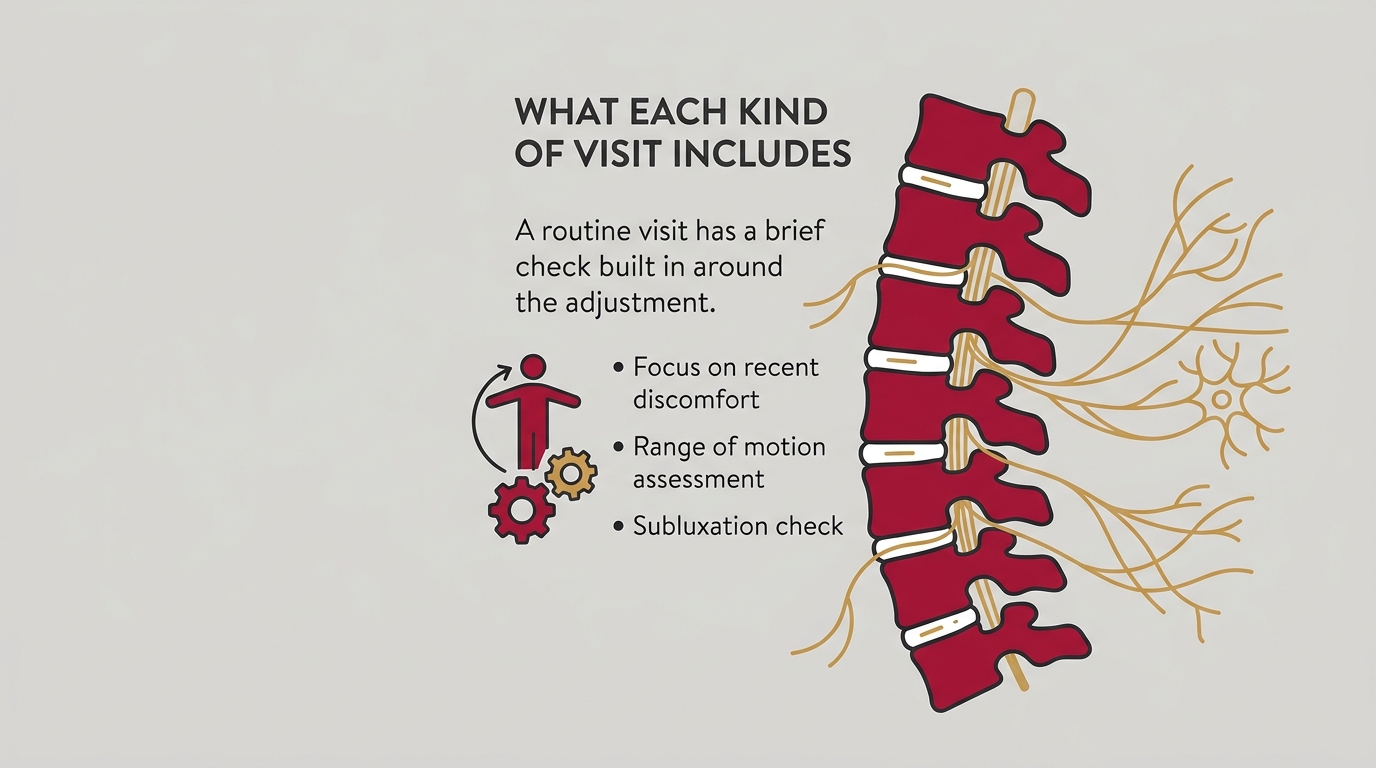
A routine visit has a brief check built in around the adjustment. A reassessment goes beyond the typical office visit. It takes an updated history and exam findings and compares standardized outcome measures with the last evaluation. The National Institutes of Health says the purpose of spinal manipulations is to improve joint motion and function.
Insurance payers' billing pages spell out what these visits include, such as Manipulations – chiropractic billing.
I don't run one fixed routine on every patient. That treats people like units on a line, and I don't call it care. I set your plan from your own findings, because you're the person I'm treating.
The table below lines up the two visit types side by side.
| Feature | Routine adjustment visit | Reassessment visit |
|---|---|---|
| What gets checked | Progress report from the patient and a brief physical exam: current status, change in condition, new complaints | Updated history, symptoms, physical exam findings and standardized outcome measures compared with the previous evaluation |
| What gets decided | Continue, cease or minimally alter the treatment plan | Need for continued skilled care, and a revised treatment plan with updated goals |
| What gets recorded | Response or non-response and the plan for later sessions | Evidence of the effectiveness of the care and progress toward goals |
The routine adjustment visit
A payer policy, Medical Policy Bulletin – Manipulation / E&M from Highmark Blue Cross Blue Shield West Virginia, describes what it calls the typical manipulation service. It has two parts. The first is a progress report from the patient. The second is a brief physical exam. The exam sets the method, location and intensity of the manipulation, if it is medically indicated. It also leads to a decision on whether to continue the treatment plan.
The same policy says a post-manipulation evaluation of how the patient responded should be noted, along with a decision to continue the plan, cease it, or minimally alter it. It says the treatment plan should be updated as the patient's condition changes, and it should be kept in the medical records.
Blue Cross and Blue Shield of Vermont puts out the Educational Sheet for E&M with Chiropractic Manipulation Therapy. It quotes a coding reference that says the work done during the service includes an interactive patient reassessment. That means figuring out your current status, deciding whether there are reasons for or against treating, and assessing how your condition has changed. It also means evaluating any new complaints, correlating physical findings, and coordinating and modifying your current treatment plan.
A guideline from National Imaging Associates, Inc. (Evolent Health) covers the daily treatment note. It says the note includes an assessment of whether you did or did not respond to the treatment. It also includes the plan for later treatment sessions, assessments or updates.
The reassessment visit
That same guideline says a re-evaluation goes beyond a typical office visit. It includes:
- An updated history
- The patient's symptoms
- Physical exam findings
- A fitting standardized outcome tool or measurement, compared with the earlier evaluation or re-evaluation
The guideline lists more for a re-evaluation. It should show proof that continued skilled care is needed, and it should pick the right services for new or existing treatment goals. It should revise your treatment plan with updated goals. It should also link the care to real change in how you function, and give proof that the care is working and you're moving toward your goals.
The Chiropractic Clinical Practice Guidelines on chiro.org say a partial reassessment means repeating two or more of the earlier tests that came back positive. A full reassessment means repeating three or more of those earlier positive tests.
The National Library of Medicine says to use validated patient-reported outcome measures. These are questionnaires you fill out that have been tested and shown to work. They're used to assess your symptoms and characteristics, and to track your progress over time.
How Long a First Visit and a Routine Visit Take
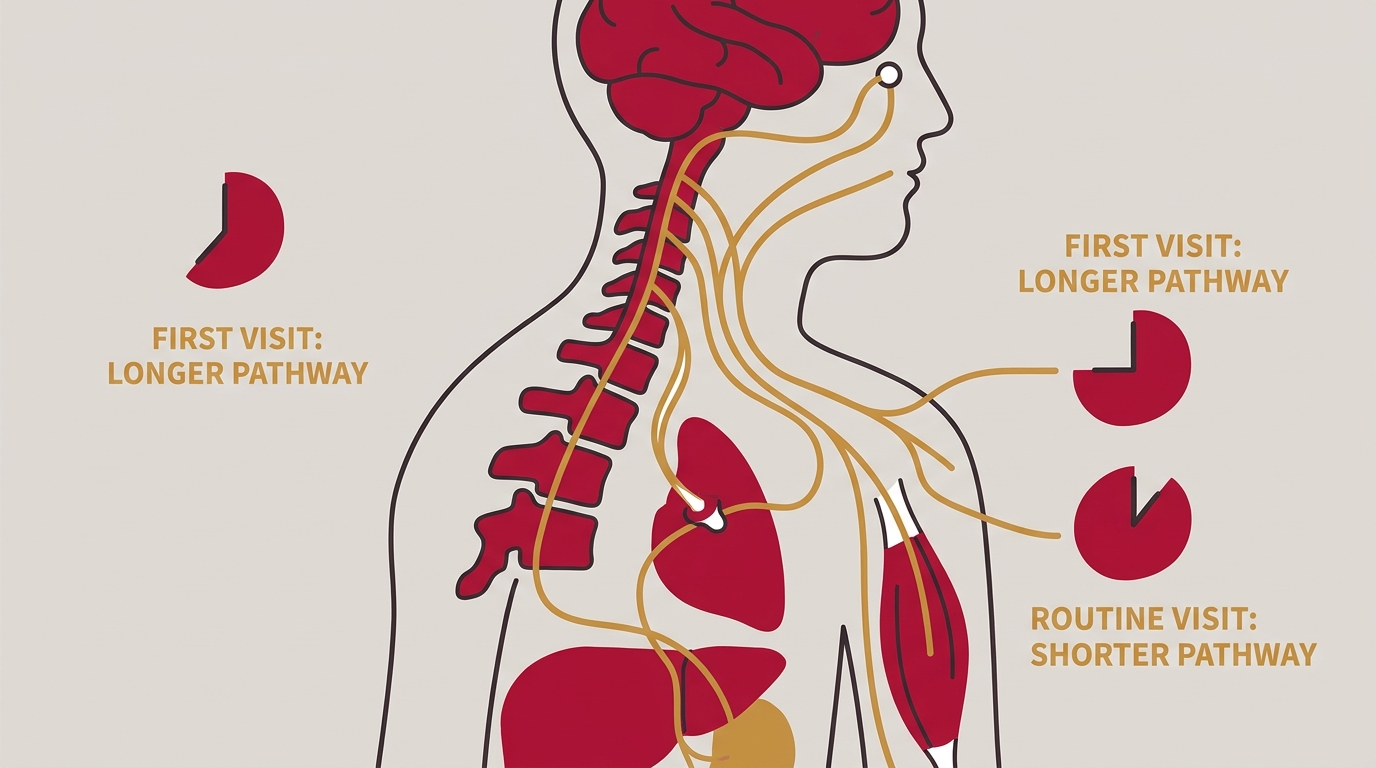
Your first visit takes about 45 to 60 minutes. Touch of Wellness Chiropractic gives individualized care in Morton, Illinois, aimed at the root cause. It uses spinal adjustment and advanced therapy methods to restore nervous system function and resolve muscle, bone and nerve-related conditions. Its clinical standard is 15-minute door-to-door efficiency, and it has same-day availability.
The city of Morton's website, morton-il.gov, says a normal trip across town takes only minutes, and nearby towns are only a few minutes more by car.
I don't treat speed and quality as a trade-off. I hold a visit to 15 minutes door to door out of respect for your time, and I don't let that turn into hurried care. A short visit can still be a thorough one.
What Triggers a Reassessment, and How Often
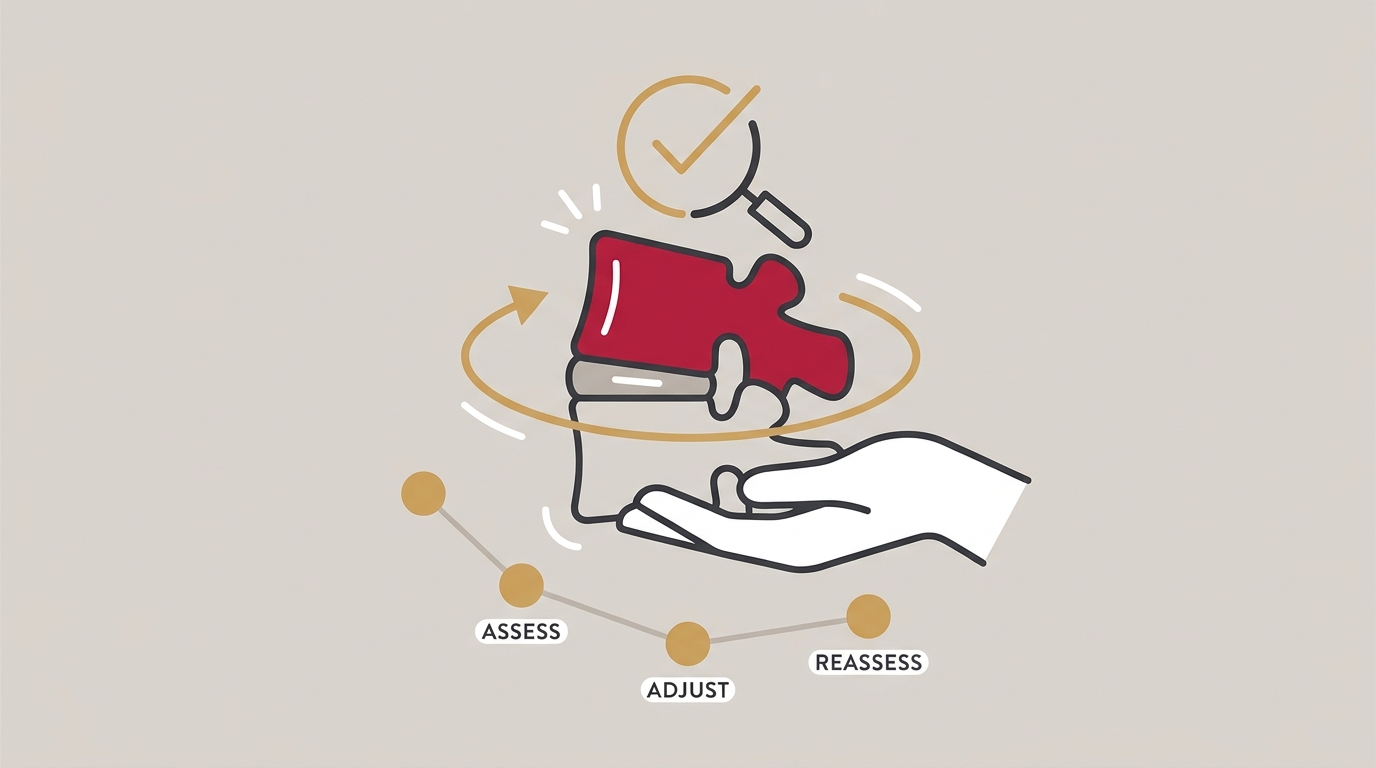
A chiropractic guideline on chiro.org says a patient's progress must be judged on a per-visit and periodic basis. That gives quantitative and qualitative information about progress. It is used to decide how often and for how long chiropractic care goes on. The same guideline says how often to do partial and full reassessments is at the discretion of the practitioner, in line with the objectives of the plan of care. You can read it in full at Reassessment and Outcomes Assessment.
A National Imaging Associates guideline says re-evaluations should not be routine or recurring. Experts broadly agree on the general reasons to formally re-evaluate a patient. They agree less on the reasons proposed for reporting re-evaluations. You can read it in Record Keeping and Documentation Standards: Chiropractic Care.
The same guideline says a re-evaluation of an established patient is called for if any one of these is true:
- The patient has a new condition.
- There is a significant or unexpected change in symptoms, or a drop in how well the patient can function.
- You are checking whether treatment is working, at a point in care when meaningful change can reasonably be seen.
- There is a reason to decide the treatment plan or goals need to change.
I count continuing a therapy that shows no results as the failure. I judge care by whether you respond to it. If you don't, I change course at the reassessment instead of going on hope. If your pain isn't getting better, Reassessing Care Plans When Pain Does Not Improve: A Complete Guide goes deeper.
Payment that rewards volume pushes toward quantity over quality. I name that push instead of letting it reach you dressed up as "medical necessity." I don't book a re-exam to fit a billing schedule. I set one when a real trigger shows up, and I won't let the first pass for clinical judgment.
How Progress Is Measured With Outcome Tools

The chiro.org guideline says patient-reported surveys are encouraged as part of the outcomes assessment plan. These cover quality of life, mental health and general health. What they show may be used to change a patient's care or to support continuing it.
The National Imaging Associates guideline says an updated plan of care should list:
- The time frame for the current treatment period
- The total visits since the start of care
- The change in objective outcome measures and standardized testing, compared to baseline (the starting point) and/or the most recent re-assessment or updated plan of care
It should also record measurable overall progress toward each goal, including whether each goal was met or not met. Goals should be updated and changed as fits, and treatments should be changed so the goals can be met.
The review also looks for outcome tools used at pre-determined intervals. It looks for treatment that does not go on once further meaningful change would be minimal or hard to measure. To see how this plays out, read Plateau or Progress: How Re-Evaluation Visits Tell the Difference and What a New Care Plan Looks Like After Re-Evaluation.
A survey published in Chiropractic & Manual Therapies, Chiropractor perspectives on the use of patient reported outcome measures: VHA survey, asked chiropractors in the Veterans Affairs health system about patient-reported outcome measures. The survey defined them as standardized, validated questionnaires that patients fill out to identify and put a number on how they see their own health.
Over the past 12 months, those chiropractors used the questionnaires for a larger share of patients at first visits than at follow-up visits. The middle answer was 95.0% of patients at first visits and 74.5% at follow-up visits. The study reported that gap with r = 0.640 and p < 0.001, which means a gap that big would be very unlikely by chance.
The study also says best practices for muscle and bone pain care recommend checking progress with these questionnaires. But there is no objective guidance on the best timing for first and follow-up checks, or on how often to repeat them.
I'd take an honest, measured score over a nice-sounding reassurance that explains nothing. I'll give you an unwelcome number before a comforting phrase, because I want you to have the true picture. Our Chiropractic Care page explains how the work is done.
Frequently Asked Questions
Does every visit include some kind of re-check?
Yes. A chiro.org guideline says each per-visit recheck should include at least one test that was used before, and that test should be done every time you receive chiropractic care. The recheck gives your doctor the information to decide, visit by visit, whether you need an adjustment. Ask your doctor which test they repeat for you.
Which questionnaires are most often used to measure progress?
For low back pain, it's the Oswestry Disability Index. For neck pain, it's the Neck Disability Index. In the survey of chiropractors in the Veterans Affairs health system, published in Chiropractic & Manual Therapies, 75 respondents named the Oswestry and 63 named the Neck Disability Index. Both rate disability. If you have back or neck pain, ask which one your doctor uses so you can follow your own score.
How long can a first plan of care run before it is reviewed?
The National Imaging Associates guideline says the first plan of care for a muscle or bone condition should not run longer than 4 weeks. Ask your doctor when your plan will be looked at again.
When does a long course of care get flagged for review?
The National Imaging Associates review flags treatment that has gone on longer than 2 to 3 months for the same or similar condition. If you're near that mark, ask your doctor how your progress compares to your starting point.
Book Your Reassessment With Touch of Wellness Chiropractic
The check at every visit gives your doctor the information to decide, visit by visit, whether you need an adjustment. A reassessment goes beyond a typical office visit. It includes an updated history, your symptoms and exam findings, and a fitting standardized outcome measure compared with your earlier evaluation. At Touch of Wellness Chiropractic in Morton, Illinois, we provide Chiropractic Care, Shockwave Therapy, Cold Laser Therapy, Acupuncture and Neuropathy Care.
If you have a sudden severe headache, numbness or weakness in an arm or leg, trouble speaking or seeing, or loss of bladder or bowel control, call 911 or your doctor right away.
Would you like to Book Appointment and find out where your care stands?
Results may vary.