
Treatment guidelines refer to Maximum Therapeutic Improvement: the point at which a patient's condition has plateaued and is unlikely to improve further. A change in pain that matters to the person is typically an improvement of 10 to 20 percent or more on a 0-to-10 pain rating scale. A change in a test score can be statistically significant, but patients do not necessarily see it as clinically significant.
What a Re-Evaluation Measures, and What Counts as Real Change
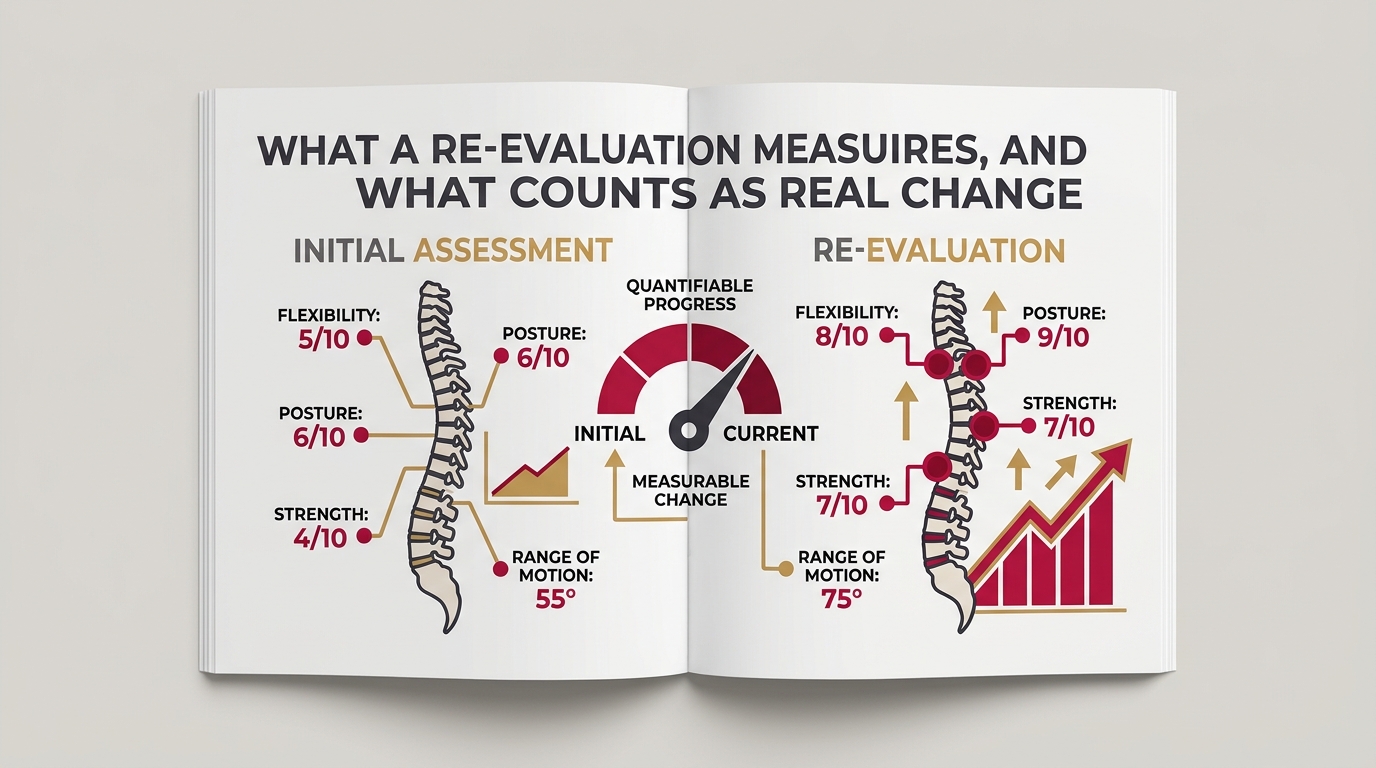
A re-evaluation compares scores over time. In one study of chiropractic patients, all patients reported their pain levels on a pain numerical rating scale at each data collection point. They also reported their function. Patients with chronic neck pain used the Neck Disability Index. Patients with chronic low-back pain used the Oswestry Disability Index. How a reassessment differs from a regular adjustment visit is laid out in Reassessment vs. Routine Adjustment Visits: What Is Different.
A score change has to do two things. It has to clear measurement error, and it has to matter to the patient.
- A within-person change in pain that matters to the individual is typically an improvement of 10 to 20 percent or more on the 0-to-10 scale. More than 30 percent is considered a moderate improvement. Pain levels at the start can affect these percentages. Source: Interpretation of chronic pain clinical trial outcomes: IMMPACT recommended considerations.
- The minimal clinically important difference is the smallest change or difference that patients or clinicians might consider important.
- The minimal detectable change is the smallest change or difference that is not the result of measurement error.
- A change in a test score may be statistically significant, but patients do not necessarily perceive it as clinically significant.
These two thresholds answer different questions. The minimal detectable change marks the smallest change that is not measurement error. The minimal clinically important difference marks the smallest change that patients or clinicians might consider important. In a study of the WHODAS 2.0, the minimal detectable change was 8.6 points, which was higher than the minimal clinically important difference. The minimal detectable percentage change was 66%, and the authors called that unacceptably high. The study is MCID and minimal detectable change of WHODAS 2.0 in chronic musculoskeletal pain.
The table below lines up each term with what it means.
| Term or signal | What it means |
|---|---|
| Minimal detectable change | Smallest change not the result of measurement error |
| Minimal clinically important difference | Smallest change patients or clinicians might consider important |
| Meaningful change on a 0-10 pain scale | Typically 10-20% or more; over 30% is moderate improvement; baseline pain can affect this |
| Statistically significant change | Not necessarily perceived by patients as clinically significant |
| WHODAS 2.0 example | Minimal detectable change of 8.6 points was higher than the minimal clinically important difference |
What a True Plateau Looks Like
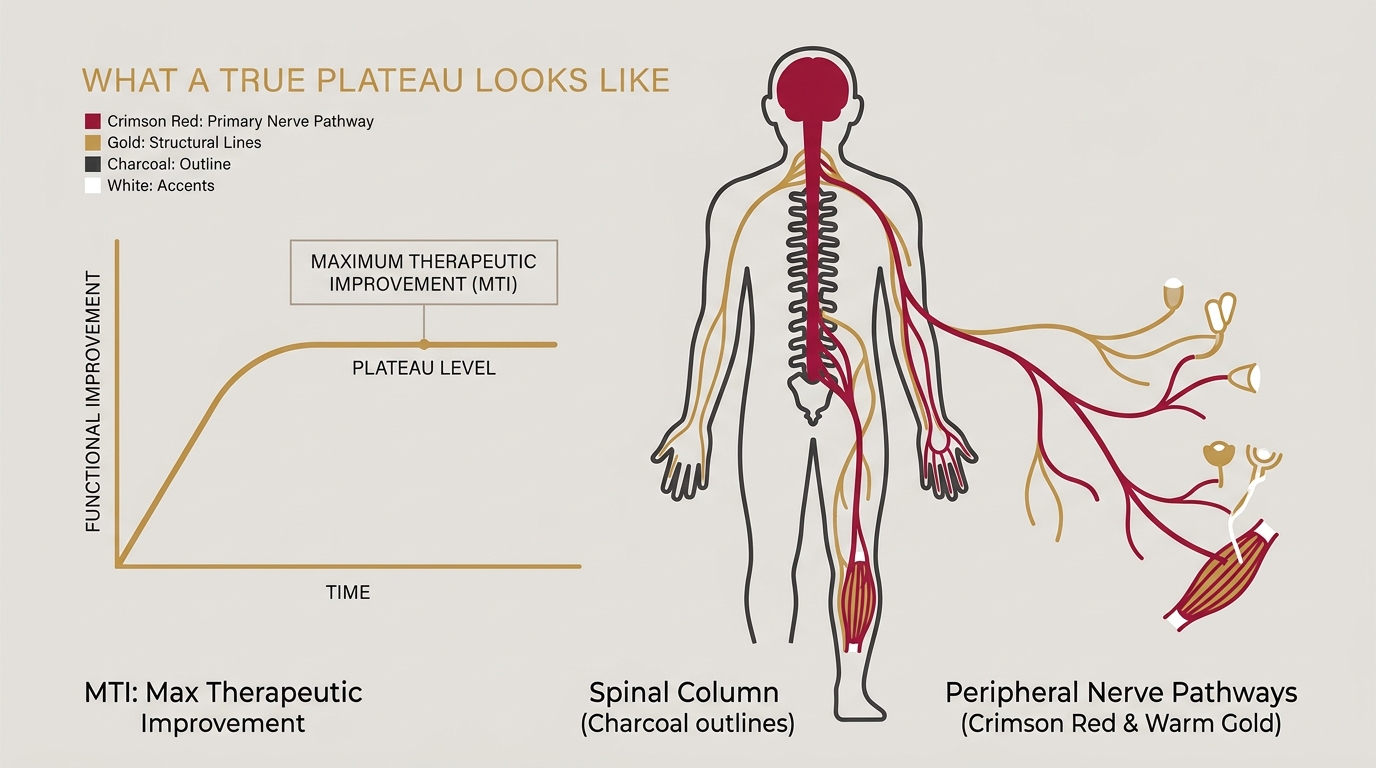
Treatment guidelines refer to Maximum Therapeutic Improvement, or MTI. That's the point where your condition has plateaued and is unlikely to improve further.
One guideline suggests that your pain or function must worsen by the minimal clinically important change for more than 24 hours to justify ongoing care.
The authors say guidelines on how long to treat chronic pain patients who haven't yet reached MTI seem to be loosely based on how often and how long treatment was given in trials. They also say there's little guidance, and no evidence, for care after MTI is reached. Their work is Visit Frequency and Outcomes for Patients Using Ongoing Chiropractic Care for Chronic Low-Back and Neck Pain.
I treat continuing a therapy that shows no results as the failure. I judge care by whether you respond, and when you don't, I change course. When I find a true plateau, I write a new plan. What a New Care Plan Looks Like After Re-Evaluation shows what that looks like.
I'll be plain about the money side. Payment systems that pay for volume push providers toward more visits instead of better care, and I see that happening. I won't let that pressure pass as medical necessity or clinical judgment, and I won't treat you past a plateau because it pays.
What Slow, Normal Progress Looks Like in Chronic Pain
Progress in chronic pain can be slow. In a 3-month look at chiropractic patients with chronic low-back and/or neck pain, back pain went down by 0.40 points and neck pain went down by 0.44 points. Function improved by 2.7 points on the Oswestry Disability Index and 3.0 points on the Neck Disability Index. The study reports all p<.001 for these changes.
Visit frequency told a narrower story. Only visits more than once a week were linked to significantly better improvement, and only for patients with chronic low-back pain. The authors say these patients were improving, but slowly, and may have reached maximum therapeutic improvement.
You can read the full study here: Visit Frequency and Outcomes for Patients Using Ongoing Chiropractic Care for Chronic Low-Back and Neck Pain.
I judge your progress against your own scores, one patient at a time. I won't run everyone through one routine, because that treats people like units on a line.
What happens when pain doesn't improve is laid out in Reassessing Care Plans When Pain Does Not Improve: A Complete Guide.
Why Acute Back Pain Doesn't Follow One Path
Acute low back pain doesn't follow one course. A community-based study collected its first data within 4 weeks of when the low back pain began. Follow-up data came 8, 12, 26, and 52 weeks after onset. It found four distinct paths:
- Mild or moderate pain that went up and down: 54.0%
- Steady moderate pain: 33.0%
- Moderate to severe pain that went up and down: 6.8%
- Delayed recovery by week 52: 6.2%
The biggest group, just over half of people, started at an average pain of 4.1 out of 10. Their pain dropped fast at first, then rose at later checks.
Higher pain at the start and a history of low back pain episodes were significantly linked with less favorable trajectories. Nearly half of the participants had less favorable trajectories. The study is The course of acute low back pain: a community-based inception cohort study.
That paper also cites Downie et al., who followed 1,585 patients over 12 weeks and found 5 pain trajectory groups. Rapid recovery by week 2 was 35.8%, recovery by week 12 was 34.3%, incomplete recovery was 14.0%, fluctuating pain was 10.5%, and persistent high pain was 5.4%.
I won't apply one standard routine to every complaint. I haven't seen any single approach shown to work for every patient. So I fit your care to you, and we check it again at each re-evaluation.
How Maintenance Care Changes What Counts as Progress
In maintenance care, progress looks different. In one study, patients who got maintenance care had flat pain trajectories around each new treatment period. That means their pain stayed steady, with no rise. They also reported fewer days with pain than patients who got the control intervention.
The entire effect came from one group, the dysfunctional subgroup. These patients reported fewer days with activity-limiting pain within each new low back pain episode. Their total pain-free periods between episodes were also longer, by 9.8 weeks compared to the control group. The 95% confidence interval, the range the true difference is likely to fall in, was 3.3 to 16.3 weeks.
An earlier look at the same data sorted people into groups by psychological traits. It suggested the results don't depend on how many treatments a person gets. The dysfunctional subgroup got the benefit of maintenance care with the same number of visits as the control group.
I judge maintenance care by measured benefit, like fewer pain days and longer pain-free stretches. I won't frighten you into committing to care, and I won't stretch it out longer than needed. I count both as ethical breaches, not as a practice style.
To see how the work is done, visit Chiropractic Care.
Frequently Asked Questions
How often should a re-evaluation visit happen?
Available recommendations for provider-based care tend to give a frequency and duration of treatment, such as 10 treatments over 8 weeks. They also set a time to reassess before the care plan continues. Ask your doctor when your reassessment is due.
Do patients with worse pain at the start use more visits?
In one study, yes. When visit frequency was added to the models, people with worse pain and function at the start used more visits. But only visits more than once a week, for people with chronic low back pain, were linked to significantly better improvement.
Is it normal to still have some pain after months of chiropractic care?
In one sample, 70 percent of patients said their treatment goal was pain management, not a cure. On average, these patients had been in pain for 14 years and using chiropractic care for 11 years.
If you tell me you were brushed off elsewhere, I believe you. I treat pain that lasts for months as real, not as something in your head.
Can care continue after a patient reaches a plateau?
Yes, under certain conditions. The guidelines all acknowledge that care beyond Maximum Therapeutic Improvement, such as chronic pain management or support care, might be needed. One example is when symptoms worsen after a therapeutic withdrawal of treatment. Ask your doctor whether that fits you.
Your Next Re-Evaluation
A re-evaluation settles the question of plateau or progress with measured scores, not impressions. A change in pain that matters to you is typically 10 to 20 percent or more on a 0-to-10 scale.
In one study, only visits more than once a week were linked to significantly better improvement, and only for chronic low-back pain.
I'd rather tell you the truth, even when it isn't what you hoped for, than give you comfort that explains nothing. If you've reached a plateau, I'll say so.
If you have a sudden severe headache, numbness or weakness in an arm or leg, trouble speaking or seeing, or loss of bladder or bowel control, call 911 or your doctor right away.
At Touch of Wellness Chiropractic in Morton, IL, our doctors provide Chiropractic Care, along with Shockwave Therapy, Neuropathy Care, Acupuncture, Cold Laser Therapy, Massage Therapy, and DOT Physicals. Ready to see where your numbers stand at your next re-evaluation? Book Appointment
Results may vary.