
The Centers for Medicare & Medicaid Services (CMS) says that once the provider cannot determine there is any improvement, treatment becomes maintenance, and Medicare no longer covers it. Medicare considers treatment maintenance therapy when further clinical improvement cannot reasonably be expected from continuous, ongoing care and the chiropractic treatment becomes supportive rather than corrective. According to the Illinois Chiropractic Society, the insurance company decides what is medically necessary in Illinois, and the Illinois Department of Insurance does not have authority to review medical records and make its own independent assessment of medical necessity. Usually the policy defines "medical necessity," and that definition refers to standards of good practice in the community for diagnosis or treatment of a covered illness or injury.
Why Coverage Follows Your Response, Not the Plan Itself
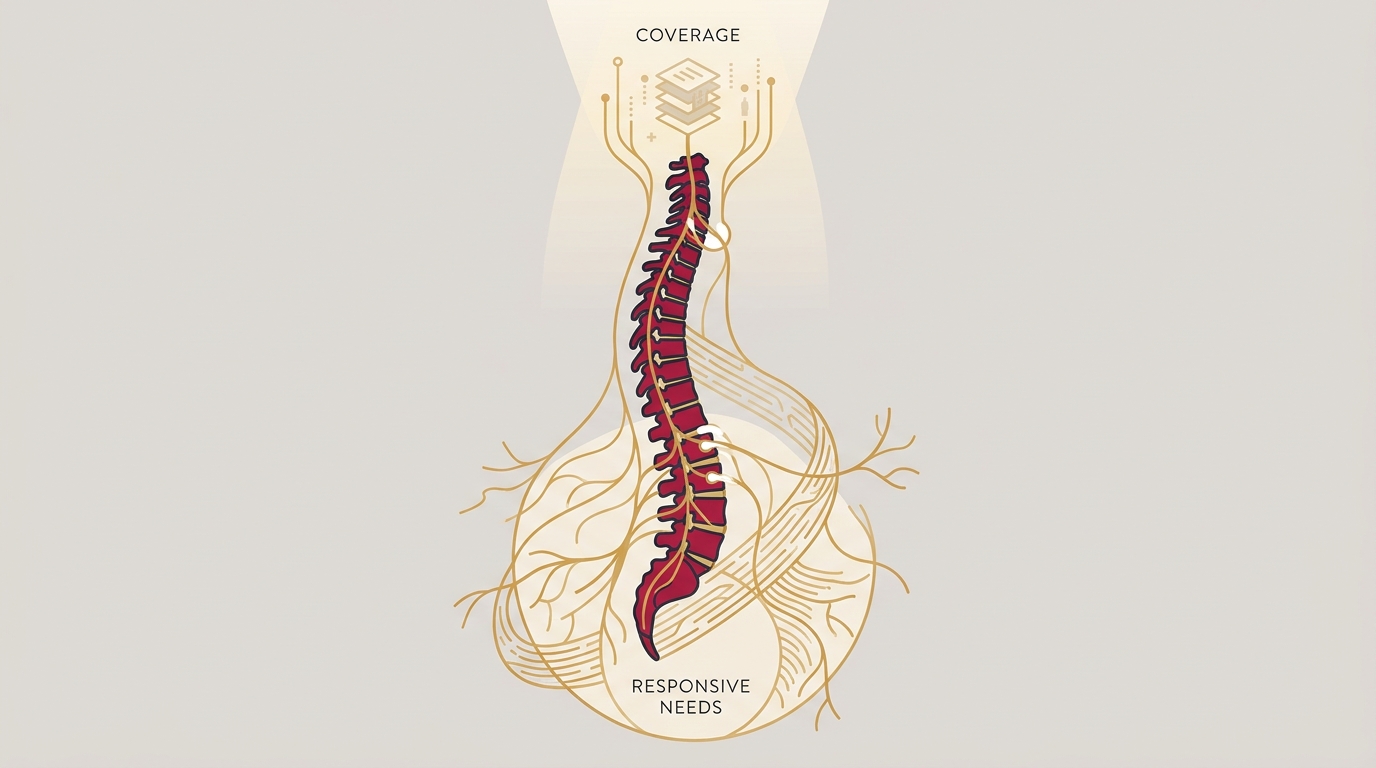
Coverage starts with medical necessity. The Illinois Chiropractic Society says the policy usually defines "medical necessity." That definition points to standards of good practice in the community for diagnosis or treatment of a covered illness or injury.
Medicare has its own rule. The Centers for Medicare & Medicaid Services (CMS) Pub. 100-02 Medicare Benefit Policy transmittal (maintenance therapy) says the chiropractor should get the chance to improve the condition, or to stop or slow it from getting worse, within a reasonable and generally predictable amount of time.
Medicare also uses two labels. A condition is acute when you're being treated for a new injury that an x-ray or physical exam has found. A condition is chronic when more treatment isn't expected to significantly improve or resolve it, but continued therapy can be expected to bring some functional improvement. That means some improvement in how you function.
I judge care by whether you respond. If a therapy shows no results, I change course, because I count keeping it going as the failure. I read coverage rules by that same test: your response.
I would rather tell you the honest reason coverage changed, even if you don't like it, than give you a nice-sounding line that explains nothing.
If your pain is not getting better, read Reassessing Care Plans When Pain Does Not Improve: A Complete Guide. To see what comes next, read What a New Care Plan Looks Like After Re-Evaluation.
How Medicare Treats a Revised Chiropractic Plan

Medicare Part B only covers spinal adjustments by a chiropractor to correct a subluxation. A subluxation is when the spinal joints do not move properly, but the contact between the joints stays intact. Coverage applies only when your chiropractor uses their hands or a device called an "activator."
The file also has to show the problem. The CMS Medicare Documentation Job Aid for Chiropractic Doctors (MLN1232664, March 2022) says documentation must show at least 2 of these 4 things: pain, asymmetry or misalignment, range of motion abnormality, and tissue tone changes. These are called P.A.R.T. At least 1 of the 2 must fall under asymmetry/misalignment or range of motion abnormality. The job aid also says to include:
- Dated documentation of the first evaluation
- A primary diagnosis of subluxation, including the level of subluxation
- Any documentation that supports medical necessity
The job aid lists evaluation of the musculoskeletal and nervous system through physical examination as part of the initial evaluation. CMS lays out the rules on active and maintenance care in Chiropractic AT modifier: active vs maintenance treatment and in the Pub. 100-02 Medicare Benefit Policy transmittal (maintenance therapy).
I won't let a pay-per-visit incentive pass as clinical judgment. When a push for more visits gets called "medical necessity," I name the money behind it and put the quality of your care first.
To see why repeating a plan without progress is a problem, read Why Repeating the Same Adjustment Plan Without Progress Is a Red Flag.
The AT Modifier and Why It Matters
Starting October 1, 2004, Medicare requires the AT modifier on Medicare claims before it will pay for billing codes 98940–98942. A modifier is an add-on code.
CMS adds a caution in its MLN Matters article SE1602. Having the AT modifier on a claim may not always mean the service is reasonable and necessary.
When Medicare Calls Care Maintenance
Medicare pays only for active, corrective treatment to correct acute or chronic subluxation. It does not pay for maintenance therapy.
CMS says to be aware of this: once the provider cannot determine there is any improvement, treatment becomes maintenance, and Medicare no longer covers it. Medicare considers treatment maintenance therapy when further clinical improvement cannot reasonably be expected from continuous, ongoing care and the chiropractic treatment becomes supportive rather than corrective.
The CMS transmittal defines maintenance therapy as a treatment plan that tries to prevent disease, promote health, and lengthen and improve quality of life. It also defines it as care done to maintain a long-lasting condition or keep it from getting worse.
How Illinois Regulates Private and HMO Plan Denials

The Illinois Chiropractic Society explains that in Illinois, the insurance company decides what is medically necessary. The Illinois Department of Insurance, sadly, doesn't have the power to review medical records and make its own separate judgment about medical necessity.
The Department says it has limited jurisdiction over claim denials for medical necessity. It can make sure the payer, or the Utilization Review Firm the payer delegated, handled the review process according to the law.
According to the Illinois Chiropractic Society, if an insurer or a health maintenance organization (HMO) denies a claim for lack of medical necessity, the doctor or the patient may appeal. The appeal asks the Department to check whether the payer followed the proper procedures required by state law. The Department cannot make a company pay more benefits. It can ask the company to review the claim and give it further consideration. The Department describes its process in Understanding the Provider Complaint Process.
Some plans fall outside the Department's reach. Its list names these:
- Medicare HMOs
- Military insurance
- Policies bought in another state (HMO policies may be the exception)
- Medicare
- Medicaid
- KidCare
- The Illinois Comprehensive Health Insurance Plan
- The State of Illinois Employee Quality Care Plan
- Workers' Compensation
The Illinois outside review law also leaves out coverage under a plan through Medicare, Medicaid, or the federal employees health benefits program.
The Illinois Chiropractic Society also points to the Illinois Prompt Pay Law. Payments other than regular ongoing payments, including regular claims for services, must be paid within 30 days after the insurer gets proper written proof of the loss.
How to Appeal When a Revised Plan Is Denied
If a health care plan covers you, you have the right to appeal when your plan denies a service. If your plan then denies the appeal for medical services, you can ask for an external independent review. The Illinois Attorney General lays out these rights in Appeals and Independent Reviews: Your Rights.
The managed care law has limits. The Act does not apply to indemnity health insurance policies, plans that offer only dental or vision coverage, Preferred Provider Administrators, ERISA plans, or care provided under the Workers' Compensation Act or the Workers' Occupational Diseases Act.
The plan's written decision on an appeal must give clear and detailed reasons. It must also give the medical or clinical criteria used. Those criteria must be based on sound clinical evidence and reviewed from time to time.
The table below shows each step, who acts, and the deadline.
| Step | Who acts | Deadline |
|---|---|---|
| Standard internal appeal | Your health plan decides | 15 business days after it receives the required information |
| Expedited internal appeal | Your health plan decides and notifies orally | 24 hours after it receives the required information |
| Request for external independent review | The request is made in writing | Within 30 days of receiving the adverse determination from the internal appeals process |
| Standard external independent review | The external reviewer decides | 5 days after receiving all the materials |
Standard and Expedited Internal Appeals
Once you file an appeal, the health care plan must tell you, within 3 business days, all the information it needs to evaluate the appeal. Once the plan has that information, it must make a decision within 15 business days.
An expedited review must be given if a delay would significantly increase the risk to an enrollee's health. It must also be given when extended services for an ongoing course of treatment are at issue. In an expedited review, once the plan has the required information, it must make a decision within 24 hours and orally notify the party who filed the appeal.
Requesting an External Independent Review
A demand for an external review must be made in writing within 30 days of the date you received the adverse determination from the plan's internal appeals process.
The external reviewer must be a clinical peer. The reviewer must have no direct financial interest in the case and must not know who the enrollee is. After the reviewer gets all the materials, the reviewer has 5 days to decide whether the claim or service is medically appropriate.
Your plan pays the reviewer's fees, and only your plan does. That's true whether or not the service or claim is found medically appropriate.
The Illinois Chiropractic Society notes that the independent reviewer's decision is final as to medical necessity. If the reviewer decides the services are medically necessary, the plan must pay for them.
Deadlines and Notices to Watch For
Read every denial letter closely. The Illinois Department of Insurance says all health denial letters that involve medical necessity, experimental or investigational care, pre-existing conditions, or rescissions must include notice of your right to appeal a coverage decision. A rescission is when coverage is canceled after the fact.
The final adverse decision notice has to say three things clearly. It must say that it is the final adverse decision, that all internal appeals have been used up, and that you have 4 months from the date of the letter to file for an outside review.
Denial notices must also tell you that the deadlines for filing an appeal or an external review request are not postponed or delayed by health care provider appeals. The one exception is when the provider is acting as your authorized representative.
You may ask for an expedited external review if you have a medical condition where the time for a standard external review would seriously jeopardize your life or health, or would jeopardize your ability to regain maximum function. According to HealthCare.gov, standard external reviews are decided as soon as possible, and no later than 45 days after the request was received.
To see how to file a complaint, read Filing a Complaint Against Health Insurers with the IDOI.
Where to Get Help With a Denied Claim
Start by contacting the insurance company, HMO, or administrator about your problem. Keep notes on your phone calls: the name of the person you speak to, the date of the call, and a summary of the conversation.
You can call the Illinois Department of Insurance Consumer Assistance Hotline at (866) 445-5364. Insurance analysts can answer general questions. Consumer complaints, however, must be submitted in writing. The Department also publishes an External Review Notice checklist.
The Illinois Chiropractic Society says the Department will review issues other than medical necessity. One example is whether the decision matched your plan's coverage for certain procedures and number of days of treatment.
You can also call the Illinois Attorney General's Health Care Helpline at 1-877-305-5145.
How You Can Pay if Coverage Ends
If insurance stops paying, you still have ways to pay for care. Patients at Touch of Wellness Chiropractic use a mix of these:
- Insurance
- Cash
- Credit cards
- Health savings account and flexible spending account (HSA/FSA) funds
- Affirm
- Payment plans
- Care plans
- Pay-in-full courtesy pricing
- Personal checks
- Personal injury cases
- Automatic bank debit (AutoDebit)
Affirm is a payment service we use to finance what you pay for care. To learn how the work is done, see our Chiropractic Care page.
Frequently Asked Questions
Does Medicare pay for more than one chiropractic treatment a day?
No. CMS says Medicare limits payment to no more than one treatment per day. Room or ward fees are not covered either.
Does Medicare cover X-rays, massage or acupuncture my chiropractor orders?
No. Medicare doesn't cover other services or tests a chiropractor orders. That includes X-rays, massage therapy, and acupuncture.
Can my chiropractor file the appeal for me?
Yes. After any denial of services, you can file the appeal yourself. So can your designee or guardian, your primary care physician, or your health care provider.
Why might I be asked to sign an Advance Beneficiary Notice?
Because Medicare could deny the claim. The Centers for Medicare & Medicaid Services (CMS) says chiropractors should consider getting an Advance Beneficiary Notice (ABN) from Medicare patients in case a claim is denied.
Do Illinois prompt-pay rules apply to my employer's self-insured plan?
No. State laws, including the Prompt Pay Law, don't apply to self-insured employers and health and welfare benefit plans. Ask your employer's benefits office whether your plan is self-insured.
A Revised Plan Can Stay Covered While You Improve
CMS says that once the provider cannot determine there is any improvement, treatment becomes maintenance and Medicare no longer covers it. CMS policy also says the chiropractor should be given the chance to improve the condition, or to stop or slow it from getting worse, within a reasonable and generally predictable amount of time. That is why I write down how you respond at every step.
I don't accept that pain with no known cause can't be helped. Not having an explanation yet is not the same as having no options. If you've been told nothing can be done, I still look for a path to care, and to coverage.
At Touch of Wellness Chiropractic, we provide chiropractic care built around what you report, and we change the plan when it isn't working. If you have a sudden severe headache, numbness or weakness in an arm or leg, trouble speaking or seeing, or loss of bladder or bowel control, call 911 or your doctor right away.
Would you like to Book Appointment and start a care plan built around how you respond?
Results may vary.