
A chiropractor's credentials shape a treatment plan by determining which diagnostic tools, techniques, and clinical reasoning a provider applies to a given condition. The Doctor of Chiropractic degree establishes a baseline of training in anatomy, diagnosis, and spinal health, but it does not standardize how that training gets used. Board certifications and postgraduate diplomate programs add specialized knowledge in areas such as sports injuries, pediatrics, orthopedics, or neurology, and that specialized knowledge directly informs which assessments a chiropractor orders and which interventions a chiropractor recommends. A provider's continuing education record also matters, since license renewal requires ongoing coursework that keeps clinical knowledge current between initial licensure and active practice. Beyond formal credentials, a chiropractor's underlying treatment philosophy influences plan design. Some practitioners operate from a narrower, adjustment-focused model, while others integrate multiple modalities and view spinal care as one tool among several. Technique-specific training, such as certification in a particular adjusting method, further narrows how a provider evaluates spinal mechanics and selects interventions for a specific presentation. The legal scope of practice set by a state licensing board also defines the outer boundary of what any treatment plan can include, regardless of a provider's individual credentials. Taken together, a chiropractor's degree, board certifications, specialty training, continuing education, and treatment philosophy combine to produce a personalized clinical approach rather than a single standardized protocol applied uniformly across all patients. Two chiropractors examining the same condition can arrive at different, equally valid treatment plans because their underlying credentials and training differ.
What a Chiropractic Credential Actually Certifies
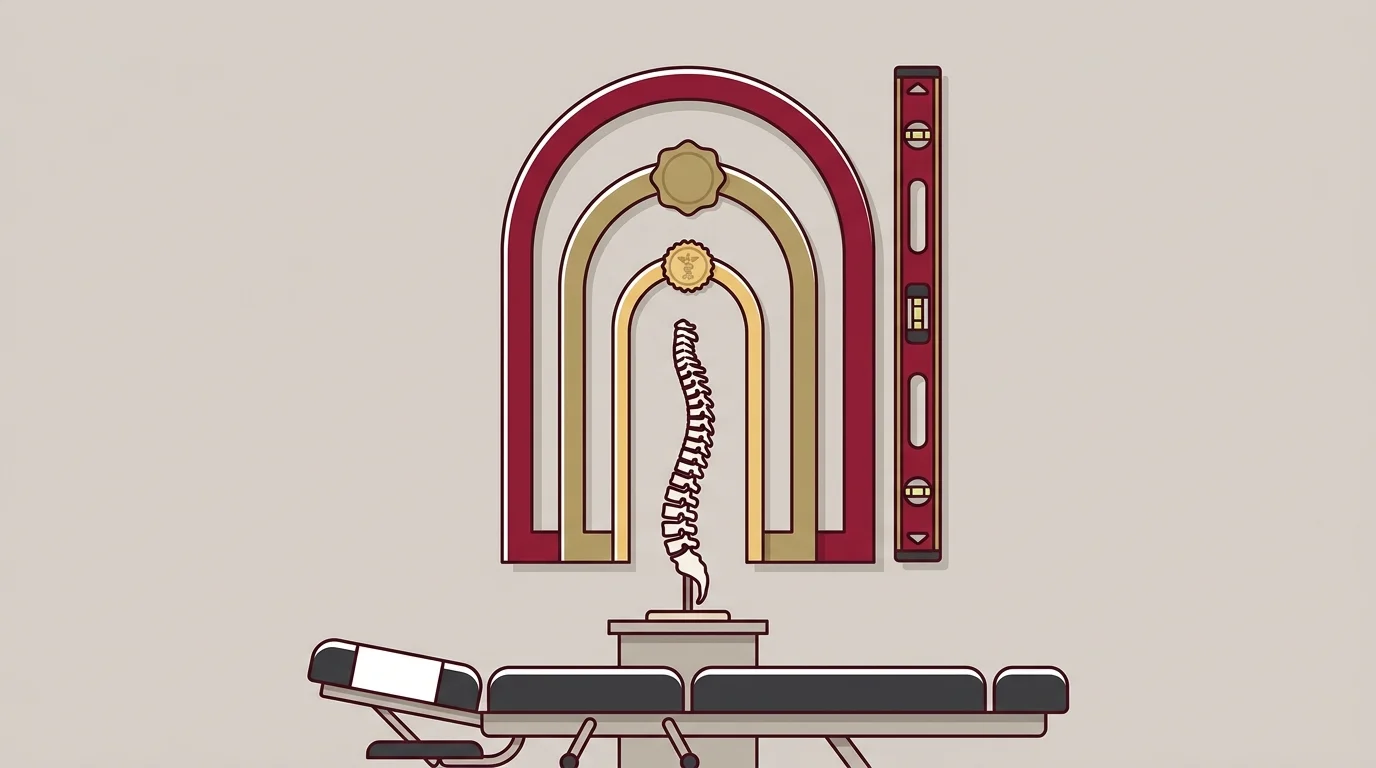
A credential is not a trophy on a wall. It's a certification that a specific body of knowledge was tested and verified.
So a treatment plan isn't a static document. It's a direct read of a chiropractor's education, specialized training, and clinical philosophy. Read the credentials right, and you're reading the blueprint behind the plan.
The Degree, the License, and the Layers Above Them
The Doctor of Chiropractic degree is the foundation every licensed provider shares. But beyond that baseline, credentials tell a story about commitment to a specific area of practice, from sports medicine to pediatrics.
The term credential covers more than the initial degree and license. It also includes ongoing continuing education and advanced diplomate programs that signal a deeper level of expertise. Understanding that layered structure is part of the process behind building a chiropractic plan.
Why One-Protocol Thinking Breaks Down at the Exam Table
A single protocol assumes every spine presenting with the same symptom needs the same intervention. That assumption does not survive contact with actual patients.
No protocol is proven for every patient. A method that resolves one case can miss the mechanism driving another entirely, and a careful exam is what tells them apart.
The Assembly-Line Protocol and What It Skips
An assembly-line protocol treats the presenting symptom as the whole problem. What it skips is the differential reasoning that board certifications and diplomate training are built to supply.
A chiropractor without specialized training in a condition's underlying mechanism can still address the surface complaint. But the deeper diagnostic step gets skipped, and that's the step specialized credentials exist to catch. That gap only shows up later, when the plan stalls.
The Generalist Mandate as a Different Version of the Same Flaw
There's a parallel flaw hiding inside the opposite assumption: that any license is interchangeable with any other, because a Doctor of Chiropractic degree is the only credential that matters. Licensure confirms a baseline. It does not confirm the specialized reasoning a complex case demands.
Treating all licensed providers as functionally identical erases the exact distinctions this article has been building. The credential stack is what separates a generalist response from a plan built around the condition in front of the chiropractor. A guide to asking about evolving treatment plans walks through what that distinction looks like once a plan is already underway.
The Licensing Floor Every Chiropractor Must Clear
Every license rests on the same floor. Before specialization enters the picture, a chiropractor has to clear a national board exam that tests general clinical knowledge, not just spinal mechanics.
That exam is where differential diagnosis gets tested first, before any specialty training begins.
What the National Board Exam Actually Weighs
The National Board of Chiropractic Examiners' Part I test plan gives the Pathology section 16% of the exam.
That weighting signals how much diagnostic reasoning the floor requires before anyone reaches matching adjustments to spinal findings.
Where a Flat Protocol Collapses Under a Real Case
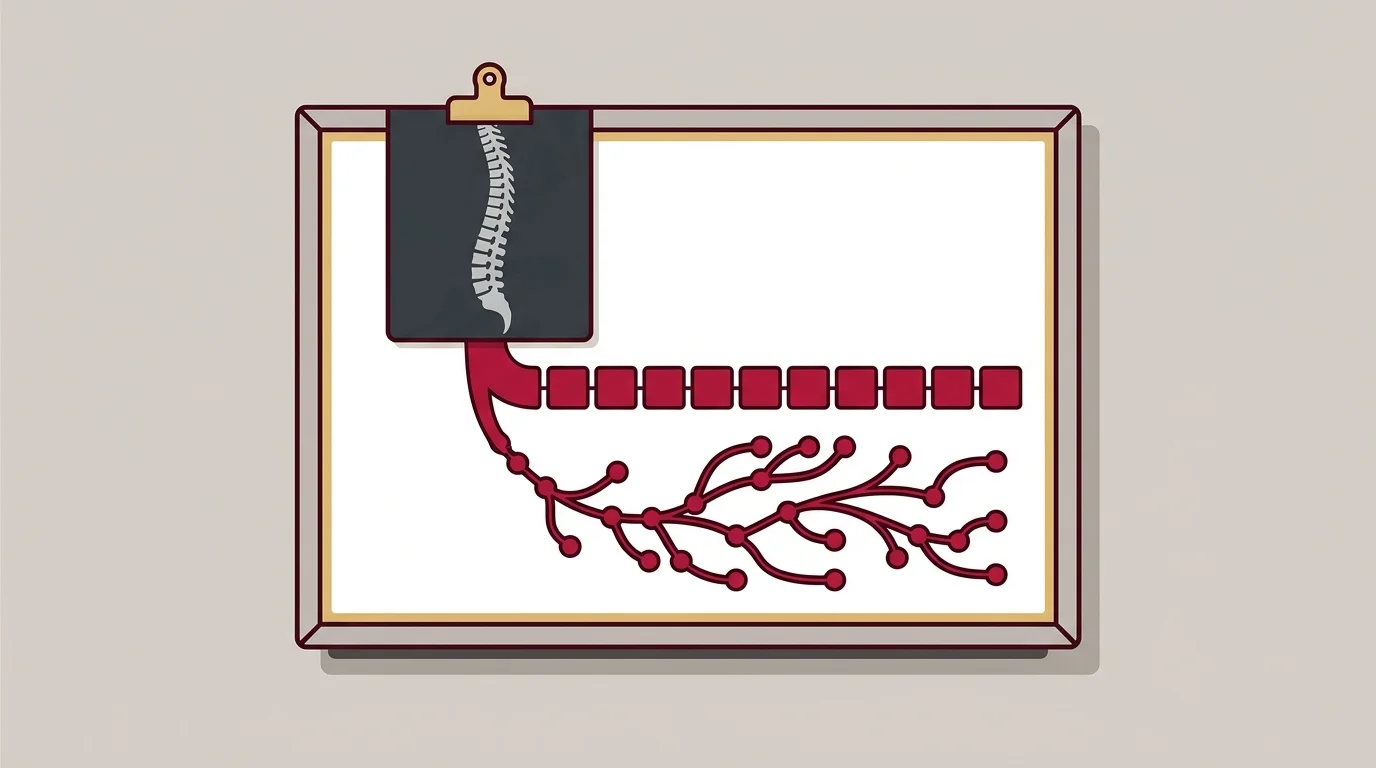
A flat protocol treats the floor like it's enough. It isn't. And the gap shows up fastest in patients whose case doesn't match the textbook.
The Mechanism: Treating the Symptom Code Instead of the Case
A symptom code describes where it hurts. It says nothing about why.
Treating the code means matching a complaint to a standard intervention and moving on. The mechanism underneath stays unexamined unless the provider has training built to look for it.
A 2024 study by Schut (The Journal of Chiropractic Education) identified 49 postgraduate training opportunities for chiropractors in the US, and 19 of them were board specialty diplomate programs.
That's the pool of advanced training a flat protocol never draws on. Patients dismissed by traditional medicine are not imagining their symptoms. The system that labeled them that way simply stopped looking past the code. There is more on what chiropractic treatment involves if this is the part that matters to you.
How Continuing Education Keeps a License Current
A degree and a board exam only mark the starting line. Keeping a license active means heading back to coursework year after year, and that requirement never really switches off.
The Postgraduate Tracks That Build a Specialist

Maintenance coursework keeps a license active, but it doesn't build a specialist. That's exactly why postgraduate diplomate tracks sit above the continuing education floor we just covered.
| Training Pathway | Focus Area | Clinical Philosophy |
|---|---|---|
| Board Specialty Diplomate | A single condition category, studied in depth beyond general practice | Diagnostic precision inside one narrow domain, built to catch what a flat protocol misses |
| Broad Postgraduate Program | A cluster of related techniques or patient populations rather than one narrow condition | Expanded clinical range without the single-condition depth a board diplomate provides |
| Evidence-Based Practice Coursework | Applying current research to case-by-case decisions instead of inherited habit | Treatment plans adjusted as the evidence changes, not locked to one fixed method |
| Technique-Specific Certification | A particular adjusting method and the spinal mechanics it is built to evaluate | A narrower lens on intervention selection, shaped by the credential behind the technique |
Diplomate Programs Versus General Continuing Education
General continuing education renews what a chiropractor already knows. A diplomate program adds what the D.C. degree never covered in that depth.
The field already carries dozens of these advanced tracks, split between broad postgraduate options and narrower board specialty diplomates. That split is the blueprint read backward: the more specialized the diplomate, the narrower the condition it's built to solve.
Reading the Research: How Evidence-Based Practice Gets Built Into a Plan
Specialized training only matters if it's applied with current evidence, not inherited habit. A 2013 paper by Mansholt et al. (Chiropractic & Manual Therapies) notes that many chiropractic colleges now teach evidence-based clinical practice approaches to chiropractic care. Putting that teaching to work, case by case, is what keeps a plan tied to current research.
Straights, Mixers, and the Philosophy Behind the Plan on Your Chart
A credential doesn't just add technique. It carries a philosophy. A 2003 paper by Cooper and McKee (The Milbank Quarterly) describes "straight" chiropractors as attributing a range of conditions to subluxations that interfere with the flow of "vital energy" and relying on chiropractic adjustment to free that process. A profession that tries to be a generalist guide for every age and every complaint stops being a specialty at all. Specialized nervous system and spinal care is a distinct identity, not a subset of general practice.
Frequently Asked Questions
That blueprint idea raises practical questions fast. Here are straight answers to the ones that come up most.
What's the difference between a D.C. degree and a specialty board certification?
The D.C. degree is the floor every licensed provider clears. A specialty board certification is proof of advanced training in one specific area, built on top of that floor.
Are all chiropractors required to get continuing education credits to stay licensed?
Yes. Every active license requires ongoing continuing education, though the exact hour requirement is set state by state.
Does a chiropractor with more credentials charge more for their services?
No. Touch of Wellness Chiropractic uses courtesy pricing with no hidden admin fees, and patients know their costs before treatment starts.
How can a chiropractor's training in a specific technique like Gonstead or Activator affect my treatment?
A named technique like Gonstead or Activator is a specific method for delivering a chiropractic adjustment. Training in that method shapes how a provider evaluates your spine and selects the approach for your case.
Does every chiropractor take X-rays in the office?
No. Some chiropractors take X-rays in their own offices, and others don't. Touch of Wellness Chiropractic asks patients to bring any X-rays or MRIs they already have.
Can a chiropractor's credentials tell me if they practice a straight or mixer philosophy of care?
Somewhat. A straight philosophy relies on chiropractic adjustment as the primary tool. A mixer philosophy treats it as one option among several, which shows up in how broad a treatment plan looks.
The Blueprint Behind the Plan on Your Chart
A blueprint is drawn for one structure only. It marks the load-bearing walls, the wiring paths and the weight limits that another building would never share. A treatment plan works exactly the same way.
Read it against the credential that drew it, and it explains itself. Pathology weighting, board specialty training, diplomate coursework, a declared treatment philosophy — each one is a line on that blueprint.
Strip the credential away and the plan looks arbitrary. It isn't.
Standing on a generic protocol means standing on someone else's blueprint, stretched to fit a frame it was never drawn for. A plan built from your own exam means the drawing was made for your spine.
That difference is worth checking before the first adjustment, not after the third one fails. Schedule a visit at Touch Of Wellness Chiropractic.