
A Scientific Reports study listed these red flags, which are signs of a possible underlying problem: bladder and bowel problems, numbness in the saddle area, fever, chills, nerve symptoms that keep getting worse, a past injury, long use of corticosteroid drugs, a recent infection, past cancer, weight loss with no reason, intravenous drug use, a weak immune system, morning stiffness, back pain that gets better with exercise but not with rest, waking up in the second half of the night because of pain, pain that switches between the buttocks, and not getting better with conservative care. The American Chiropractic Association guideline does not recommend routine imaging for non-specific low back pain. It says imaging is called for when there are severe or getting-worse nerve problems, or when the history or physical exam raises suspicion of a serious problem underneath. The Journal of Chiropractic Medicine says overactive reflexes, muscle stiffness, repeated jerking in the feet and legs, abnormal reflexes, and loss of the sense of where your body parts are all commonly show up on exam in degenerative cervical myelopathy.
Red Flags That Mean Adjustment Alone Is Not Enough
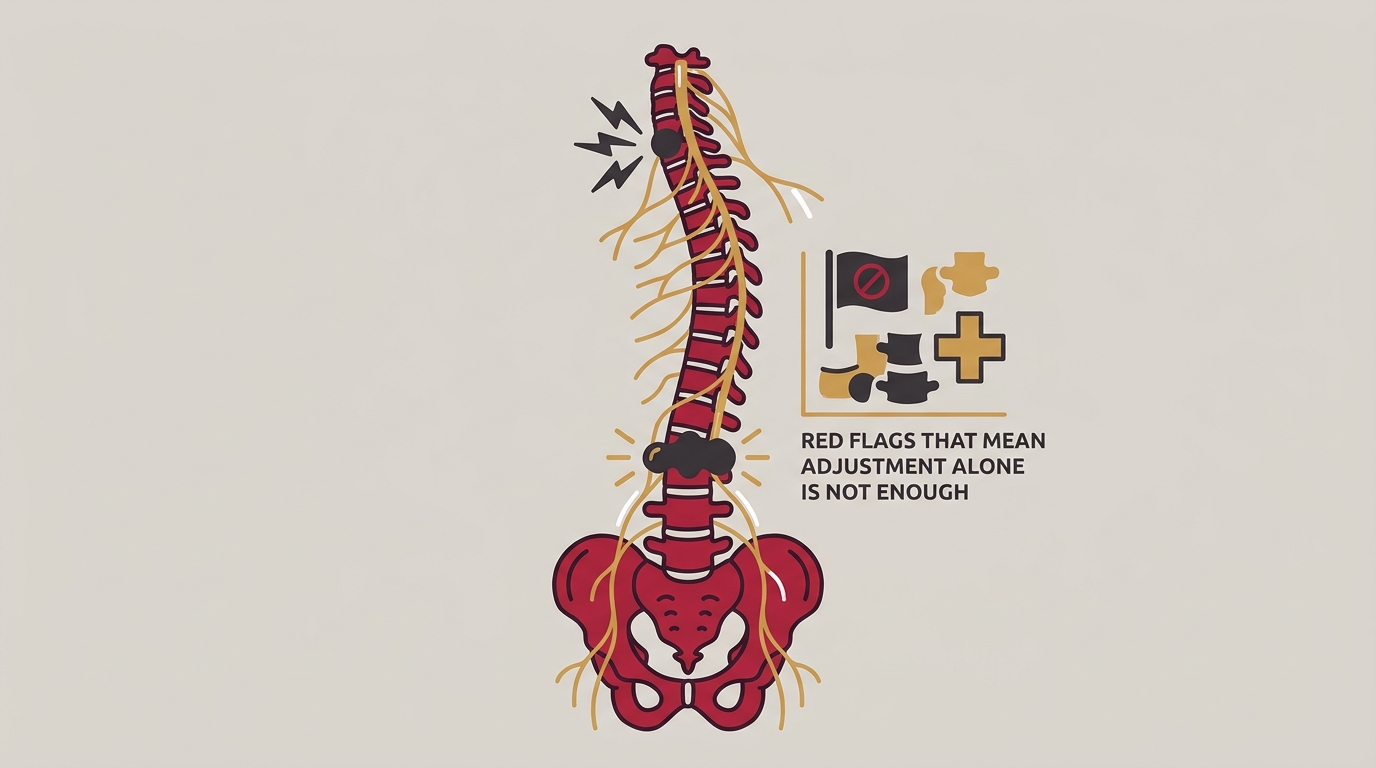
Some signs tell a chiropractor that something more may be going on. A study in Scientific Reports listed these red flags, which are signs of a possible underlying problem:
- Bladder and bowel problems
- Numbness in the saddle area (saddle anesthesia)
- Fever and chills
- Nerve symptoms that keep getting worse
- A past injury
- Long use of corticosteroid drugs
- A recent infection
- Past cancer
- Weight loss with no reason
- Intravenous drug use
- A weak immune system
- Morning stiffness
- Back pain that gets better with exercise but not with rest
- Waking up in the second half of the night because of pain
- Pain that switches between the buttocks
- Not getting better with conservative care
That last one matters to me. Going on with a therapy that shows no results is the failure itself. I judge care by whether you respond, and if you don't, I change course. I wrote more about this in Why Repeating the Same Adjustment Plan Without Progress Is a Red Flag.
The American Chiropractic Association guideline draws a clear line. It does not recommend routine imaging or other tests for non-specific low back pain. Imaging is called for when nerve problems (neurologic deficits) are severe or getting worse. It's also called for when your history or physical exam raises suspicion of a serious problem underneath.
In the Scientific Reports study, clinicians used the International Framework For Red Flags, published by Finucane and others, whenever they suspected an underlying problem. It helped them judge how much the information they'd gathered mattered and choose the most fitting next step. The diagnosis itself came from several things together: age and sex, pain features (where the pain is, how it spreads, and what makes it better or worse), clear nerve deficits found on exam, and red flags.
I would rather name a serious finding plainly, even when it's unwelcome, than hand you a kind-sounding line that explains nothing.
The table below lines up the red flags and the guideline's line on imaging.
| Sign or finding | What it means for imaging |
|---|---|
| Bladder/bowel problems, saddle numbness, fever, progressive nerve symptoms, trauma, cancer history, unexplained weight loss, failure to improve | Listed as red flags (signs of a possible underlying problem) in a Scientific Reports study |
| Severe or progressive nerve deficits, or history or exam that raises suspicion of serious underlying disease | Imaging is indicated |
| Non-specific low back pain | Routine imaging is not recommended |
Neurological Changes That Point to Degenerative Cervical Myelopathy
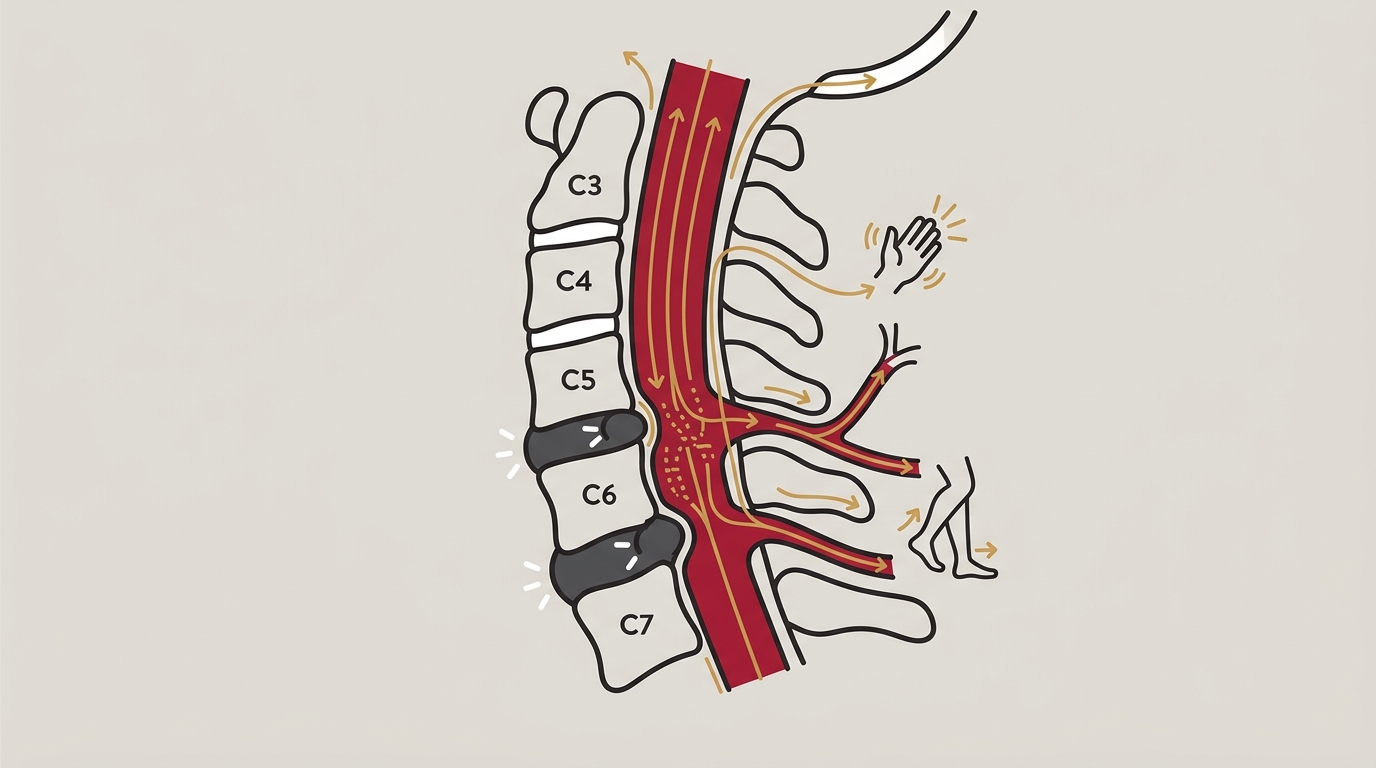
The Journal of Chiropractic Medicine calls degenerative cervical myelopathy (DCM) the most common form of spinal cord impairment in adults. Its estimated incidence is 4.1 per 100,000 people, and its estimated prevalence is 60.5 per 100,000. The two figures differ because they count different things: incidence counts new cases, and prevalence counts how many people have it.
Symptoms people report
Commonly reported symptoms are:
- Numb hands
- Tingling or pins and needles in both arms
- Neck pain or stiffness
- Weak arms or hands, or less skill with the fingers
- Trouble walking
Why early signs get missed
Tingling or pins and needles in the arms or legs may be the first sign. Patients and providers often miss it because it's mild and gets confused with nerve damage in the limbs and with nerve-root problems.
I don't accept that a symptom with no known cause can't be helped. A missing explanation isn't a missing set of options. If you've been told nothing can be done, I don't take that as the last word.
What shows up on exam
Common exam findings include overactive reflexes, muscle stiffness, repeated jerking in the feet and legs (called clonus), abnormal reflexes, and loss of the sense of where your body parts are (proprioception). A clinical review of DCM says two sensitive findings are a present Hoffman's sign and hand numbness. The patient in the Journal of Chiropractic Medicine case report showed both during the course of care.
Why a cervical MRI matters
When DCM is suspected, the report says to think about adding a neck MRI (magnetic resonance imaging scan) to what the symptoms and exam show, to try to confirm it. It calls the cervical MRI the gold standard.
Why Delay in Diagnosing Cervical Myelopathy Costs Patients
The Journal of Chiropractic Medicine says DCM usually gets worse over time. It also says there's little evidence that treatment without surgery stops it or turns it back.
The report says a patient should be sent to a neurosurgeon for a consult promptly, because a diagnosis made in good time has been shown to lead to better results in quality of life, impairment, and disability. One study of 746 patients found that surgery within 6 months of when symptoms started gave the highest chance that symptoms would get better or go away.
Now look at how long the wait can be. A retrospective study, which looks back at past records, covered 42 patients who needed surgery for DCM. It found an average delay of a little over 2 years (2.2 years) from the first symptoms to the diagnosis.
When someone tells me they were brushed off, I take their symptoms as real. I never hint that it's in their head, and I don't wait for symptoms to keep getting worse before I take them seriously.
How Re-Evaluation in One Case Led to Advanced Imaging
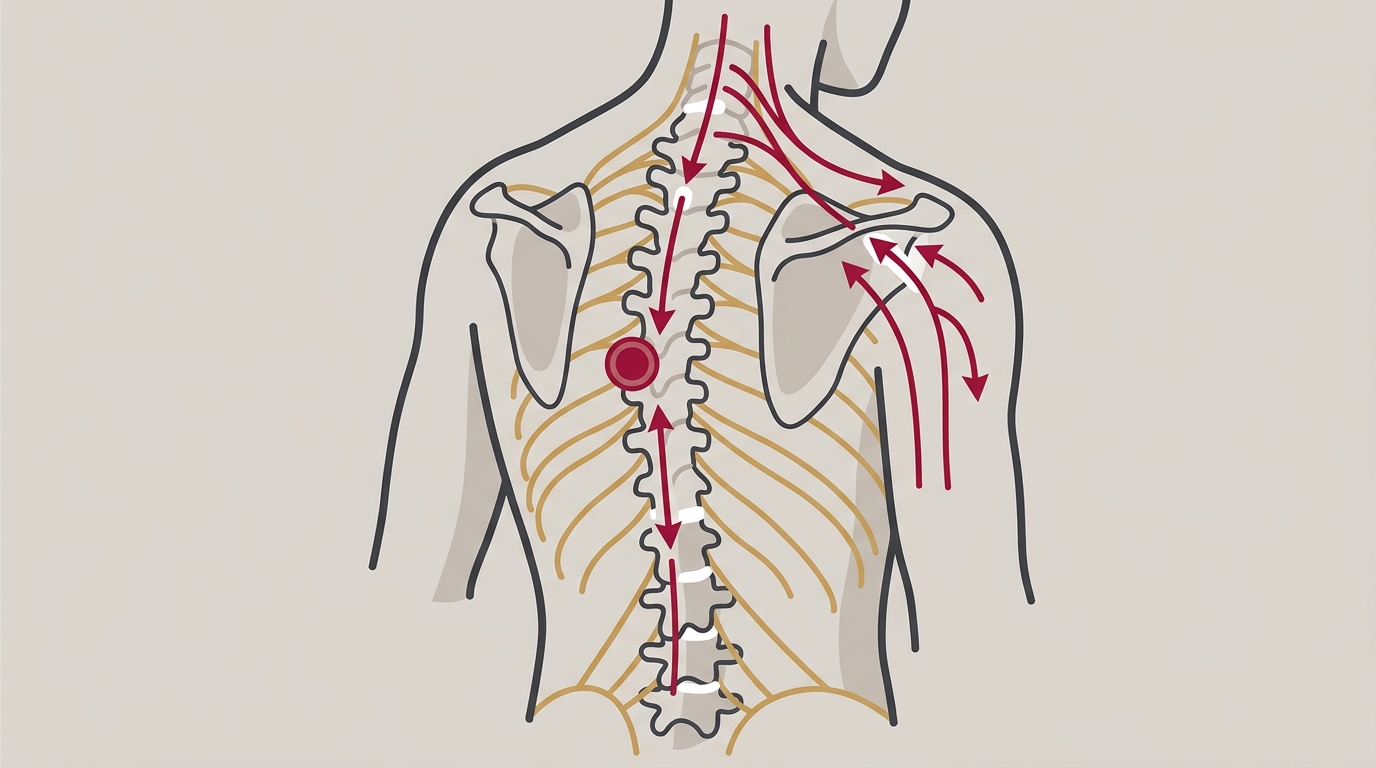
A case report in the Journal of Chiropractic Medicine shows what re-checking can catch. It's called Degenerative Cervical Myelopathy in a Veteran Chiropractic Patient Referred for Lumbar Radicular Pain: A Case Report.
When the patient was re-checked, the nerve findings kept getting worse. Cervical myelopathy, a neck spinal cord problem, was suspected. That called for working with the primary care doctor to ask for advanced imaging. The authors say that without routine re-evaluations, this case of underlying degenerative cervical myelopathy may have gone unnoticed.
This patient had many health problems at once. The report says that's exactly why it matters to go back and check the nerve exam again, even when the main complaint is getting better. I don't run one fixed routine on everyone. I fit each re-check to the person in front of me.
The report also noted its own limits:
- X-rays of the lower back were ordered even though that was inconsistent with American College of Radiology appropriateness criteria for ordering lower back X-rays. The case was complex, and other health problems limited parts of the evaluation. The X-rays were ordered because of concern for the patient's safety.
- The authors say this single case report may not match all cases of degenerative cervical myelopathy. It lacks generalizability, which means you can't assume its findings hold in other cases.
Why Chiropractors Don't X-Ray Everyone
A review in Chiropractic & Manual Therapies found no evidence that routine or repeat X-rays of the spine improve outcomes or help patients when there are no red flags (warning signs of a serious problem). Those X-rays are the ones used to check how the spine works or how it's built. Research on the National Library of Medicine site adds that there's little to no research comparing chiropractic treatment with X-rays to treatment without them.
The harms of routine X-rays
Research has concluded that strong evidence links several possible harms to routine, repeated X-rays. They include changes in how treatment is done, overdiagnosis (finding problems that would not have caused harm), radiation exposure, and unnecessary costs. X-rays use ionizing radiation, and that carries risk. So reviewers on the National Library of Medicine site recommend that chiropractors not use X-rays for routine and repeat checks of the structure and function of the spine.
X-ray findings and pain don't always match
Research shows that pain, tissue damage, and injury do not always go together. Many people with no pain have identical structural changes on X-rays to those seen in people with pain.
When X-rays are justified
Sometimes signs or symptoms point to a possibly serious problem underneath. Those are the red flags. When they show up, chiropractors can use X-rays to help reach a diagnosis.
What chiropractors themselves say
Chiropractors gave conflicting comments about what could happen if they don't order spine X-rays. Their concerns included missing a disease, avoiding adverse treatment effects, lawsuits, deciding the treatment plan, and using X-ray-driven techniques. On the other side, they weighed the perceived benefits of less radiation for patients and lower costs.
I don't apply one standard imaging routine to every complaint. I fit care to you.
I also name the money side. When a payment system rewards volume over quality, I call that pressure what it is. I won't let it be presented to you as medical necessity or pass as clinical judgment.
When Chiropractors and Neurosurgeons Agree More Is Needed
In a Scientific Reports study, Diagnostic and management concordance between chiropractors and neurosurgeons for patients with low back pain, the chiropractors had a limited role. They decided whether the patient needed a neurosurgeon's expertise, either surgical or non-surgical. They did not decide if surgery was needed.
How often they agreed
Overall, chiropractors and neurosurgeons agreed on the diagnosis 74.7% of the time, about 3 times out of 4. Once chance is taken into account, the agreement was moderate. The score was 0.51 on the kappa scale, which measures how much two raters agree. The 95% confidence interval, a range of likely values, was 0.35 to 0.68.
When a neurosurgeon is needed
In the study, a neurosurgeon consult was judged warranted when the patient's clinical profile showed things like nerve signs and symptoms that kept getting worse. It was also warranted when a high level of disability came with failed conservative treatment or signs of structural problems.
When more tests come first
More tests were the next step when the right tests were missing. They were also the next step when tests were not recent enough to settle the main diagnosis and the best way to manage it.
Why gaps in care persist
International practice guidelines for managing low back pain exist. But the study says significant gaps remain between the evidence and what happens in clinical practice. That contributes to inappropriate use of tests and treatments, including overuse of opioid prescriptions and imaging. It also contributes to over-reliance on medical specialists' expertise.
How shared care helped
A retrospective review (a look back at data collected ahead of time) from spine clinics in Ontario looked at a shared-care model, where several kinds of health professionals work together. It found the model significantly improved how appropriate referrals were, how efficiently magnetic resonance imaging (MRI) was used, and wait times for surgical assessment for people with low back pain.
If your pain isn't getting better, read Reassessing Care Plans When Pain Does Not Improve: A Complete Guide. To see how the work is done, visit our Chiropractic Care page.
Frequently Asked Questions
Does Touch of Wellness Chiropractic take X-rays in the office?
No. We never take X-rays or other imaging here. If you already have imaging, like X-rays or magnetic resonance imaging (MRI) scans, bring it to your first visit.
Is there a cancer risk from getting X-rays?
The U.S. Food and Drug Administration (FDA) says the risk of cancer from medical imaging radiation is generally very small, and it depends on the dose. Your lifetime risk goes up with a larger dose and with more X-ray exams.
Can cervical cord compression get worse even without myelopathy symptoms?
It may. Some published research suggests that people whose spinal cord is squeezed but who have no myelopathy (spinal cord problem) may start to show myelopathy changes. The rate depends on how long they were followed: about 8 in 100 (8%) after 1 year, and about 23 in 100 (23%) at a 4-year follow-up.
Can X-ray posture measurements change from one day to the next?
They can. Accuracy can be questioned, because X-ray measurements can vary with how you stand. Research says a huge number of things shape your standing position. These include how you're positioned, body changes over time, differences between the doctors reading the X-ray, stress, pain, your sleep or physical activity the night before, hydration, and your emotional state.
Imaging Follows Warning Signs, Not a Schedule
Imaging should follow clear warning signs, not a calendar. We don't take X-rays here, and we never take imaging of any kind. Bring any imaging you already have, like X-rays or magnetic resonance imaging (MRI) scans, to your first visit. Touch of Wellness Chiropractic in Morton, IL provides chiropractic care, including chiropractic adjustment, along with Acupuncture, Cold Laser Therapy, Shockwave Therapy, Neuropathy Care and DOT Physicals, with Massage Therapy as part of care.
If you have a sudden severe headache, numbness or weakness in an arm or leg, trouble speaking or seeing, or loss of bladder or bowel control, call 911 or your doctor right away.
Would you like to Book Appointment and bring your imaging along?
Results may vary.