
A chiropractor can refer you to the right specialist or alternative medicine provider when a problem is outside the chiropractor's scope, or when another provider is better equipped to help. The aim is to co-manage your care, or, when it fits, to move it fully to someone else. A chiropractic clinical practice guideline says a variety of health care providers play a critical role at different stages of treatment and recovery. It says chiropractors should consult them, refer patients to them, and co-manage patients with them when that is in the patient's best interest. A first trial of chiropractic care is usually a group of visits close together, such as 4 to 6 visits over 1 to 2 months. A re-check follows to see if care is working and whether to continue or step up care.
When Referral Out Fits and When Care Continues
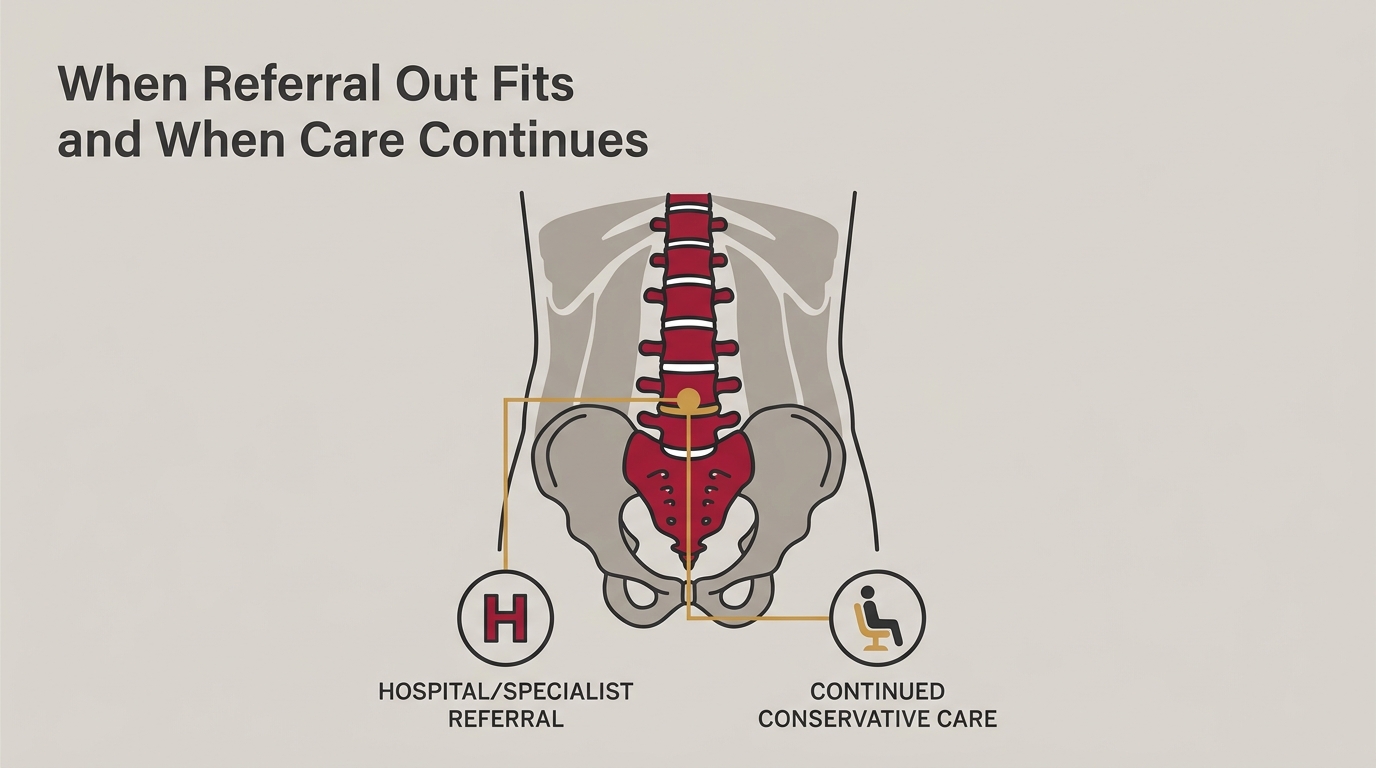
A referral can fit for more than one reason. The problem may be outside what a chiropractor treats. Another provider may be better equipped to help. In those cases, KMC University says a chiropractor can refer you to the right specialist or alternative medicine provider. The aim is to co-manage your care, or, when it fits, to move it fully to the other provider.
KMC University names two more cases. One is when a chiropractor decides a patient has serious reasons not to have chiropractic manipulations. The other is when a patient doesn't respond to a trial period of treatment. In both cases, it may be best to stop care and send the patient for a medical consultation.
The Clinical Practice Guideline: Chiropractic Care for Low Back Pain (JMPT full text) says a variety of health care providers play a critical role in treatment and recovery at different stages. It says doctors of chiropractic should consult them, refer patients to them, and co-manage patients with them when that is in the patient's best interest.
Being willing to change course when something isn't working is not a weakness. It's the sign of a competent provider. I hold myself to one rule here: I count it as a failure to keep going with a therapy that shows no results. When a trial brings no response, I change the path.
I'd rather tell you something true and unwelcome than something nice that explains nothing. If the honest call is to refer you out, I make that call, even when it isn't what you hoped to hear.
Findings That Call for Referral Right Away
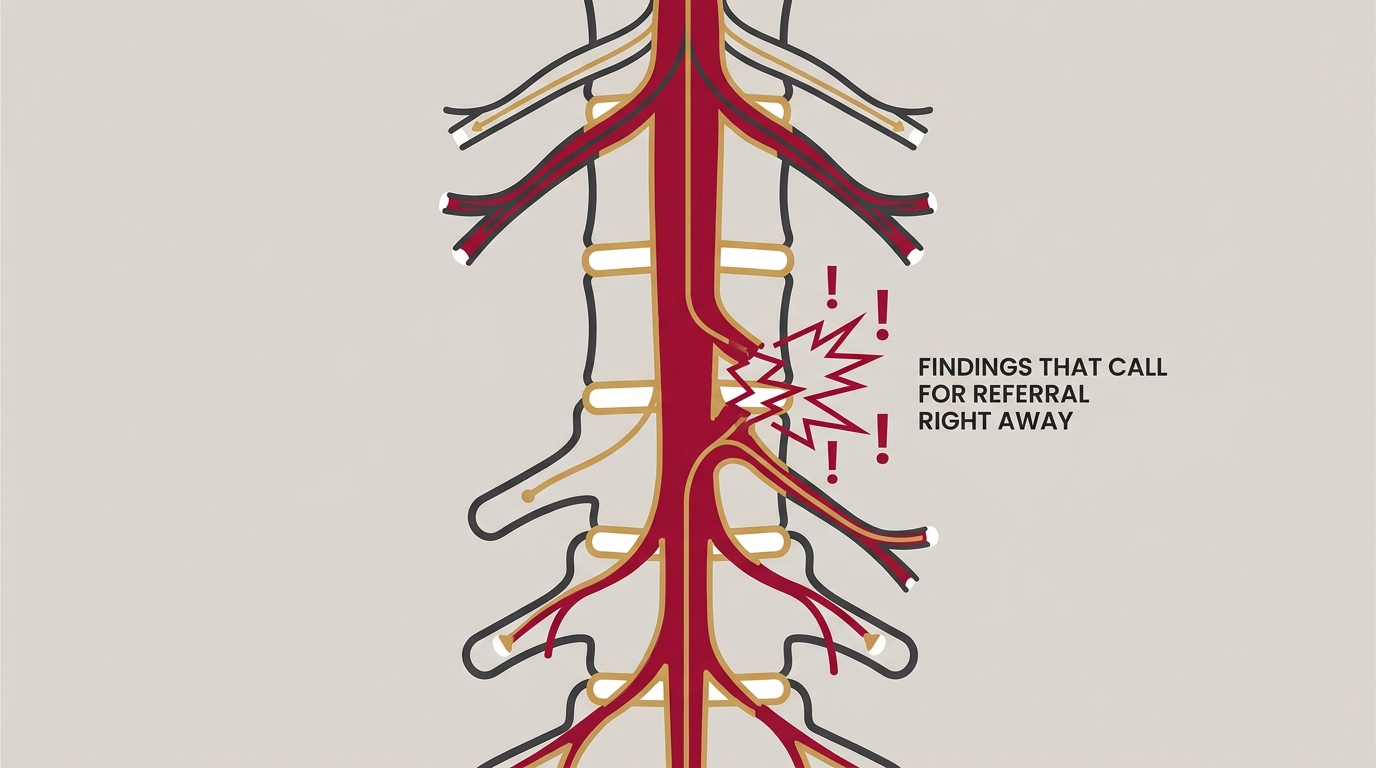
Some findings call for a referral right away. In a pathway from Alberta Health Services, yellow flags need more investigation, shared care with other providers, and other clinical support tools (see Section 7B). Red flags need immediate referral, which means the patient is sent to another provider right away.
A study in Chiropractic & Manual Therapies left out patients suspected of having a serious health problem. That meant cancer, inflammatory diseases (swelling-type diseases), broken bones, or nerve root trouble that needed to be sent to a surgeon.
Aetna's policy says that when medicine or surgery is needed, the chiropractor should send the patient to a medical doctor or an osteopathic doctor, as fits the case.
Some problems sit outside muscles, bones and the spine. The Cleveland Clinic Journal of Medicine says evidence is still scarce to support spinal manipulative therapy for conditions that are not muscle or bone problems. Examples are colic, high blood pressure, asthma, and painful periods not caused by another illness. The National Library of Medicine describes chiropractic as a health profession focused mainly on care without drugs for muscle and bone problems, with emphasis on the spine and related conditions.
I keep this practice focused on spine and nerve care. I don't try to treat every problem for every person. When a problem sits outside that focus, I send you on. For more on that, read When a Chiropractor Should Refer You to an Orthopedic Doctor.
The First Trial of Care and the Reassessment That Follows
At our office, the first visit follows set steps in order. One of those steps is an adjustment. It usually happens the same visit, unless something needs to be referred out first.
A first trial of chiropractic care is usually a group of visits close together, for example 4 to 6 visits over 1 to 2 months. After that comes a re-check. It shows whether the care is working and helps decide whether to keep going or step up care. For more, read Reassessing Care Plans When Pain Does Not Improve: A Complete Guide.
What if care isn't helping you reach your goals for function or pain? Or what if the chiropractor thinks you've stopped getting better? In either case, the chiropractor may order more diagnostic tests. They may also help set up a referral to a specialist when that seems right. This comes from Collaborative musculoskeletal care: The role for chiropractors.
The Journal of Manipulative and Physiological Therapeutics guideline says other clinical methods exist for conditions that don't respond to the more evidence-informed approaches. It calls these patients primary nonresponders. Those other methods give them a chance at better results through alternative and personalized approaches.
The Cleveland Clinic Journal of Medicine reports on clinical prediction rules, which were meant to find the patients most likely to benefit from spinal adjustment. When those rules were re-tested in validation studies, they didn't find those patients. They did no better than chance at predicting who would respond well to treatment.
So I don't run one standard routine on every complaint. I build care around the person in front of me.
I also don't accept that a pain with no known cause is a pain that can't be helped. To me, having no explanation yet is different from having nothing to try. If you've been told nothing can be done, I still look for a personalized option.
What Points Toward Continued Care
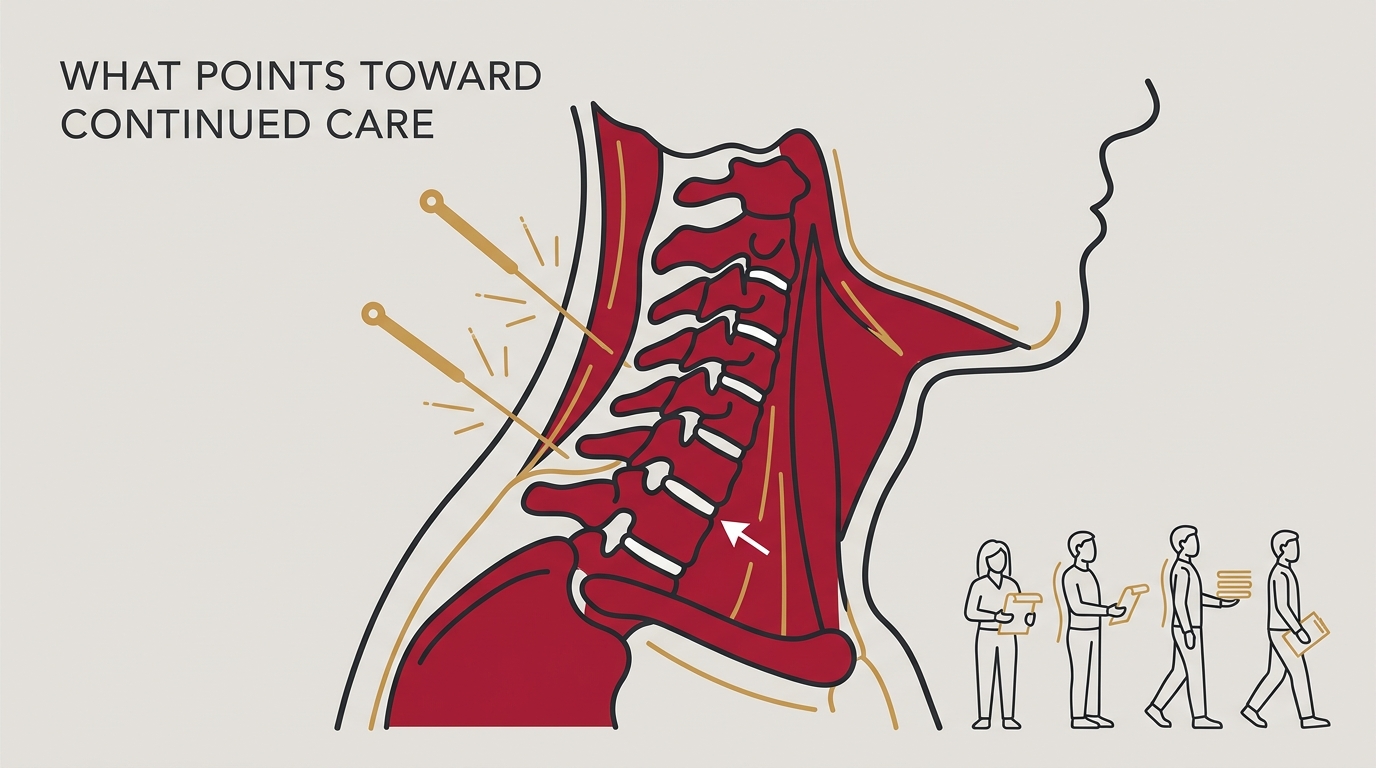
A Norwegian study in Chiropractic & Manual Therapies looked at patients with neck pain. The strongest clinical sign that the chiropractor would recommend continued care 4 weeks after the first treatment was a long time with neck pain. The chiropractors' own characteristics weren't linked to that recommendation.
You can read the study here: Clinical indicators for recommending continued care to patients with neck pain in chiropractic practice: a cohort study.
The number of signs mattered. Among patients with all three clinical indicators, 39% (about 4 in 10) were recommended continued care. With two indicators, it was 25% (1 in 4). With one, it was 10% (1 in 10).
Maintenance care is a traditional chiropractic approach. It's care that keeps going after you've reached the best result you can from a first care plan. That first plan usually lasts 2 to 4 weeks. The 4 weeks in the neck pain study is a different thing: it's the point when continued care was recommended.
Studies of low back pain found that maintenance care was offered to patients who'd had pain episodes before, had pain for a long time, and got better after the first treatment.
The Cleveland Clinic Journal of Medicine says patients with long-lasting or more complex conditions may benefit from supportive treatment after the first trial of care. Even so, helping patients manage symptoms on their own and rely less on the practitioner stays a top priority.
The table below sets out these signs and what each one points to.
| Signal | What it points to |
|---|---|
| All three clinical indicators (neck pain study) | 39% were recommended continued care, vs. 25% with two and 10% with one |
| Long neck pain duration | Strongest clinical indicator for being recommended continued care 4 weeks after the initial treatment |
| Previous pain episodes, long pain duration and improvement after initial treatment (low back pain studies) | Maintenance care is offered to these patients |
| Chronic or more complex condition | May benefit from supportive treatment beyond the initial trial; self-management stays a top priority |
How a Referral Is Handled
A referral gets written down. The notes cover how the decision to refer was made, the talk with you about the referral, the referral itself, and any follow-up. KMC University explains this in When It's Time to Go: Referral Documentation.
Chiropractors can make a diagnosis, says the Cleveland Clinic Journal of Medicine. They can also order or perform imaging and other diagnostic tests, such as nerve and muscle tests, ultrasound of muscles and bones, and lab tests. Because of that, a referring physician or your primary care clinician doesn't need to coordinate treatment decisions for the chiropractor.
How Physicians and Chiropractors Share Patients
Where you start can matter. The Cleveland Clinic Journal of Medicine cites retrospective analyses of large administrative datasets. They report that patients who first see a practitioner who does not prescribe drugs, such as a chiropractor, for back and neck pain are more likely to get care that follows guidelines. That means less use of imaging, drugs, or interventional services. These patients are also less likely to need another specialist referral than patients who first went to other types of practitioners.
So how do physicians and chiropractors actually send patients to each other? One study looked at exactly that: Characteristics of interprofessional collaboration between physicians and chiropractors within Québec multidisciplinary clinics: a mixed-methods study. In its survey of 19 physicians and 23 chiropractors, nearly 70% (about 7 in 10) of the physicians sent patients to chiropractors at least once a month. They did it mainly because of established relationships or patient requests.
The study named several things that help the two groups work together. They were personal experience with chiropractic care, working in the same location, clear referral pathways, and direct ways to communicate. The chiropractors said the strongest enablers were knowing other providers personally and being physically close. They said clinical workload and patients' financial limits were the main barriers.
The study also found that, even though the relationships between the providers were good, working together still relies heavily on informal, relationship-driven contact rather than on structures built into the organizations.
Put those findings side by side and a pattern shows up. In this study, physicians sent patients mainly because of established relationships or patient requests, and chiropractors pointed to patients' money limits as a main barrier. Referrals, in other words, don't run on need alone.
Who Makes These Decisions: The Doctors at Touch of Wellness
We're a practice with more than one doctor. Our Chiropractic Care page explains how the work is done.
- Dr. Karen Hannah, DC is the owner and lead doctor. She earned her Doctor of Chiropractic at Palmer College of Chiropractic in 2009. She also has a post-doctorate acupuncture certification and a Medical Examiner credential.
- Dr. Bill Ellis IX, DC is a Doctor of Chiropractic. He earned his degree at Palmer College in 2011.
- Dr. David Hannah, DC, D.A.C.O. is a Doctor of Chiropractic. He spent 14 years on the Palmer College faculty.
- Dr. Chase Bishop, DC is a Doctor of Chiropractic.
We build your care plan from what you tell us. When an approach isn't producing results, we change it.
The National Board of Chiropractic Examiners says chiropractic physicians are only allowed to practice in states where they're licensed.
Frequently Asked Questions
Will a chiropractor prescribe medication or perform invasive procedures?
No. The chiropractic profession isn't against drug or invasive treatments in principle, according to the Cleveland Clinic Journal of Medicine. Chiropractors simply don't provide them, and you shouldn't expect to get them from a chiropractor.
What happens to my records if I'm referred to another provider?
KMC University's guidance tells chiropractors to send important notes or exam findings from your records, along with any lab or imaging results that are available. That way you do not have to repeat tests that were already done. When you are referred, ask us to send these to your new provider.
Can I come back to chiropractic care after seeing another doctor?
Talk with us about it. A clear plan comes first. KMC University's guidance says a treatment plan sets how often and how long care will go on. It also sets functional goals, ways to measure whether treatment is working, and the recommended services with the reason for each. Bring any imaging you already have, and we will build the plan from what you tell us.
How quickly do patients who respond to chiropractic care usually feel relief?
Quickly. The best evidence available suggests that if you get pain relief from chiropractic care, you get it fast, says the Cleveland Clinic Journal of Medicine. Some signs predict no relief: poor mental health (such as depression, anxiety or fear of movement), poor sleep and tiredness patterns, long-lasting pain, and high pain at the start. Tell us how you feel at each visit so we can see whether care is working.
Book an Evaluation to See Which Path Fits
Whether you stay in care or get referred to another provider, being willing to change course when something isn't working isn't a weakness. It's the sign of a competent provider.
A referral out fits when a problem is outside a chiropractor's scope, or when another provider is better equipped to help. Care can then be shared, or moved over fully when that's appropriate. Continued care fits when your signs and your response point that way.
Our doctors in Morton, Illinois provide chiropractic care for adults with back, neck, disc, joint or nerve pain. If you have a sudden severe headache, numbness or weakness in an arm or leg, trouble speaking or seeing, or loss of bladder or bowel control, call 911 or your doctor right away.
Would you like to Book Appointment and find out which path fits you?
Results may vary.