
At Touch of Wellness Chiropractic, you can pay in many ways: insurance, cash, credit cards, health savings and flexible spending accounts (HSA/FSA), Affirm, payment plans, care plans, pay-in-full courtesy pricing, personal checks, personal injury cases and AutoDebit. You are told what care costs before treatment starts. The Centers for Medicare & Medicaid Services (CMS) says that for people with no health insurance, or who pay on their own ("self-paying"), the rules that began January 1, 2022 require most providers to give a "good faith estimate" of costs before non-emergency care.
Ask for a Good Faith Estimate: Who Gets One and What It Lists
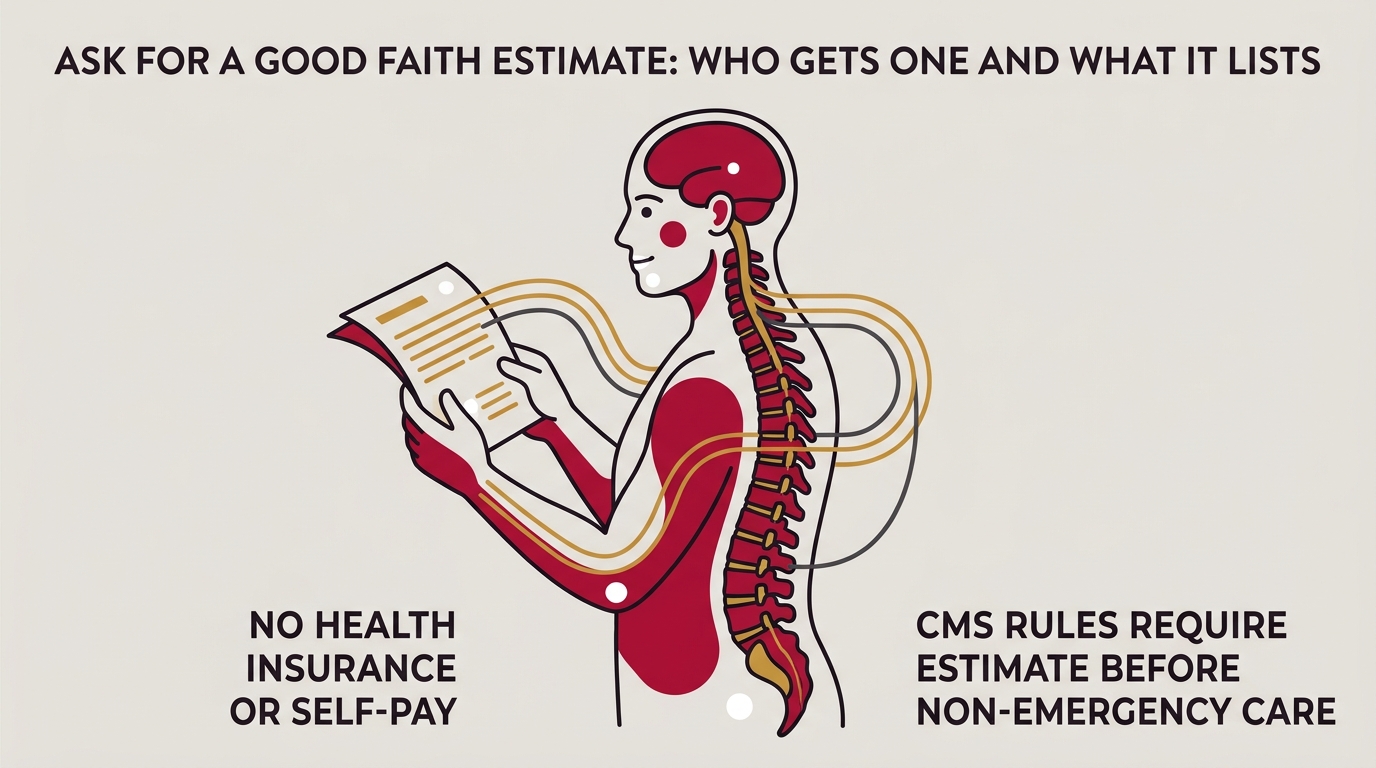
If you have no health insurance, or you pay for care on your own, the Centers for Medicare & Medicaid Services (CMS) says the rules that began January 1, 2022 require most providers to give you a good faith estimate before non-emergency care.
The estimate has to list the costs you can expect for the main item or service. It also has to list any other items or services that would reasonably be expected.
You don't have to book first. The CMS guidance says a provider or facility must also give you this estimate when you ask for it, whether or not you've scheduled the item or service.
That same guidance says the estimate must show three things for each item or service it lists:
- the applicable diagnosis codes
- the expected service codes
- the expected charges
I'd take an honest cost in writing over a kind, vague "don't worry about it" any day. I'd rather hand you a number you can read and check, even when it isn't the one you hoped for, than comfort that explains nothing. To see how to ask for a cost breakdown for this kind of care, read How to Request a Courtesy Pricing Breakdown for Neuropathy Care. You can also read the rules in the CMS source, Guidance: Good Faith Estimate and Patient-Provider Dispute Resolution.
What a Good Faith Estimate Leaves Out
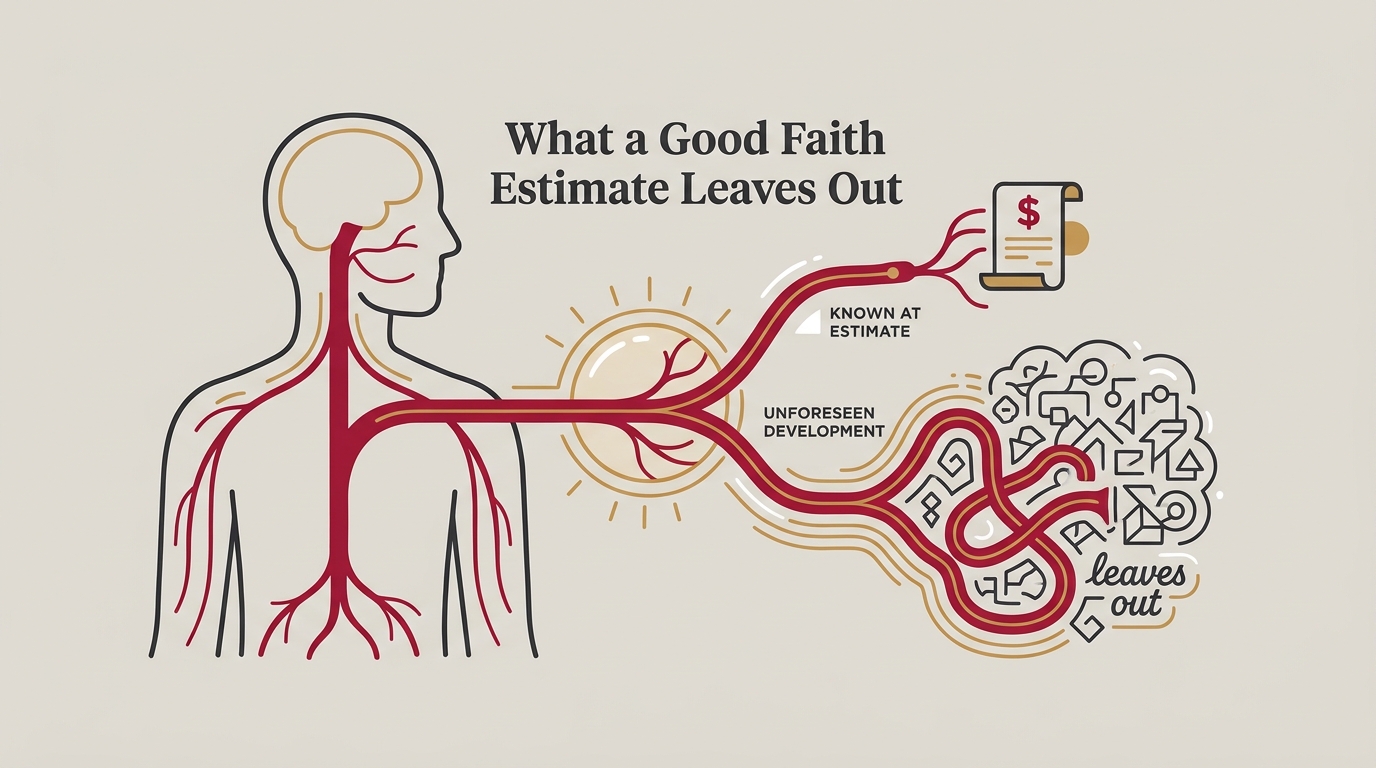
A good faith estimate is based on what was known when it was made. CMS says it must state this. So it will not include costs for unexpected items or services that could come up from unforeseen events and were not reasonably expected.
CMS also describes items or services that are expected to be given before or after the period of care for the main item or service. Its example is physical therapy after knee surgery. So ask what comes before and after the main care.
Keep any estimate you get in a safe place. You can compare it with bills that come later, in case you want to dispute a bill through the Patient-Provider Dispute Resolution process.
For what a longer plan can hold, read What a Multi-Week Nerve Care Plan Actually Includes for the Cost. To see a sample estimate, open the CMS Sample Good Faith Estimate for Uninsured (or Self-Pay) Individuals.
Ask How You Can Pay at Touch of Wellness Chiropractic in Morton
You can pay in many ways here. The list includes insurance, cash, credit cards, health savings and flexible spending accounts, Affirm, payment plans, care plans, pay-in-full courtesy pricing, personal checks, personal injury cases and AutoDebit.
Affirm is a payment service that helps you pay by financing. AutoDebit is a payment service for recurring payments.
You're told what care costs before treatment starts.
I don't run one routine on everyone, and I don't do that with payment either. I won't treat you like a unit on a line. I fit the way you pay to you, so ask which option works for your life.
For more on costs and coverage, read Neuropathy Care Costs and Coverage in Tazewell County: A Guide. To learn about the care itself, see our Neuropathy Care page. To see how the work is done, visit Chiropractic Care.
Ask About Medical Credit Cards and Financing Before You Sign

The Consumer Financial Protection Bureau (CFPB) says medical credit cards and installment loans have largely replaced the low- or no-cost informal payment plans that medical providers offered patients directly. An installment loan is a loan you pay back in set payments over time.
With deferred interest, the interest is put off for a set time. If you still owe a balance after that time ends, you are charged all the interest that would have built up since your original purchase date. The CFPB says that from 2018 to 2020, people used medical credit cards or loans with deferred interest periods to pay for almost $23 billion in health care costs, across more than 17 million medical purchases. In the same years, people paid $1 billion in deferred interest on these health care charges. The $23 billion is the care paid for with these cards and loans; the $1 billion is the deferred interest people paid.
Where the loan starts matters too. The CFPB says installment loans that start with a medical provider tend to have no interest or low interest. Loans from financing companies tend to charge the going market interest rate or more, depending on how risky the patient's credit is.
The CFPB also says products with more than four payments, or that charge interest, fall under the Truth in Lending Act and Regulation Z. Those are federal rules.
Now look at where the offers show up. The CFPB says patients are typically offered these products in a medical provider's office. That happens even when their insurance may cover the procedure, or when they qualify for a hospital's reduced-cost or no-cost financial assistance program.
Patients who should qualify for reduced-cost or free care through a financial assistance program or their insurance plan may be signed up for a medical card or loan instead. The CFPB adds that when providers offer these products, patients seem not to fully understand the terms. Sometimes they end up with credit they cannot afford.
I name a money push for what it is. When a financing offer lands in front of you even though coverage may exist, I won't call that medical need. I call it a money matter, and I say so out loud.
These five questions can help you sort out a financing offer.
| Question to ask | Why it matters |
|---|---|
| Is the interest deferred? | A balance left after the set period is charged all the interest that would have built up since the original purchase date |
| Who issues the loan? | Installment loans that start with a medical provider tend to have zero or low interest; loans through financing companies tend to charge the market rate or above, depending on credit risk |
| How many payments, and is there interest? | Products with more than four payments or interest charges are subject to the Truth in Lending Act (TILA) and Regulation Z |
| Do I qualify for reduced or free care first? | Patients who should be eligible for reduced or free care may be signed up for a card or loan instead |
| Do I understand every term? | Patients offered these products by providers appear not to fully understand the terms and sometimes end up with credit they cannot afford |
You can read more in the CFPB pages Medical Credit Cards and Financing Plans, Medical Credit Cards and Financing Plans (full report), and CFPB Report Highlights Costly Credit Cards and Loans Pushed on Patients.
Frequently Asked Questions
Who is not eligible for a good faith estimate?
People enrolled in federal health care programs are not eligible. CMS guidance (CCIIO) says this is because those programs have other protections against surprise bills. If you are in one of those programs, ask about those protections instead.
Does a good faith estimate include other providers' charges?
Not always. CMS says the federal government is not enforcing the requirement for co-providers and co-facilities right now. So your estimate may not have their information. Ask if other providers will bill you, and ask what they will charge.
How does a medical credit card's interest rate compare with a regular card?
The CFPB puts the interest rate on the typical medical credit card at 26.99 percent. The average rate for all general purpose credit cards is about 16 percent right now. One number is the typical medical card, and the other is the average of all general purpose cards. Check the annual percentage rate (APR) before you sign.
What counts as a surprise bill?
CMS says surprise billing happens when an out-of-network provider or facility, one outside your insurance network, unexpectedly bills you for the uncovered balance remaining on the bill. Ask about your network before care starts.
Does just asking about cost count as requesting an estimate?
With a convening provider or convening facility, yes. CMS says they must treat any talk or question about the possible costs of items or services being considered as a request for a good faith estimate. So you can simply ask about cost, and then keep what you receive.
Get Your Own Cost Breakdown Before You Start
Asking these questions first is normal. At Touch of Wellness Chiropractic in Morton, our work includes Chiropractic Care and Neuropathy Care. You're told what care costs before treatment starts.
If you have a sudden severe headache, numbness or weakness in an arm or leg, trouble speaking or seeing, or loss of bladder or bowel control, call 911 or your doctor right away.
Ready to get your own cost breakdown before you start a nerve care plan in Morton? Book Appointment