
The American Association of Neuromuscular and Electrodiagnostic Medicine (AANEM) says both electromyography (EMG) tests and nerve conduction studies (NCS) are usually required for a clinical diagnosis of peripheral nervous system disorders, and doing one test does not remove the need for the other. UnitedHealthcare says nerve conduction studies are proven and medically necessary when done together with needle EMG, for any of its listed known or suspected disorders. Aetna considers exams and nerve conduction studies done with automated devices, such as NC-stat DPNCheck and the Brevio NCS monitor, experimental or unproven. Chiropractor Billers says Medicare does not cover chiropractic exams, x-rays, diagnostic tests, massage therapy, electrical stimulation, ultrasound, manual therapy (CPT 97140), therapeutic exercises, or any other service performed by a chiropractor, regardless of medical necessity.
What a Standard Nerve Conduction Exam Includes
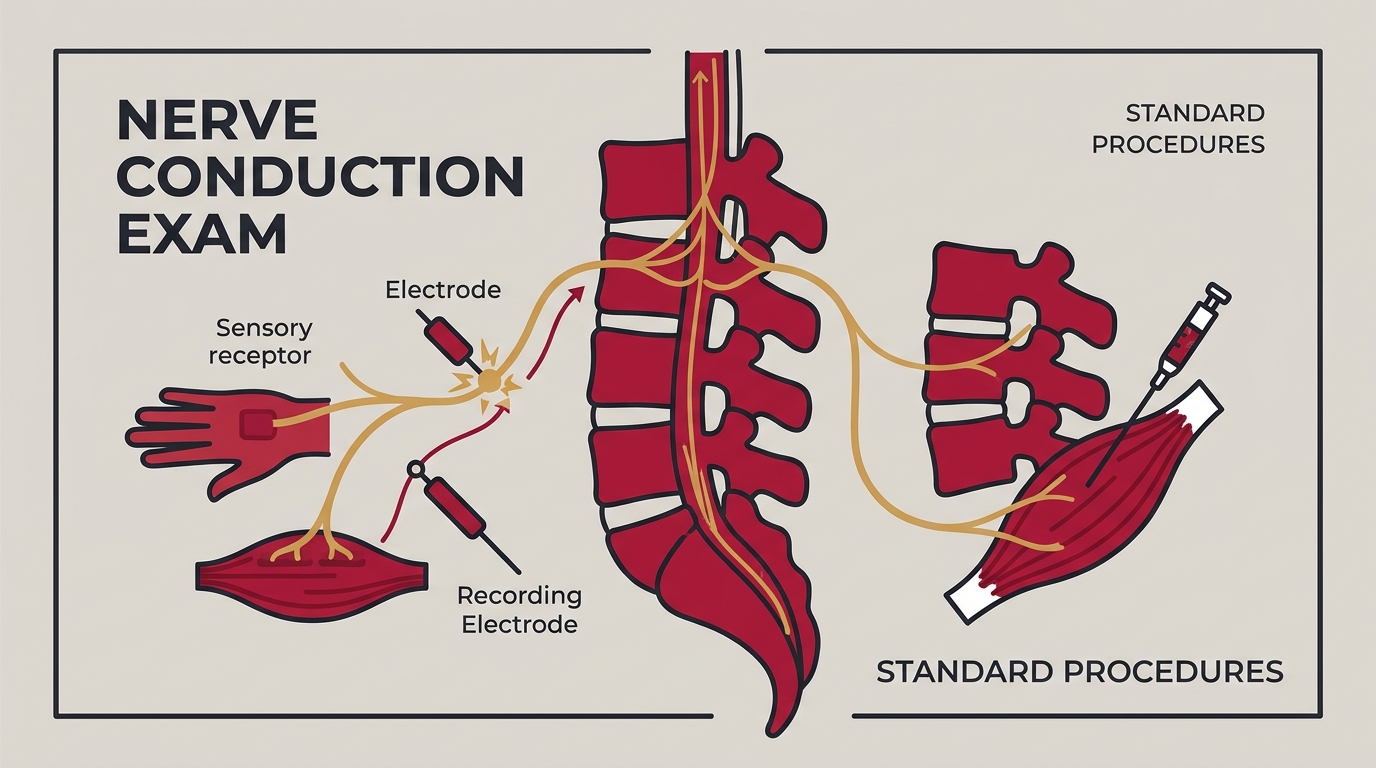
A standard exam has two parts. One part is the nerve conduction study, or NCS. The other part is the needle electromyography test, or EMG. The AANEM says both are usually required for a clinical diagnosis of peripheral nervous system disorders. It also says doing one test does not remove the need for the other.
Billing has its own rules. Starting in 2012, three new billing codes were created to report electromyography studies done on the same day as nerve conduction testing. They are 95885, 95886, and 95887. When you report any of them, report it together with codes 95907 through 95913.
Studies are counted in a set way. Each type of nerve conduction study counts only once, even when several spots on the same nerve are stimulated or recorded. You add up those separate tests to decide which billing code to use.
The header for codes 95907 through 95913 adds two points you should know. The number of nerves tested should be the minimum needed to address the clinical issue. And standardized screening tests aren't equivalent to carefully designed nerve conduction studies, because they don't involve the same physician work.
A "complete" arm or leg has its own rule. To report a needle electromyography code for a complete arm or leg, you must evaluate at least 5 muscles served by 3 nerves, or 4 spinal levels. The 3 nerves have to be main nerves, such as radial, ulnar, median, tibial, peroneal, or femoral, and not sub branches. All of this is in the AANEM's Model Policy for Nerve Conduction Studies and Needle Electromyography.
For the cost side, see Neuropathy Care Costs and Coverage in Tazewell County: A Guide.
Which Nerve Tests the Big Insurers Cover
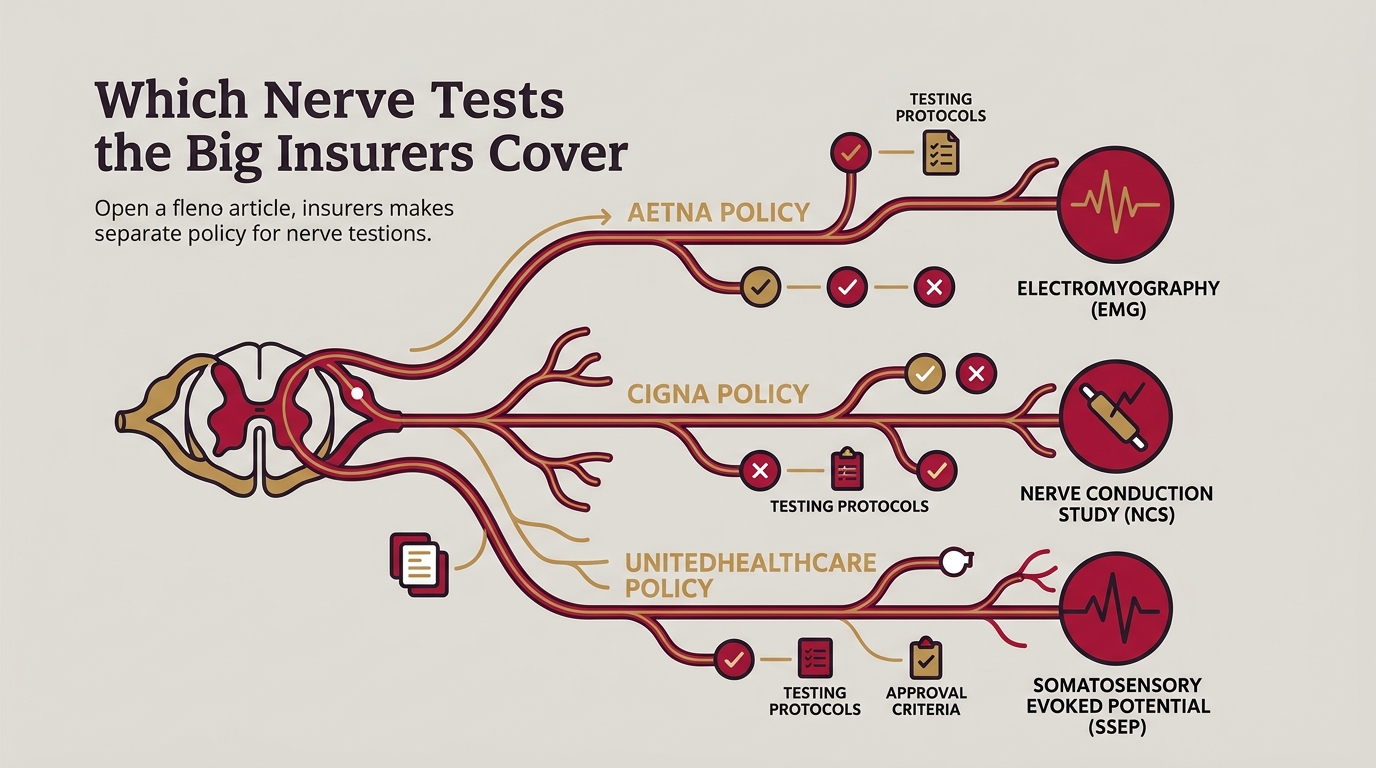
Aetna, Cigna and UnitedHealthcare each write their own policy on nerve testing. Here are the three you'll want to have handy: Aetna's Electrodiagnostic Testing - Clinical Policy Bulletin 0502, Cigna's Electrodiagnostic Testing (EMG/NCV) (CPG 129), and UnitedHealthcare's Neurophysiologic Testing and Monitoring.
Aetna's Rules for Nerve Conduction Studies
Aetna's policy says the wording for billing codes 95907 to 95913 describes one or more nerve conduction studies. For coding, a single conduction study means one of three things: a sensory conduction test, a motor conduction test (with or without an F wave test), or an H-reflex test.
Each line on Aetna's list of nerves is a different nerve, and you should bill each one as one unit. Aetna says it's inappropriate to bill more than one unit for "inching." That's studying the same nerve by moving the stimulating electrode closer to the recording electrode, like the ulnar nerve at the elbow.
Aetna also says that, unless an approvable exception is documented, it can't approve nerve conduction studies without an approvable electromyography request.
Cigna's Rules for Nerve Conduction Studies
Cigna considers nerve conduction velocity testing and needle electromyography testing medically necessary when they're done and interpreted at the same time. That holds for any of the indications on its list.
Cigna's policy also sorts codes by how many studies are done. Code 95907 is for 1 to 2 studies, code 95908 is for 3 to 4 studies, and code 95909 is for 5 to 6 studies.
UnitedHealthcare's Rules for Nerve Conduction Studies
UnitedHealthcare says nerve conduction studies are proven and medically necessary when they're done together with needle electromyography. That covers studies with or without standard late responses, such as the F-wave and H-reflex tests, and it covers neuromuscular junction testing too. It applies for any of the known or suspected disorders on its list.
Which Screening and Automated Nerve Tests Insurers Exclude
Some tests get labeled unproven, and others won't be paid for on their own. Here's where each payer draws the line.
Aetna considers nerve conduction studies experimental, investigational, or unproven for screening neuropathy when symptoms and physical findings are mild, mainly sensory, and have a known cause. It also puts nerve conduction studies used to screen for polyneuropathy (damage to many nerves) from diabetes or end-stage renal disease (kidney failure) on that list.
Aetna also considers exams and nerve conduction studies done with automated devices experimental or unproven. Its list names the ADVANCE NCS/EMG System, Brevio NCS monitor, Cadwell Sierra, NC-stat DPNCheck, NC-stat monitor, Neural Scan - Axon II, VT3000, XLTEK Neuropath, and other automated devices. Cigna takes a similar view: it doesn't consider automated noninvasive nerve conduction testing medically necessary, and it names the NC-stat System and the Brevio nerve conduction monitoring system as examples.
UnitedHealthcare treats non-invasive automatic, portable, or automated point-of-care nerve conduction monitoring systems as unproven and not medically necessary. That applies to systems that test only distal motor latencies and conduction velocities, which are the timing and speed of signals in the nerve. It treats quantitative sensory testing the same way, including monofilament testing, pressure-specified sensory testing, computer assisted sensory examinations, and current perception threshold testing. It also describes paraspinal electromyography as a type of surface electromyography used to evaluate back pain, and it lists surface electromyography as unproven and not medically necessary.
The AANEM policy says an exam with a portable hand-held device that cannot show and analyze waveforms in real time is included in the evaluation and management (E/M) service. It will not be paid separately. The AANEM policy also says the Current Perception Threshold/Sensory Nerve Conduction Threshold Test (sNCT) is investigational and not covered. The instructions for billing code 95905 say to report it once per limb. They say not to report it with codes 95885, 95886, or 95907 through 95913.
The table below lists these tests, how each one is treated, and who says so.
| Test | How it is treated | Who says so |
|---|---|---|
| Exams and NCS using automated devices such as NC-stat DPNCheck | Experimental or unproven | Aetna |
| Automated noninvasive nerve conduction testing | Not medically necessary | Cigna |
| Automated point-of-care systems testing only distal motor latencies and conduction velocities | Unproven and not medically necessary | UnitedHealthcare |
| Quantitative sensory testing, including monofilament | Unproven and not medically necessary | UnitedHealthcare |
| Current Perception Threshold / sNCT testing | Investigational and not covered | AANEM |
| Surface EMG, including paraspinal EMG | Unproven and not medically necessary | UnitedHealthcare |
| NCS to screen for polyneuropathy of diabetes or end-stage renal disease | Experimental or unproven | Aetna |
If a claim for one of these tests gets turned down, read What to Do If Insurance Denies Your Neuropathy Exam Claim.
Who Performs and Interprets These Tests
Insurers and specialty groups don't only care about which tests get done. They also have a say in who should do them and who should read the results.
A model policy from the American Association of Neuromuscular and Electrodiagnostic Medicine (AANEM) says non-physician providers don't have the appropriate training and knowledge to perform and interpret electromyography (EMG) studies, or to interpret nerve conduction studies (NCS). It names physical therapists, chiropractors, physician assistants, and others. You can read it yourself in the AANEM's Model Policy for Nerve Conduction Studies and Needle Electromyography.
UnitedHealthcare says the AANEM recommends that a needle electromyography exam must be performed by a physician specially trained in electrodiagnostic medicine.
Cigna adds two rules, one about timing and one about supervision. It doesn't consider nerve conduction testing medically necessary when the interpretation is delayed and not completed at the time of testing. It also doesn't consider nerve conduction velocity testing medically necessary when it's done without the direct supervision of a trained electrodiagnostic physician.
How Often Insurers Pay for Repeat Testing
Aetna considers two electrodiagnostic tests per year medically necessary. That's per diagnosis, and only when the criteria in Section I of its policy have been met. Aetna also says you must send in a full electrodiagnostic report. It should include all the electrodiagnostic tests that were done, along with data summary tables.
The American Association of Neuromuscular and Electrodiagnostic Medicine (AANEM) has a table of testing numbers. It calls the table a tool to spot outlier trends and prevent abuse and overuse. It's not an absolute maximum, and it shouldn't be used to automatically deny payment for studies above the maximum.
A small number of cases need more testing than the table lists. The AANEM estimates that's about 10% of cases, or about 1 in 10. In those cases, the physician should be able to give extra documentation to justify the added testing.
The numbers don't simply stack up, either. Polyneuropathy (damage to many nerves) allows 10 studies, and lumbar radiculopathy (a pinched nerve root in the lower back) allows 7. When both diagnoses are being considered, you don't add them together to get 17.
Sometimes it may be necessary to test some muscles or nerves in the limb on the other side, which at times has no symptoms. This helps better define the diagnosis. The AANEM says it is appropriate to bill for this extra testing, and the table already accounts for it. The full text is in the AANEM's Model Policy for Nerve Conduction Studies and Needle Electromyography.
I read every yearly limit and overuse table as a payment rule, not a medical verdict. Paying for volume pushes toward quantity over quality, and I name that money pressure out loud instead of letting it pass as clinical judgment.
What Medicare Pays For When a Chiropractor Is Involved
Chiropractor Billers says Medicare doesn't cover chiropractic exams, x-rays, diagnostic tests, massage therapy, electrical stimulation, ultrasound, manual therapy (Current Procedural Terminology code 97140), therapeutic exercises, or any other service performed by a chiropractor, regardless of medical necessity.
Medicare itself says it doesn't cover other services or tests a chiropractor orders. That includes X-rays, massage therapy, and acupuncture.
If you want the nerve test billing rules, see the Centers for Medicare & Medicaid Services page, Billing and Coding: Nerve Conduction Studies and Electromyography (A57668).
Why Your Own Plan Document Decides What Gets Billed
UnitedHealthcare says that listing a code in its policy does not imply that the service the code describes is a covered or non-covered health service.
Cigna says claims sent in for services that do not come with covered codes under its policy will be denied as not covered. Its policy is Electrodiagnostic Testing (EMG/NCV) (CPG 129).
To check your own plan before a visit, start with Understanding Insurance Verification Before a Neuropathy Consultation. It lays out how.
What the First Exam Here Includes, and Why No X-Rays Are Taken
Your first visit starts with a consultation. A hands-on evaluation is part of the visit too. We never take X-rays or other imaging here. Bring any imaging you already have, such as X-rays or MRIs (magnetic resonance imaging scans), to your first visit.
The American Chiropractic Association guideline doesn't recommend routine imaging or other diagnostic tests for patients with non-specific low back pain. It says imaging is indicated when there are severe and/or progressing nerve-function problems (neurologic deficits). It also says imaging is indicated when the history or physical exam raises suspicion of a serious underlying problem.
I won't run everyone through one fixed routine, because that treats people like units on a line. I build your first exam on what you tell me.
You can read about our Neuropathy Care and how the work is done on our Chiropractic Care page.
Frequently Asked Questions
Does insurance cover a nerve conduction study without a needle EMG?
It depends on your plan. Cigna doesn't consider nerve conduction velocity testing medically necessary without needle electromyography. The exceptions are follow-up testing, current use of blood thinners (anticoagulants), the presence of swelling called lymphedema, or carpal tunnel syndrome.
UnitedHealthcare's policy covers studies done without needle electromyography for people who have a listed known or suspected disorder along with a listed clinical indication. Ask your plan which rule applies to you before you book the test.
Does an abnormal monofilament or sensory test prove nerve damage?
No. UnitedHealthcare notes that abnormal quantitative sensory testing results are not specific to any particular neuropathy. They also do not independently confirm nerve damage. If you get an abnormal result, ask your doctor what other tests are needed.
What can I do if my plan denies a nerve test claim?
You can appeal. If your health plan denies coverage of a test, such as a body scan, you and your doctor can appeal that decision to the plan. If the plan still refuses to cover it, you can appeal to an external reviewer.
Do routine or repeat spinal X-rays help?
Not when there are no red flags, which are warning signs of a serious problem. One review found no evidence that routine or repeat spine X-rays, used to check how the spine works or how it's built, lead to better health results or help patients in that case.
Research has also concluded there's strong evidence linking several possible harms to routine, repeated X-rays. Those include changed treatment steps, overdiagnosis, radiation exposure, and unnecessary costs.
When would a chiropractor use X-rays at all?
When signs or symptoms point to a possibly serious underlying problem, called red flags, chiropractors can use X-rays to help with their diagnosis.
Bring Your Imaging and Your Questions
A standard nerve conduction study done with needle EMG is the test UnitedHealthcare calls proven and medically necessary for its listed disorders. Aetna calls exams and nerve conduction studies done with automated devices experimental or unproven. Our rule on imaging is simple: we don't take X-rays here, so bring any X-rays or MRIs you already have to your first visit. Touch of Wellness Chiropractic in Morton, IL provides chiropractic care, Neuropathy Care, Shockwave Therapy, Acupuncture, Cold Laser Therapy, Massage Therapy and DOT Physicals. Would you like to Book Appointment and talk with our doctors about your pain?
Results may vary.