
The Medicare-approved amount for a chiropractic spinal manipulation is typically $30 to $50 per visit, depending on where you live, so your 20% coinsurance is roughly $6 to $10 per adjustment (MedicareFAQ.com). In 2026, Medicare Part D puts a $2,100 yearly cap on what you pay out of pocket for prescription drugs. Once you reach it, your plan pays 100% of your covered medication costs for the rest of the year (National Council on Aging). A review in Chiropractic & Manual Therapies found that patients with spine-related muscle and bone pain who saw a chiropractor as their first provider had much less follow-up care and fewer related costs. That led to lower overall health care costs compared with medical management.
What Painful Diabetic Neuropathy Adds to Yearly Health Costs

A study of insurance claims looked at people with diabetes. It compared people with diabetic nerve damage (neuropathy) to people with none. On average, yearly costs from all causes ran about $3,100 ($3,093) higher for nerve damage without pain. They ran about $9,300 ($9,349) higher for painful nerve damage, and about $20,900 ($20,887) higher for severe painful nerve damage. Those are costs from all causes, not just the nerve damage.
Those figures are increases over the no-neuropathy group. The table below gives each group's mean total all-cause cost, with its standard deviation, which shows how spread out costs were within the group.
| Patient group | Mean total all-cause cost | Standard deviation |
|---|---|---|
| No neuropathy | $13,629 | $21,504 |
| Neuropathy without pain | $16,722 | $23,961 |
| Painful neuropathy | $22,978 | $27,979 |
| Severe painful neuropathy | $34,516 | $34,244 |
The study says these differences were statistically significant (p less than 0.0001). That means they were very unlikely to be due to chance. For painful and severe painful nerve damage, more than half of the costs went to prescriptions and to hospital stays where the patient stayed overnight.
These numbers are not copays alone. The study counted the sum of payer and patient out-of-pocket costs, which included deductibles, copayments and coinsurance. Office visits increased directly with severity, from a mean of 9.8 visits per patient per year with no diabetic nerve damage to 16.3 with severe painful nerve damage.
If you want to know what care costs and what insurance covers near you, read Neuropathy Care Costs and Coverage in Tazewell County: A Guide. The study is Healthcare costs and medical utilization patterns associated with painful and severe painful diabetic peripheral neuropathy.
How Medicare Part D Copays, Deductibles and the Cap Work in 2026
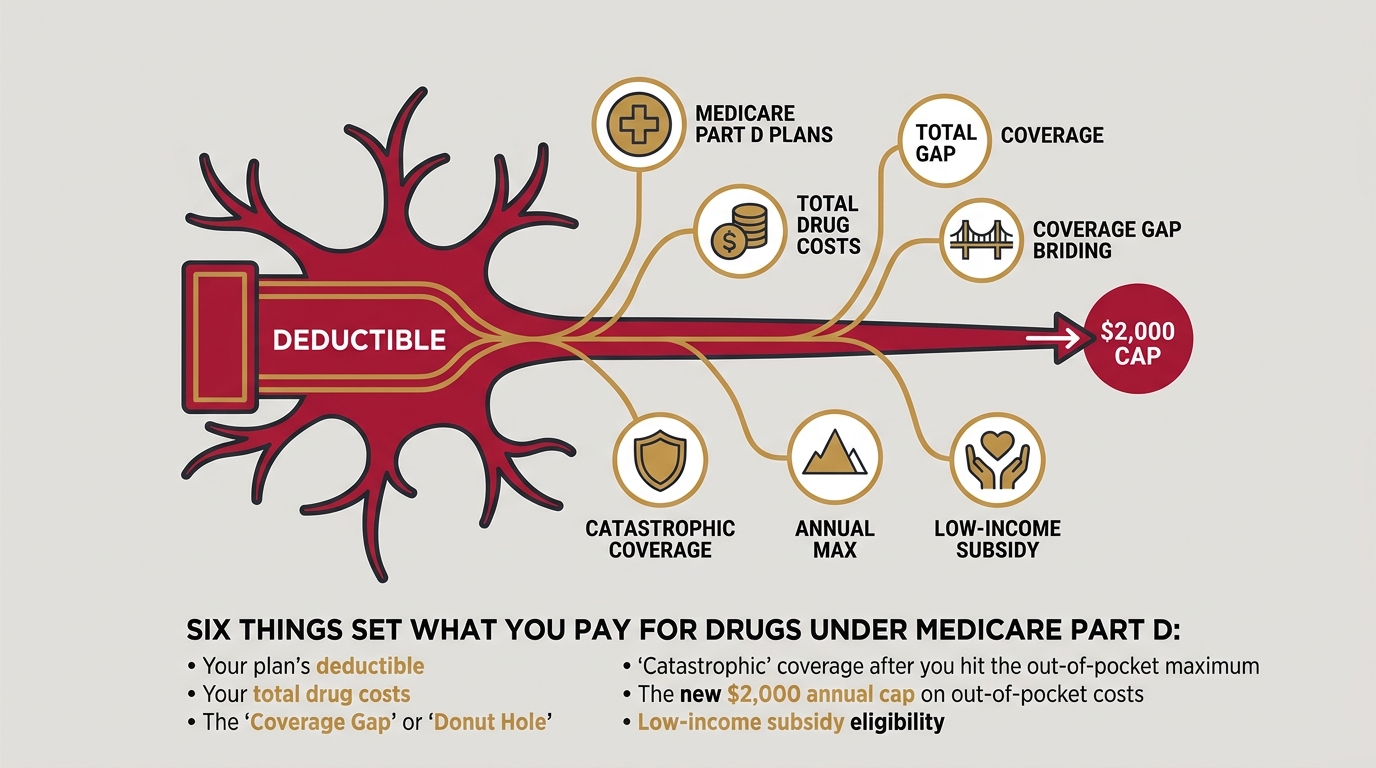
Six things set what you pay for drugs under Medicare Part D:
- Premium: Premiums are different from plan to plan. The average estimated premium in 2026 is $34.50.
- Deductible: The most a plan can charge as a deductible in 2026 is $615. Some plans have a $0 deductible and pay for your prescriptions right away.
- Copay: A copay is a set dollar amount you pay for a prescription. For example, you might pay $5 for a generic drug, $25 for a "preferred" brand name drug, and $40 for a non-preferred brand name drug.
- Coinsurance: This is a percentage of the drug's price. Plans typically use it for drugs in higher tiers, like tier 4 and tier 5. If your prescription costs $350 and your coinsurance is 25%, you pay $87.50.
- Tiers: Each tier has its own copay or coinsurance amount. Your drugs may be covered by all the plans in your area, but each plan may put them on different tiers with different copay amounts. The same drug can cost you different amounts under different plans.
- Yearly cap: In 2026, Part D puts a $2,100 yearly cap on what you pay out of pocket for prescription drugs. Once you reach it, your plan pays 100% of your covered medication costs for the rest of the year.
The National Council on Aging walks through these costs in How Much Does Medicare Part D Cost in 2026?. AARP covers the 2026 changes in 3 Big Medicare Prescription Drug Changes Coming in 2026.
How Three Nerve Pain Drugs Compared on Cost and Results in One Study

The Endocrine claims study above counted these as medicines for nerve-related pain: amitriptyline, capsaicin, duloxetine, gabapentin, nortriptyline, opioids, pregabalin, sodium valproate anticonvulsants (seizure medicines) and venlafaxine antidepressants.
A study presented at ISPOR compared gabapentin, pregabalin and duloxetine for painful diabetic nerve damage. The table below shows each drug's average treatment cost and how often treatment worked in that study.
| Drug | Average cost | Treatment success |
|---|---|---|
| Gabapentin | $4.64 ±$1.25 | 63% |
| Pregabalin | $26.20 ±$5.30 | 70% |
| Duloxetine | $7.23 ±$2.10 | 35% (lowest) |
Gabapentin had the lowest average treatment cost, and it worked for 63% of patients. Pregabalin worked better, at 70%, but it cost much more. Duloxetine had moderate costs but the lowest effectiveness of the three, at 35%.
That 35% means most people on duloxetine in this study did not reach treatment success. A treatment that isn't working for you isn't a bargain, whatever it costs. If you aren't responding, that's the signal to change course.
No drug in this study reached every patient. I don't run one standard routine for every complaint. I haven't seen any single approach work for every patient, so I fit the care to the person in front of me.
To see what staying on a drug costs over time, read The True Long-Term Cost of Staying on Nerve Pain Medication. The study is Cost-Effectiveness of Gabapentin, Pregabalin, and Duloxetine in Painful Diabetic Neuropathy.
What a Medicare-Covered Chiropractic Visit Costs
Once you've met the 2026 Part B deductible of $283, Medicare pays 80% of the Medicare-approved amount. You pay the other 20% as coinsurance.
MedicareFAQ.com says the Medicare-approved amount for a chiropractic spinal manipulation is typically $30 to $50 per visit, depending on where you live. Your 20% share comes to roughly $6 to $10 per adjustment.
At Touch of Wellness Chiropractic, we tell you what care costs before treatment starts. If you want to see what a longer plan holds, read What a Multi-Week Nerve Care Plan Actually Includes for the Cost. You can also learn about our Neuropathy Care. And our Chiropractic Care page explains how the work is done.
If you have a sudden severe headache, numbness or weakness in an arm or leg, trouble speaking or seeing, or loss of bladder or bowel control, call 911 or your doctor right away.
How Seeing a Chiropractor First Relates to Downstream Costs
A systematic review in Chiropractic & Manual Therapies compared the cost of chiropractic care with medical management for adults with spine-related muscle and bone pain.
Spinal pain patients who saw a chiropractor as their first provider needed fewer opioid prescriptions, surgeries, hospital stays, emergency department visits, referrals to other doctors and injection procedures. They also had much less follow-up care and fewer related costs. That led to lower overall health care costs compared with medical management.
Chiropractic care guidelines agree with the American College of Physicians' recommendations for initial management of low back pain using treatment that does not use drugs.
The Oregon Department of Consumer and Business Services reprinted the review. Ten studies found that care from a Doctor of Chiropractic (DC) had lower overall costs. No studies found that DC care had higher overall costs.
Two of those studies found that chiropractic office costs were higher only when referral costs were left out of the math. Once referral costs were counted, chiropractic office visit costs did not differ significantly from medical care costs.
The authors point out that most of the studies they included are cohort studies. Those can only show links between things. They can't prove that one thing causes another, and they're a lower level of evidence than randomized controlled trials.
Want to read it yourself? Here's the review: Cost of chiropractic versus medical management of adults with spine-related musculoskeletal pain: a systematic review. The Oregon reprint is Farabaugh et al. 2024 (Oregon Medical Advisory Committee packet).
How Early Chiropractic Care Relates to Opioid Fills
In a study of Medicare patients with spinal pain, the adjusted risk of filling an opioid prescription within 365 days of the first visit was 56% lower for people who got chiropractic care than for people who did not.
The hazard ratio was 0.44, which means their risk was 0.44 times that of people who did not get chiropractic care. The 95% confidence interval, the range the true number likely falls in, was 0.40 to 0.49.
Timing mattered. Among people who got chiropractic care early, the adjusted risk of filling an opioid prescription was 62% lower than for people who did not get it. The hazard ratio was 0.38, and the 95% confidence interval was 0.34 to 0.42.
For people whose chiropractic care was delayed or late, the study found no statistically significant difference in opioid fills compared with people who did not get chiropractic care.
Opioid pain medicines are still widely prescribed for spinal pain. That's true even though current evidence-based clinical guidelines name treatments without drugs as the preferred first choice.
You can read the study here: Association between chiropractic care and use of prescription opioids among older Medicare beneficiaries with spinal pain.
Frequently Asked Questions
Do my copays count toward the Part D out-of-pocket cap?
Yes. The National Council on Aging says your true out-of-pocket costs are the money you paid for covered drugs. That includes your copays and the drug costs you paid to meet your deductible.
How common is it to skip filling a prescription because of cost?
More common than you might think. In one AARP survey, almost half of the people asked said they had not filled a prescription because of its cost, or knew someone who had not.
Is gabapentin or pregabalin the better value for nerve pain?
In the study presented at ISPOR (the International Society for Pharmacoeconomics and Outcomes Research), gabapentin was the best-value first choice of medicine for painful diabetic nerve damage, especially in the middle range of willingness-to-pay. Pregabalin was a workable alternative when people are willing to pay more. Duloxetine was not recommended as a main choice because its value for the money was not good enough.
Does starting with a chiropractor mean fewer imaging tests?
In the Oregon reprint of the Chiropractic & Manual Therapies review, fifteen studies found that scans to look inside the body were used less with care from a Doctor of Chiropractic (DC). That was most true for advanced imaging, such as magnetic resonance imaging (MRI) scans.
We don't take X-rays here. Bring any imaging you already have, such as X-rays or MRIs, to your first visit.
Do diabetes complications raise what a health plan spends each year?
Yes. The Endocrine study cites an earlier look back at insurance claims. Patients with diabetes alone cost their health plan about $6,600 ($6,632) a year in total medical costs.
Patients with diabetes complications, including painful diabetic nerve damage, had much higher yearly costs, from about $12,500 ($12,492) to about $30,700 ($30,655).
Compare Your Costs, Then Build a Plan That Fits You
Under Medicare, the approved amount for a chiropractic adjustment of the spine is typically $30 to $50 per visit, so your 20% share is roughly $6 to $10 per adjustment. In 2026, Part D caps what you pay out of pocket for prescription drugs at $2,100 a year. After you hit that limit, your plan pays 100% of your covered medication costs for the rest of the year.
Patients with spine-related muscle and bone pain who saw a chiropractor first had much less follow-up care and fewer related costs. That led to lower overall health care costs compared with medical management.
I don't run people through one fixed routine like units on a line. I build each plan around the patient in front of me. At Touch of Wellness Chiropractic in Morton, our doctors provide Chiropractic Care and Neuropathy Care, along with Shockwave Therapy, Cold Laser Therapy and Acupuncture.
Ready to hear what your care costs before treatment starts and get a plan built for you? Book Appointment
Results may vary.