
In the past, when CMS (the federal agency that runs Medicare) decided what to cover, it took "reasonable and necessary" to mean that an item or service is safe, works, and is not experimental. Under paragraph (1)(A) of a Social Security Act rule, no payment may be made under Medicare Part A or Part B for any expenses for items and services that are not reasonable and necessary for the diagnosis and treatment of illness or injury. The Medicare Advantage Policy Manual (M-MED90) says the U.S. Food and Drug Administration (FDA) determines the safety and effectiveness of a device or drug, but does not establish medical necessity. A Medicare medical policy from Providence Health Plan says low-level laser therapy is a service excluded by law under national coverage determination 270.6. So it is not a covered service, whether billing code S8948 or 97037 is used.
How the FDA Clears Cold Laser and Similar Devices
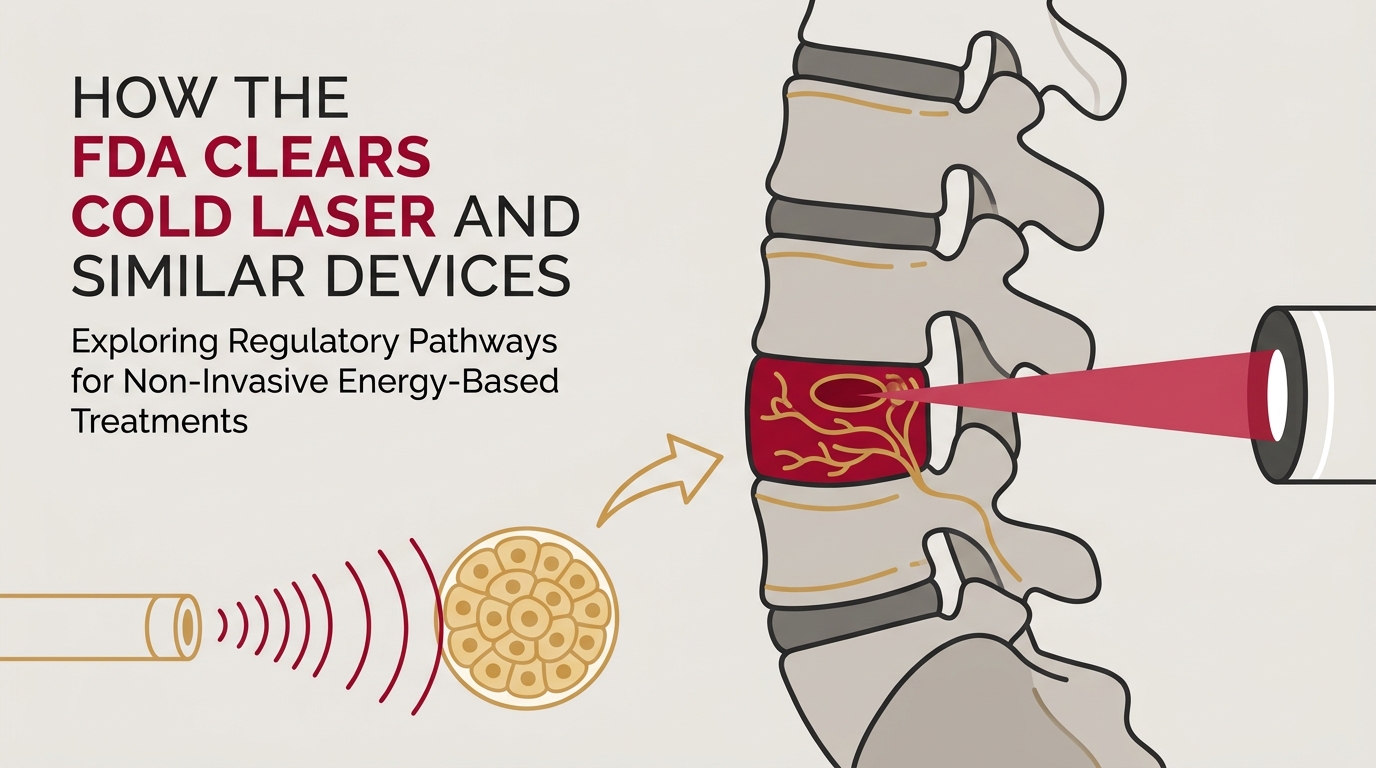
The Food and Drug Administration (FDA) describes one type of device that's based on a laser (light amplification by stimulated emission of radiation). Its light waves stay in step, travel in a narrow beam, and are typically one color. It gives off energy in infrared or other wavelengths, and it has a non-heating effect. The FDA says it's indicated as an add-on in pain therapy or a related indication.
Two FDA paths matter here. The first is called a 510(k). It is a premarketing submission made to the FDA. It shows that the device to be marketed is as safe and effective as a legally marketed device that is not subject to premarket approval. The FDA calls that "substantially equivalent."
The second path is Premarket Approval. The FDA calls it the most stringent type of device marketing application. You submit it to request approval to market a device. Unlike premarket notification, it rests on the FDA deciding that the application has sufficient valid scientific evidence. That evidence has to give reasonable assurance that the device is safe and effective for its intended use.
Cold Laser Therapy is the name you see here. Its clinical name is low-level laser. It's an add-on treatment.
Why FDA Clearance Doesn't Make a Therapy Covered
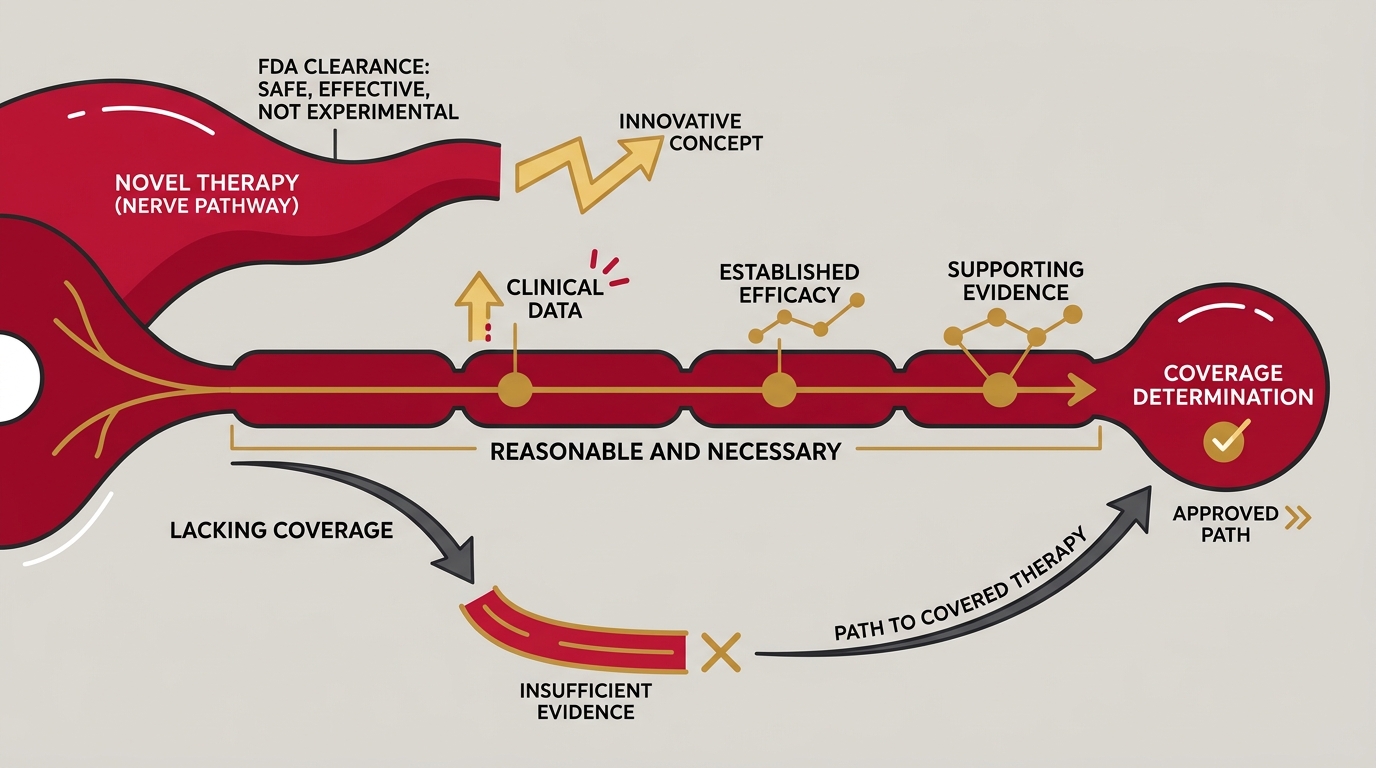
In the past, CMS took "reasonable and necessary" to mean safe, effective, and not experimental. The Social Security Act says Medicare Part A and Part B cannot pay for items and services that are not reasonable and necessary for the diagnosis and treatment of illness or injury.
The U.S. Department of Health and Human Services, Departmental Appeals Board published the Medicare Appeals Council decision - BioniCare device. It says FDA approval or clearance alone doesn't generally give a device the right to Medicare coverage. When the FDA classifies a device as not experimental, that means only one thing, as a first step: the device is eligible to be considered for Medicare coverage.
The same decision says Medicare's manual tells its contractors to base local coverage decisions on the strongest evidence available at the time the decision is issued. Testimonials that show only limited acceptance aren't enough to prove general acceptance by the medical community. Neither are limited case studies handed out by sponsors who have a money interest in the outcome.
The Medicare Advantage Policy Manual (M-MED90) says the FDA determines safety and effectiveness, but does not establish medical necessity. That policy also says that if a procedure or device lacks scientific evidence of safety and efficacy because it is investigational or experimental, the service is not covered, as not reasonable and necessary to treat illness or injury.
I'd rather tell you a plain truth you may not want to hear about what coverage rules leave out than hand you a nice-sounding reassurance that explains nothing.
Here's a table that lines up each rule and what it means for coverage.
| Rule | What it means for coverage |
|---|---|
| FDA approval or clearance alone | Does not generally entitle a device to Medicare coverage |
| FDA classification makes a device non-experimental | As a threshold matter, only eligible to be considered for Medicare coverage |
| FDA determines safety and effectiveness | Does not establish medical necessity |
| Testimonials showing limited acceptance; limited case studies from sponsors with a financial interest | Not sufficient evidence of general acceptance by the medical community |
| Not reasonable and necessary | No payment may be made under Medicare Part A or Part B |
Medicare Won't Pay for Care Tied to a Non-Covered Device
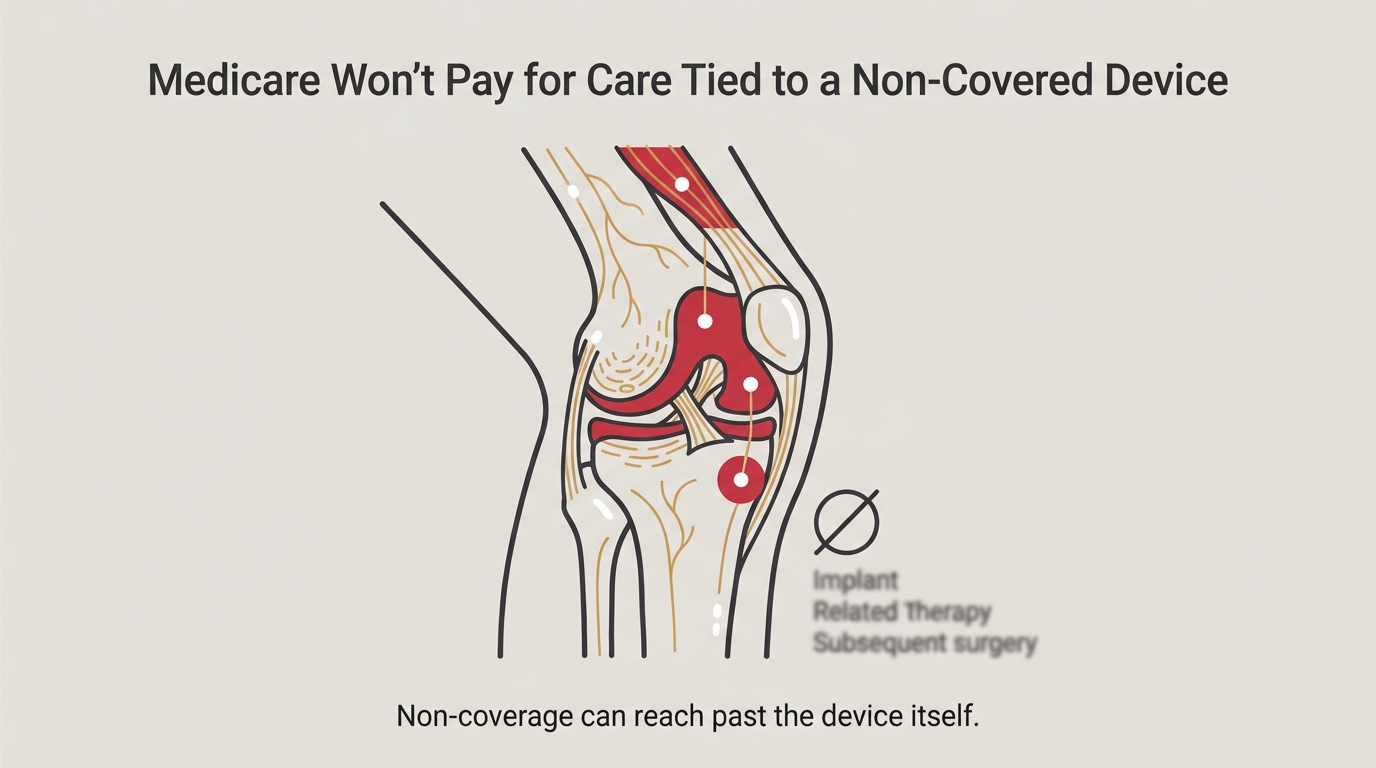
Non-coverage can reach past the device itself. The Medicare Benefit Policy Manual Chapter 14 - Medical Devices says Medicare does not pay for medical and hospital services that are related to the use of a device that Medicare does not cover.
Those non-covered services fall into three groups:
- Services given in preparation for the use of the non-covered device.
- Services given at the same time as the device and needed for its use.
- Services given as necessary after-care that are incident to recovery from the use of the device.
The manual also lists devices that may be covered. Those include devices the FDA approved through the Pre-Market Approval process. They also include devices the FDA cleared through the 510(k) process.
Medicare also has rules for studies of investigational devices. Those rules do not add coverage for any device or service that Medicare would not cover outside the study.
What Research Shows for Cold Laser Therapy on Low Back Pain
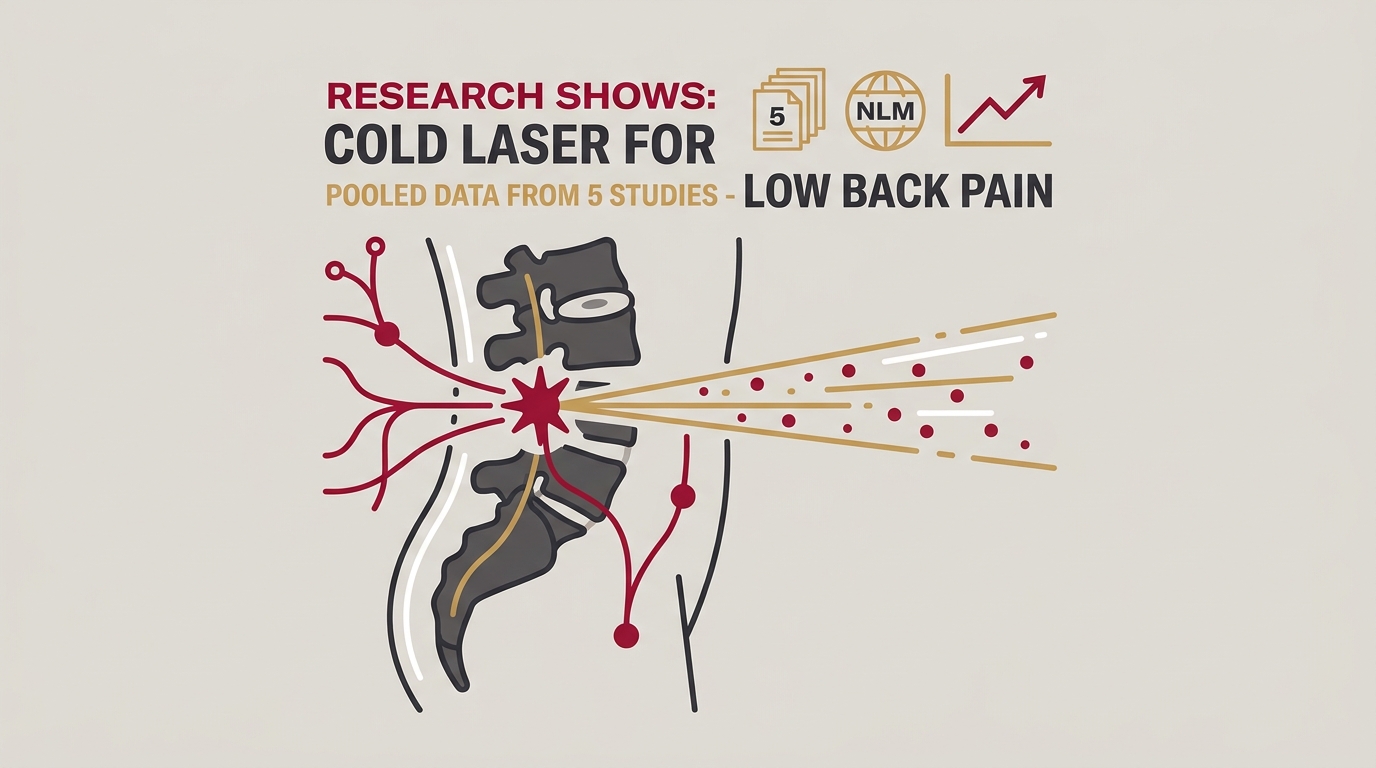
The National Library of Medicine lists a pooled result built from five studies. It looked at pain scores on the visual analog scale (VAS). After treatment, pain scores were significantly lower in the low-level laser therapy (LLLT) group than in the placebo group.
The weighted mean difference (WMD), which is an average difference between groups that gives each study its weight, was -13.57. The 95 percent confidence interval, a range the true difference likely falls in, was -17.42 to -9.72. A second number reported with it, I(2), was 0 percent.
I judge Cold Laser Therapy by how you respond to it. If you don't respond, I change course. I won't keep a therapy going when it shows no results.
What Medicare Plans Say About Cold Laser and Shockwave Therapy
Two Medicare plan policies show how this plays out.
The first is the Medicare Medical Policy Low-Level and High-Power Laser Therapy from Providence Health Plan. It says low-level laser therapy is excluded by law, based on national coverage determination 270.6. So whether billing code S8948 or 97037 is used, it isn't a covered service.
The second is the Medicare Advantage Policy Manual (M-MED90). It says Medicare coverage guidance isn't available for extracorporeal shock wave therapy (ESWT) for muscle and bone conditions. When that happens, the health plan's own medical policy applies.
Want more on this gap? Read Acoustic Wave Therapy vs Traditional Insured Treatments: Coverage Gaps.
Medicare Covers Only the Adjustment, So Other Therapies Are Self-Pay
According to Does Medicare Cover Chiropractic Care? (2026 Rules, Costs, and Limits), Medicare Part B covers a chiropractor's hands-on spinal manipulation to correct a vertebral subluxation, and nothing else. X-rays, massage, electrical stimulation, and maintenance care are all excluded.
Medicare has covered this one service since 1972. For over 50 years, it has been the only chiropractic service Medicare covers.
That means Medicare doesn't cover massage therapy, electrical stimulation, ultrasound, or any other chiropractor service beyond hands-on spinal manipulation to correct a subluxation. If your chiropractor recommends any of them, you pay the full cost out of pocket.
Our Chiropractic Care page explains how the work is done, and our Neuropathy Care page covers that service. To see how billing differs, read Shockwave Therapy Billing vs Chiropractic Adjustment Billing.
How Patients Are Told in Advance What They Will Owe
Medicare itself warns you about this. Your doctor may recommend services that Medicare doesn't cover or offers too often, and that could mean extra costs for you.
The Medicare Advantage Policy Manual (M-MED90) says that in some cases, providers may bill members for services or procedures that aren't covered. It encourages providers to tell members ahead of time when they may have to pay the cost of non-covered or excluded services.
MedicareFAQ.com adds one more point. If you sign the Advance Beneficiary Notice (ABN) and continue treatment, you become responsible for the full cost.
That's why it pays to ask what your care will cost before treatment starts. For a closer look at one service, read Neuropathy Care Costs and Coverage in Tazewell County: A Guide.
When Out-of-Pocket Therapy Costs Count Toward a Tax Deduction
Money you pay yourself may help at tax time. The Internal Revenue Service (IRS) says you can deduct on Schedule A (Form 1040) only the part of your medical and dental expenses that is more than 7.5% of your adjusted gross income.
The IRS also says you can include in your medical expenses the amount you pay for acupuncture. You can read the full rules in Publication 502 Medical and Dental Expenses (2025).
Frequently Asked Questions
Can a Medicare Advantage plan cover more chiropractic care than Original Medicare?
Some can. Some Medicare Advantage plans go further and offer expanded chiropractic coverage as a supplemental benefit. Ask your plan what it adds before you book care.
Is a cold laser regulated like a surgical laser?
The FDA classification regulation 21 CFR 878.4810 describes a carbon dioxide or argon laser intended to cut, destroy, remove, or coagulate (clot) tissue by light. If you want to know which kind of device is used in your care, ask your doctor.
What happened to patients who signed advance notices and then got a non-covered device?
They were held liable for the items. In the BioniCare case, the Medicare Appeals Council found that 36 Medicare beneficiaries had received valid advance beneficiary notices (ABNs), so they were liable for the non-covered items. Read any notice closely before you sign it.
Can I deduct therapy costs my insurance already paid?
No. The IRS says you can't include medical costs that were paid by insurance companies or other sources. Leave out any amount that insurance or another source covered.
Ask About a Care Plan Fitted to You
Paying out of pocket for these therapies comes from coverage rules for the devices. It isn't a verdict on what they're worth. Touch of Wellness Chiropractic offers Chiropractic Care and uses hands-on care plus Shockwave Therapy and Cold Laser Therapy. I won't run every patient through the same routine. I fit add-on therapies into a plan built for the one patient in front of me. Would you like to Book Appointment and talk about a plan that fits you?
Results may vary.