
Aetna considers extracorporeal shock-wave therapy and extracorporeal pulse activation therapy (also known as extracorporeal acoustic wave therapy) experimental, investigational, or unproven for a list of conditions. Aetna says the list is not complete. Its reason is that the medical literature does not have enough evidence that the therapy works for those conditions. UnitedHealthcare's policy for commercial and individual exchange plans, effective 10/01/2026, says extracorporeal shock wave therapy, whether low energy, high energy, or radial wave, is unproven and not medically necessary for any muscle, bone or soft tissue use, because there is not enough evidence that it works. MediPrimer reports that as long as the care is medically necessary, Medicare sets no limit on the number of visits or on the total amount it pays. Medfinder reports that most commercial and Medicare Part D plans cover generic pregabalin, usually at Tier 2 or Tier 3, which are the plan's drug price levels.
What Shockwave Therapy Is, in Insurers' Own Words

Aetna describes extracorporeal shock wave therapy as a treatment without surgery. It sends shock waves to muscle and bone areas of the body, most often the elbow, shoulder or heel. The goal is to lower pain and help the hurt soft tissue heal.
Aetna also names a second type, extracorporeal pulse activation therapy, which it also calls radial wave therapy. Aetna says it uses waves of pressure to turn moving (kinetic) energy into shock waves that spread outward from the center.
UnitedHealthcare explains how the therapy may work. It says the forces from the shock waves may do one or more of these things:
- Lower the pain signals sent by sensory nerves
- Make calcium deposits break apart
- Break down scar tissue
- Cause a short-lived inflammatory (swelling) response
- Help tissue heal
How Aetna and UnitedHealthcare Classify Shockwave Therapy
Aetna names one use as medically necessary. In its Extracorporeal Shock-Wave Therapy for Musculoskeletal Indications and Soft Tissue Injuries - Clinical Policy Bulletin, Aetna considers extracorporeal shock-wave therapy medically necessary for calcific tendinopathy of the shoulder, a tendon problem with calcium buildup. The problem must have lasted at least 6 months. The calcium deposit must be 1 cm or larger. And the person must not have responded to proper conservative care, such as rest, ice and medicines.
Aetna considers extracorporeal shock-wave therapy and extracorporeal pulse activation therapy experimental, investigational, or unproven for a list of conditions. The list is not complete. Aetna's reason is not enough evidence in the medical literature that the therapy works for them.
UnitedHealthcare goes further. Its ESWT for Musculoskeletal Conditions and Soft Tissue Indications (Commercial, eff. 10/01/2026) says extracorporeal shock wave therapy is unproven and not medically necessary for any muscle, bone or soft tissue use. That holds whether it's low energy, high energy or radial wave. The reason given is not enough evidence that it works.
UnitedHealthcare also says what decides coverage. Whether a health service is covered comes down to the member's own benefit plan document and to laws that may require coverage of a specific service.
Here's how the two insurers' positions line up, use by use.
| Use | Insurer position | Insurer |
|---|---|---|
| Calcific shoulder tendinopathy of at least 6 months, calcium deposit 1 cm or larger | Medically necessary when appropriate conservative therapies have failed | Aetna |
| A list of conditions (not all-inclusive), including extracorporeal pulse activation therapy | Experimental, investigational, or unproven | Aetna |
| Low energy, high energy or radial wave, for any musculoskeletal or soft tissue indication | Unproven and not medically necessary | UnitedHealthcare (commercial and individual exchange plans) |
| Benefit coverage for health services | Decided by the member's benefit plan document and applicable laws that may require coverage for a specific service | UnitedHealthcare |
What Research Shows for Shockwave Therapy on Tendons and Nerves
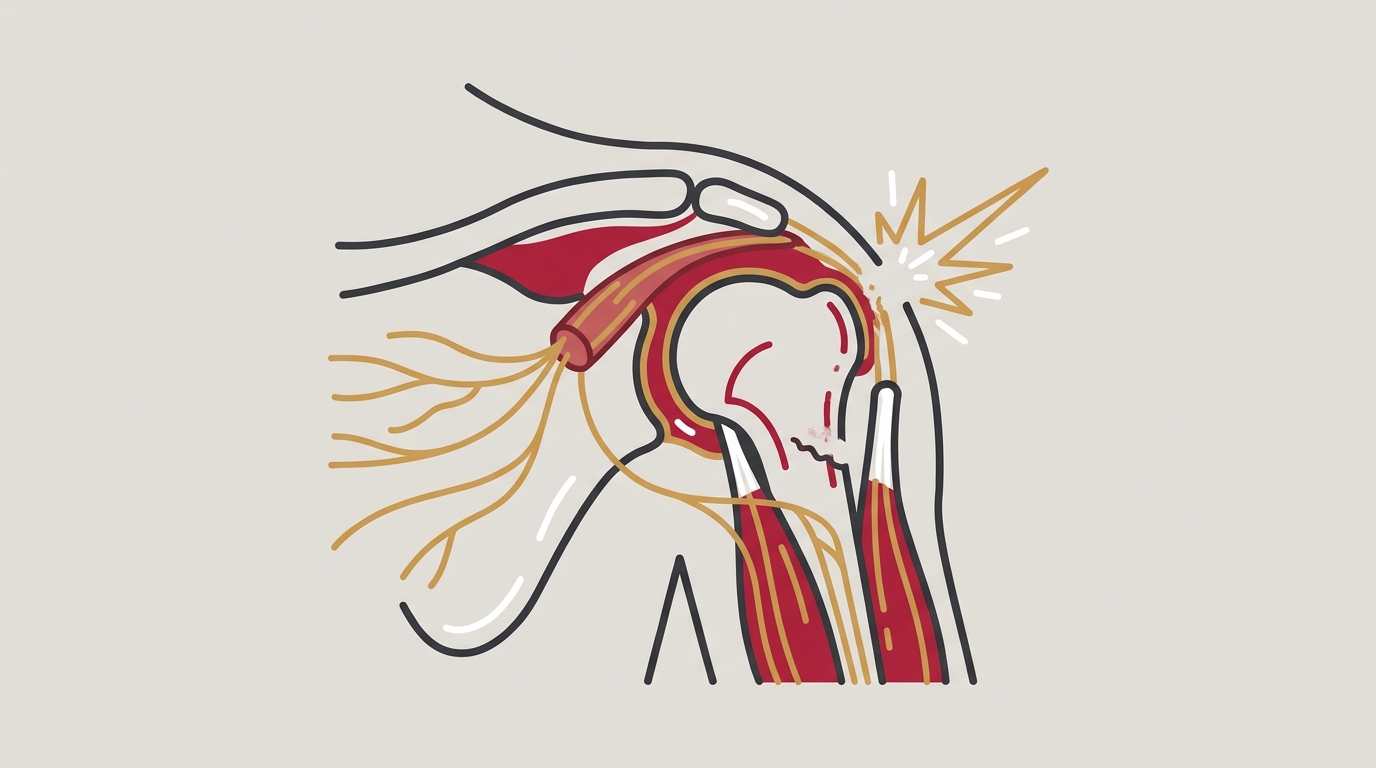
The tendon research is mixed. UnitedHealthcare cites two combined analyses of studies, called meta-analyses.
The 2023 analysis looked at Achilles tendinopathy, a heel tendon problem. It found very low-quality evidence that extracorporeal shock wave therapy was no more effective at lowering pain than any other conservative treatment. The study's numbers were a difference of -0.8, a 95% confidence interval (a range the true value likely falls in) of -3.15 to 1.56, and a p-value above 0.5.
The 2024 analysis found that extracorporeal shock wave therapy significantly reduced pain in these problems. The scores are on the study's own scale, and each one has its 95% confidence interval in brackets:
- Plantar fasciitis (heel pain): -1.63 (-3.04 to -0.21)
- Lateral epicondylitis (outer elbow pain): -0.63 (-1.11 to -0.16)
- Chronic Achilles tendinopathy: -1.38 (-1.66 to -1.10)
- Rotator cuff tendinopathy (a shoulder tendon problem): -2.37 (-3.58 to -1.15)
Patellar tendinopathy went the other way. It showed an increase in pain, with a score of 1.36 (0.99 to 1.73).
Nerves have their own research. The Effect of ESWT on nerve conduction: systematic review and meta-analysis (Front Neurol 2024) concluded that extracorporeal shock wave therapy had some excitatory effect on the nerves outside the brain and spine. That means a boost in activity, especially on sensory nerve studies.
With numbers this mixed, we judge care by how the patient responds. If there's no response, we change course. Sticking with a therapy that shows no results is the real failure.
Medicare and Medicare Advantage Rules for Shockwave Therapy in Illinois
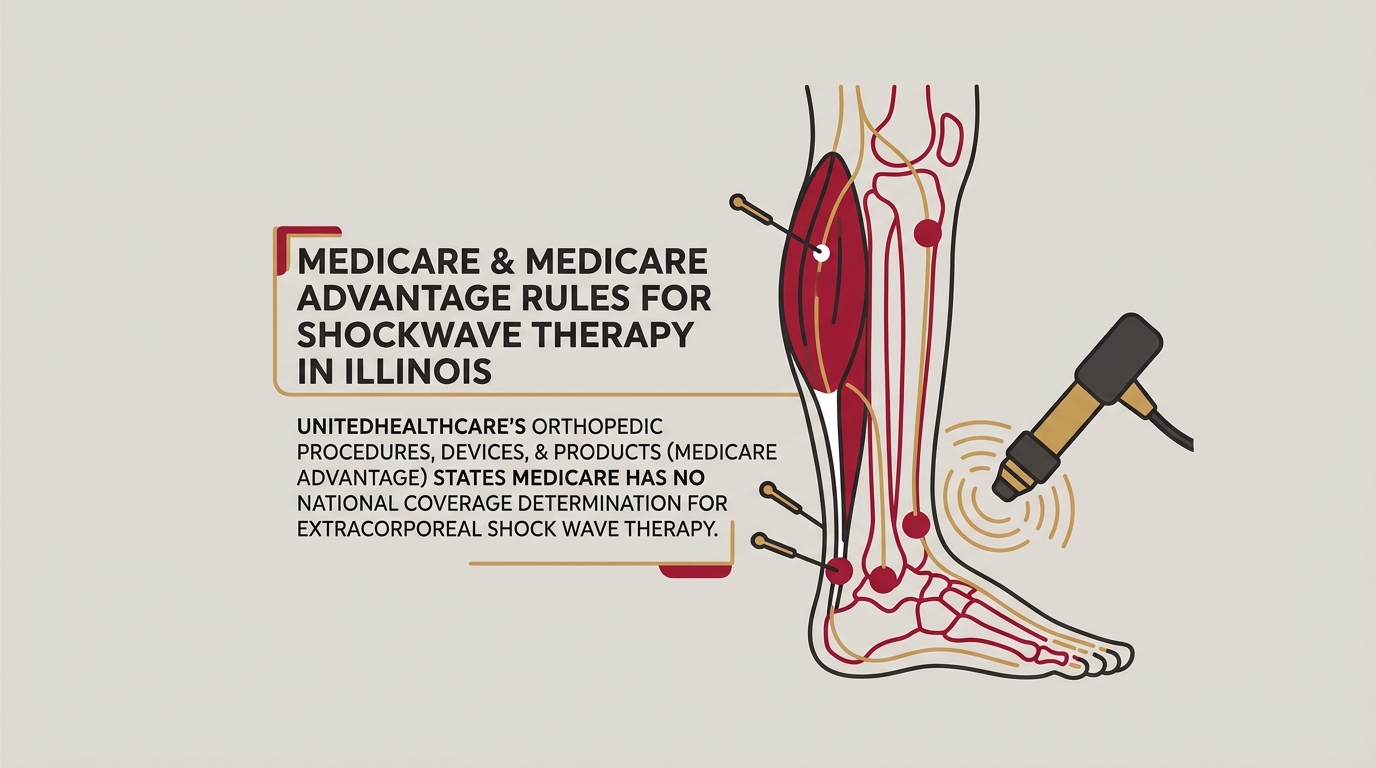
UnitedHealthcare's Orthopedic Procedures, Devices, and Products (Medicare Advantage) says Medicare does not have a national coverage determination for extracorporeal shock wave therapy. Local coverage determinations do exist, and following those policies is required where they apply.
That same policy lists National Government Services, Inc. (NGS) as the contractor for Connecticut, Illinois, Maine, Massachusetts, Minnesota, New Hampshire, New York, Rhode Island, Vermont and Wisconsin. Illinois is on that list.
Some plans fall back on their own rules. Medicare Advantage Policy M-MED90: ESWT (published 01/01/2026) says Medicare coverage guidance isn't available for extracorporeal shock wave therapy for muscle and bone conditions. When that's the case, the health plan's own medical policy applies.
If you're sorting out billing, read Shockwave Therapy Billing vs Chiropractic Adjustment Billing. If you're dealing with nerve problems, our Neuropathy Care page covers that work. And our Chiropractic Care page explains how the hands-on work is done.
How Medicare Covers Physical Therapy: No Visit Cap, but Rules Apply
Medicare.gov's Physical Therapy Coverage page says physical therapy helps bring back or improve how your body moves after an injury, an illness, or surgery.
MediPrimer's Does Medicare Cover Physical Therapy? says that as long as the care is medically necessary, Medicare sets no limit on how many visits you get or on the total amount it pays. Rules still apply.
- Certification. Medicare says your doctor or another health care provider, such as a nurse practitioner, clinical nurse specialist, or physician assistant, must certify that you need physical therapy. Certify means formally confirm.
- Your share. MediPrimer says that once you have met your Part B deductible, you pay 20% (one fifth) of the Medicare-approved amount.
- Plan of care. Health Law Alliance, in Physical Therapy Medicare Audits and the Therapy Threshold, says a physician or non-physician practitioner must certify your therapy plan within 30 calendar days of the first day of treatment, or later if they give a reason for the delay. The plan must be recertified at least every 90 calendar days.
- Maintenance programs. Health Law Alliance says that when you, a family member, a caregiver, or unskilled staff can carry out a maintenance program, Medicare does not cover a therapist's services to deliver it.
- Medicare Advantage. MediPrimer says a Medicare Advantage plan must cover at least what Original Medicare covers. But it may require prior authorization (approval before the care) or require you to use therapy providers in its network.
Dollar Thresholds That Trigger Extra Billing Steps
MediPrimer gives two 2026 thresholds. Both count physical therapy and speech-language pathology combined, and they are two different thresholds:
- The KX modifier threshold is $2,480 for calendar year 2026.
- The targeted medical review threshold is $3,000 for 2026.
Health Law Alliance says that if a claim goes in above the KX threshold without the KX modifier, it's denied.
How One Illinois PPO Covers Office Visits, Therapy and Chiropractic Care
This section looks at the Blue Cross and Blue Shield of Illinois BluePrint preferred provider organization (PPO) plan for 2026.
A covered visit to a physician's office (not a specialist) costs $30 per visit, then no charge, and no deductible applies. A covered visit to a specialist's office costs $60 per visit, then no charge, and no deductible applies.
Outpatient physical, occupational and speech therapies cost 20% of the Maximum Allowance (one fifth) from participating providers. From non-participating providers they cost 40% of the Maximum Allowance (two fifths). The plan sets no limit on the number of visits for these therapies.
Chiropractic and osteopathic services cost 20% of the Maximum Allowance from participating providers and 40% from non-participating providers. The 2026 booklet lists "Chiropractic and Osteopathic Manipulations" at 30 visits per benefit period, as specified in its "Your Benefit Period" provision. Outpatient diagnostic services, such as labs and X-rays, cost 20% of the Maximum Allowance in network and 40% out of network.
The individual deductible is $500 per benefit period with participating providers and $1,000 per benefit period with non-participating providers.
The table below puts these costs side by side.
| Service | Participating provider | Non-participating provider | Visit limit |
|---|---|---|---|
| Physician's office visit (other than a specialist) | $30 per visit, then no charge, no deductible | Not stated | Not stated |
| Specialist's office visit | $60 per visit, then no charge, no deductible | Not stated | Not stated |
| Outpatient physical, occupational and/or speech therapies | 20% of the Maximum Allowance | 40% of the Maximum Allowance | No limit |
| Chiropractic and osteopathic services | 20% of the Maximum Allowance | 40% of the Maximum Allowance | 30 visits per benefit period, listed for "Chiropractic and Osteopathic Manipulations" |
| Outpatient diagnostic services (labs, X-rays and other diagnostic services) | 20% of the Maximum Allowance | 40% of the Maximum Allowance | Not stated |
| Individual deductible | $500 per benefit period | $1,000 per benefit period | Not applicable |
Want more on nerve care costs near you? Read Neuropathy Care Costs and Coverage in Tazewell County: A Guide. Blue Cross and Blue Shield of Illinois also posts its Blue Cross Medicare Advantage Prior Authorization Requirements 2026.
How Plans Cover Nerve Pain Drugs: Tiers, Step Therapy and Prior Authorization
Cigna says various guidelines for diabetic peripheral neuropathy (nerve damage from diabetes), neuropathic pain (nerve pain), postherpetic neuralgia (nerve pain after shingles), and restless legs syndrome recommend gabapentin or immediate-release pregabalin as treatment options.
Medfinder's Lyrica Availability 2026: A Guide for Providers says most commercial and Medicare Part D plans cover generic pregabalin, usually at Tier 2 or Tier 3. It also says many plans want a documented trial of gabapentin before they approve pregabalin. And brand-name Lyrica will almost universally require prior authorization in 2026.
Cigna's Lyrica CR Prior Authorization with Step Therapy Policy recommends prior authorization for prescription benefit coverage of pregabalin extended-release tablets under its national formulary. When clinically appropriate, the patient is directed to try gabapentin immediate-release (brand or generic) or generic immediate-release pregabalin, and also generic pregabalin extended-release tablets, as Step 1. Brand Lyrica CR is Step 2.
Centene's Clinical Policy: Pregabalin (Lyrica, Lyrica CR), posted by Silver Summit Health Plan, lists these requirements:
- A failed 30-day trial of gabapentin at 1,800 milligrams a day or more, unless gabapentin is contraindicated (not safe for the patient) or the patient has clinically significant side effects.
- A failed 30-day trial of a formulary serotonin/norepinephrine reuptake inhibitor (SNRI), such as duloxetine or venlafaxine, at up to the highest indicated doses.
- Documentation from the provider, such as office chart notes, lab results, or other clinical information, showing the member has met all of the approval criteria.
I don't hold every patient to one required order of steps. I build each care plan from what you tell me, and I change the approach when it isn't producing results.
Illinois Marketplace Plans and Step Therapy
The Centene policy has one exception. For requests under the Illinois Health Insurance Marketplace, the step therapy requirements above (trying other drugs first) do not apply as of January 1, 2026, under Illinois House Bill 5395.
Why Shockwave Therapy Usually Means an Out-of-Pocket Cost
When a plan doesn't cover a service, you may be the one who pays. Medicare Advantage Policy M-MED90 says that in some cases, providers may bill members for services or procedures that are not covered. It encourages providers to tell you ahead of time when you may have to pay for non-covered or excluded services.
Checking with your plan doesn't settle it either. Blue Cross and Blue Shield of Illinois says that checking eligibility or benefit information, or getting prior authorization for a service, does not promise payment. You can find the plan's benefits in its BluePrint PPO 2026 benefit booklet.
I give you a plain account of what will be billed to you, and I'd rather hand you a true answer you don't like than comfort that explains nothing. At our clinic, you're told what care costs before treatment starts.
We use hands-on care plus Shockwave and Cold Laser. To learn why some nerve therapies are paid out of pocket, read Why Advanced Restorative Nerve Therapies Are Paid Out-of-Pocket.
Frequently Asked Questions
Are these the same shock waves used for kidney stones?
Yes, the same kind. UnitedHealthcare says the shock waves used for bone and muscle problems are the same kind used to break up kidney stones, but they have 10 times less energy.
Is there a standard Shockwave Therapy dose or schedule?
Not yet. Aetna's policy says the ways of using extracorporeal shock wave therapy for muscle and bone problems have not yet been standardized. It also says the exact doses and the best schedule for how often to use it have not been studied much.
Does Shockwave Therapy work better than a steroid injection for nerve conduction?
Not clearly. The Frontiers in Neurology review found that shock wave therapy worked better than the control group. It also found that shock wave therapy combined with physical therapy worked better than physical therapy alone. But its effect might not be greater than that of a local corticosteroid injection.
Which wins if my plan document and the insurer's coverage policy disagree?
Your plan document. UnitedHealthcare says that if the two conflict, the member's own benefit plan document takes priority over its policy. Cigna says that in the event of a conflict, a customer's benefit plan document always overrides the information in its coverage policies.
Once a plan approves pregabalin, how long does the approval last?
It depends on the plan. The Centene policy approves for 12 months for Medicaid, the Health Insurance Marketplace, and individual coverage health reimbursement arrangement plans. For commercial plans, it's 12 months or the length of the request, whichever is shorter. Cigna approves pregabalin extended-release tablets for 1 year if the patient meets both listed conditions.
How common is painful diabetic neuropathy, and how often does it go untreated?
Cigna says painful diabetic neuropathy, which is nerve damage from diabetes, affects about 1 in 6 patients with diabetes (16%). It often goes unreported (12.5%, about 1 in 8) and even more often goes untreated (39%, about 4 in 10). If you have a sudden severe headache, numbness or weakness in an arm or leg, trouble speaking or seeing, or loss of bladder or bowel control, call 911 or your doctor right away.
Book a Visit and Build a Plan Around You
Conventional care is covered, but with rules, limits and paperwork. Medicare sets no limit on visits or on the total it pays for medically necessary care, yet it still asks for certification and a plan of care. Aetna considers extracorporeal shock-wave therapy experimental, investigational, or unproven for a list of conditions, and it says that list is not complete. I don't run you through one fixed routine like a unit on a line. I offer Shockwave Therapy as a self-pay option inside a plan fitted to you.
Touch of Wellness Chiropractic offers Chiropractic Care, Shockwave Therapy, Neuropathy Care and other services in Morton, IL. Would you like to Book Appointment and talk through what fits you?
Results may vary.