
Weekend dry needling certifications put patients at risk because they compress a technique involving needle insertion through skin and into muscle tissue into a short course, without the anatomical depth and supervised clinical practice needed to manage what can go wrong. A needle carries no built-in safety margin. The only safety margin that exists is the training behind the hand holding it. Weekend courses teach the mechanical motion of insertion but skip the extended study of nerve pathways, vascular structures, and organ proximity that determines whether a needle placement is safe in a given patient. This gap matters because dry needling and acupuncture use the same fundamental tool on the same tissue, yet the training pathways behind them differ enormously in scope. Practitioners with only weekend-course preparation have not logged the extensive supervised clinical hours that post-doctorate acupuncture training requires, hours spent learning to recognize contraindications, manage adverse reactions, and understand regional anatomy in three dimensions rather than on a diagram. Documented complications from inadequately supervised needling include punctured lung tissue, nerve injury, and infection, all traceable to gaps in anatomical knowledge rather than to the technique itself. Regulation of who may perform dry needling also varies widely across states and professions, meaning the credentialing bar a practitioner cleared to legally offer the service says little about how deeply they understand the anatomy underneath the needle. The technique is not inherently unsafe. The mismatch between a brief certification and the anatomical mastery the technique demands is where the risk originates, and that mismatch is the reason patients evaluating any needle-based therapy should look past whether a provider is legally permitted to needle and ask how many hours of anatomical and clinical training stand behind that permission.
What Counts as Dry Needling, and Where Does Training Actually Diverge?
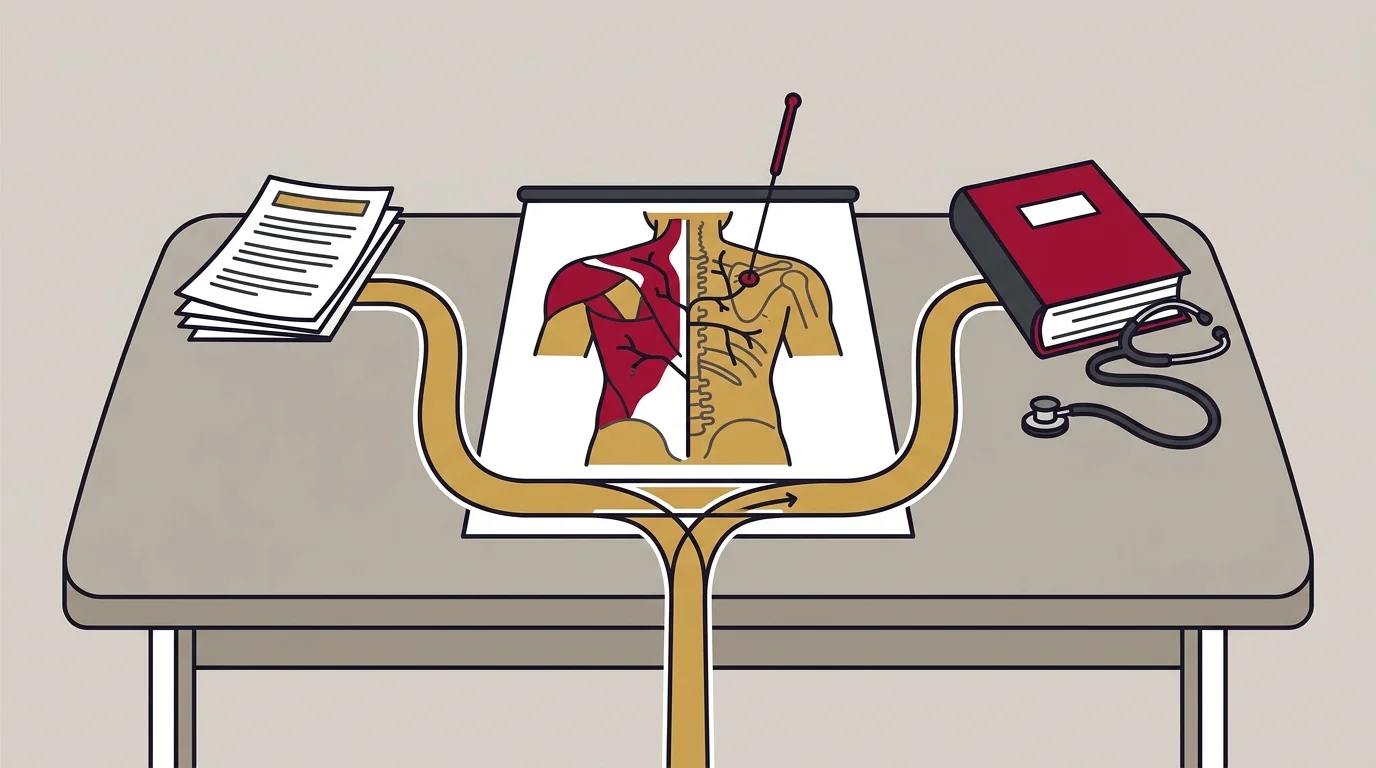
Dry needling is a technique where a thin filament needle is inserted into muscle tissue to release tension at a trigger point. It uses the same tool acupuncture uses. In recent years, the lines between different needle-based therapies have become blurred, leaving patients confused and vulnerable.
That blur is not accidental. Both approaches place a needle through skin and into muscle, so from the outside they can look identical. But the training standing behind the hand holding the needle is where the two paths split apart.
Where the Boundary Gets Blurry
A weekend certification course provides a fundamentally different level of anatomical knowledge and clinical experience than a post-doctorate degree. One teaches a motion. The other teaches the anatomy that makes the motion safe.
That gap shows up most clearly with chronic, layered pain that does not resolve with a single mechanical technique. For a closer look at how training depth changes outcomes over time, see what separates acupuncture certification from dry needling.
What the Training Hour Gap Actually Looks Like
Numbers make this gap concrete. Every profession sets its own hour floor before a practitioner may pick up a needle.
In Tennessee, physical therapists must complete 50 hours of instruction covering musculoskeletal and neuromuscular systems, pain mechanisms, trigger points, and universal precautions. On top of that, they need 24 more hours specific to dry needling. Per Tennessee's dry needling rule, physical therapists in Tennessee must complete 50 hours of instruction in musculoskeletal and neuromuscular systems, anatomical basis of pain mechanisms, trigger points, and universal precautions, plus an additional 24 hours of dry needling-specific instruction before performing dry needling. Compare that to massage therapists performing dry needling, who need a minimum of 60 hours face-to-face training and 15 hours of supervised clinical practice. The Australian Institute of Sport's position statement documents that massage therapists performing dry needling must complete a minimum of 60 hours face-to-face training and 15 hours supervised clinical practice if the skill was learned at a post-graduate workshop.
| Credential Path | Required Hours | What the Hours Cover |
|---|---|---|
| Physical Therapist Dry Needling Certification (Tennessee) | 50 hours foundational instruction plus 24 hours dry needling-specific instruction | Musculoskeletal and neuromuscular systems, pain mechanisms, trigger points, universal precautions, and dry needling-specific technique |
| Physical Therapist Dry Needling Certification (Tennessee) — Add-On Requirement | 24 additional hours beyond the 50-hour foundation | Dry needling-specific instruction layered on top of general musculoskeletal and neuromuscular coursework |
| Massage Therapist Dry Needling Certification (Post-Graduate Workshop Pathway) | 60 hours face-to-face training | Face-to-face instruction in dry needling technique following a post-graduate workshop |
| Massage Therapist Dry Needling Certification (Supervised Clinical Component) | 15 hours supervised clinical practice | Supervised hands-on clinical practice required alongside the face-to-face training hours |
Why a 24-Hour Add-On Course Isn't a Substitute for Anatomical Mastery
Add those figures together and the total still lands far below what post-doctorate acupuncture training demands. A short add-on course teaches a checklist of precautions. It can't teach the anatomical reasoning that lets a practitioner catch a problem before it happens.
And that distinction only matters more as pain cases grow complex. Why Does It Matter walks through what the deeper training actually changes for patient outcomes.
What Happens When Training Gaps Meet Real Tissue

Training gaps do not stay theoretical once a needle enters real tissue. Deep dry needling over the posterior thorax has produced documented cases of bilateral pneumothorax progressing to tension pneumothorax and respiratory failure. PubMed Central documents that respiratory failure was reported in a patient who developed bilateral pneumothorax and subsequent tension pneumothorax from dry needling used to treat myofascial pain — a single reported case. A needle carries no built-in safety margin. A practitioner who has not mapped the chest wall in depth cannot always feel the difference between muscle and lung.
One case doesn't describe every dry needling treatment ever performed. But it shows exactly what an anatomical blind spot can do when the needle goes deeper than intended. Verifying a Chiropractor's Clinical Acupuncture Credentials before treatment starts is how a patient closes that gap.
| Event Severity | Reported Rate | Example Finding |
|---|---|---|
| Minor adverse event | 36.7% of treatments | Bleeding, bruising, and pain during dry needling |
| Major adverse event | Fewer than 0.1% of treatments | Rare but serious complication following dry needling |
| Respiratory complication | Single documented case | Bilateral pneumothorax and tension pneumothorax after dry needling for back muscle pain |
How Adverse Events Break Down by Severity
Broader data puts that risk in proportion. Per The International Journal of Sports Physical Therapy, minor adverse events occurred in 36.7% of dry needling treatments, while major adverse events were reported in fewer than 0.1% of treatments.
Most sessions end without serious incident. But the rare major event is still where the training gap does its damage. That's the distinction this article keeps coming back to.
Why Thin Regulation Lets the Gap Persist
There's no single national rulebook for needle-based therapies. What exists instead is a patchwork, stitched together state by state and profession by profession.
And that patchwork is exactly why the training gap survives. When the rules themselves are thin, a weekend certificate can look legally sufficient while staying clinically incomplete.
| State or Board | Who May Perform the Procedure | Specific Requirement |
|---|---|---|
| Nevada Chiropractic Board | Chiropractic physicians who hold specific certification | Certification required specifically for dry needling before a physician may perform the procedure |
| Nevada Chiropractic Board | Chiropractic assistants | Barred outright from performing dry needling under any circumstance |
| States with thin or silent regulation | Practitioners across several professions with minimal oversight | No dedicated certification standard beyond a general scope-of-practice license |
| Physical therapy boards (varies by state) | Physical therapists meeting state-specific coursework minimums | Coursework requirement tied to hours rather than post-doctorate clinical mastery |
How State Boards Draw the Line Differently
Some states require dozens of hours before a provider may pick up a needle. Others say almost nothing at all, leaving the decision to individual employers or professional boards.
That inconsistency means a practitioner's legal permission to needle can rest on where they happen to practice, not on how much anatomy they have mastered. A credential earned in one state does not guarantee the same depth of training in another.
Where Chiropractic Regulation Sets a Higher Bar
Some chiropractic boards have moved to close part of that gap head-on. Nevada makes chiropractic physicians earn certification specifically to perform dry needling, and it draws a hard line around who may not touch a needle at all. Nevada's administrative code documents that Nevada chiropractic physicians must obtain certification specifically to perform dry needling, and chiropractic assistants are prohibited from performing this procedure.
Chiropractic assistants are prohibited from performing dry needling under that same Nevada rule. That distinction reflects the same principle this article keeps returning to: the needle is not the safeguard, the training behind it is. Setting that bar for who may hold the needle is one piece of a larger commitment. Our approach to care reflects that same standard across every service we offer.
What Comprehensive Acupuncture Training Actually Requires

Comprehensive acupuncture training is not a longer version of a weekend course. It is a different kind of education entirely, built on hours of anatomy study before a single supervised needle insertion ever happens.
| Training Component | Minimum Hours | Purpose |
|---|---|---|
| Didactic Education | 1,000 hours minimum | Builds foundational anatomical and clinical knowledge before any patient contact |
| Supervised Clinical Practice | 500 hours minimum | Tests classroom anatomical knowledge against real patients under direct supervision |
| Total Entry-Level Program | 1,725 hours minimum | Sets the full training floor a board-approved acupuncture school must meet |
| Post-Graduate Add-On Course (Massage Therapy Comparison) | 60 hours face-to-face plus 15 hours supervised practice | Shows the scale of a short add-on course next to a full entry-level program |
The Didactic-to-Clinical Ratio That Weekend Courses Skip
Nebraska sets one clear benchmark for what that education looks like. Board-approved acupuncture schools there must include at least 1,725 total hours of entry-level education. That breaks down to a minimum of 1,000 didactic hours and 500 clinical hours.
Per Nebraska's acupuncture school regulation, board-approved acupuncture schools in Nebraska must include at least 1,725 total hours of entry-level education, consisting of a minimum of 1,000 didactic hours and 500 clinical hours. And that structure matters more than the total. Didactic study builds the anatomical map first, then clinical hours test that map against real patients under supervision, long before anyone practices alone.
How Other Manual-Therapy Fields Are Closing the Gap
Massage therapy has already moved to narrow its own version of this gap for practitioners who add dry needling later in their careers. The direction is the same everywhere training standards tighten: more supervised hours, not fewer, standing behind the hand that holds the needle.
Frequently Asked Questions
A few questions come up again and again once patients understand what separates a weekend certificate from post-doctorate training. Here are direct answers to the ones that matter most.
How can a patient verify a practitioner's training for dry needling?
Ask directly. How many hours of anatomical and clinical training did they complete before treating patients? A specific number tied to a named program is a good sign, and a vague answer about being certified is not.
Is dry needling legally classified the same as acupuncture?
No. Dry needling and acupuncture use a similar tool, but state boards regulate them under different rules and different training thresholds. The legal line follows the profession and the state, not the technique itself.
What injuries have been documented from improperly performed dry needling?
Documented cases include bleeding, bruising, and pain at the needle site as minor outcomes. Rare but serious cases include pneumothorax, where the needle passes too close to the lung.
How much training separates a post-doctorate acupuncture provider from a weekend-certified practitioner?
Post-doctorate acupuncture education combines didactic study with supervised clinical practice beyond the chiropractic degree. A weekend course teaches a technique in a sliver of that time, with no equivalent clinical supervision built in.
Does every state regulate who can legally perform dry needling?
No. Some states set clear hour requirements before a provider may needle a patient, while others leave the standard largely undefined. That patchwork means legal permission does not always reflect anatomical mastery.
What does universal precautions training cover in a dry needling course?
Universal precautions training covers infection control, needle disposal, and recognizing contraindications before treatment begins. It is one required component among several, not a substitute for anatomical depth.
The Hours Are the Whole Story
A needle has no safety margin of its own. The only margin that exists is the hours behind the hand that holds it, and every figure in this article traces back to that.
A weekend certificate teaches a motion. Post-doctorate acupuncture training teaches the anatomy that makes the motion safe.
That difference is not a technicality. It is the difference between a practitioner who can needle and one who understands what the needle is near.
Dr. Hannah built her practice on that distinction, and patients deserve a straight answer about who is holding the needle. If you want to know what stands behind the hand treating you, book an appointment with Touch of Wellness Chiropractic.