
Why Long-Term Bute for Horses May Mask Spinal Subluxations and Joint Dysfunction
Long-term phenylbutazone does not fix spinal subluxations in horses. It silences the pain signal that makes those problems visible.
The horse moves more freely because the warning system is chemically suppressed — not because the mechanical problem is gone. That distinction is everything.
Phenylbutazone inhibits cyclooxygenase enzymes, which shuts down the inflammatory response. That shutdown removes the horse's natural protective guard reflexes. Without those reflexes, a horse with a restricted vertebral segment keeps training, keeps competing, and keeps loading the misaligned joint at full intensity — accelerating the structural damage the pain was warning against. According to the University of Minnesota Extension, extended pain masking overrides those protective reflexes entirely, allowing repetitive mechanical load on a misaligned joint to worsen structural damage with every training session.
The pharmaceutical risks compound fast. Phenylbutazone carries a narrow therapeutic index — the gap between therapeutic and toxic is small. The FDA warns that administration beyond 5 consecutive days dramatically increases the risk of systemic clinical toxicity: gastrointestinal ulcerations, right dorsal colitis, renal papillary necrosis. The structural problem that triggered the pain stays completely unaddressed the entire time.
Standardized equine lameness evaluations use a 0-to-5 grading scale. Oklahoma State University Extension documents how early spinal dysfunction shows up as subtle gait changes — compensatory head nods, hip hikes, slight asymmetries — long before an obvious lameness score registers. Bute suppresses the horse's expression of those early signals. The owner sees improvement. The subluxation progresses.
Animal Chiropractic works differently. Segmental mobility evaluations identify exactly where vertebral restrictions are occurring. Research published through the National Institutes of Health found that over 70% of performance horses evaluated presented with segmentally restricted pelvic or back mobility. Specific adjustments to those restricted segments restore correct range of motion and nervous system communication — without suppressing the feedback the horse's body is generating for a reason.
Bute manages pain. It does that well. The real question is what is accumulating underneath that managed pain — and how long the clock has been ticking.
Last Updated: August 18, 2026
- • What Bute Actually Does — And What It Doesn't
- • Why Most Owners Miss the Spinal Source
- • The Hidden Cost to the GI Tract and Systemic Health
- • Reading the Gait: What the Horse Is Still Telling You
-
• Frequently Asked Questions
- • How does long-term bute use mask spinal subluxations in performance horses?
- • What are the clinical signs of right dorsal colitis from equine NSAID overuse?
- • Can animal chiropractic address the root mechanical cause of equine gait issues?
- • What are the risks of using phenylbutazone for more than five consecutive days?
- • How do clinicians differentiate between primary joint lameness and spinal subluxations?
- • The Clock Doesn't Stop Because the Horse Stops Limping
What Bute Actually Does — And What It Doesn't
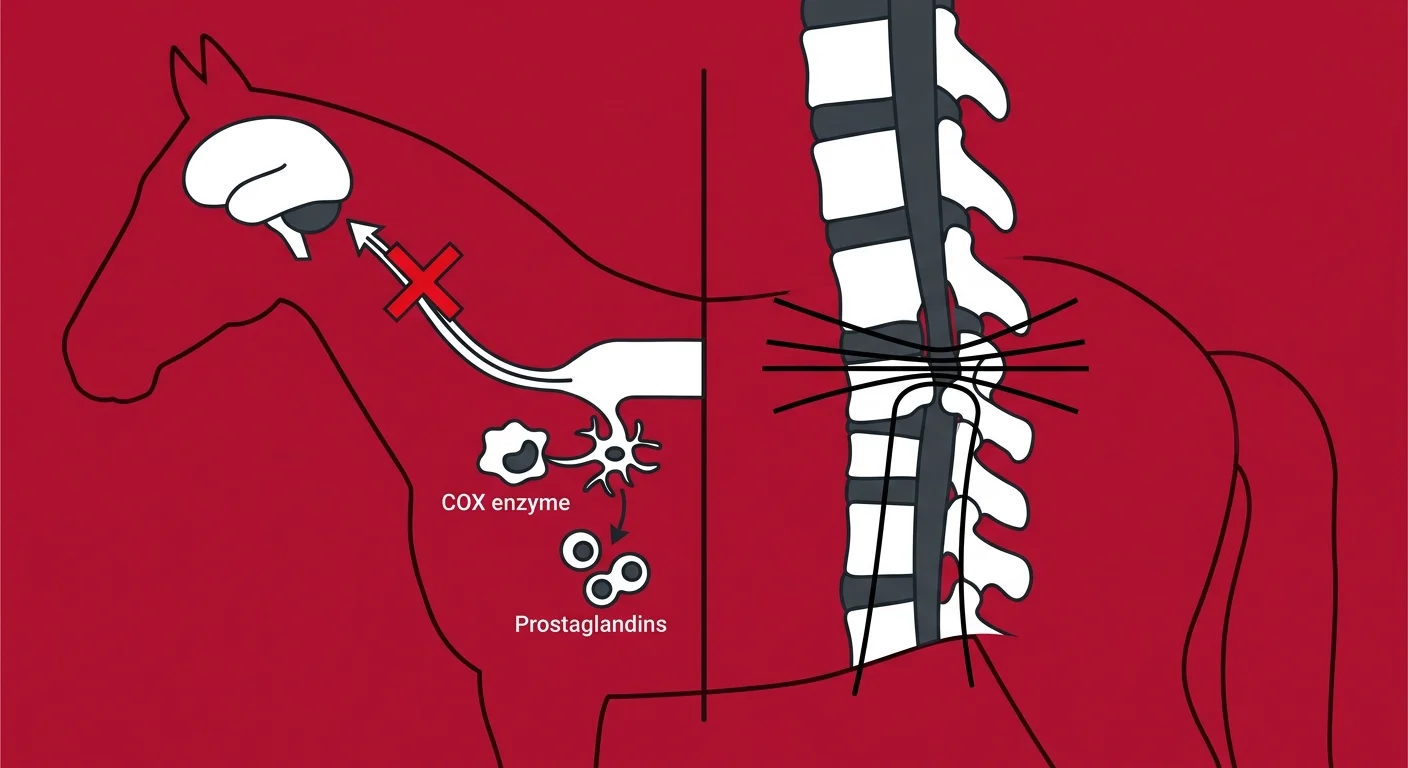
Bute is the default answer in equine management. Trainers reach for it without thinking. Owners trust it because the horse looks better within hours.
That improvement is real.
And it is exactly the problem.
Phenylbutazone kills the pain signal. It does nothing to the mechanical source generating that signal.
The joint restriction stays. The vertebral immobility stays. The soft tissue compensation pattern stays.
The clock keeps ticking.
That distinction is the entire argument behind restorative care versus symptom masking: one approach finds the structural source and corrects it.
The other quiets the alarm while the building keeps burning.
The COX Pathway: Pain Signal Off, Damage Signal On
Here's what phenylbutazone does inside the body. It blocks cyclooxygenase enzymes — the COX pathway — shutting down the inflammatory cascade responsible for pain signaling.
But that same shutdown hits something else: the prostaglandins protecting the stomach lining.
One inhibition. Two consequences. And only one of them shows up in how the horse moves.
NIH research puts a number on it: NSAID-driven COX inhibition can suppress mucosal prostaglandin synthesis by up to 90%.
That's not a side effect. That's the stomach's entire protective barrier, gone.
The resulting lesions concentrate in the stomach and the right dorsal colon. The horse's pain looks managed. The tissue damage is accelerating on a parallel track.
The pain signal goes off. The damage signal goes off with it.
That's not a therapeutic trade-off. That's a diagnostic blackout.
Why Suppressing the Warning System Isn't the Same as Fixing the Problem
Here's what gets missed in every conversation about bute: the horse's pain expression isn't a nuisance.
It's clinical data.
When a horse shortens stride, guards a hip, or resists collection, the nervous system is broadcasting a mechanical problem. Those are diagnostic signals — the body's feedback architecture working exactly as it should. Bute turns off the broadcast. The problem keeps transmitting. Nobody hears it.
Phenylbutazone carries a narrow therapeutic index. What the FDA documents make clear: prolonged or high-dose use leads to GI tract damage, renal papillary necrosis, and blood dyscrasias.
The margin between therapeutic and toxic is thin. It gets thinner every day the drug runs without addressing the root cause.
That risk profile doesn't stay flat. It compounds.
And while that pain signal is off, the horse loads a misaligned joint at full training intensity — day after day — because nothing hurts.
Repetitive mechanical stress on a restricted segment doesn't pause because the horse feels better. It accelerates structural deterioration. The joint degrades faster, not slower, under the cover of chemical silence.
What AVCA Certified Animal Chiropractic addresses is what bute never touches: the mechanical source. Providers who understand what AVCA certification actually means are trained to locate and correct that source — before the accumulating structural damage becomes impossible to reverse.
| Mechanism | What Bute Does | What Bute Leaves Untouched |
|---|---|---|
| COX enzyme inhibition | Blocks the inflammatory cascade that generates pain signaling | The mechanical source — vertebral restriction, joint misalignment, soft tissue compensation — generating that signal |
| Mucosal prostaglandin suppression | Shuts down the stomach lining's protective barrier alongside the pain response | The structural load being placed on restricted joints during training and competition |
| Guard reflex suppression | Removes the horse's natural protective movement patterns that limit loading on damaged tissue | The repetitive mechanical stress accumulating on misaligned segments with each training session |
| Pain signal suppression | Quiets the nervous system's broadcast of gait asymmetries, stride shortening, and resistance cues | The underlying nervous system and joint integrity those signals were reporting on |
| Systemic drug exposure | Introduces a compound with a narrow margin between therapeutic and toxic dose into the horse's system | The root mechanical dysfunction — bute has no mechanism for restoring vertebral mobility or joint alignment |
| Visible symptom reduction | Creates the appearance of improvement — the horse moves more freely, resists less, performs better short-term | The silent damage clock — structural deterioration that continues and accelerates under the cover of managed pain |
Why Most Owners Miss the Spinal Source
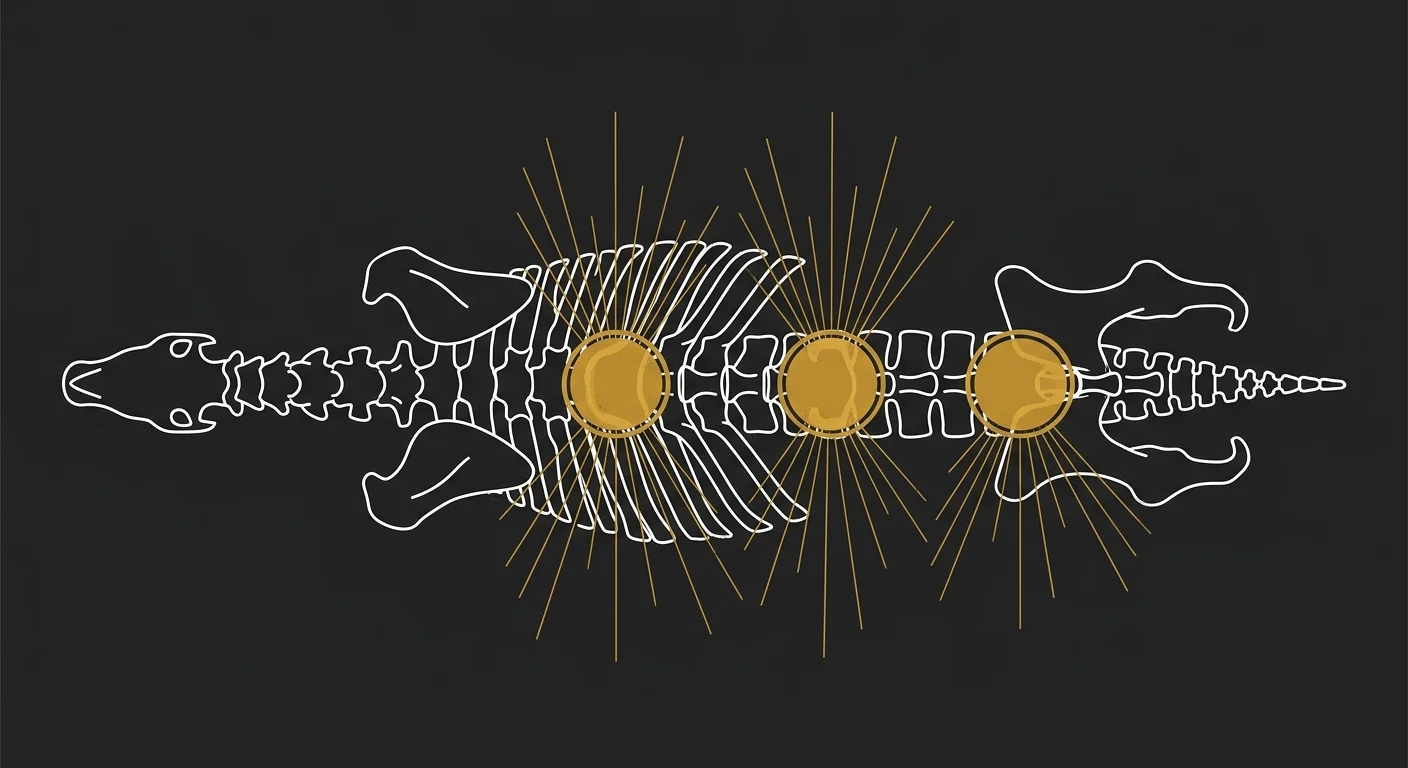
That's the trap.
Bute quiets the pain expression — and the moment it does, the owner loses the only detection system they had. The horse moves. The owner watches. Nobody checks the spine.
Most owners aren't ignoring the spinal source. They're trusting the signal they were given.
Bute switched that signal off.
When the horse moves better, the assumption is that the horse is better. Those are not the same thing.
The standardized lameness grading scale runs from 0 to 5. And NIH-published research confirms that early structural dysfunction shows up as subtle gait changes — compensatory head nods, hip hikes, slight asymmetries — long before a horse reaches a scoreable lameness level.
Bute suppresses those early signals. The owner sees a sound horse.
The clock keeps running.
How Vertebral Subluxations Develop in Performance Horses
Performance horses don't blow out a vertebral segment in one dramatic moment. It builds through repetition.
The same movement pattern, executed thousands of times under load, creates predictable zones of vertebral immobility — concentrated in the pelvis and the thoracolumbar junction.
Segmental mobility evaluations locate exactly where those restrictions are.
NIH clinical findings show that over 70% of performance horses evaluated presented with segmentally restricted pelvic or back mobility.
That is not an edge case. That is the baseline population of horses currently competing, being managed with anti-inflammatories, and being assessed as sound.
The ability to recognize equine gait abnormalities before they become a lameness score depends on an intact feedback loop between horse and observer.
Bute cuts that loop at the source. The horse's nervous system is still broadcasting. The signal just isn't reaching anyone who can act on it.
The Cookie-Cutter Protocol That Keeps the Problem Hidden
Here's how the standard protocol plays out.
The horse shows stiffness. Bute goes in. Movement improves within hours. Training resumes.
Nobody evaluates the spine.
That cycle — suppress, resume, suppress again — isn't negligence. It's exactly what conventional management is built to produce.
The problem: it treats the alarm as the problem. Not the structural failure the alarm is pointing to.
When the horse's natural protective guard reflexes are chemically overridden, full training load keeps transferring through a misaligned joint.
Repetitive mechanical stress on a restricted segment doesn't pause because the horse feels better. It accelerates structural deterioration with every ride.
The cookie-cutter protocol keeps the horse in work. It does not keep the joint intact.
Suppressing pain without locating the subluxation produces progressive joint deterioration. That's not a theoretical risk.
That's what happens when you keep loading a joint that isn't moving correctly.
Who This Approach Isn't Designed For
If the goal is to manage the horse pharmaceutically, return to training fast, and skip the spinal evaluation entirely — this isn't the right fit.
Animal chiropractic requires a full assessment before anything is adjusted. It requires an owner willing to follow a clinical lead that identifies restrictions the horse has been compensating around for months.
Showing up for the process — not just the result — is part of the deal.
Owners who need the horse back in competition before the evaluation is finished — or who want to layer chiropractic on top of an unchanged pharmaceutical protocol without adjusting anything structurally — this work isn't built for that.
The assessment is always the starting point. If that's not acceptable before anything else begins, that's important information for both parties.
| Clinical Finding | What NSAID Management Reports | What Spinal Assessment Reveals |
|---|---|---|
| Shortened stride or stiffness before work | Horse is sore — administer anti-inflammatory and rest | Possible vertebral restriction in the thoracolumbar junction creating guarded movement patterns |
| Improvement within hours of bute administration | Treatment is working — horse is recovering | Pain signal suppressed; mechanical source unchanged and continuing to load under normal training |
| Resistance to collection or lateral flexion | Behavioral issue or muscle fatigue — continue protocol | Segmental immobility restricting normal range of motion in the cervical or lumbar spine |
| Compensatory head nod or hip hike during movement | Minor asymmetry — not yet a scoreable lameness event | Early-stage spinal dysfunction broadcasting through gait before it registers as formal lameness |
| Horse appears sound after repeated NSAID cycles | Condition is managed — training can continue at full intensity | Protective guard reflexes overridden; misaligned joint accumulating repetitive mechanical stress with every ride |
| Recurrent stiffness returning between treatment intervals | Dosage or frequency adjustment needed | Unresolved subluxation re-expressing as pain once suppression clears — the structural source was never addressed |
The Hidden Cost to the GI Tract and Systemic Health
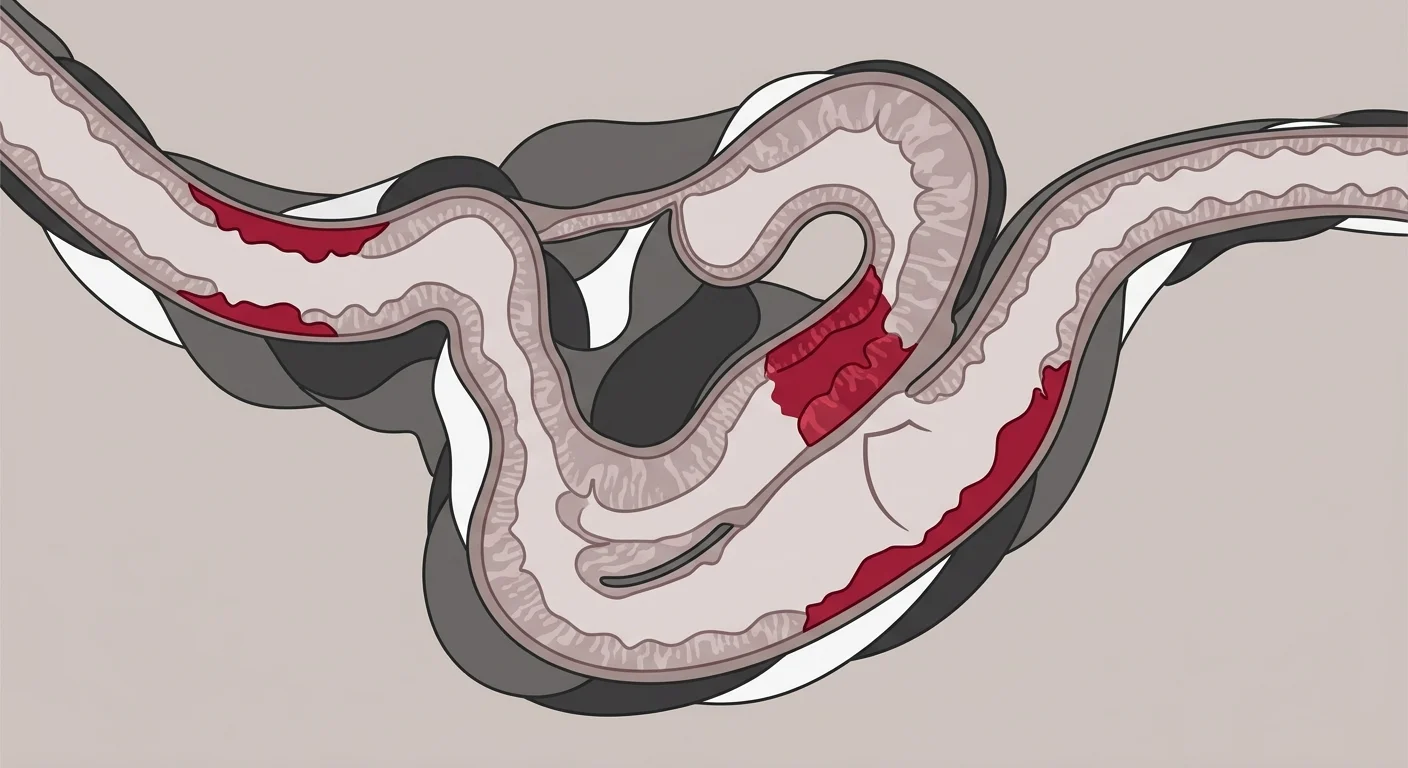
That's the first clock. But there's a second one — and it's running inside the gut.
Every dose of phenylbutazone that silences the pain signal runs through the COX pathway. And the COX pathway does not govern inflammation alone. It governs the prostaglandins that hold the stomach lining together. Suppress those enzymes aggressively enough, and the GI tract loses its own protective architecture.
And nobody talks about this part. Owners see the horse moving better. Nobody's watching the stomach.
Prostaglandin Suppression and the Mucosal Damage Pathway
Here's what actually happens. Phenylbutazone blocks the COX pathway — the same enzymes that control prostaglandin production in the gut wall. And that inhibition has a ceiling most long-term protocols blow straight past. NSAID-driven COX suppression can reduce mucosal prostaglandin synthesis by up to 90%.
That's not reduced protection. That's near-total elimination.
Prostaglandins regulate mucosal blood flow. When that supply collapses, the stomach lining loses the mechanism it depends on to repair itself. The lesions don't scatter randomly. They concentrate in the stomach wall and the right dorsal colon.
The damage follows the biology. It always does.
What the University of Minnesota Extension documents is unambiguous: phenylbutazone carries a narrow therapeutic index and a very low margin of safety. Administration exceeding five consecutive days dramatically increases the risk of systemic clinical toxicity.
The window between therapeutic and harmful is not wide. And every day the root mechanical cause goes unaddressed, the horse stays inside it.
Right Dorsal Colitis: What Chronic Bute Use Actually Produces
Right dorsal colitis isn't a rare complication. It's the documented endpoint of a predictable sequence: COX inhibition, prostaglandin loss, mucosal blood flow collapse, tissue breakdown in the right dorsal colon.
The horse that's been on bute for weeks isn't a horse that received extended pain management. It's a horse whose GI tract has been running without its protective barrier.
The FDA documents what prolonged or high-dose phenylbutazone use actually produces: GI tract damage, renal papillary necrosis, blood dyscrasias. These aren't outcomes reserved for horses with pre-existing conditions.
They're the consequences of a drug with a narrow therapeutic index running past its safe window — while the underlying mechanical problem stays completely untouched.
The contrast with root-cause chiropractic adjustments is clearest here. One approach suppresses the alarm, erodes the GI tract, and narrows the body's safety margin with every passing day. The other locates the mechanical restriction, corrects it directly, and leaves both the horse's pain-signaling architecture and its stomach lining intact.
The clock keeps ticking either way. The question is which approach actually stops it.
| Duration of Bute Use | Primary Risk | Organ System Affected | Clinical Consequence |
|---|---|---|---|
| Short-term (standard dose) | GI tract damage | Stomach and right dorsal colon | Mucosal prostaglandin synthesis suppressed by up to 90%, destroying the stomach lining's protective barrier |
| Exceeding 5 consecutive days | Systemic clinical toxicity | Multi-system (GI, renal, blood) | Risk of systemic toxicity escalates dramatically — narrow margin of safety collapses |
| Prolonged or high-dose use | GI tract damage and right dorsal colitis | Right dorsal colon and stomach wall | Lesions concentrate in the stomach and right dorsal colon as mucosal blood flow is eliminated |
| Prolonged or high-dose use | Renal papillary necrosis | Kidneys | Prolonged or high-dose use leads to GI tract damage, renal papillary necrosis, and blood dyscrasias |
| Prolonged or high-dose use | Blood dyscrasias | Circulatory system | Narrow therapeutic index means prolonged administration produces hematological complications alongside GI and renal damage |
Reading the Gait: What the Horse Is Still Telling You
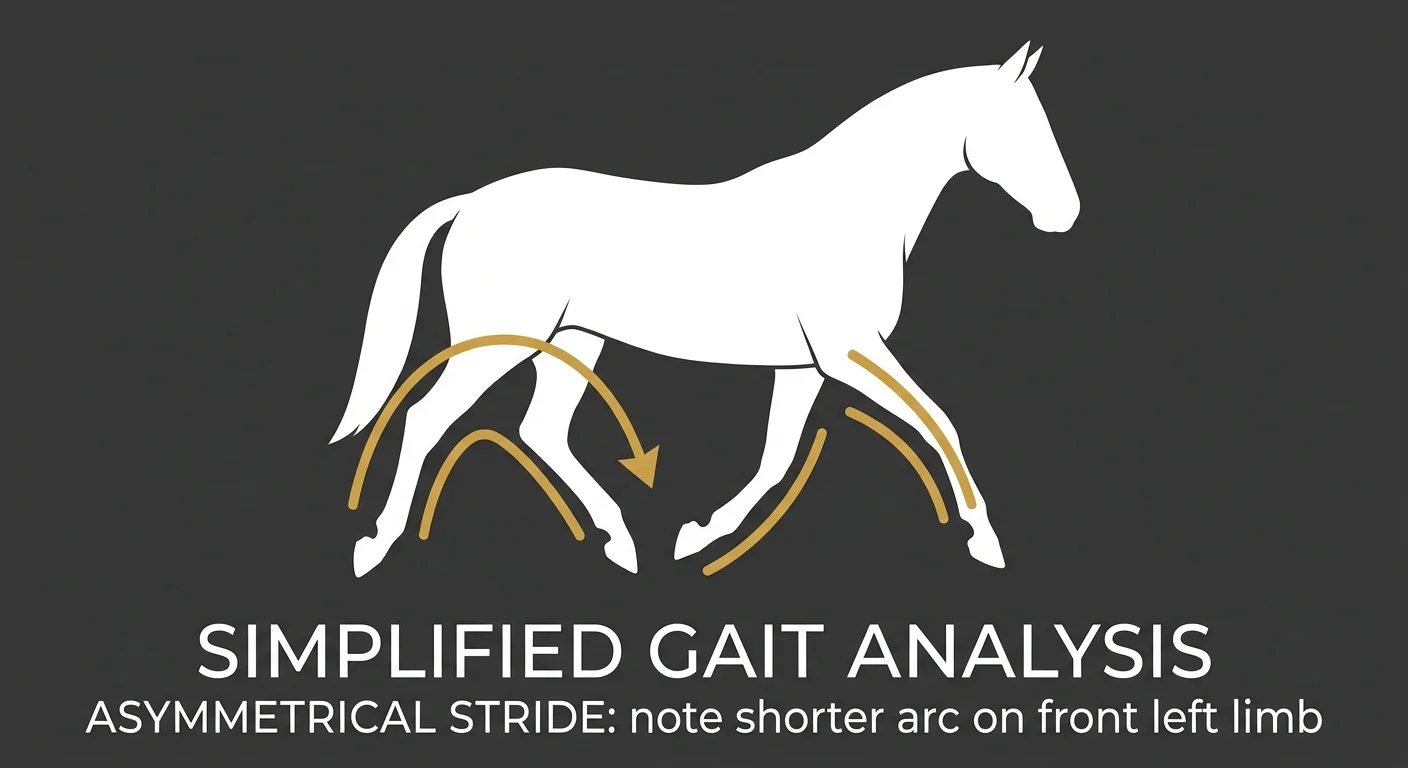
Bute quiets the signal. The structural problem generating that signal keeps running.
That's the whole trap.
Two damage tracks are already running — the spinal restriction loading under full training intensity, the GI tract eroding dose by dose. Both run silently.
But the horse hasn't stopped talking. The compensatory signals persist even when the pain threshold has been artificially raised. The nervous system is still transmitting. The question is whether anyone is positioned to receive it.
Pharmaceutical suppression doesn't erase gait signals. It dims them.
What survives are the signals pointing directly at structural sources — the subtle asymmetries, the reluctance patterns, the compensatory weight shifts no NSAID fully erases. Those aren't noise. Those are the diagnostic data bute has been filtering out.
The 0-to-5 Lameness Scale and What Each Grade Signals Mechanically
The standardized equine lameness scale runs from 0 to 5. Zero means no detectable lameness. Five means minimal weight-bearing.
What the Oklahoma State University Extension lameness assessment framework documents is that structural pain registers at Grades 1 and 2 as subtle gait alterations — the kind most owners read as stiffness, mood, or a bad training day. Those aren't attitude problems. Those are the earliest mechanical broadcasts the nervous system sends.
A Grade 1 horse isn't 'off.' It's early.
The compensatory head nod, the slight hip hike, the fractional stride shortening on one diagonal — these are the nervous system's first localized broadcasts. They're specific. They point somewhere. And they disappear the moment bute brings the pain signal below the horse's behavioral expression threshold.
The clock keeps ticking. The grade stays hidden.
The lameness scale was built to catch dysfunction before it becomes catastrophic. Bute intercepts it at the exact grade where that scale is most useful — early — and replaces the owner's view of a Grade 1 or Grade 2 horse with the view of a Grade 0 horse.
The mechanical reality underneath doesn't change. The owner's access to it does.
Compensatory Patterns That Survive Pharmaceutical Suppression
Compensatory patterns aren't the primary problem. They're the body's working solution to one.
A vertebral restriction. A misaligned segment. A joint not tracking correctly through its range of motion. The compensation is the horse reorganizing around a structural failure it can't fix on its own.
When a horse guards a restricted segment, it redistributes load through adjacent joints and soft tissue. That redistribution shows up as asymmetrical muscle development, altered stride length, and the hip hike that indicates the pelvis isn't moving symmetrically.
These patterns survive pharmaceutical suppression because they're structural adaptations — not pain responses. The horse isn't flinching. It's reorganizing. Bute has no mechanism for that.
Here's what stays readable even through a bute protocol: the head nod diminishes. The hip hike remains. The stride asymmetry persists.
An owner who knows what to watch for — and understands that compensation patterns outlast chemical suppression — is still receiving information. Most aren't trained to read it. And the conventional management model isn't built to ask them to.
When Chiropractic Assessment Picks Up What Bute Has Hidden
Segmental mobility evaluation doesn't rely on behavioral pain expression. It doesn't need the horse to flinch or refuse.
It locates vertebral restrictions through direct palpation and range-of-motion testing — the same methodology that peer-reviewed NIH clinical research confirms identifies segmentally restricted pelvic or back mobility in over 70% of performance horses evaluated. That's not a rare finding. That's the baseline.
That's the clinical picture bute has been managing around. Not resolving — managing around.
And an AVCA Certified Animal Chiropractic evaluation isn't interchangeable with an assessment by someone without formal training. The legal and safety distinctions between certified practitioners and lay adjusters are significant — and they bear directly on whether what's happening to your horse's spine is qualified care or expensive guesswork. The credential isn't a cosmetic difference. It's the whole question.
What chiropractic assessment surfaces is the mechanical reality the horse has been compensating around — often for months — while bute kept the behavioral expression below the owner's detection threshold.
Correcting the restriction restores the range of motion the joint lost. It reinstates the pain-signaling architecture as a functional feedback tool rather than a suppressed alarm. The horse's natural protective guard reflexes return.
And the silent damage clock, for the first time, actually stops.
| Lameness Grade | Observable Sign | What It Indicates Mechanically | NSAID Effect on Visibility |
|---|---|---|---|
| Grade 0 | No detectable gait irregularity | No lameness present; joint mechanics functioning within normal range | No effect — baseline reading |
| Grade 1 | Subtle compensatory head nod; fractional stride shortening on one diagonal | Early vertebral restriction or joint misalignment — nervous system broadcasting localized mechanical stress | Pain signal suppressed below behavioral expression threshold; Grade 1 reads as Grade 0 under NSAID coverage |
| Grade 2 | Consistent hip hike; asymmetrical stride length; mild reluctance on one rein | Pelvic segment not tracking symmetrically through range of motion; load redistribution already underway | Head nod diminishes under NSAIDs; hip hike and stride asymmetry persist as structural adaptations — not pain responses |
| Grade 3 | Obvious lameness at trot; consistent weight-off loading; marked muscle asymmetry | Sustained mechanical overload on adjacent joints from months of compensatory redistribution; structural damage progressing | NSAID coverage at this grade is managing around a restriction that has been accelerating uncorrected — chemical suppression narrows the safety margin |
| Grade 4–5 | Severe lameness; minimal or non-weight-bearing; visible distress | Joint deterioration advanced; protective guard reflexes suppressed long enough that the body's compensatory architecture has broken down | NSAIDs no longer masking — damage has outpaced suppression; natural protective guard reflexes cannot compensate for the structural collapse |
Frequently Asked Questions
Bute silences the alarm. The damage keeps accumulating underneath it.
What follows are the questions that don't get answered at the barn — the ones where the real answer costs more than a refill.
Some come up after the third bute cycle. Some come up after the horse still isn't right.
All of them matter more than the standard management model has room to admit.
How does long-term bute use mask spinal subluxations in performance horses?
Phenylbutazone raises the pain threshold. It doesn't touch the vertebral restriction that produced the pain signal.
So the horse moves more freely — and loads the restricted segment more aggressively — while the mechanical damage progresses without a single behavioral flag to interrupt it.
The suppression isn't selective. It quiets the entire signaling architecture. The owner sees a sound horse. The restricted joint sees a horse working at full load with no protective guard response left.
That gap — between how the horse looks and what the joint is experiencing — is exactly where the damage accumulates. The clock keeps ticking. It just does it quietly.
What are the clinical signs of right dorsal colitis from equine NSAID overuse?
NSAIDs knock out the COX enzymes that keep mucosal prostaglandin synthesis running — by up to 90%. Those prostaglandins regulate mucosal blood flow. Pull them, and the stomach lining and right dorsal colon lose both their protective barrier and their ability to repair.
Right dorsal colitis shows up as weight loss, intermittent colic, reduced appetite, loose manure. Signs that are easy to blame on stress, travel, or a feed change.
The GI damage doesn't announce itself cleanly. It runs on its own timeline — the same way the spinal damage does — while the horse continues to look manageable from the outside.
Can animal chiropractic address the root mechanical cause of equine gait issues?
Yes — and that distinction is the entire clinical argument.
Segmental mobility evaluation finds the specific vertebral restriction through direct palpation and range-of-motion testing. It doesn't need the horse to express pain behaviorally. It finds the mechanical source directly — the restriction itself, not the behavioral echo of it.
The adjustment addresses the segment: restoring the range of motion the joint lost, reinstating the nervous system's feedback architecture, removing the load imbalance redistributing through adjacent structures.
Over 70% of performance horses evaluated presented with segmentally restricted pelvic or back mobility. That is not a rare finding. That is the clinical baseline of horses currently in work.
Bute addresses none of what the adjustment corrects. That is not a close comparison.
What are the risks of using phenylbutazone for more than five consecutive days?
Phenylbutazone carries a narrow therapeutic index and a very low margin of safety. Past five consecutive days, the risk of systemic clinical toxicity rises sharply.
The documented consequences are not theoretical: GI tract damage, renal papillary necrosis, blood dyscrasias.
These aren't outcomes reserved for horses with pre-existing vulnerabilities. They're the predictable endpoint of a drug running past its safe window — while the mechanical problem it was masking continues, unaddressed, underneath.
The window between therapeutic and harmful isn't wide. And it narrows every day the structural source stays uncorrected.
How do clinicians differentiate between primary joint lameness and spinal subluxations?
Primary joint lameness localizes to a specific distal structure — a joint, a tendon, a hoof — and responds to nerve blocks at that site. The clinical picture is clean.
Spinal subluxations produce a different pattern: diffuse gait asymmetry, compensatory shifts that move across sessions, reluctance in specific movement planes, segmental stiffness that survives standard lameness workups without a clean localization.
Segmental mobility testing — direct palpation of vertebral segments through their range of motion — identifies restrictions that don't show on radiograph and don't localize to a distal structure. The restriction is there. Standard workups aren't built to find it.
The differentiation requires a practitioner trained to evaluate both systems. An AVCA-certified evaluation applies that credential to a structured assessment of the spine — not a supplementary opinion. The diagnostic work the standard lameness workup wasn't designed to do.
The Clock Doesn't Stop Because the Horse Stops Limping
The horse stops limping. The bute gets refilled. And the vertebral restriction that started everything keeps loading — silently, progressively, with nothing behavioral left to interrupt it.
That's not a treatment outcome. That's a managed illusion — and managed illusions have a bill that comes due.
The silent damage clock was never about pain. Pain was the warning. Bute silenced the warning.
What kept running — the restricted segment, the compensatory load redistribution, the GI tract stripped of its protective barrier — ran on its own timeline. Indifferent to whether the horse looked comfortable at the trot. Indifferent to whether the owner felt reassured at the fence.
The clock doesn't stop because the horse stops limping. It stops when the mechanical cause is located, addressed, and corrected. That's the work Touch of Wellness Chiropractic is built to do.
Here's the thing: if the horse in your care has been on long-term bute — moving better, but never quite right — that's not a success story in progress.
That's the clock still running.
AVCA Certified Animal Chiropractic evaluation doesn't replace the pharmaceutical conversation. It answers the question bute was never designed to answer: what is the mechanical source, and what does it actually take to correct it. The horse looks better. That has never meant the horse is better. Those are two completely different things — and until the mechanical restriction is found and addressed, the clock keeps ticking.
The bute quieted the problem. It didn't answer it. If that horse is still not quite right after the pain is managed, the spine hasn't been looked at — and that's the question that's been sitting there the whole time. An AVCA-certified Animal Chiropractic evaluation is where that question gets a real answer.