
Why Desk Workers Experience Co-Occurring Tension Headaches and Jaw Clicking
Desk workers who get tension headaches and jaw clicking at the same time aren't dealing with two separate conditions. They're dealing with one mechanical failure expressing itself in two places.
The head, neck, and jaw operate as a single load-bearing chain — not independent structures. When hours at a screen pull the head forward, the cervical spine absorbs that shift. The muscles of the neck and jaw compensate together. Forward head posture alters the biomechanics of the temporomandibular joint and increases strain throughout the cervical musculature. The jaw doesn't click because something is wrong with the jaw in isolation. It clicks because the system it depends on is out of alignment.
The tension has to go somewhere. In desk workers, it goes to the neck and the jaw simultaneously.
TMJ disorders affect between 5% and 12% of the population, with the highest concentration in younger adults — exactly the demographic logging the most screen time. Up to 70% of people with TMJ disorders also report co-occurring tension-type headaches or neck tension. That overlap isn't coincidence. It's anatomy.
So many desk workers treat their headaches and jaw problems separately — and neither one fully resolves. The headache gets managed with pain relief. The jaw gets a dental splint. Both symptoms return. Neither intervention touched the cervical spine dysfunction generating both.
Manual therapy directed at the cervical spine produces measurable improvements in jaw range of motion and headache frequency. Chiropractic care is a recognized, non-pharmacological approach for tension-type headaches. But the critical point isn't which treatment works in isolation — it's that treating the neck and jaw as one connected system is what produces lasting results. Treating them separately is why the symptoms keep coming back.
Last Updated: August 25, 2026
- • The Real Reason Your Jaw and Head Hurt at the Same Time
- • Who Actually Gets Both Symptoms — And Why It's Not Random
- • What Happens When You Only Treat One Side of the Problem
- • What Has to Change for Both Symptoms to Resolve
-
• Frequently Asked Questions
- • Why do my jaw clicking and tension headaches happen at the same time?
- • Can poor desk posture cause both TMD and tension headaches?
- • Why does standard dental TMJ treatment fail to resolve my tension headaches?
- • How does cervical spine care relieve jaw pain and clicking?
- • What should I do if dental splints aren't fixing my jaw clicking?
- • Stop Treating Two Problems That Are Actually One
The Real Reason Your Jaw and Head Hurt at the Same Time
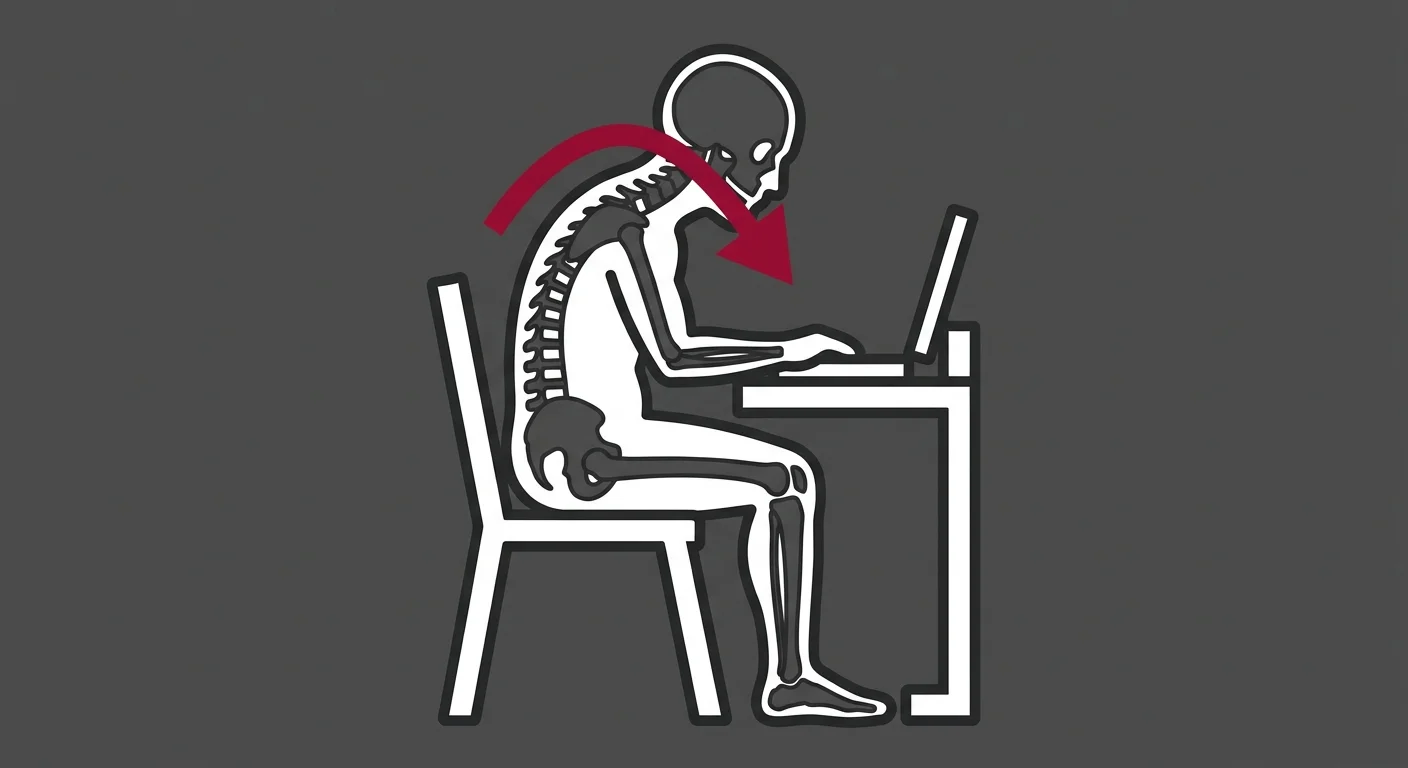
Your jaw and head hurt at the same time because they share the same root. That's not a metaphor. It's anatomy — and it starts the moment you sit down at a desk.
The cervical spine doesn't just hold your head up. It anchors the whole chain — from your skull down through your jaw muscles. Push that chain forward for eight hours at a screen, and nothing downstream stays neutral.
According to NIH data, TMJ disorders affect between 5% and 12% of the population — concentrated heavily in younger adults who log the most cumulative hours at workstations. That concentration isn't coincidence. It's a postural pattern with a predictable outcome, and the demographic it hits hardest is the one spending the most time in exactly the wrong position.
One Chain, Two Symptoms
The head, neck, and jaw aren't separate departments. They're one load-bearing chain. When desk posture pulls the head forward, every structure downstream compensates — and the jaw is downstream.
Forward head posture changes how the temporomandibular joint loads and tracks. The jaw's resting position shifts. The muscles of mastication compensate for what the cervical spine is no longer holding correctly. That clicking you hear isn't a dental problem waiting for a splint — it's mechanical feedback from a system that's no longer aligned at the source.
Published research puts the co-occurrence rate at up to 70% — meaning seven out of ten people with TMJ disorders also report tension-type headaches or persistent neck tension. That's not two conditions. That's one chain pulling on itself from both ends.
Why the Cookie-Cutter Approach to TMJ Gets It Wrong
Here's the thing: most TMJ patients end up in a dental chair. That's where the diagnosis lands, so that's where treatment begins and ends. A splint gets made. The bite gets measured. But the cervical spine — the structure that's actually loading the jaw from above — never gets assessed.
That's the cookie-cutter failure in plain terms. Dental-only management treats the jaw as if it exists in isolation — as if the cervical spine above it isn't loading it every hour of every workday. Patients who've spent months in splints without lasting relief are often the ones who eventually learn that when dental splints stop working, the cervical spine was part of the picture the whole time.
Individualized chiropractic care starts where the dental model stops — with the cervical subluxations and postural collapse that pull the jaw out of its natural resting position before the first symptom ever shows up.
Treating two symptoms without addressing one shared cause isn't a care plan. It's a loop. The headache returns. The jaw keeps clicking. And the desk worker keeps cycling through the same interventions wondering why nothing sticks. The answer isn't a different splint or a stronger pain reliever. It's a provider who's willing to look at the chain instead of just one of its links.
| Symptom | Where It Shows Up | Shared Root Cause | Commonly Misattributed To |
|---|---|---|---|
| Jaw clicking | Temporomandibular joint | Cervical misalignment and forward head posture disrupting jaw tracking | Dental bite misalignment or teeth grinding habit |
| Tension headaches | Base of skull, temples, or forehead | Chronic cervical muscle overload from sustained forward head posture | Stress, dehydration, or screen time eye strain |
| Jaw clenching and teeth grinding | Muscles of mastication | Postural stress loading the neck and jaw simultaneously throughout the workday | Anxiety or sleep disorder in isolation |
| Neck stiffness and restricted range of motion | Upper cervical spine | Prolonged desk posture compressing cervical structures and shortening posterior neck muscles | Sleeping position or acute muscle strain |
| Facial muscle tightness and fatigue | Cheeks, temples, and jaw hinge | Sustained muscular compensation for a cervical spine that's no longer in neutral | Chewing habits or dental occlusion problems |
Who Actually Gets Both Symptoms — And Why It's Not Random
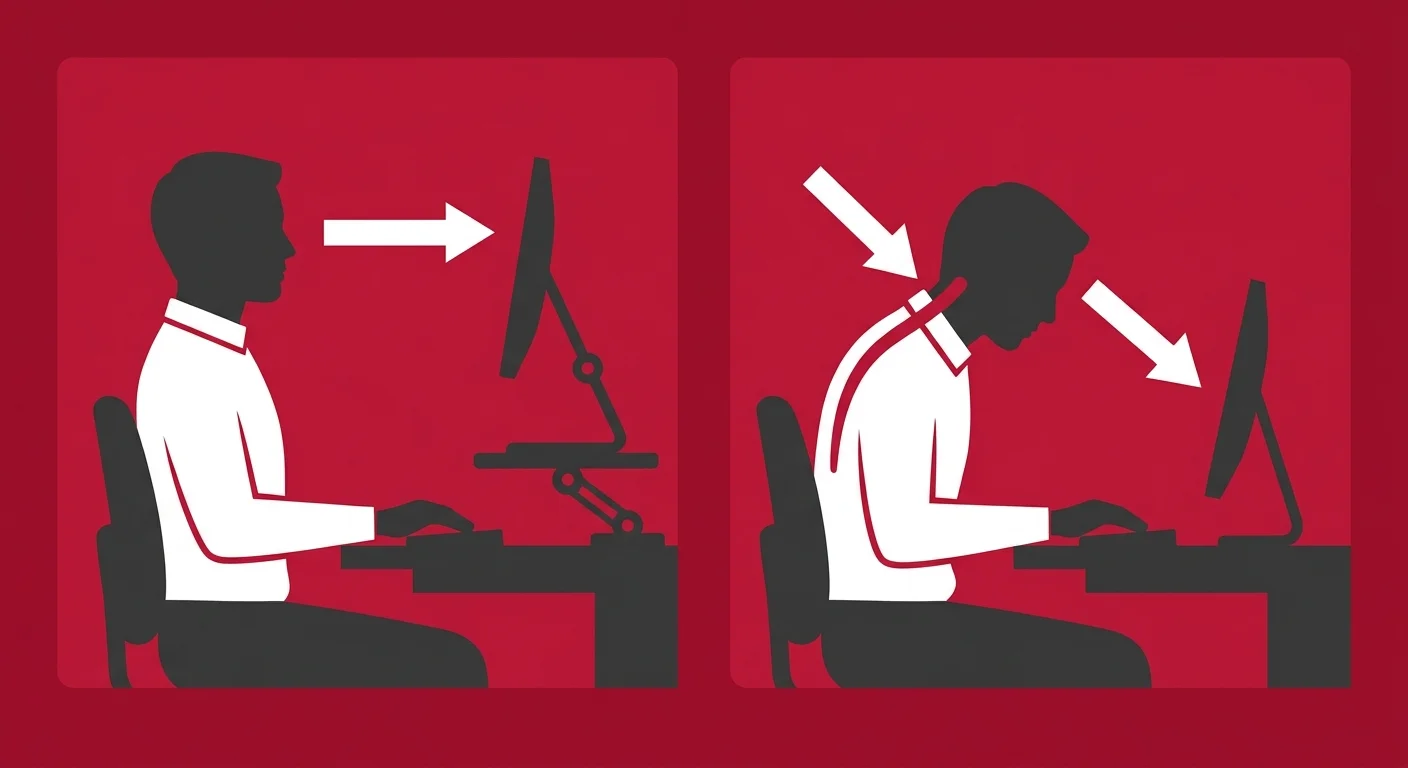
Not every desk worker ends up with both. But the ones who do share a predictable profile. And it has nothing to do with how many hours they log on a screen.
The desk workers who get both symptoms are the ones whose heads have drifted forward at the workstation — over months, sometimes years. That drift doesn't just strain the neck. It changes where the jaw sits. It changes how the muscles of mastication fire. It changes how tension distributes across the entire cervicocranial system. One shift in cervical position. Everything downstream pays for it.
That distinction matters more than most people realize — because the wrong diagnosis sends you to the wrong provider. Before any assessment is worth having, you need to differentiate jaw-driven from neck-driven head pain. Get that wrong and every intervention that follows is aimed at the wrong target. You're not failing treatment. You're treating the wrong problem.
The Desk-Posture Cascade That Loads Both Systems
Here's what actually happens at the desk. The head drifts forward. The cervical spine curves to compensate. The muscles at the base of the skull shorten. And the jaw — which depends on that cervical foundation for its resting position — shifts out of alignment.
NIH research on posture and TMJ confirms that forward head posture significantly alters temporomandibular joint biomechanics and increases strain throughout the cervical musculature. The mandible doesn't hang there independently. Its resting position is shaped directly by the angle of the cervical spine above it. Change that angle — the way a forward-drifting head does every hour at a desk — and you change everything downstream.
Chronic postural stress at a workstation directly triggers jaw clenching, teeth grinding, and localized mechanical overload in the joint itself. That's the full chain. Posture loads the cervical spine. The cervical spine loads the jaw. The jaw loads the muscles of mastication. And the tension has to go somewhere. In most desk workers, it surfaces as pain at the base of the skull — which gets labeled a headache and handed to the wrong provider.
This Is Not the Right Fit for Everyone
This isn't for everyone. If you're expecting a dental-style bite adjustment, you're at the wrong door. If you believe one session erases years of postural loading, that's not what happens here — and no honest provider will tell you otherwise.
If you've already decided which modalities are acceptable before anyone has assessed your spine — if you won't engage an evaluation before declaring what treatment you need — the assessment-first model here isn't going to work for you. The assessment drives the care plan. Not the other way around. That's not a negotiating position. It's a clinical standard.
And if you want a one-visit resolution to a postural pattern that built over years at a desk, that's not an honest expectation. What this model offers is a real look at the whole chain. Not a patch on one of its links.
| Postural Factor | Effect on Cervical Spine | Effect on Jaw and TMJ | Typical Desk-Worker Trigger |
|---|---|---|---|
| Forward head posture | Increases compressive load on cervical vertebrae and shortens suboccipital muscles | Shifts the mandible out of its natural resting position, altering how the jaw tracks during movement | Head drifts forward toward the monitor over hours of screen time |
| Sustained neck flexion | Creates chronic tension in the muscles running from the cervical spine to the base of the skull | Overloads the muscles of mastication as they compensate for altered cervical alignment | Looking down at a keyboard or second monitor for extended periods |
| Rounded shoulders and upper back collapse | Accelerates forward head drift by removing the thoracic support that holds the cervical spine upright | Increases the mechanical demand on the jaw joint, which depends on an aligned cervical foundation above it | Slouching into a chair back without lumbar or shoulder support during long work sessions |
| Chronic postural muscle bracing | Triggers persistent tension in the cervical stabilizers, reducing range of motion and compressing facet joints | Drives jaw clenching and teeth grinding as the body braces systemically against unresolved cervical load | Stress-loaded desk work where the body holds tension without release throughout the workday |
| Static posture with no positional breaks | Allows compressive cervical loading to accumulate without reset, progressively deepening the postural collapse pattern | Prevents the muscles of mastication from releasing, leading to sustained overload in the TMJ | Uninterrupted work blocks with no movement, stretching, or postural correction throughout the day |
What Happens When You Only Treat One Side of the Problem
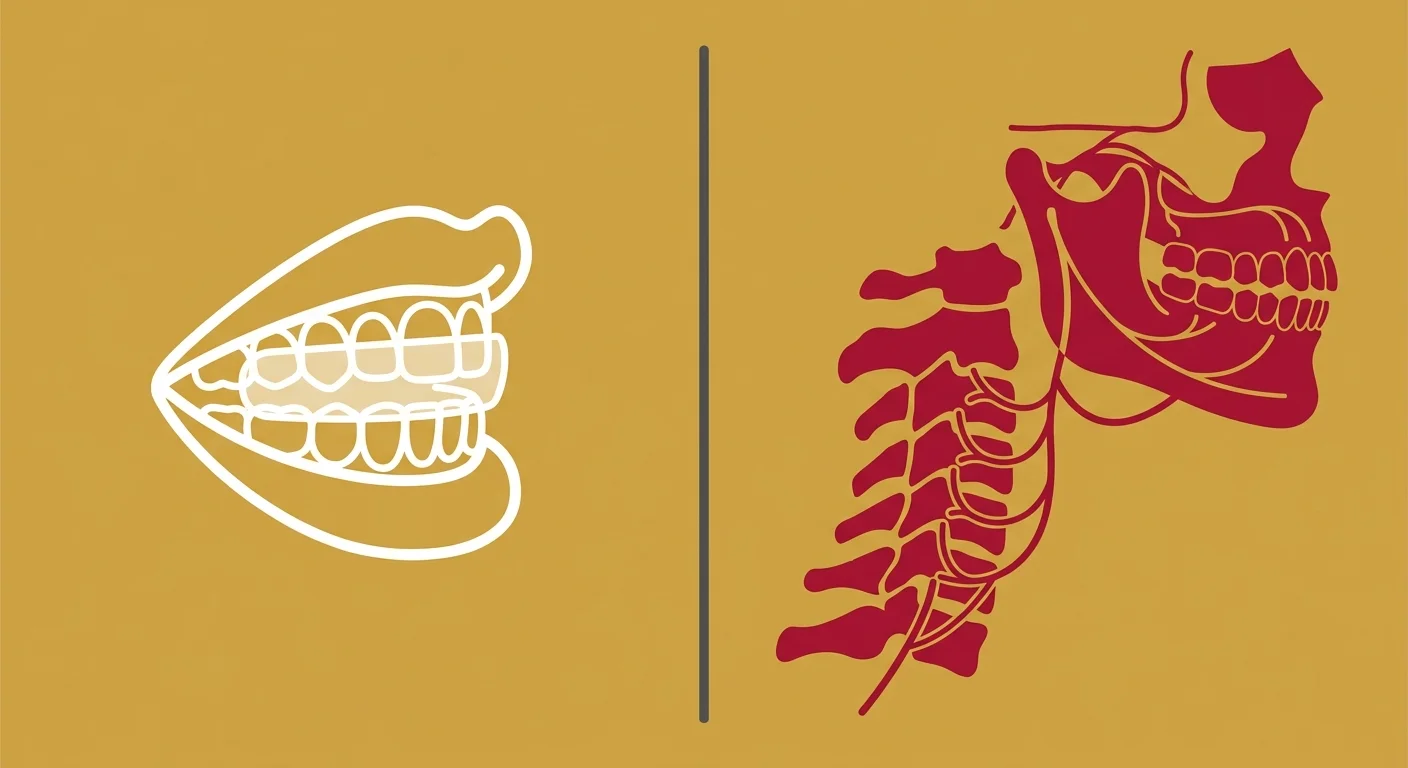
Treating the jaw and the head as two separate problems is exactly why so many desk workers stay stuck.
One appointment for the headache. Another for the jaw. And the cervical spine — the structure generating both — never gets assessed.
That's not two treatment failures. That's one root cause going untouched.
Up to 70% of people with TMJ disorders also report co-occurring tension-type headaches or neck tension.
Not a coincidence. One mechanical system expressing the same root failure in two different locations.
So you treat one side. The headache backs off for a few days. The jaw clicks less after the splint is fitted.
Then both come back.
The chain hasn't been corrected. It's been managed at one link — and tension has to go somewhere. It always finds its way back.
Why Dental Splints Alone Don't Break the Cycle
Dental splints do something real. They reduce tooth grinding, redistribute bite pressure, and can take localized strain off the jaw joint.
But they don't change the cervical spine mechanics loading the jaw from above. That load doesn't disappear because the bite is balanced. It keeps accumulating — and the jaw keeps paying for it.
That's the cycle. The splint helps — until the postural load rebuilds the tension and the jaw clicks again.
Patients who've gone through a first chiropractic exam for chronic headaches and TMJ often describe years of rotating through dental interventions without anyone evaluating the cervical spine.
Years. And the neck never came up.
The splint isn't the wrong tool. It's an incomplete one.
Dental-only management treats the end of the chain — the jaw — without asking why the chain collapsed. Until the cervical spine is in the picture, the cycle doesn't break.
What the Research Actually Shows About Cervical Involvement
NIH-indexed clinical findings show that manual therapy and targeted adjustments directed at the cervical spine produce significant improvements in jaw range of motion and headache frequency.
That's not a marketing claim. That's a measurable, documented outcome — exactly what you'd expect when you treat the structure that's actually generating the symptoms, not the structure absorbing the fallout.
Professional association evidence confirms that chiropractic adjustments are a recognized, non-pharmacological approach to reducing both the frequency and intensity of tension-type headaches.
The mechanism isn't complicated. Correct the cervical dysfunction. Reduce the load on the cervicocranial system. The headache pattern shifts.
And knowing how to differentiate between a migraine, TMD, and a cervicogenic headache is what makes that intervention precise instead of a guess.
The research keeps pointing back to the same conclusion.
The jaw and the neck are one system. Treating them as one system produces results that treating either in isolation simply doesn't.
That's not a new idea. It's just one the dental-only model keeps setting aside — and patients keep paying for that gap.
| Treatment Approach | What It Addresses | What It Misses | Typical Patient Outcome |
|---|---|---|---|
| Dental splint only | Bite pressure distribution, tooth grinding, localized jaw joint strain | Cervical spine mechanics loading the jaw from above; forward head posture driving the entire pattern | Temporary relief from jaw symptoms; tension headaches persist or return; cycle repeats when postural load rebuilds |
| Pain medication only | Symptom suppression — headache pain and muscle tension in the short term | The mechanical source of both the headache and the jaw dysfunction; no structural change occurs | Headache backs off temporarily; returns when medication wears off; underlying postural load never addressed |
| Cervical spine care only (without jaw awareness) | Cervical alignment, upper neck subluxations, cervicocranial muscle tension | Jaw-specific dysfunction patterns that may require coordinated assessment alongside spinal correction | Headache frequency often improves; jaw symptoms may partially resolve but are not fully evaluated |
| Dental splint plus cervical spine care | Bite mechanics at the jaw joint AND the spinal mechanics loading the jaw from above | Ergonomic and behavioral factors at the workstation that perpetuate postural collapse between appointments | Significant reduction in both headache frequency and jaw clicking; gains hold longer because the root load is addressed |
| Individualized assessment-first model (cervical, postural, and jaw evaluated together) | The full mechanical chain — head position, cervical alignment, jaw resting state, and muscle tension patterns — as one system | Nothing structurally relevant is bypassed; treatment follows what the assessment actually finds | Care plan fits the patient's actual clinical picture; relief is more durable because the chain is corrected, not just managed at one link |
What Has to Change for Both Symptoms to Resolve
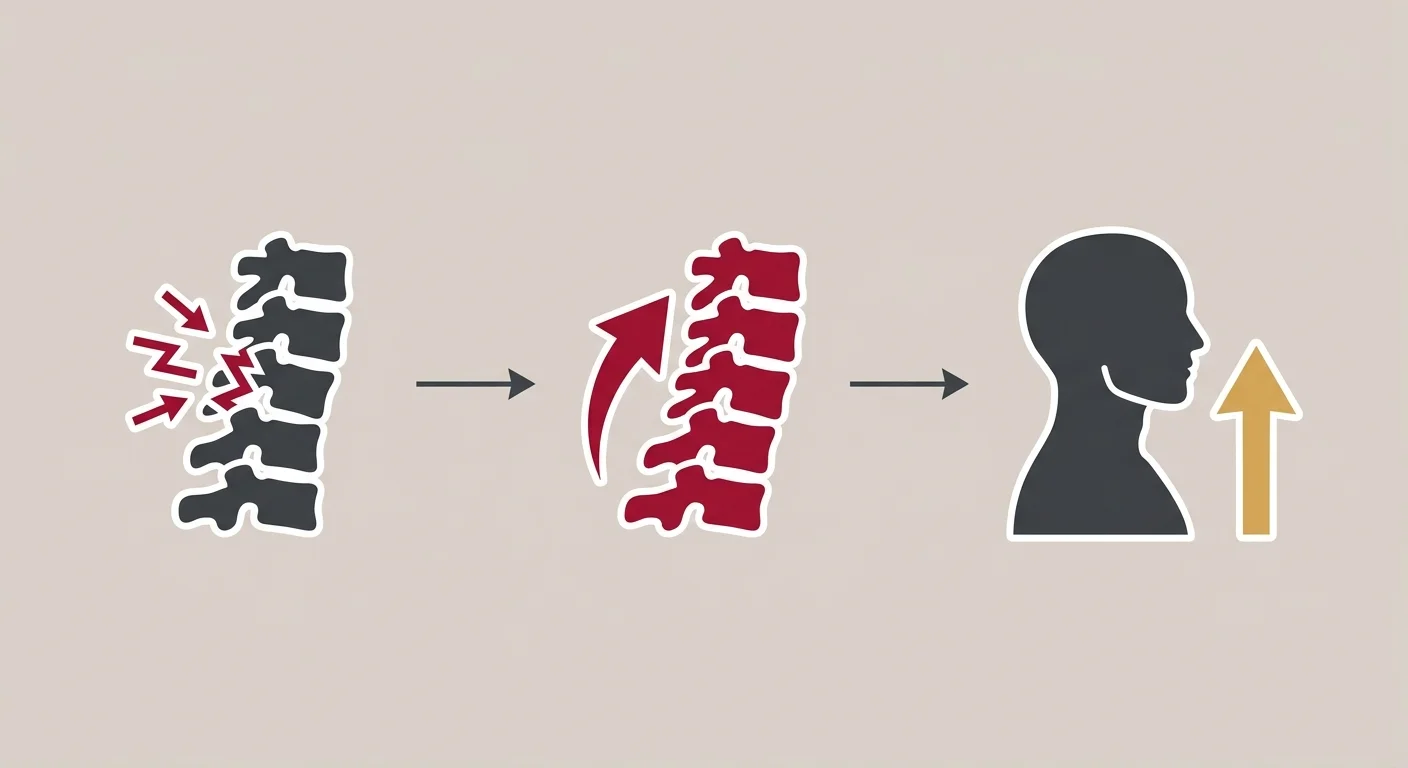
So here's where everything lands.
Not 'which symptom do you treat first?' That's the wrong question. The right question is what actually has to change for both symptoms to resolve — not for a week, but structurally.
It's not a different splint. It's not a stronger muscle relaxant.
It's the cervical spine mechanics. That's the structure loading the jaw from above and generating tension throughout the cervicocranial system. Until that gets assessed and corrected, the cycle doesn't break — it just restarts.
Targeted adjustments to the cervical spine produce measurable improvements in jaw range of motion and headache frequency. That's not a side effect. That's what happens when you treat the chain instead of one link at a time.
Cervical Alignment as the Starting Point — Not an Add-On
Cervical alignment isn't something you add on after the dental work is done. It's the starting point.
The jaw's resting position, its tracking under load, the muscular tension feeding both the clicking and the headache pain — all of it is downstream of how the cervical spine is positioned. You can't resolve what's downstream without addressing what's upstream.
Research into whether restoring upper cervical alignment halts recurring tension headaches keeps pointing to the same structural reality. When the atlas and axis are out of position, the tension pattern doesn't stay in the neck. It distributes upward into the skull and downward into the jaw. That's not a theory. That's the load path — and it's exactly what gets missed when the assessment starts and ends with the bite.
The American Chiropractic Association recognizes chiropractic adjustments as an effective, non-pharmacological approach to reducing the frequency and intensity of tension-type headaches. That recognition exists because correcting cervical dysfunction reduces the load on the entire system. Not just the neck. The whole chain.
What a First Assessment for This Pattern Actually Looks Like
A real assessment for this pattern doesn't start with the jaw.
It starts with the cervical spine. That's where the load originates. The jaw findings come after the cervical picture is clear — not before.
At Touch of Wellness Chiropractic, Dr. Karen Hannah's assessment for this pattern evaluates cervical alignment, postural load, and the specific subluxations feeding tension into the cervicocranial system.
That's what a first chiropractic exam for chronic headaches and TMJ looks like when it's built from what you actually report — not from a standard intake form that treats every patient's jaw the same way.
Chronic postural stress at a workstation directly triggers jaw clenching, teeth grinding, and mechanical overload in the joint. That means the assessment has to account for how you sit, how long you've been sitting that way, and what that cumulative load has done to the cervical spine. The tension has to go somewhere. Figuring out exactly where it's been going is step one. Everything else comes after that.
| Clinical Focus Area | Assessment Finding | Connection to Headache or Jaw Symptom | Care Priority |
|---|---|---|---|
| Cervical spine alignment | Subluxations at C1–C2 and surrounding vertebral segments altering load distribution | Drives tension upward into the skull and downward into the jaw, feeding both headache and jaw clicking | Starting point — assessed before any jaw findings are interpreted |
| Forward head posture | Head displaced anterior to the shoulders, shortening suboccipital muscles and shifting mandibular resting position | Creates mechanical overload in the cervicocranial system and forces the jaw out of its natural alignment | Evaluated through postural load assessment alongside cervical findings |
| Cervical musculature tension | Chronic shortening and trigger point activity in neck muscles from sustained desk posture | Refers pain into the skull and alters how the muscles of mastication fire under load | Addressed through cervical care — not jaw-specific intervention |
| Jaw resting position and tracking | Mandibular position and movement pattern disrupted by upstream cervical misalignment | Produces the clicking, locking, and uneven bite load reported as TMJ symptoms | Reassessed after cervical alignment is corrected — not treated in isolation first |
| Cumulative workstation load | Duration, frequency, and ergonomic pattern of desk posture over months or years | Determines how deeply the postural collapse has loaded the cervical spine and how that load has transferred to the jaw | Informs care plan scope — what you actually report drives the plan, not a standard protocol |
Frequently Asked Questions
Knowing the mechanism is step one. But it doesn't tell you what's actually happening in your spine — especially when the dental route already came up empty.
These are the questions that come after the mouthguard didn't fix it. Straight answers — because you've already sat through enough vague ones.
Why do my jaw clicking and tension headaches happen at the same time?
They share the same structural root. The cervical spine connects directly to both the skull and the jaw. When forward head posture loads that system, tension distributes into both regions at once. Up to 70% of people with TMD also report co-occurring tension headaches or neck tension. That's not two conditions running in parallel. It's one postural collapse expressing itself in two locations.
Can poor desk posture cause both TMD and tension headaches?
Yes — and the mechanism is direct. Sustained desk posture drives the head forward, increasing cervical load and shifting the jaw's resting position. That postural stress triggers jaw clenching, teeth grinding, and mechanical overload in the joint. The neck and jaw muscles don't function independently at a workstation. They share the load — and when that load exceeds what the system can absorb, they share the breakdown too.
Why does standard dental TMJ treatment fail to resolve my tension headaches?
Because it addresses the end of the chain, not the source of the load. Dental splints reduce grinding and redistribute bite pressure — that's real. But they don't correct the cervical mechanics feeding tension into the jaw from above. So the splint helps temporarily. Then the postural load rebuilds. The clicking returns. The headache returns. The cycle doesn't break because the cervical spine was never in the picture.
How does cervical spine care relieve jaw pain and clicking?
Cervical adjustments correct the structural load — and when that load shifts, the entire cervicocranial system responds. The jaw stops working against a neck that's been mechanically overloaded for months. Range of motion improves. Headache frequency drops. The American Chiropractic Association recognizes chiropractic care as an effective, non-pharmacological approach to reducing the frequency and intensity of tension-type headaches. That's not because it masks the symptom. It's because correcting the structure reduces the load on everything downstream.
What should I do if dental splints aren't fixing my jaw clicking?
Stop rotating through the same partial intervention and get the cervical spine evaluated. The splint isn't wrong — it's incomplete. If it helped temporarily and the symptoms came back, that's the clearest signal the source of the load was never addressed. A cervical assessment looks at alignment, postural load, and the specific subluxations feeding tension into the jaw and skull. That's not a follow-up to dental work. It's the starting point that should've been part of the picture from the beginning.
Stop Treating Two Problems That Are Actually One
Here's the actual problem: you're not dealing with two conditions. You're dealing with one collapse that's been split across two billing codes.
The dentist addresses the jaw. The pain reliever quiets the head. The cervical spine — the structure that's loading both — never gets looked at.
So the headache comes back. The clicking comes back. And you rotate through the same short-term fixes that were never going to hold.
The head, neck, and jaw aren't separate departments. They're one continuous load-bearing chain — and at the desk, that chain collapsed forward together.
You don't restore a chain by treating its links one at a time. You correct the structure that's generating the load.
That's not a philosophy. That's the only clinical read that actually holds.
The answer isn't a different splint. It isn't a stronger medication.
It's a real cervical spine assessment — one that connects the postural collapse at the desk to where that tension has been going. Into the jaw. Into the skull. Into the pattern you've been trying to break for months.
At Touch of Wellness Chiropractic, that's exactly where the assessment starts. Not at the symptom. At the structure producing it.
The tension has to go somewhere. The only question is whether you're ready to look at what's driving it.
That tension has to go somewhere. And if the dental route hasn't held, the cervical spine is still unexamined. At Touch of Wellness Chiropractic, the assessment starts with what you actually report — not a jaw protocol that ignores the rest of the chain. Book Appointment and find out what's actually driving it.