
What Happens During a Canine Chiropractic Exam? Step-by-Step Diagnostic Process
A canine chiropractic exam is a diagnostic investigation, not a treatment session. It begins with observation and ends with a clinical decision grounded in physical evidence. The adjustment, when it happens, is the conclusion the evidence supports — not the assumption the exam started from.
The process moves through six distinct stages. Stage 1 is Observational Gait and Posture Assessment — the practitioner watches how the dog moves before touching anything. Stage 2 is Full History and Symptom Interview, building a complete clinical picture from the owner. Stage 3 is Static Palpation and Soft Tissue Evaluation, identifying heat, tension, or asymmetry along the spine. Stage 4 is Motion Palpation and Kinematic Analysis, assessing restricted movement across three planes: flex-extension, lateral bending, and rotation. Stage 5 is Neurological Reflex and Sensitivity Testing, evaluating how the nervous system is responding to spinal restrictions. Stage 6 is Clinical Findings Review and Adjustment Decision — where all the evidence is weighed and a care recommendation is made.
Every stage builds on the one before it. Skipping stages doesn't speed anything up. It breaks the diagnostic chain and leaves the practitioner guessing instead of concluding.
Under state practice acts, adjustments on animals must be performed by a licensed doctor of chiropractic or veterinarian certified by a recognized credentialing body such as the AVCA. That requirement exists because Animal Chiropractic is a clinical discipline — not a wellness service.
Leading academic veterinary sports medicine programs use spinal manipulation therapy to restore biological range of motion in dogs, and their protocols require full physical examinations before any adjustment is performed. That standard exists for a reason. Spinal segments with restricted mobility alter weight distribution and force compensatory patterns throughout the hindlimbs. What looks like a gait problem in the back legs is frequently a spinal problem expressing itself downstream.
A thorough exam finds the source. A template misses it.
Last Updated: August 18, 2026
- • Why Most Dog Owners Never See a Real Diagnostic Process
-
• The Step-by-Step Diagnostic Process: From Observation to Adjustment
- • Stage 1: Observational Gait and Posture Assessment
- • Stage 2: Full History and Symptom Interview
- • Stage 3: Static Palpation and Soft Tissue Evaluation
- • Stage 4: Motion Palpation and Kinematic Analysis
- • Stage 5: Neurological Reflex and Sensitivity Testing
- • Stage 6: Clinical Findings Review and Adjustment Decision
- • What the Exam Reveals: Reading the Diagnostic Findings
- • Who This Exam Is and Isn't For
-
• Frequently Asked Questions
- • What happens during a dog's first canine chiropractic exam?
- • How do you check if a dog's spine is out of alignment?
- • Can canine chiropractic adjustments help dogs that are bunny-hopping?
- • Is a veterinary referral required for Animal Chiropractic in Illinois?
- • What are the diagnostic steps used to identify canine vertebral subluxations?
- • How many sessions does a dog typically need before seeing improvement?
- • The Investigation Has to Come Before the Adjustment
Why Most Dog Owners Never See a Real Diagnostic Process
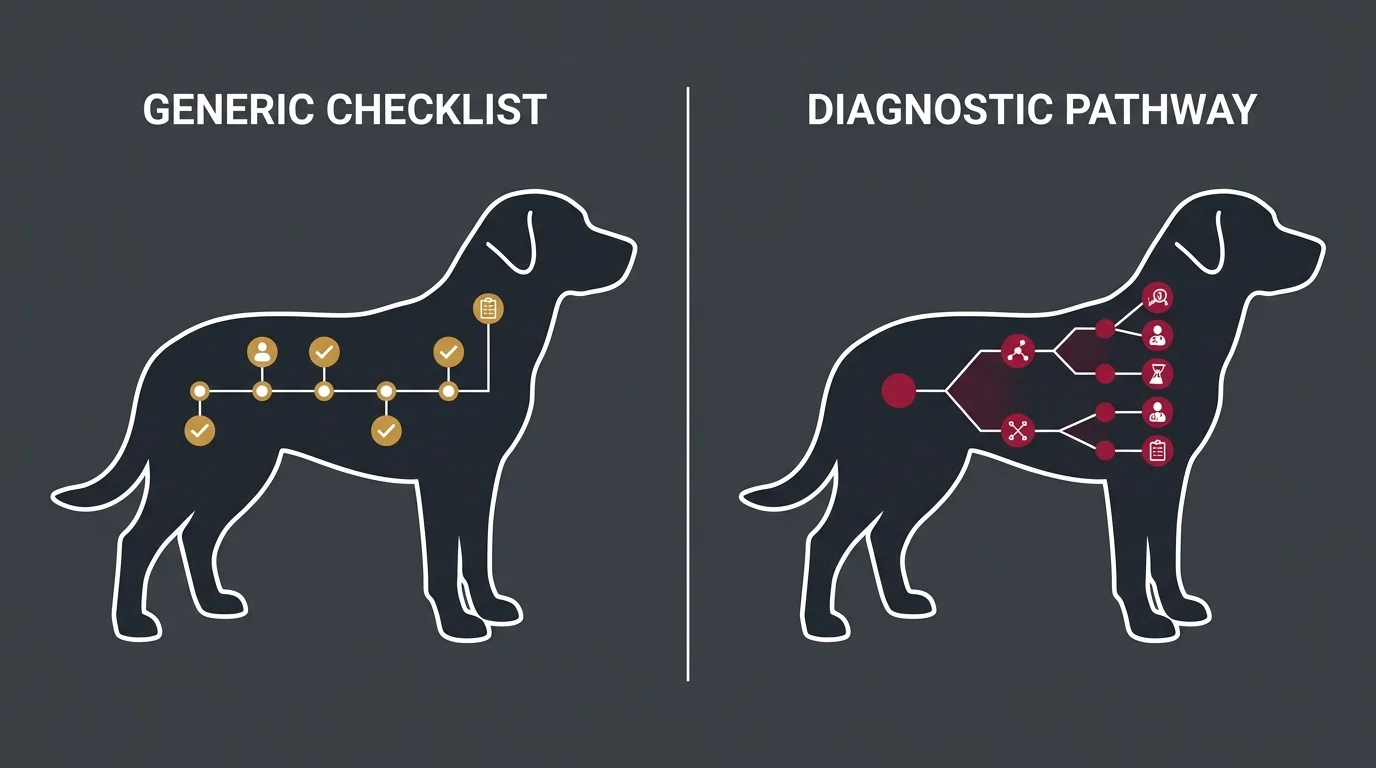
Most dog owners have seen some version of this. The dog walks in. The practitioner runs hands down the spine, makes a few passes, and it's done. Ten minutes, maybe less. They call it an exam.
It isn't. It's a template. And the difference between those two things matters more than most owners ever get told.
A real canine chiropractic exam is an investigation. Every stage gathers evidence. The practitioner isn't deciding what to adjust while they're adjusting — they're building a clinical picture that tells them whether an adjustment is warranted at all, and if so, exactly where and how. AVCA certified animal chiropractic holds practitioners to that clinical standard. A quick-sequence approach doesn't come close to meeting it.
The Template Problem: When Every Dog Gets the Same Exam
Here's what the template problem looks like in practice: the same palpation sequence, in the same order, applied to every dog that walks through the door — regardless of what the animal is actually showing, regardless of history, regardless of presentation. The exam is the same because the protocol doesn't know how to ask questions.
That's not care. It's pattern-matching against a fixed script. And when the dog doesn't respond the way the template predicts, practitioners using this model repeat the sequence anyway. The protocol doesn't have a mechanism for pivoting. It assumes every spine presents the same way — and that assumption is where animals get failed.
This isn't a fringe critique. Cornell University College of Veterinary Medicine's sports medicine and rehabilitation protocols require a full physical examination before any spinal manipulation is performed. NIH-indexed research on manipulation therapy in quadrupeds confirms the same standard. That prerequisite isn't administrative red tape. It's the clinical logic that makes the adjustment defensible — and skipping it is exactly what makes the template indefensible.
The template skips that logic entirely. It assumes the conclusion before a single piece of diagnostic evidence has been gathered. That's not a care plan — it's guesswork wearing the clothes of one. And before any owner books an appointment anywhere, understanding what AVCA certification actually means for their dog's safety is the first question worth asking.
What a Genuine Diagnostic Investigation Looks Like Instead
Here's the thing — a genuine diagnostic investigation starts before the practitioner's hands ever touch the dog. It starts with watching. How the animal enters the room. How weight distributes across all four limbs. Whether there's hesitation in a turn or asymmetry in how the head tracks. That's Stage 1 — Observational Gait and Posture Assessment — and it produces evidence that palpation alone can't replicate.
From there, every subsequent stage adds a layer to the clinical picture. The history interview. Static palpation. Motion palpation. Neurological testing. Each one answers a question the previous stage raised. By the time Stage 6 — Clinical Findings Review and Adjustment Decision — arrives, the practitioner isn't guessing. The adjustment is the conclusion. Not the starting point.
One process ends at a conclusion the evidence supports. The other ends where it started — with an assumption it never bothered to test.
| Approach | Starting Point | Adjustment Decision Based On | What Gets Missed |
|---|---|---|---|
| Template-Based Approach | Predetermined adjustment sequence applied to every dog | Protocol habit — the same steps, the same order, every time | Compensatory movement patterns, neurological involvement, and the actual spinal segment driving the symptom |
| Observation-Only Approach | Owner's verbal description of the symptom | What the owner reports — without physical corroboration | Static and dynamic palpation findings, reflex asymmetry, and soft tissue changes that don't surface in conversation |
| Pharmaceutical Masking Approach | Symptom suppression as the clinical goal | Absence of visible pain response after medication | The underlying biomechanical restriction — which continues progressing while symptoms are chemically quieted |
| Diagnostic-First Canine Chiropractic Exam | Stage 1 — Observational Gait and Posture Assessment — before hands touch the dog | Clinical evidence gathered across all six stages before any adjustment decision is made | Nothing — the exam is built to surface what a template skips |
The Step-by-Step Diagnostic Process: From Observation to Adjustment
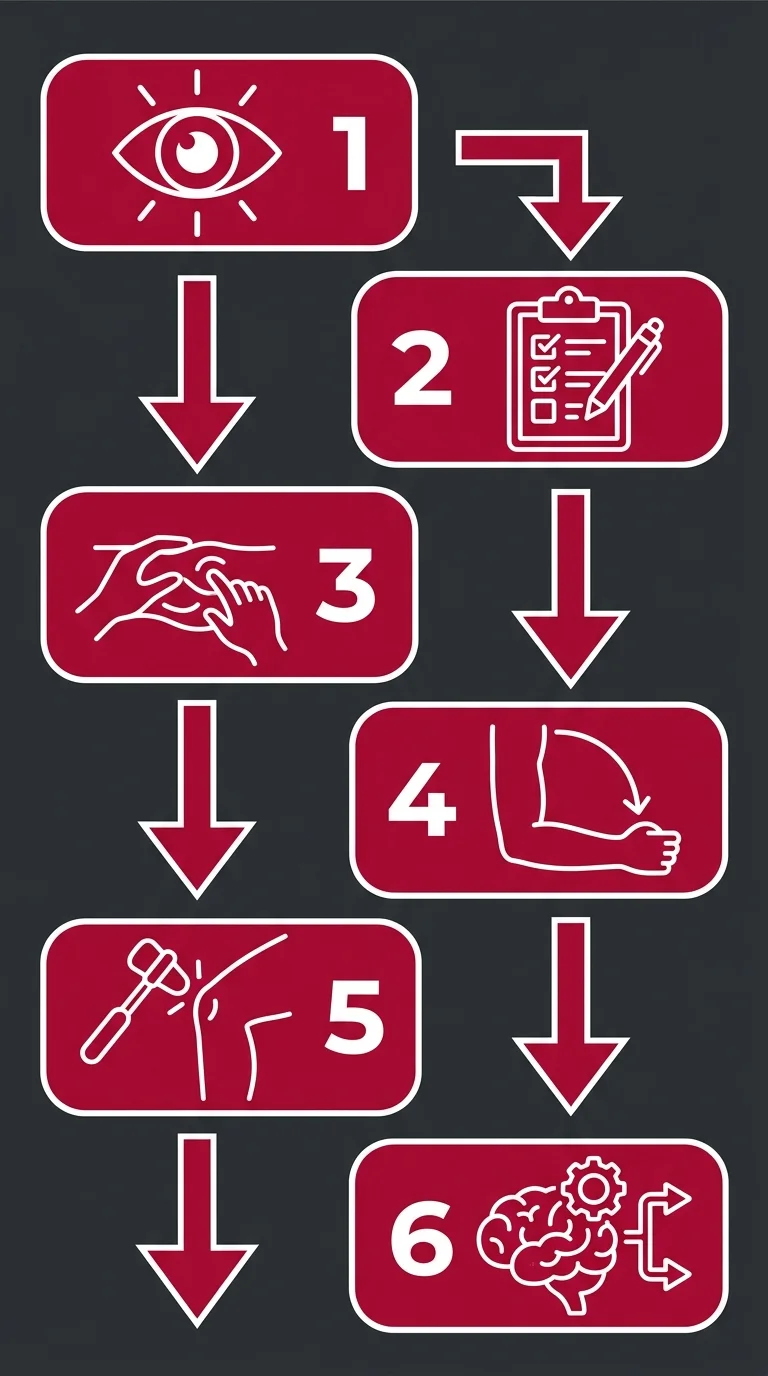
The six stages aren't checkboxes. Each one is a diagnostic layer. And what gets gathered in each stage determines what the next stage is looking for.
That's an investigation. Not a treatment session. The adjustment is the conclusion — and everything before it is the evidence.
Here's how it actually works.
Stage 1: Observational Gait and Posture Assessment
The exam doesn't start when hands touch the dog. It starts the moment the dog walks through the door.
Stage 1 is pure observation — and it starts the second the dog walks through the door. Watch how weight distributes across all four limbs. Look for hesitation in a turn. Does the head track symmetrically through movement? Patterns like why is my dog bunny-hopping are often the first visible signal of a spinal restriction that palpation will confirm later. Restricted spinal segments alter weight distribution and force compensatory patterns throughout the hindlimbs — and those patterns show up in movement long before static examination begins.
What observation produces is a hypothesis. The rest of the exam tests it.
Stage 2: Full History and Symptom Interview
Stage 2 is the Full History and Symptom Interview — the clinical conversation that gives context to everything observation flagged. When did the owner first notice the change? Has the dog had prior injuries, surgeries, or pharmaceutical interventions? What activities has the dog avoided or modified? Those answers narrow the diagnostic field before a single vertebra gets palpated.
This stage also surfaces something palpation can't. The owner knows what normal looks like for this specific dog. That's not anecdotal — it's clinical data.
Stage 3: Static Palpation and Soft Tissue Evaluation
Stage 3 is Static Palpation and Soft Tissue Evaluation — and this is where physical examination begins in earnest. The practitioner works along the spine with deliberate, methodical pressure, identifying heat, asymmetry, muscular guarding, or tissue density changes that signal dysfunction underneath.
Vertebral subluxation complexes produce localized muscular spasm and altered neurological signaling. Static palpation locates those signatures. But it doesn't make the diagnosis — it maps the terrain. Motion palpation takes it from there.
What the practitioner feels here is a shortlist. The next stage determines what's actually on it.
Stage 4: Motion Palpation and Kinematic Analysis
Stage 4 is the most diagnostically specific stage of the entire exam. The practitioner assesses each spinal segment's actual movement capacity across three kinematic planes: flex-extension, lateral bending, and rotation. A restricted segment doesn't move the way a healthy segment does — and that restriction is measurable, not a gut feeling.
NIH biomechanics research on canine lumbar kinematics shows that spinal range of motion boundaries are quantitatively measurable. That precision matters. It's what separates a clinical finding from a practitioner's best guess. Motion palpation isn't a feel — it's a measurement.
When restricted segments are found at Stage 4, the practitioner knows which structures are candidates for adjustment. Not assumed. Identified.
Stage 5: Neurological Reflex and Sensitivity Testing
Stage 5 asks a different question than the previous four. It's not just where is the restriction — it's what is the restriction doing to the nervous system. Reflex testing, proprioceptive responses, and sensitivity mapping reveal whether spinal dysfunction is producing neurological consequences, not just biomechanical ones.
Peer-reviewed NIH research shows that manual therapy on restricted spinal segments produces statistically significant increases in mechanical nociceptive thresholds — meaning measurable decreases in pain response. That's what Stage 5 is interrogating. Not whether the dog seems uncomfortable. What the nervous system is actually doing.
By the end of Stage 5, the practitioner has observational data, history data, static tissue data, kinematic data, and neurological data. Five distinct layers of evidence. Stage 6 is where all of it converges.
Stage 6: Clinical Findings Review and Adjustment Decision
Stage 6 is where the investigation becomes a decision. The practitioner reviews every finding — gait, history, static palpation, motion restriction, neurological response — and makes a clinical call: is a chiropractic adjustment indicated, where, and how? This isn't a formality. This is the stage the other five were building toward.
The answer isn't always an adjustment. That's the whole point. A process that ends in the same intervention every time isn't a diagnostic process — it's a template with extra steps. Real clinical findings sometimes point toward a different referral pathway. Sometimes they confirm the adjustment. Either way, the decision is grounded in what five preceding stages actually found — not in what the appointment was booked for.
That's the architecture of a legitimate canine chiropractic exam. Every stage earns the next one. And the adjustment, when it comes, is the conclusion — not the starting point.
| Diagnostic Stage | What Is Being Evaluated | Kinematic Plane or System Assessed | Clinical Signal It Reveals |
|---|---|---|---|
| Stage 1 — Observational Gait and Posture Assessment | Whole-body movement patterns, weight distribution across all four limbs, head tracking symmetry, hesitation or asymmetry in turns | Full-body kinematic baseline — ground contact, stance width, propulsion symmetry | Compensatory loading patterns and hindlimb gait anomalies that signal spinal restriction before physical contact begins |
| Stage 2 — Full History and Symptom Interview | Owner-reported changes in behavior, activity avoidance, prior injuries, surgeries, and pharmaceutical history | Temporal and contextual systems — behavioral, pharmaceutical, and musculoskeletal history | Onset pattern, aggravating factors, and the owner's established baseline for this specific dog's normal function |
| Stage 3 — Static Palpation and Soft Tissue Evaluation | Heat asymmetry, tissue density changes, muscular guarding, and point tenderness along the spine and surrounding musculature | Soft tissue and paraspinal structures — static positional assessment | Localized muscular spasm, inflammation signatures, and areas of neurological signaling disruption that map the terrain for motion palpation |
| Stage 4 — Motion Palpation and Kinematic Analysis | Segmental movement capacity through active and passive range of motion at each vertebral level | Three kinematic planes — flex-extension, lateral bending, and rotation | Restricted spinal segments with measurable movement deficits that differentiate clinical findings from practitioner inference |
| Stage 5 — Neurological Reflex and Sensitivity Testing | Reflex integrity, proprioceptive response accuracy, and mechanical sensitivity thresholds at restricted segments | Peripheral and central nervous system — neurological output from identified spinal restrictions | Quantifiable changes in pain response and reflex function that reveal whether dysfunction has produced neurological consequences beyond biomechanics |
| Stage 6 — Clinical Findings Review and Adjustment Decision | Synthesis of all preceding diagnostic stages — gait, history, static tissue, motion restriction, and neurological data | Whole-body integration — all systems evaluated against each other | Evidence-based determination of whether a chiropractic adjustment is indicated, at which segments, and through which approach — or whether a different referral pathway is appropriate |
What the Exam Reveals: Reading the Diagnostic Findings
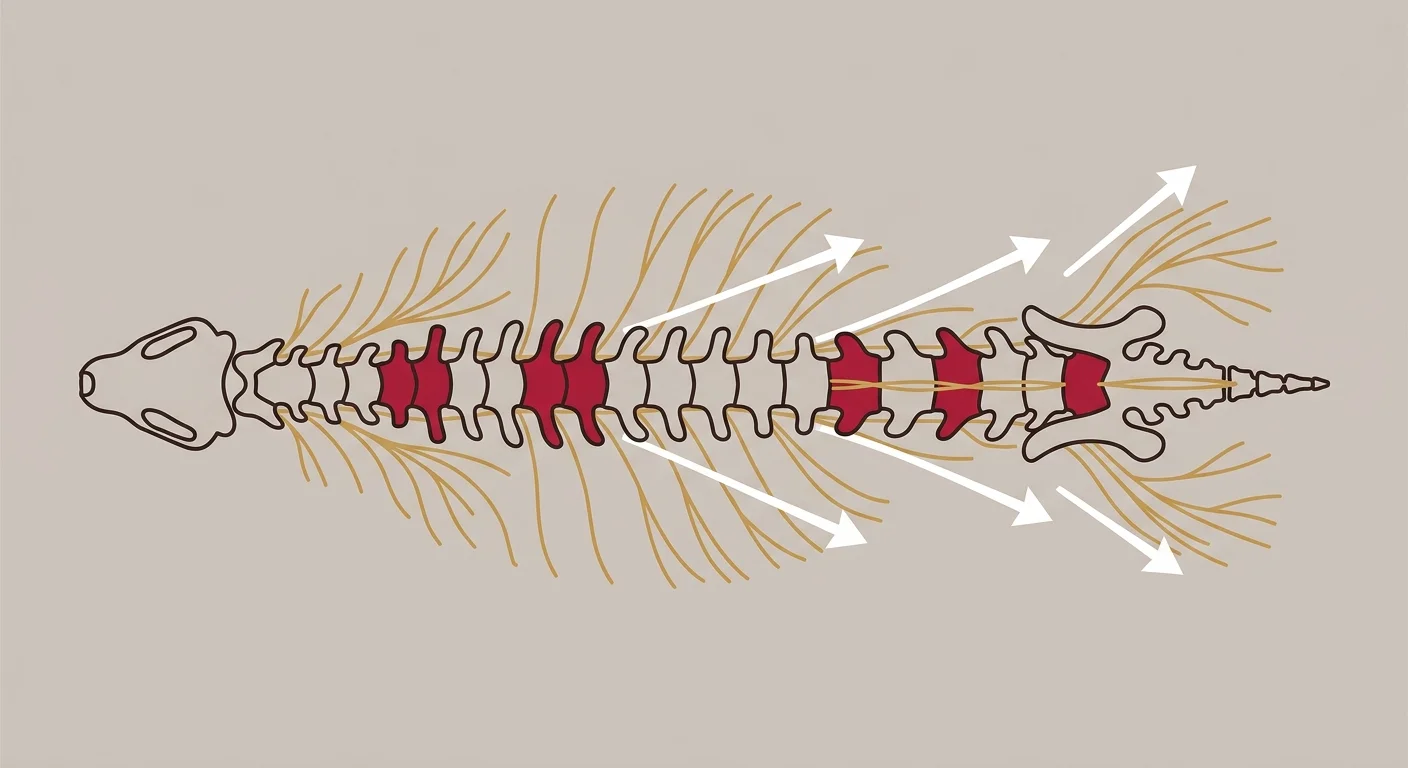
Gathering findings is one skill. Reading them is another.
Gait asymmetry points somewhere. Soft tissue guarding points somewhere. A restricted segment in motion palpation points somewhere. The exam's job is to triangulate those signals into one clinical conclusion. Not treat each one like its own isolated curiosity with its own separate answer.
Here's what those findings actually mean — in language an owner can observe, track, and verify.
Spinal Restriction Patterns and What They Mean for Hindlimb Function
A restricted spinal segment doesn't stay local. It travels downstream — and most owners don't realize it until they're watching their dog compensate in ways they can't explain.
When a spinal segment loses full range of motion, the body redistributes the load. Weight shifts. Compensatory muscle patterns kick in. The hindlimbs start carrying the consequence of a problem that originated several vertebrae away. By the time an owner notices reluctance to jump or a favor on one side, that compensation has been running for weeks.
Vertebral subluxation complexes produce localized muscular spasm and altered neurological signaling. That's why hindlimb function degrades even when nothing happened to the hindlimb itself. The restriction pattern is the source. The limb is just where it shows up. Stages 3 and 4 of the exam exist specifically to find that pattern.
Pain Threshold Changes and the Difference Between Masking and Resolving
Here's what masking looks like: the dog moves better for a few days, then reverts. The underlying restriction hasn't changed. The pain signal has just been chemically suppressed — and when the drug clears, the signal comes back. That isn't resolution. That's delay with a price tag.
Manual therapy on restricted spinal segments produces statistically significant increases in mechanical nociceptive thresholds. The dog's measurable pain response decreases. That's a physiological change — not a chemical one. The nervous system responds differently because the structural input changed. Not because a drug is suppressing the signal from underneath.
Owners who've watched their dogs cycle through pharmaceutical protocols — and who've tracked the documented risks that accumulate with long-term NSAID use — describe the same arc every time: improvement, then regression, then a higher dose. The underlying biomechanical dysfunction never left. It was there the whole time. Nobody addressed it because nobody was looking for it.
Chiropractic manual therapy addresses the functional biomechanical dysfunction directly. That's the difference between a dog that improves and a dog that recovers. Those aren't the same outcome.
How Findings Drive the Care Plan — Not the Other Way Around
The care plan isn't written before the exam. That should be obvious. But a template-based approach does exactly that — the sequence is decided in advance, and the findings get bent to fit the plan rather than the plan following the findings.
A diagnostic-first process works in the opposite direction. Findings from all six exam stages determine what intervention is appropriate — and exactly where. A restricted segment identified in Stage 4 becomes the adjustment target in Stage 6 because the evidence points there. Not because the protocol assumes every dog needs the same three adjustments in the same three locations.
That's the whole point of the investigation. The adjustment is the conclusion — not the starting point. Real findings produce real care plans. A plan written before the exam is over isn't a care plan. It's a template with the dog's name on it. And it's the version no owner should ever settle for.
| Diagnostic Finding | Underlying Mechanism | Functional Consequence | Care Plan Implication |
|---|---|---|---|
| Gait asymmetry or compensatory movement pattern | Spinal segment restriction forces mechanical load redistribution — downstream joints and muscles absorb what the restricted segment can't | Hindlimb weakness, reluctance to jump, uneven muscle development on one side of the back or pelvis | Directs Stage 3 and Stage 4 palpation toward the originating restriction, not the compensating limb |
| Localized soft tissue heat or muscular guarding | Vertebral subluxation complexes trigger localized muscular spasm and altered neurological signaling at the affected segment | Chronic tension at specific spinal regions, reduced local range of motion, progressive stiffness that worsens without intervention | Flags the segment for motion palpation confirmation and narrows the adjustment target zone identified in Stage 6 |
| Restricted segment mobility across kinematic planes | Flex-extension, lateral bending, or rotational capacity is reduced — the segment cannot complete its full three-dimensional range of motion | Compensatory hypermobility in adjacent segments, progressive joint loading imbalance, accelerated wear on surrounding structures | Identifies the specific structural candidates for chiropractic adjustment — only restricted segments confirmed in Stage 4 become Stage 6 targets |
| Diminished neurological reflex or proprioceptive response | Spinal dysfunction produces neurological consequences beyond biomechanical restriction — the nervous system's signaling is altered at the level of the affected segment | Delayed or absent proprioceptive placement, stumbling on uneven surfaces, reduced awareness of hindlimb position | Confirms that spinal restriction is producing neurological impact — elevates clinical urgency and shapes the adjustment approach selected in Stage 6 |
| Elevated mechanical pain threshold following restricted segment identification | Manual therapy on restricted segments produces a physiological change in nociceptive response — the nervous system signals differently because the structural input has changed | Measurable decrease in pain response that reflects structural resolution rather than chemical suppression of the pain signal | Validates the intervention selected in Stage 6 and establishes a baseline against which subsequent sessions are measured |
| Owner-reported behavioral change without observable injury | Compensation patterns often precede visible structural signs — the dog modifies behavior to protect a restriction the owner hasn't located and the dog can't report | Activity avoidance, altered play behavior, reluctance to use stairs or jump into vehicles — all without a discrete injury event the owner can identify | Anchors the Stage 2 history interview to functional behavioral data, not just physical symptoms — and cross-references against Stage 3 and 4 findings for clinical confirmation |
Who This Exam Is and Isn't For
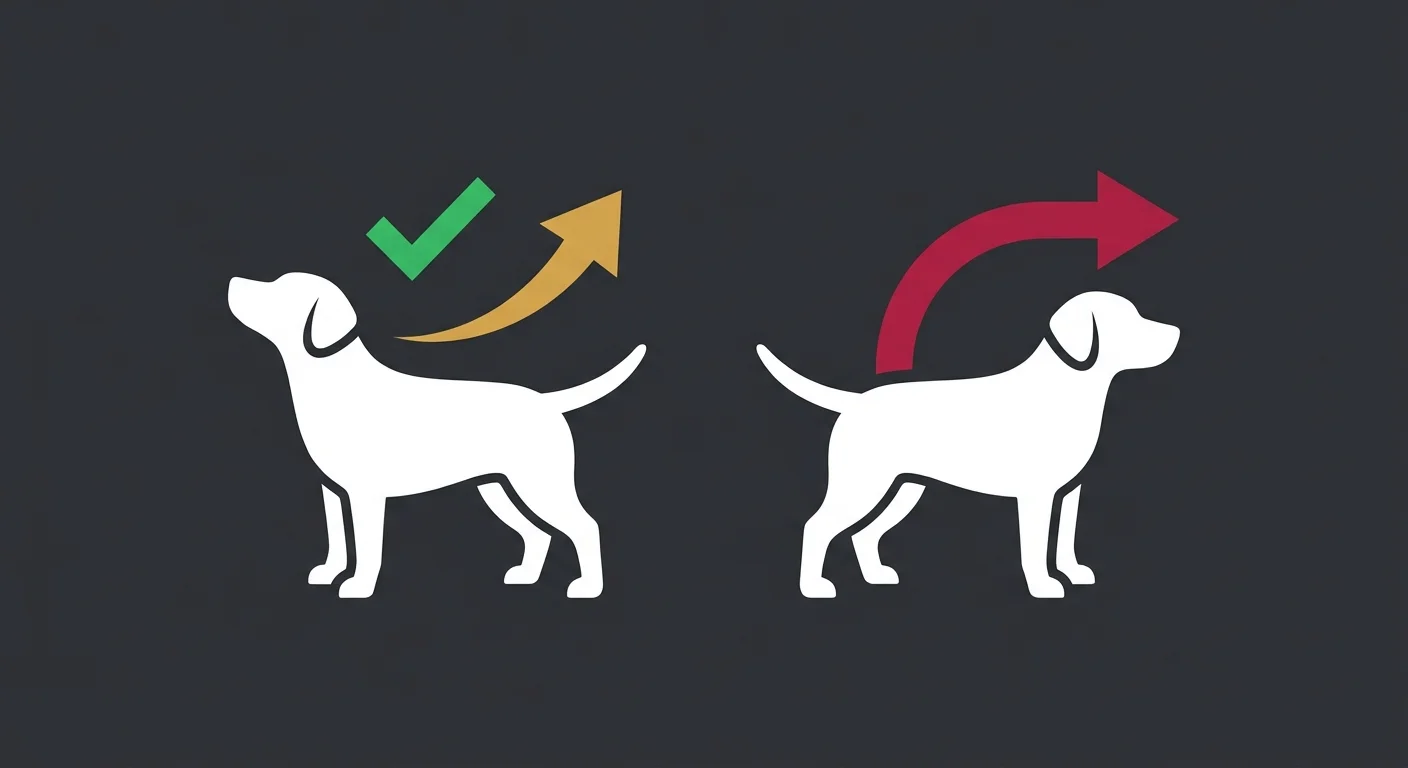
Not every dog is the right candidate for this kind of exam. And not every owner is ready for what it actually asks of them.
This is a clinical investigation. It requires a complete assessment before any intervention is decided. That commitment isn't negotiable — it's the whole point. If you're looking for a quick pass down the spine and a receipt, this isn't that.
That's worth naming directly. Because the six stages filter as much as they diagnose.
Dogs That Benefit Most from a Full Diagnostic Workup
Dogs with unexplained gait changes are the strongest candidates. Bunny-hopping. Favoring one side. Hesitating at stairs. Losing hindlimb drive with no clean orthopedic explanation. Those aren't random symptoms — they're a pattern the body is producing because something upstream forced it to compensate. Restricted spinal segments alter weight distribution and push the load somewhere else. The six-stage process is built to trace that pattern back to its origin, not just note that the pattern exists.
Dogs cycling through pharmaceutical protocols without lasting improvement are also strong candidates. Here's what that cycle looks like: the symptom improves for a week, then comes back. Every time. That's not a treatment failing — that's a suppression protocol running out the clock. The biomechanical dysfunction is still there. It was there when the first prescription was written. The full diagnostic workup is built to find what the medication was covering.
Working dogs and sport dogs with performance declines — not injuries — belong in this category too. A dog that was clearing jumps cleanly and now knocks bars isn't broken. It's telling you something. The exam is how you listen.
When Animal Chiropractic Is Not the Right Starting Point
Acute trauma is not the entry point for Animal Chiropractic. Fractures, dislocations, active neurological emergencies — those go to veterinary triage first. AVCA-certified practitioners work within a defined scope. This exam is a diagnostic and functional intervention. It's not an emergency room.
Illinois practice standards require that adjustments be performed by a licensed doctor of chiropractic or veterinarian who holds certification from a recognized agency like the AVCA. That credential boundary exists for a reason. And it means the referral pathway matters. If a dog hasn't had a recent veterinary evaluation ruling out acute pathology, that evaluation should come first.
Progressive or rapidly deteriorating neurological conditions warrant imaging and specialist referral before a chiropractic workup begins. The six-stage process is built for functional biomechanical dysfunction — not for conditions requiring surgical or emergency medical intervention. Recognizing that boundary is part of what individualized chiropractic care looks like in a legitimate diagnostic setting.
The Owner Who Won't Get Results from This Process
The owner who won't follow the care plan after the exam is a problem before the exam starts. Six stages produce findings. Findings become recommendations. Selectively applying some and ignoring others doesn't produce partial results — it produces exactly where the dog started. The dog carries the cost of that decision. Not the protocol.
And then there's the owner who needs the adjustment to happen on the first visit. Before the history is taken. Before motion palpation is complete. Before anyone has a clear neurological picture. That owner isn't looking for a diagnosis — they're looking for confirmation. The adjustment is the conclusion the evidence earns. Walking in with that conclusion already decided turns a clinical exam into theater. It's not the same thing.
The owner genuinely exploring alternatives to a pharmaceutical protocol? That's a real clinical question and this process is built to answer it. But the owner who wants someone to rubber-stamp a decision they've already made — without letting the findings go somewhere unexpected — isn't looking for an investigation. Real investigation ends where the evidence points. Not where the owner hoped it would.
| Dog Presentation | Likely Diagnostic Value | Recommended Starting Point | Red Flag Requiring Veterinary Referral First |
|---|---|---|---|
| Unexplained gait changes — bunny-hopping, hindlimb drift, reluctance to jump | High — compensatory patterns trace back to spinal restriction; the six stages are built for this presentation | Full six-stage diagnostic workup; recent veterinary evaluation ruling out acute orthopedic pathology recommended | Sudden-onset paralysis, loss of bladder or bowel control — requires emergency veterinary triage before any chiropractic workup |
| Dog cycling through pharmaceuticals with improvement-then-regression pattern | High — underlying biomechanical dysfunction is likely unaddressed; the exam identifies what suppression has been masking | Full six-stage diagnostic workup; review of current pharmaceutical protocol with prescribing veterinarian | Rapidly progressing neurological deterioration — imaging and specialist referral before chiropractic evaluation |
| Working or sport dog with performance decline — not acute injury | High — movement pattern changes in high-performance dogs carry diagnostic information the exam is designed to read | Full six-stage diagnostic workup; sport history and activity log reviewed during Stage 2 history interview | Suspected fracture or dislocation — requires radiographic confirmation and orthopedic clearance first |
| Dog with chronic soft tissue guarding or localized muscle spasm | High — Stage 3 Static Palpation and Soft Tissue Evaluation is specifically designed to map these patterns and connect them to spinal restriction | Full six-stage diagnostic workup; findings cross-referenced across Stages 3, 4, and 5 | Active infection or inflammatory condition at the palpation site — requires veterinary clearance before hands-on assessment proceeds |
| Acute trauma — known impact, fall, or collision | Low as an entry point — fractures, dislocations, and instability must be ruled out before functional assessment begins | Immediate veterinary triage and imaging; chiropractic workup is appropriate after acute pathology is cleared | Any suspected spinal instability or cord compression — surgical or emergency medical intervention takes priority |
| Dog without a recent veterinary evaluation and presenting with progressive symptoms | Conditional — the diagnostic value depends on what underlying pathology has or hasn't been ruled out | Veterinary evaluation first to establish baseline and rule out conditions outside the scope of Animal Chiropractic | Undiagnosed masses, systemic illness, or conditions with signs that overlap spinal dysfunction — veterinary differential diagnosis required before chiropractic assessment |
Frequently Asked Questions
A process this thorough raises questions. Good. That means you're paying attention.
Here's what comes up most. Direct answers only.
What happens during a dog's first canine chiropractic exam?
The first visit is an investigation. It isn't a treatment session.
All six stages run before any intervention is considered: Observational Gait and Posture Assessment, Full History and Symptom Interview, Static Palpation and Soft Tissue Evaluation, Motion Palpation and Kinematic Analysis, Neurological Reflex and Sensitivity Testing, and Clinical Findings Review and Adjustment Decision.
The history comes first. The hands come after the eyes. The adjustment — if the evidence warrants it — comes last.
How do you check if a dog's spine is out of alignment?
Motion palpation is the primary diagnostic tool. It evaluates each spinal segment in three kinematic planes — flex-extension, lateral bending, and rotation — and identifies segments where normal movement is restricted rather than free.
Static palpation adds the soft tissue layer: muscle tone asymmetry, localized tenderness, postural deviation. Together, those findings build a map of where the spine is moving correctly and where it isn't.
That map is what Stage 6 reads when the adjustment decision gets made. It isn't subjective. It's built from what each stage found.
Can canine chiropractic adjustments help dogs that are bunny-hopping?
Bunny-hopping is a compensation pattern — not a diagnosis. It tells you the dog has found a way to move that reduces discomfort. It doesn't tell you where the restriction actually lives.
That's what the six-stage process is built for. Gait assessment reads the pattern. Motion palpation traces it back to its source. The adjustment targets the restricted segment the evidence identified — not the symptom the owner noticed.
If you want to know more about what that gait pattern is really signaling, why is my dog bunny-hopping breaks down the mechanics in detail. The symptom alone doesn't answer the clinical question. The exam does.
Is a veterinary referral required for Animal Chiropractic in Illinois?
Illinois practice standards require that chiropractic adjustments on animals be performed by a licensed doctor of chiropractic or veterinarian who holds certification from a recognized agency like the AVCA. That credential boundary exists for a reason — and it's worth verifying before anyone puts hands on your dog's spine.
Beyond the legal standard: make sure a recent veterinary evaluation has ruled out acute pathology before the chiropractic workup begins. Not because it's always legally required. Because it's the responsible diagnostic sequence.
If something structural or emergent is driving the symptoms, that gets identified first. The chiropractic exam is a functional investigation. It isn't a substitute for veterinary triage.
What are the diagnostic steps used to identify canine vertebral subluxations?
The diagnostic steps map directly onto the six stages. Stage 3 uses static palpation to identify soft tissue changes and postural asymmetry. Stage 4 uses motion palpation to assess each spinal segment across flex-extension, lateral bending, and rotation — the three kinematic planes where restricted mobility registers as a measurable deficit.
Stage 5 adds neurological reflex testing to identify altered signaling patterns.
When findings from all three stages converge on the same segment or region, the clinical picture is established. Stage 6 is where those findings are reviewed and the adjustment decision is made. That's not guesswork. That's five layers of evidence pointing to one conclusion.
How many sessions does a dog typically need before seeing improvement?
There's no template answer here — because the care plan isn't written before the findings are in.
Manual therapy on restricted spinal segments produces measurable physiological changes in pain threshold. The response is real and trackable. What determines how many sessions a dog needs is what the six-stage exam actually finds: the location and severity of the restriction, the baseline neurological picture, and how the dog responds to the first adjustment.
A legitimate care plan is built from those findings. Not from a standard package decided before the exam started. If you're weighing chiropractic care against long-term pharmaceutical management, the risks of long-term NSAID use for arthritic dogs is worth reading before that decision is made. The adjustment is the conclusion — and so is everything that follows it.
The Investigation Has to Come Before the Adjustment
Good detectives don't start with a conclusion. They start with evidence.
Every stage of this exam works that way. Observation feeds history. History shapes palpation. Palpation drives neurological testing. Each step answers the question the last one raised. By the end, the practitioner isn't deciding what to do — they're reading what the findings already determined.
The adjustment is the conclusion — not the starting point.
That's what separates a real investigation from a template — and the difference isn't subtle.
A template walks in with the sequence already written. Same targets. Same locations. Same adjustment — regardless of what the gait showed, what the history revealed, what motion palpation found, or what the neurological picture said. The dog's actual presentation doesn't change the protocol. Because the protocol was never designed to ask questions.
A real investigation ends where the evidence points. Sometimes that confirms what you suspected. Sometimes it doesn't. The exam's job is to find out which — not to validate a decision made before the dog walked in the door.
Owners deserve to know the difference. So do their dogs.
Touch of Wellness Chiropractic isn't the right fit if you want a quick pass down the spine and a receipt.
But if your dog has a movement pattern that doesn't make sense — gait asymmetry, hindlimb reluctance, a performance drop nobody has explained — the investigation is worth doing. Real answers come from real inquiry. A template can't produce them.
So here's the only question that matters: do you want a template, or do you want an answer? The adjustment is the conclusion — not the starting point.
If your dog's movement has been off and no one's given you a straight answer — that's worth investigating. Book an appointment and find out what the exam actually shows. The adjustment comes after the findings. Not before.