
The Real Cost of Chronic Pain in 2026: Shockwave Therapy vs Repeated Cortisone Injections
Cortisone injections and Shockwave Therapy are not two versions of the same solution. They operate through entirely different mechanisms, produce fundamentally different long-term outcomes, and carry very different biological costs.
Cortisone is a corticosteroid injected directly into an inflamed site to suppress the local inflammatory response. Pain relief arrives fast. For many people, it works well for several weeks. But the relief is temporary by design. Once the anti-inflammatory effect fades, the underlying structural problem is still there — untouched. Repeated injections compound the risk: research documents that corticosteroids progressively deplete local collagen synthesis, reduce cellular viability, and compromise the mechanical integrity of soft tissues. The pain returns. The cycle continues. With each round, the structural foundation weakens.
That's the cost no one names at the injection appointment. Cortisone borrows against tissue health — fast relief, compounding structural damage. Shockwave Therapy addresses the debt itself.
Shockwave Therapy delivers focused acoustic pressure waves into damaged, fibrotic tissue — physically breaking down scar blockages and calcifications while triggering the body's own repair mechanisms. At the cellular level, it stimulates vessel-endothelial growth factors that initiate new blood vessel formation in oxygen-starved tissue. That's not symptom suppression. That's tissue remodeling.
At 12-month follow-up, clinical research shows Shockwave Therapy outperforms corticosteroid injections in both success rates and long-term recurrence. The gap isn't close — and it widens the longer the condition goes unaddressed.
Roughly 20.9% of U.S. adults live with chronic pain. A significant portion cycle through repeated injections that delay — and sometimes damage — the path to actual recovery.
The real cost of chronic pain in 2026 isn't just the pain itself. It's the progressive tissue degeneration that accumulates with every round of temporary relief. Cortisone manages symptoms while the underlying structure continues to break down. Shockwave Therapy addresses the biological root of why the tissue isn't healing. Those aren't equivalent choices.
Last Updated: July 29, 2026
- • Why Chronic Pain Keeps Coming Back (And What That Tells You)
- • What Cortisone Actually Does Inside Your Body
- • How Shockwave Therapy Works at the Tissue Level
- • How the Two Approaches Compare Across the Treatment Timeline
-
• Frequently Asked Questions
- • Why does cortisone pain relief wear off so quickly?
- • Can shockwave therapy safely break down chronic scar tissue?
- • What is the long-term structural cost of repeated cortisone injections?
- • How many shockwave therapy sessions are typically needed to see lasting results?
- • Why is shockwave therapy considered a root-cause solution compared to cortisone?
- • Stop Borrowing Against Your Tissue
Why Chronic Pain Keeps Coming Back (And What That Tells You)
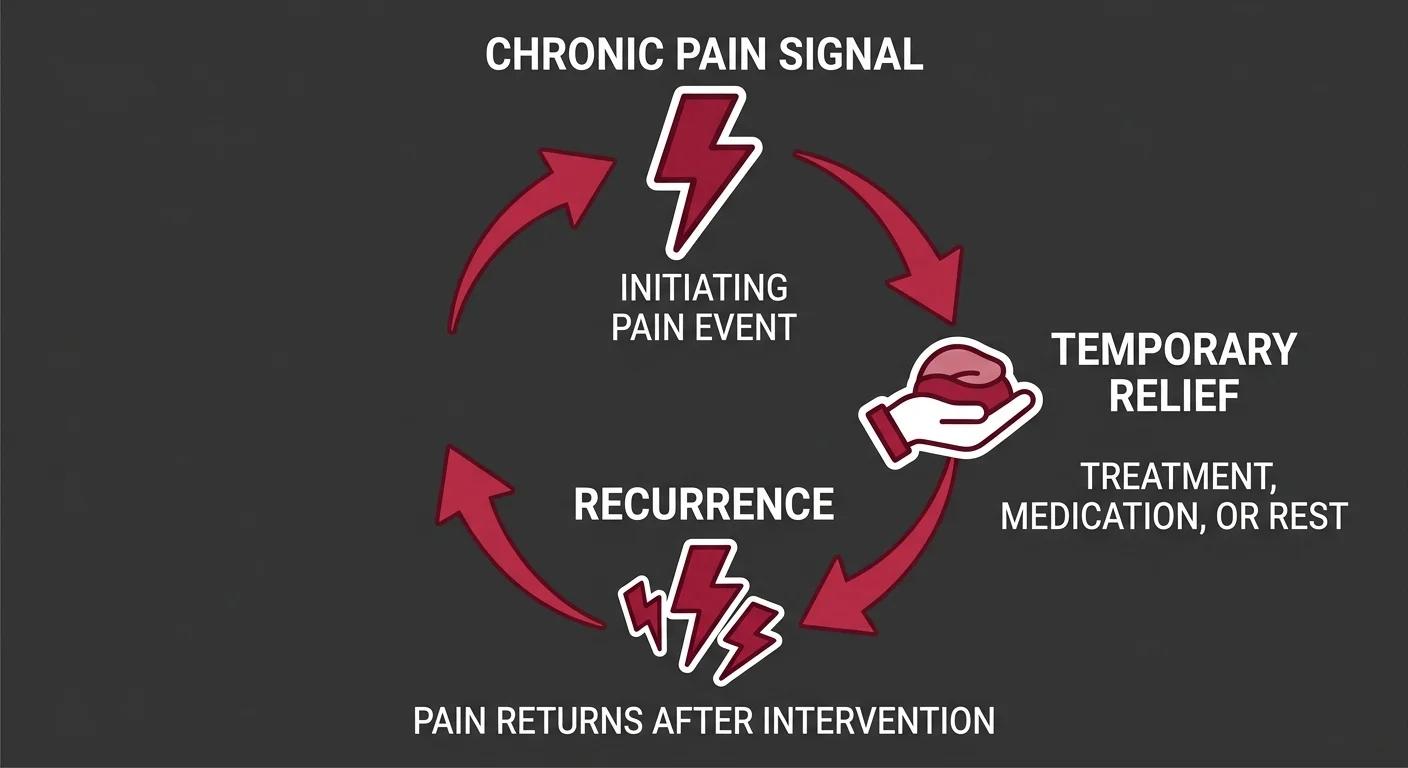
Most people dealing with chronic pain already know the pattern. The pain eases. Then it comes back — same place, same intensity, as if nothing was ever done.
That's not bad luck. That's what happens when treatment mutes the signal without touching the source. The tissue generating the pain isn't healing. It's just quiet — temporarily — while the structural problem underneath keeps compounding.
Think of it as a payday loan on your tissue. The relief is real. But the principal — the actual structural damage — doesn't shrink. Every cycle of temporary relief borrows against what you still owe. The debt doesn't disappear. It compounds.
The Biology Behind the Cycle
Here's what's actually happening inside the tissue. Chronic musculoskeletal pain isn't an ongoing inflammation event — not after the first few weeks. What persists is fibrotic scar tissue, calcifications, and regions of compromised blood flow that have stalled the body's natural repair process. The tissue can't fix itself because the blood supply isn't there to do the job.
Corticosteroid injections interrupt inflammatory signaling. In the acute phase — the first few days or weeks — that makes sense. Inflammation is the problem, and cortisone addresses it. But chronic conditions aren't acute. The inflammation has largely resolved. What remains is structural: dense, poorly vascularized scar tissue that can't repair itself because the blood supply isn't there to support it. Cortisone doesn't change that. It quiets the complaint.
That's the biology behind the cycle. Cortisone quiets the signal. The structural blockage stays in place. The pain returns because the tissue causing it hasn't changed.
Shockwave Therapy works by physically remodeling that fibrotic tissue and breaking down calcifications through mechanical transduction — which is exactly why understanding how shockwave therapy regenerates damaged tissue at the cellular level matters before comparing it to any injection protocol.
What the Prevalence Data Actually Shows
And this isn't a fringe problem. CDC data puts chronic pain at 20.9% of U.S. adults — roughly 51.6 million people. Of those, 6.9% experience high-impact chronic pain that actively limits major life activities. That's tens of millions in a holding pattern, cycling through interventions that address the experience of pain without ever touching its structural source.
Those numbers don't just describe a problem. They describe a model that isn't working. When the dominant clinical approach is built to suppress rather than resolve, pain comes back — because it was never actually addressed.
Individualized chiropractic care starts from a different premise entirely: find what's actually driving the condition, then treat that.
| Pain Pattern | What It Signals Biologically | What It Requires Clinically |
|---|---|---|
| Pain returns within weeks of an injection | The inflammatory signal was suppressed, but the underlying fibrotic scar tissue and compromised blood supply were never addressed — the structural source remains intact | Mechanical remodeling of the fibrotic tissue to restore vascular access and allow the body's repair process to restart |
| Pain always occurs in the same location | A localized region of dense, poorly vascularized scar tissue or calcification has stalled the repair cycle — the tissue is structurally stagnant, not randomly inflamed | Site-specific acoustic pressure therapy to break down the calcification or scar blockage driving the localized failure |
| Pain intensity stays the same across months or years | Symptomatic treatment hasn't changed the tissue architecture — the underlying structure is neither healing nor degrading at a rate the patient notices, it's simply stuck | Therapy that stimulates cellular proliferation and new blood vessel formation in oxygen-starved tissue, not further suppression of the pain signal |
| Each injection provides less relief than the last | Repeated corticosteroid exposure progressively depletes local collagen synthesis and reduces cellular viability — the tissue's structural integrity is weakening with each cycle | A full reassessment of the structural damage accumulated across injection cycles, followed by a remodeling-based approach rather than continued biochemical suppression |
| Pain limits daily function even on 'good' days | The condition has crossed from intermittent discomfort into high-impact chronic pain — the nervous system and surrounding tissue are in a sustained state of structural compromise | Root-cause clinical assessment to identify the specific biological mechanism driving the limitation, not symptom management layered on top of unresolved structural damage |
What Cortisone Actually Does Inside Your Body
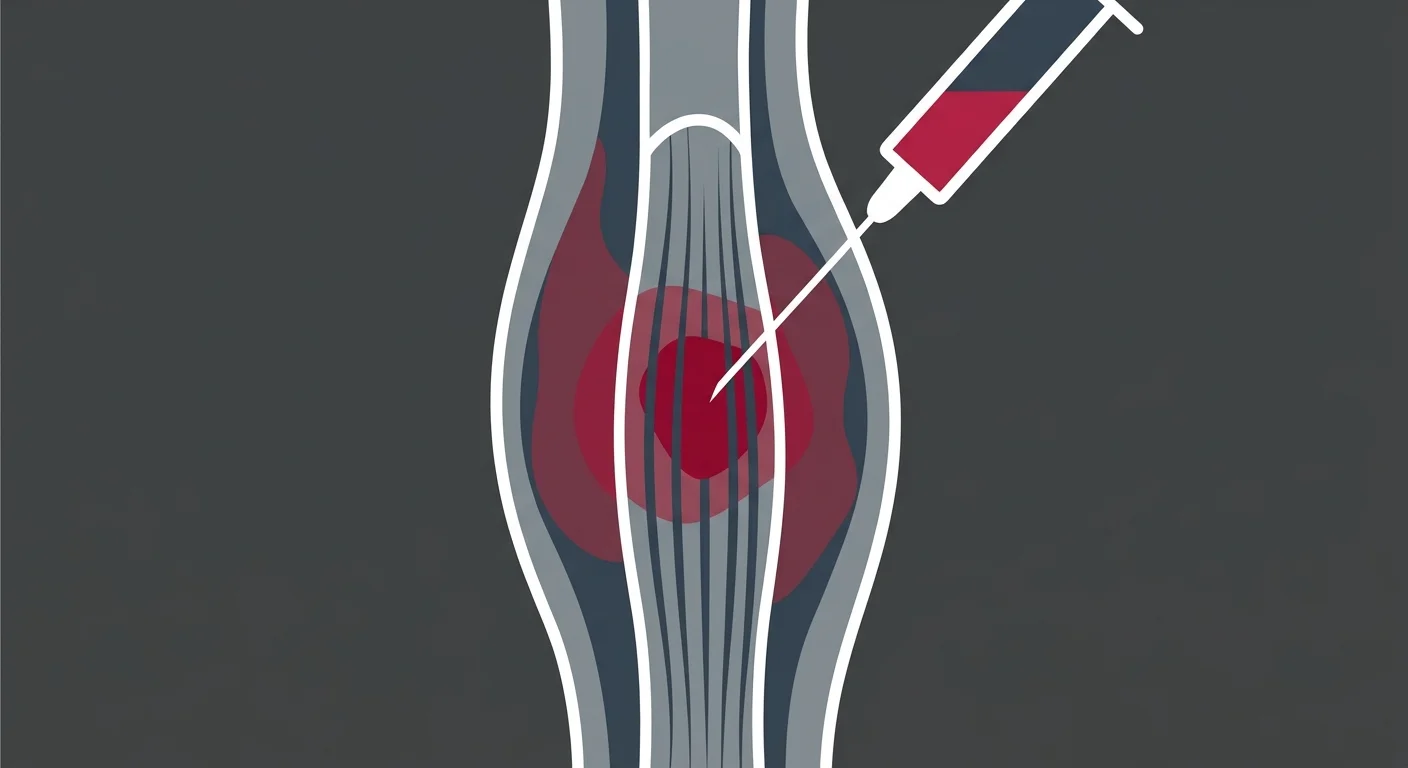
Cortisone doesn't heal anything.
That's not a condemnation. It's a description of how the drug actually works.
A corticosteroid injection is a biochemical signal blocker. It tells the local inflammatory pathway to shut up — and for a window of several weeks, it does exactly that. Pain drops. Swelling retreats. The patient walks out feeling like something finally worked.
What it doesn't do is touch the structural problem that generated the pain in the first place.
The tissue is still compromised. The scar blockages are still there. The microvascular supply is still starved.
The injection muted the alarm. It didn't fix the wiring.
Why the Cookie-Cutter Injection Approach Fails Long-Term
Here's the thing — most injection protocols aren't built around your specific structural picture. They're built around a diagnosis code.
Plantar fasciitis gets a plantar injection. Shoulder tendinopathy gets a shoulder injection. The location of the pain determines the location of the shot. Full stop.
That's the cookie-cutter model in its purest form: same intervention, same site, same timeline — regardless of what's actually happening in the tissue.
It doesn't ask how much scar tissue has accumulated. It doesn't ask how impaired the local blood supply is. It doesn't consider how many prior cycles have already degraded the structural integrity of the area.
Same protocol. Different patient. Every time.
And repeated cycles aren't neutral. NIH research documents that corticosteroids progressively reduce cellular viability, deplete local collagen synthesis, and compromise the mechanical integrity of soft tissue over time. Tendon degradation and rupture aren't theoretical risks. They're documented adverse outcomes.
Every round of cortisone that doesn't resolve the condition isn't just a failed attempt. It's a structural withdrawal from a tissue account that's already running low.
Cortisone borrows against the tissue's structural integrity to deliver short-term relief. The debt doesn't disappear between injections.
It accumulates. And how blood flow starves chronic scar tissue explains precisely why each cycle leaves the tissue less capable of recovering on its own.
The Short-Term Relief Trap
So here's what the relief cycle actually looks like from the inside.
The injection goes in. Inflammation suppresses. Pain drops within days. The patient feels — genuinely — better. Then, somewhere between four and six weeks later, the effect fades. The pain comes back.
And it comes back to a tissue that hasn't changed structurally — except it's now slightly more compromised than it was before the injection.
That's not a patient failing the treatment.
That's the treatment reaching the outer boundary of what it was ever designed to do.
The trap isn't that cortisone stops working. The trap is that it works just well enough, just long enough, to make another round feel like the reasonable next step — while the underlying structural problem keeps deepening with each cycle.
That's the short-term relief trap. And it's why people who've been cycling through injections for months still can't point to a moment when they actually got better.
| Injection Timeline | Reported Pain Relief | Documented Tissue Effect |
|---|---|---|
| Days 1–7 post-injection | Rapid pain reduction as inflammatory signaling suppresses | No structural change; scar tissue and microvascular impairment remain intact |
| Weeks 4–6 post-injection | Pain relief fades as cortisone effect dissipates | Tissue structure unchanged; recurrent pain returns as underlying condition persists |
| Repeated injection cycles | Temporary relief with each round; diminishing window between recurrences | Progressive depletion of local collagen synthesis and reduction in cellular viability |
| Cumulative multi-cycle exposure | Pain management increasingly reliant on injection frequency | Mechanical integrity of localized soft tissues progressively compromised; tendon rupture documented as adverse outcome |
How Shockwave Therapy Works at the Tissue Level
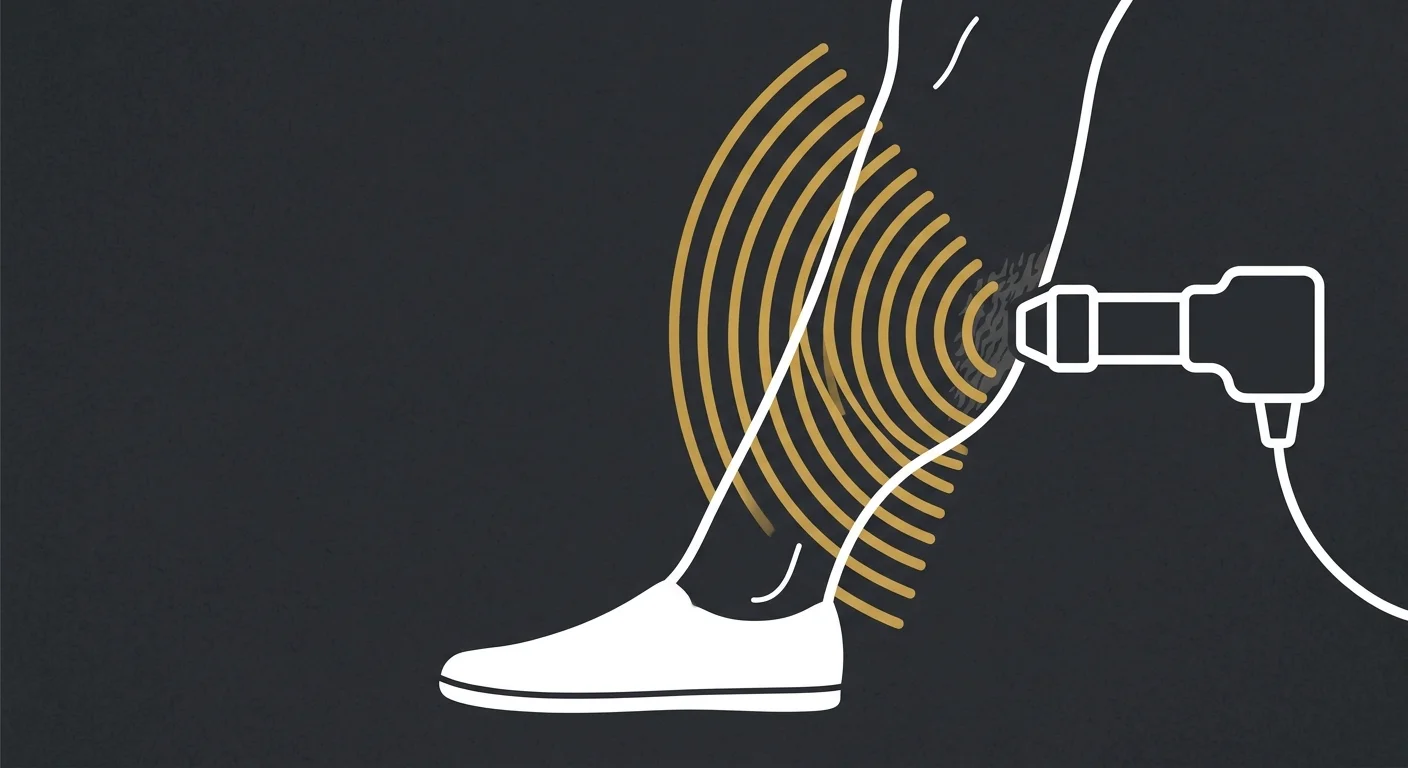
Cortisone works at the level of the signal. Shockwave Therapy works at the level of the structure.
That's not a small distinction. That's the entire reason outcomes between the two approaches diverge so dramatically — and why one of them keeps failing people who've already tried the other.
By the time pain turns chronic, the inflammatory alarm stopped ringing a long time ago. What's left isn't a fire to put out. It's a structural wreck — dense scar formation, calcified deposits, a microvascular supply so compromised the body can't run basic repair operations.
The biological infrastructure required for healing has collapsed. Cortisone has nothing useful to say to tissue in that condition. That's exactly the level Shockwave Therapy targets.
Advanced shockwave therapy delivers focused acoustic pressure waves directly into damaged, fibrotic tissue — physically breaking apart the scar blockages and calcifications that have stalled healing.
The mechanical transduction isn't a side effect. It's the point. That acoustic load triggers a regenerative cascade the tissue hasn't been able to produce on its own — because nothing gave it the right signal until now.
The Biological Case for Shockwave Therapy
Here's what's happening at the cellular level. Shockwave Therapy upregulates the local expression of vessel-endothelial growth factors — VEGF — which are the biological signals that tell the body to build new blood vessels into oxygen-starved tissue.
That process is called neovascularization. And it's the reason Shockwave Therapy produces outcomes that cortisone injections structurally cannot. Cortisone never touches VEGF expression. It doesn't even try.
New microvascular supply means oxygen and nutrients can finally reach tissue that's been isolated for months — sometimes years. NIH findings on VEGF upregulation confirm this isn't theoretical: Shockwave Therapy measurably stimulates cellular proliferation and restores microvascular blood flow in chronic scar tissue.
The tissue doesn't just stop hurting. It starts changing.
That's paying down the principal.
Cortisone borrows against the tissue's structural reserve to deliver short-term relief. Each cycle leaves less to borrow. Shockwave Therapy does the opposite — it rebuilds the biological conditions that make repair possible in the first place. The difference isn't a matter of degree. It's a different transaction entirely.
What Tissue Regeneration Actually Looks Like
Tissue regeneration isn't a linear event. It's a cascade — and it needs the right biological triggers to start.
In chronically fibrotic tissue with a compromised blood supply, those triggers are gone. The cascade never fires. The tissue just stays stuck.
Shockwave Therapy provides the mechanical stimulus that restarts it. Breaking down fibrotic deposits clears the structural obstruction. VEGF upregulation rebuilds the vascular network. Cellular proliferation fills the repaired matrix with healthy tissue.
At 12-month follow-up, NIH-indexed clinical data shows Shockwave Therapy outperforms corticosteroid injections on both clinical success rates and long-term recurrence. That's not marginal. That's the measurable outcome of treating the structure instead of muting the signal.
This isn't a competition between two pain treatments. It's a gap between two different definitions of what treatment is supposed to do.
One manages the experience of the condition. The other addresses the biology of why the condition persists. For anyone who's been cycling through injections without resolution, that distinction isn't academic. At Touch of Wellness Chiropractic, it's the starting point — because the conversation that changes outcomes begins with what's actually happening in the tissue.
| Biological Mechanism | Effect on Chronic Tissue | Clinical Outcome |
|---|---|---|
| Acoustic pressure wave delivery into fibrotic tissue | Physically disrupts dense scar deposits and calcified blockages that stall the healing process | Structural obstruction cleared — tissue environment becomes capable of repair |
| VEGF upregulation (vessel-endothelial growth factor expression) | Signals the body to build new blood vessels into oxygen-starved, isolated tissue | Neovascularization initiated — microvascular supply restored to previously starved tissue |
| Cellular proliferation cascade | Healthy cells populate the repaired tissue matrix once vascular and structural conditions are restored | Tissue regenerates structurally — not just symptom suppression, but measurable biological change |
| Long-term clinical outcome vs. corticosteroid injection | Shockwave Therapy addresses the structural source of chronic pain; cortisone blocks the inflammatory signal without changing the tissue | Clinical success rates and long-term recurrence outcomes favor Shockwave Therapy at 12-month follow-up |
How the Two Approaches Compare Across the Treatment Timeline
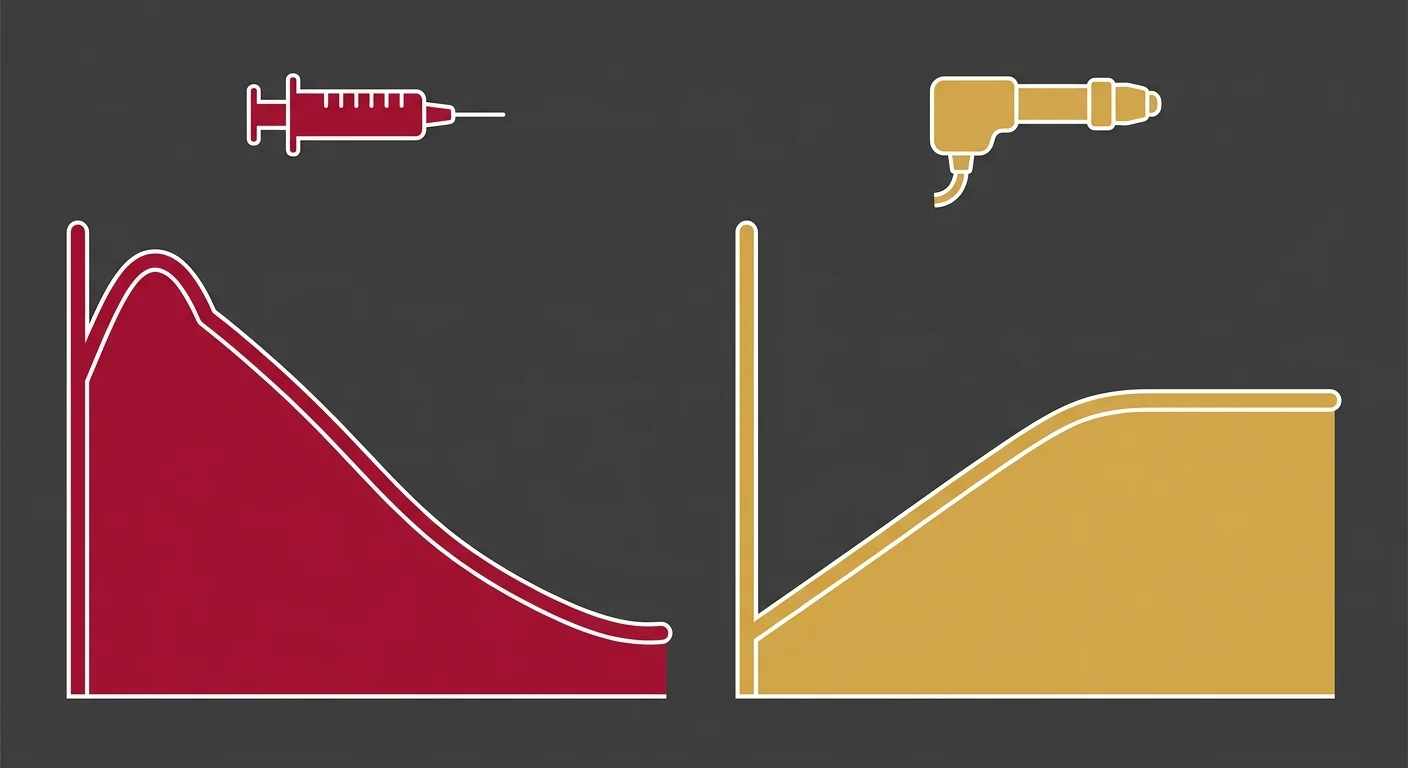
The real difference isn't how each treatment works. It's what happens to the patient six months after the fact.
Cortisone front-loads its results. Within days of the injection, inflammation quiets, pain drops, and the patient feels genuine relief. That's not a placebo. That's the biochemistry working exactly as designed. But the problem doesn't announce itself on day one. It shows up at week four. Week six. Month twelve.
Shockwave Therapy doesn't front-load the same way — and that's the point. The early response is gradual because the mechanism is structural, not chemical. What's building underneath is a biological environment that actually supports change. Cortisone pays out immediately and collects later. Shockwave Therapy invests in the tissue and pays out over time.
Short-Term vs Long-Term Outcomes Side by Side
Short-term, cortisone wins. Within days, inflammation quiets and pain drops — and that relief is real. For someone in acute distress, that matters. But the short-term win is also where the trap gets set. Relief feels like progress. A muted signal gets mistaken for a repaired structure. Those are not the same thing.
At the 12-month mark, the picture reverses entirely. NIH-indexed clinical data shows Shockwave Therapy outperforms corticosteroid injections on both clinical success rates and long-term recurrence. The tissue that went through Shockwave Therapy has been structurally remodeled — scar tissue disrupted, vascular supply rebuilt, cellular matrix repaired. The tissue that cycled through repeated cortisone hasn't. It's been quieted, repeatedly, while its structural integrity was progressively drawn down. That's not two treatments producing similar results at different speeds. That's two treatments producing fundamentally different biological outcomes.
Who Shockwave Therapy Is and Is Not For
Shockwave Therapy isn't the right tool for every situation. That's not a disclaimer — it's the whole point. The intervention has to match what's actually happening in the tissue.
It's the right conversation for chronic tendon conditions, persistent plantar pain, fibrotic soft tissue, or calcified deposits that have stalled — especially when prior interventions produced short-term relief without structural resolution. Which protocol fits the specific injury depends on tissue presentation and injury depth — that's a clinical determination, not a standing order. For conditions with significant soft tissue involvement, therapeutic cold laser therapy may be worth assessing alongside Shockwave Therapy.
Shockwave Therapy is not the right fit for someone in an acute inflammatory flare who needs immediate crisis management. Cortisone does that job better in that short window — full stop. And it's not for someone who expects one session to accomplish what full structural remodeling takes time to do. That's the same mismatch as expecting one chiropractic adjustment to resolve what took years to build. Different treatment context, same fundamental error.
What Shockwave Therapy is for is the patient who's been cycling through short-term interventions without ever landing somewhere different. The person who's tired of borrowing against their tissue and wants to start paying down the principal instead. That's the structural conversation Touch of Wellness Chiropractic is built to have — and it starts with what's actually happening in the tissue, not with a diagnosis code.
| Treatment Dimension | Cortisone Injection | Shockwave Therapy |
|---|---|---|
| Primary mechanism | Biochemical signal suppression — quiets the inflammatory response without altering the underlying tissue structure | Mechanical tissue remodeling — physically disrupts scar blockages, calcifications, and fibrotic deposits |
| Speed of initial relief | Fast — pain reduction often noticeable within days of injection | Gradual — structural change builds over weeks as the biological repair cascade progresses |
| Short-term outcome (days to weeks) | High — inflammation quiets, pain drops dramatically, patient experiences genuine relief | Modest — early sessions initiate the regenerative process; dramatic relief isn't the short-term signature |
| Long-term outcome (months to one year) | Diminishing — relief duration shortens with each injection cycle as structural integrity is progressively drawn down | Durable — clinical success and low recurrence rates at long-term follow-up reflect structural resolution, not signal suppression |
| Effect on underlying tissue | None — the structural environment (scar tissue, calcifications, impaired blood supply) remains intact and often worsens across repeated cycles | Restorative — fibrotic deposits are disrupted, microvascular blood flow is rebuilt, and the cellular repair matrix is replenished |
| Recurrence risk | High — without structural change, the condition that generated the pain signal persists and recurrence is the expected trajectory | Lower — structural remodeling addresses the biological reason the condition persisted, reducing the recurrence cycle |
| Appropriate use window | Acute inflammatory flares where immediate crisis management takes priority over structural resolution | Chronic, stalled conditions — tendon degeneration, fibrotic soft tissue, calcified deposits — where short-term interventions have failed to produce lasting change |
| Debt metaphor position | Payday loan — borrows against the tissue's structural reserve for fast relief; each cycle leaves less reserve to borrow against | Paying down the principal — rebuilds the biological conditions required for lasting repair; outcomes compound in the patient's favor over time |
Frequently Asked Questions
Some questions don't make it into the appointment. They live in the car ride home, in the midnight search bar, in the back of the mind for weeks before anyone says them out loud. These are those questions.
If you're weighing cortisone against Shockwave Therapy — or you've already been through several rounds and you're still wondering why the pain keeps coming back — here are the clearest answers we can give you.
Why does cortisone pain relief wear off so quickly?
Because it doesn't repair anything. Cortisone suppresses the inflammatory response — and when the suppression fades, the structural problem that triggered the inflammation is still there, untouched.
The relief isn't fake. The biochemistry does exactly what it's supposed to do in the short window. But the tissue underneath hasn't changed. So when the cortisone clears, the pain returns — because the signal was never the problem. The structure was.
That's the payday loan in real time. Fast payout. The debt stays on the books.
Can shockwave therapy safely break down chronic scar tissue?
Yes — and the mechanism is documented. Shockwave Therapy delivers focused acoustic pressure waves directly into fibrotic tissue, physically disrupting the scar deposits and calcifications that have been blocking the body's natural repair pathways.
It's not aggressive the way surgery is aggressive. It's mechanical — precise, targeted, calibrated to what the tissue actually shows. That physical disruption is what initiates the regenerative cascade. Once the blockage clears, the body can rebuild the vascular network that chronic scar tissue starved out.
But the clinical assessment comes first. The protocol follows from what's actually in the tissue — not from a standard intake form.
What is the long-term structural cost of repeated cortisone injections?
It compounds. Each injection cycle draws down the tissue's structural reserve — reducing cellular viability, depleting local collagen synthesis, progressively compromising the mechanical integrity of the soft tissue.
The first injection feels like a solution. The second feels like maintenance. By the third or fourth, the tissue is structurally worse than it was before the first one — and the pain is still coming back.
That's not a worst-case scenario. That's the documented risk profile of repeated local corticosteroid injections. Each withdrawal leaves less structural reserve to borrow against. The debt metaphor isn't rhetorical. It's biological.
How many shockwave therapy sessions are typically needed to see lasting results?
It depends on the tissue — the severity of fibrotic involvement, the depth of the scar blockage, and what prior interventions have already run through the area. Anyone who gives you a standing-order session count before assessing the clinical picture is guessing.
What the research does show: 12-month outcomes favor Shockwave Therapy over corticosteroid injections on both clinical success rates and recurrence. The mechanism — neovascularization, cellular proliferation, matrix repair — takes time to complete. That's not a weakness. Structural remodeling isn't biochemical suppression. It takes longer because it's doing something real.
Dr. Karen Hannah assesses first, then recommends. The number comes from your actual clinical picture — not a protocol pulled off the shelf.
Why is shockwave therapy considered a root-cause solution compared to cortisone?
Because it addresses the biology of why the condition persists — not just the experience of it.
Cortisone mutes the inflammatory signal. Shockwave Therapy restores the vascular supply that chronic scar tissue has starved, upregulates the growth factors that trigger new blood vessel formation, and stimulates cellular proliferation to repair the fibrotic matrix. That's not a faster route to the same destination. That's a different definition of what treatment is supposed to accomplish.
At 12-month follow-up, clinical data shows Shockwave Therapy outperforming corticosteroid injections on both success rates and recurrence. Root-cause isn't a marketing phrase here. It's the measurable difference between repairing the structure and borrowing against what's left of it.
Stop Borrowing Against Your Tissue
Every cortisone cycle is a withdrawal.
It feels like relief. But the account it draws from is your tissue's structural reserve — and that reserve doesn't replenish between rounds. The payday loan doesn't disappear. It compounds. And at some point, the balance runs out before the pain does.
Shockwave Therapy isn't a faster version of cortisone. It's a different answer to a different question.
It doesn't draw down what's left. It rebuilds the biological conditions that make repair possible — vascular supply restored, fibrotic tissue disrupted, the regenerative cascade restarted. That's not symptom management. That's structural recovery. It's the only approach in this comparison that moves the tissue forward instead of drawing it down.
If you've been cycling through injections and still can't point to a moment when you actually got better — that's not bad luck. That's what happens when the intervention is matched to the signal and not the structure.
The decision isn't which treatment offers faster short-term relief. It's whether you're ready to stop borrowing against your tissue and start paying down the principal.
Cortisone is a payday loan on your tissue. Shockwave Therapy pays down the principal. That's the conversation Touch of Wellness Chiropractic is built to have — and it starts with what's actually happening in the tissue, not with a diagnosis code.
Cortisone is a payday loan on your tissue. Shockwave Therapy pays down the principal. If you're done borrowing against what's left and ready for a different conversation, Touch of Wellness Chiropractic starts where it always starts — with what's actually happening in the tissue.