
Radial vs Focused Shockwave Therapy: Which Protocol Fits Your Injury
Radial and focused Shockwave Therapy are not interchangeable tools. They are two distinct acoustic wave technologies built for different tissue depths, and choosing between them is a clinical decision — not a preference.
Radial Shockwave Therapy generates pressure waves that spread outward from the applicator tip, dispersing energy across a broad surface area. That dispersal pattern works for conditions in the muscle belly and superficial connective tissue — plantar fascia, upper trapezius, broad tendon insertions. The therapeutic window sits within 3 to 4 centimeters of the skin surface. Wide reach, intentional dispersion, stimulation of circulation across a broad zone.
Focused Shockwave Therapy works differently. The wave converges — generated electrostatically, electromagnetically, or piezoelectrically — compressing acoustic energy into a precise deep-tissue focal point that can reach up to 12 centimeters inside the tissue. That depth is what makes it the appropriate tool for deep bone-tendon junctions, calcific deposits, and chronic structural pathology that radial energy cannot reliably reach. The FDA granted its first premarket approval for a focused shockwave device in 2000 — specifically for chronic proximal plantar fasciitis — recognizing the clinical case for targeted depth over broad dispersion. Because the wave bypasses superficial skin layers, surface-level discomfort is typically lower even at full therapeutic intensity.
The outcomes reflect it. A randomized controlled trial comparing both modalities for chronic plantar fasciitis found focused shockwave achieved an 84% success rate in pain reduction versus 63% for radial shockwave at a 3-month post-treatment evaluation. That difference is not a quality gap between two equivalent tools. It is the predictable result of matching wave geometry to injury depth.
Focused shockwave requires precise anatomical localization — the energy converges to a microscopic focal spot. Radial shockwave naturally diffuses across generalized muscle zones and tolerates less precision. Each has a defined clinical role. Neither is universally superior.
The machine should follow the injury. When the protocol is selected first and the injury is retrofitted to whatever equipment a clinic owns, the wrong wave geometry reaches the wrong tissue — and nothing resolves.
Last Updated: July 29, 2026
- • How Radial and Focused Shockwave Therapy Actually Work
- • What Radial Shockwave Is Built For
- • What Focused Shockwave Is Built For
- • Reading Your Injury: How to Match Wave Geometry to Tissue Pathology
-
• Frequently Asked Questions
- • How do I know if my injury requires focused shockwave instead of radial shockwave?
- • Does focused shockwave therapy require more sessions than radial shockwave to see results?
- • Why do some clinics only offer radial shockwave therapy for deep tissue injuries?
- • What happens if a clinic applies the wrong shockwave protocol to my chronic tendon pain?
- • Can I combine radial and focused shockwave therapy in a single clinical care plan?
- • Stop Letting the Machine Decide Your Protocol
How Radial and Focused Shockwave Therapy Actually Work
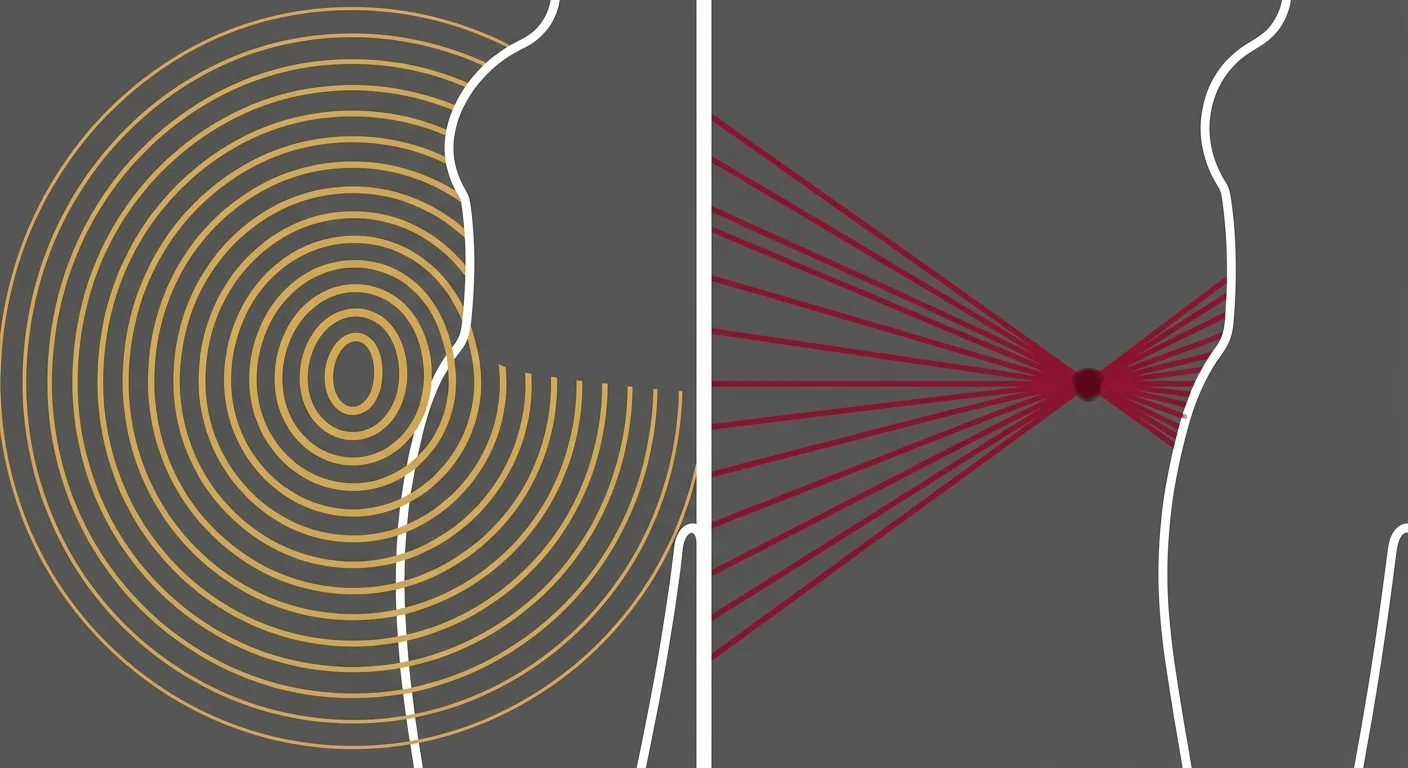
The physics decide everything. And the two technologies do fundamentally different things inside tissue — so understanding that gap is what separates a correct protocol from a wasted one.
Radial Shockwave Therapy works from the outside in. A pneumatically driven applicator fires pressure waves outward in a dispersing cone — broad, diffuse, high surface coverage. That geometry is exactly right when injured tissue is shallow and spread across a wide zone. It's not a precision instrument. It's a field tool. And for the right conditions, that's the correct call.
Focused Shockwave Therapy works from the inside out. The wave is generated electrostatically, electromagnetically, or piezoelectrically — then shaped to converge at a single deep-tissue focal point. Nothing about that process is diffuse. It's engineered precision, reaching tissue that radial energy never touches.
The Physics Behind Each Wave Type
Radial shockwaves lose energy as they travel. The pneumatic mechanism creates a pressure wave that spreads outward and dissipates with depth — capping the therapeutic range at 3 to 4 centimeters below the surface. That ceiling tells you exactly which injuries belong on the radial protocol. And which ones don't.
Focused shockwaves don't lose energy. They concentrate it. The converging wave geometry drives acoustic energy to a focal point that can sit up to 12 centimeters inside the tissue — bypassing the superficial skin sensors that would otherwise register discomfort. If you want to understand how shockwave therapy regenerates tissue at a cellular level, that mechanism is worth knowing before any clinical assessment.
Why Wave Geometry Determines Clinical Outcome
Here's what most generic clinics skip: wave geometry isn't a technical detail. It's the clinical decision. Choosing radial when the injury is deep doesn't deliver a weaker result. It delivers the wrong result. The wave never reaches the pathology.
That's where the one-machine-fits-all model breaks down completely. A clinic that owns one shockwave device isn't making a protocol decision — it's making a business decision and calling it clinical judgment. The chiropractic care for musculoskeletal issues framework that informs how Touch of Wellness Chiropractic approaches these cases starts with the injury, then determines which acoustic wave geometry matches it. The machine follows the diagnosis. Not the other way around.
| Wave Type | Generation Mechanism | Energy Pattern | Max Therapeutic Depth | Best Tissue Target |
|---|---|---|---|---|
| Radial Shockwave Therapy | Pneumatically driven applicator tip fires pressure waves outward | Dispersing cone — broad, diffuse, high surface coverage | Superficial tissue within a few centimeters of the skin surface | Muscle belly, broad tendon insertions, superficial connective tissue (e.g., plantar fascia, upper trapezius) |
| Focused Shockwave Therapy | Electrostatic, electromagnetic, or piezoelectric generation shaped by a converging reflector | Converging beam — concentrated energy channeled to a precise deep-tissue focal point | Deep structures well below the skin surface, bypassing superficial layers | Bone-tendon junctions, calcific deposits, deep chronic structural pathology (e.g., deep Achilles insertion, hip tendons) |
What Radial Shockwave Is Built For
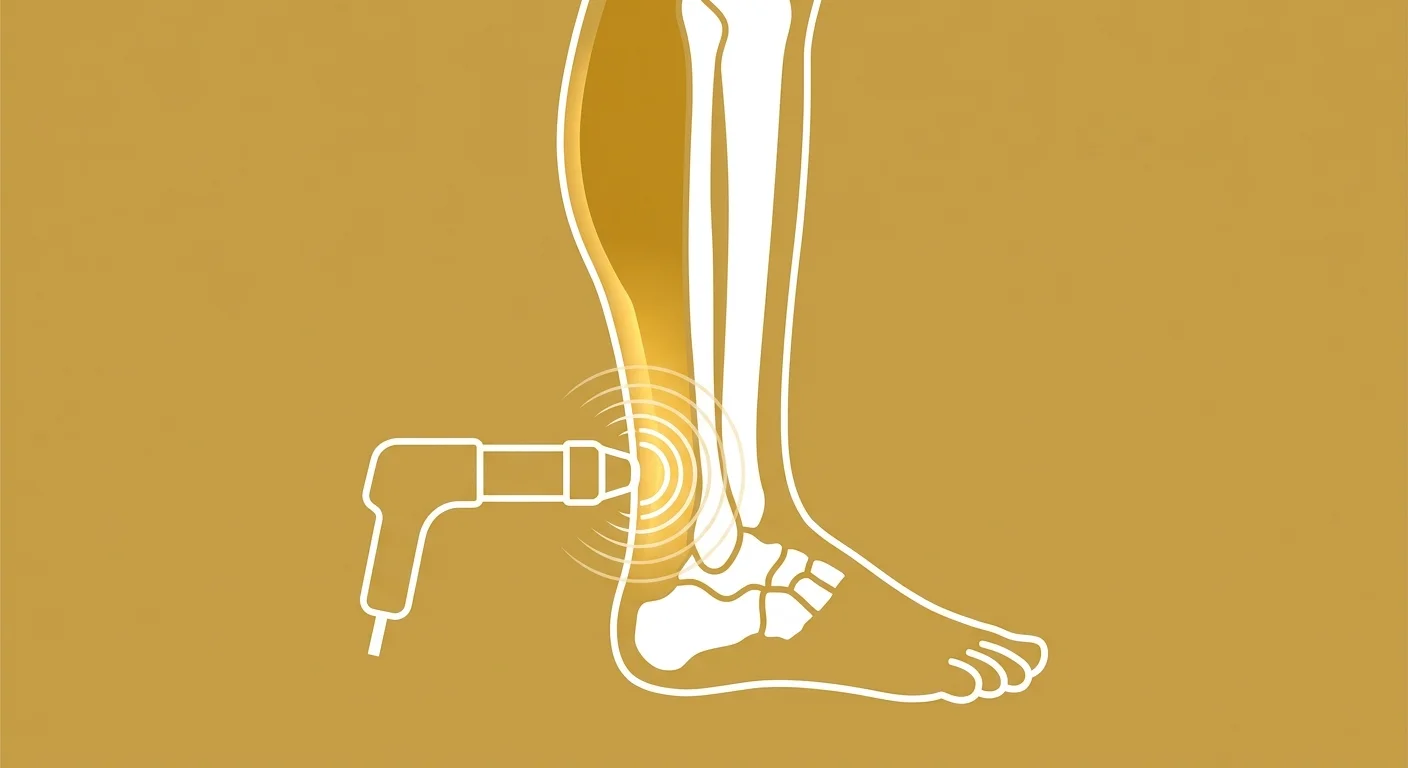
Radial Shockwave Therapy has a lane. And inside that lane, it's the right call.
The dispersing pressure wave isn't a design flaw. It's the point. When an injury is shallow and spread across a broad tissue zone, that diffuse energy pattern covers the entire affected area in a way a converging focal wave never could. Wide reach isn't a limitation here. It's the mechanism.
That 3 to 4 centimeter therapeutic window isn't a ceiling to apologize for. It's a description of where radial shockwave operates best — the muscle belly, the superficial tendon sheath, the connective tissue that responds to dispersed acoustic stimulation.
Match the geometry to the tissue and you get results. Fight the geometry and you're running the wrong protocol on the right patient.
The Injury Types That Respond to Radial Shockwave
The conditions that belong on a radial protocol share one thing: breadth, not depth. Plantar fasciitis is the clearest example. The fascia spreads across the heel and arch in a wide band — and radial's diffuse energy covers that entire zone in a single pass. A converging focal wave isn't built for that geometry.
Upper trapezius tension, broad shoulder tendinopathy, generalized muscle trigger points — all of these sit inside the radial sweet spot. The injured tissue is distributed, not concentrated. That's exactly what the dispersing pattern is designed for.
Insertional Achilles tendinopathy is another case that frequently belongs on a radial protocol — specifically when the pathology is distributed across the tendon's attachment surface rather than concentrated at a deep calcific focal point. That distinction matters. Same diagnosis, different anatomy, different wave.
For patients who are committed to resolving Achilles tendinopathy naturally without moving toward surgery, getting the wave type right from the first session is as consequential as any other clinical variable. You don't get that right by guessing.
Why the Cookie-Cutter Shockwave Clinic Gets This Wrong
Most one-machine clinics run radial shockwave on everything.
Not because the assessment pointed there. Because that's the machine they own.
That's not a protocol decision. That's an equipment decision wearing clinical clothing.
Here's what that costs the patient. A calcific deposit, a bone-tendon junction pathology, a structural lesion sitting beyond that 3 to 4 centimeter threshold — these injuries require a wave that converges at depth. Radial shockwave disperses before it gets there. The acoustic energy never touches the actual pathology.
So multiple sessions run. Nothing changes. The patient concludes Shockwave Therapy didn't work.
What actually didn't work was the protocol match.
That's the cookie-cutter model's specific failure. Not effort. Assessment.
Radial shockwave naturally diffuses across generalized muscle zones. For the right injury, that's a clinical asset. For the wrong one, it's a liability — and the clinical outcome reflects it whether the provider acknowledges the mismatch or not.
A clinic that doesn't evaluate which type of injury you have before selecting a wave type isn't treating your injury. It's running its standard operating procedure on your body.
Session Counts and Energy Parameters That Actually Matter
Session counts and energy parameters aren't variables you estimate. They're calibrated to the injury.
For chronic insertional Achilles tendinopathy, NIH-published research documents an optimal energy flux density of 0.12 to 0.16 mJ/mm² applied across 3 to 4 clinical sessions. Those numbers exist because that injury type has a defined tissue response curve. Push too hard and you exceed it. Spread the sessions too thin and you never hit it. Neither mistake is neutral — both cost the patient time they don't get back.
So what does that look like in practice? The number on the treatment plan isn't borrowed from a protocol built for a different condition. Energy density is matched to depth. Session count is matched to healing rate. When both are right, radial Shockwave Therapy produces a predictable, repeatable outcome.
When they're not matched, the patient spends weeks on a protocol that was never designed for their injury. And they usually blame shockwave. The protocol failed them — but they'll never know that, because nobody told them the selection mattered in the first place.
| Condition | Tissue Depth | Radial Shockwave Fit | Typical Session Range | Clinical Rationale |
|---|---|---|---|---|
| Plantar Fasciitis | Superficial — fascia spreads across heel and arch | Strong fit | Multiple sessions over several weeks | Diffuse radial wave covers the broad fascial band; dispersing pressure pattern matches wide-zone tissue distribution |
| Upper Trapezius Tension | Superficial — muscle belly sits close to skin surface | Strong fit | Several sessions spaced weekly | Radial energy diffuses across the entire muscle zone; broad coverage is an asset for generalized trigger point release |
| Broad Shoulder Tendinopathy | Superficial to mid-depth — tendon sheath accessible within radial range | Good fit | Several sessions over a few weeks | Dispersing wave geometry addresses the full tendon sheath surface; no deep focal point required when pathology is distributed |
| Insertional Achilles Tendinopathy | Superficial — pathology distributed across the attachment surface | Good fit for non-calcific presentations | Standard multi-session protocol | Radial wave covers the broad insertion zone; appropriate when pathology is surface-distributed rather than concentrated at a deep calcific focal point |
| Generalized Muscle Trigger Points | Superficial — trigger points within the upper muscle layers | Strong fit | Variable — typically a handful of sessions | Radial shockwave's natural diffusion across generalized muscle zones is a clinical asset here; precision localization is not required |
| Calcific Deep-Tendon Deposits | Deep — beyond superficial tissue threshold | Poor fit | N/A — wrong protocol | Radial energy disperses before reaching deep calcific pathology; wave geometry does not converge at depth; focused shockwave is the indicated tool |
What Focused Shockwave Is Built For
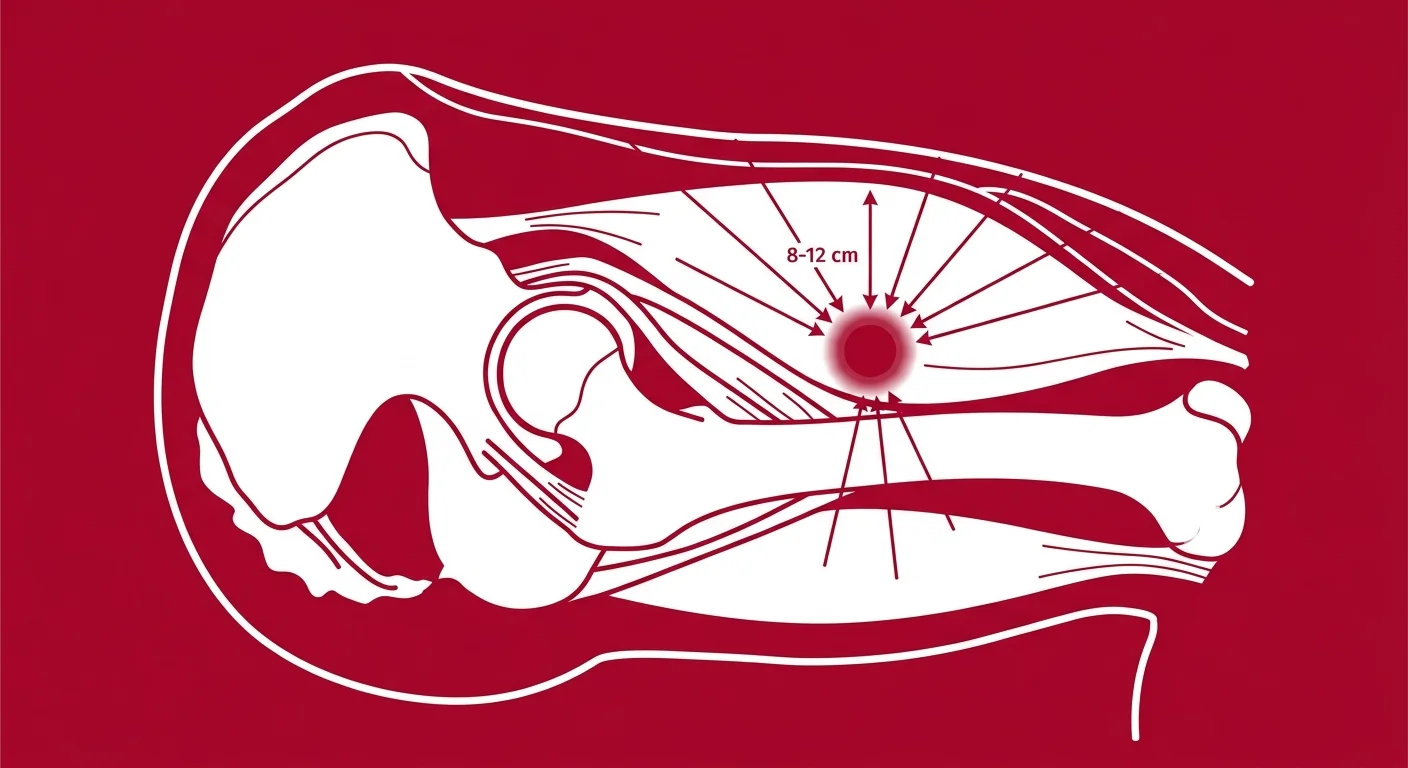
Focused shockwave doesn't treat more severe injuries. It treats structurally different ones.
Deeper. More localized. Sitting at tissue depths where a dispersing wave runs out of energy before it arrives.
That distinction isn't a technicality. It's the whole protocol decision.
Focused Shockwave Therapy was built for exactly that problem. Instead of dispersing outward, the wave converges — driving acoustic energy to a focal point up to 12 centimeters inside the tissue. Deep enough to reach bone-tendon junctions, calcific deposits, and chronic structural lesions that radial shockwave physically can't access.
That's not a product claim. That's wave physics.
The Deep Tissue Injuries Focused Shockwave Was Designed to Reach
Calcific tendinopathy is the clearest example. The calcium deposit sits at a precise anatomical point — often a deep tendon insertion — and it needs concentrated acoustic energy delivered exactly there. Not nearby. Not approximated.
A radial wave disperses and loses intensity before it arrives. A focused wave is engineered to hit that point at full therapeutic intensity, bypass superficial skin sensors, and work directly on the calcification.
The treatment sensation reflects that difference too. Patients asking what that sensation actually means will find the answer changes completely depending on which wave geometry is running.
Deep hip pathology, high hamstring tendinopathy, bone stress reactions at deep skeletal attachment sites — tissue depth is what defines the protocol for all of them.
A broad surface-level wave doesn't reach these structures. The advanced Shockwave Therapy protocols built for these injuries require precise anatomical localization — energy converging to a microscopic focal spot, not a generalized zone.
Get the localization wrong and the focal point misses the pathology entirely. There's no margin for approximation.
The FDA Clearance History That Separates Focused Shockwave From Radial
Focused shockwave isn't new. FDA clearance records show the agency granted its first premarket approval for a high-energy focused shockwave device in 2000 — for chronic proximal plantar fasciitis specifically.
Not general musculoskeletal pain. One condition, with pathology sitting deep and resisting every surface-level approach.
The clearance language itself tells you what focused shockwave is built for. When the FDA names the indication that narrowly, it's because the mechanism only works when depth and target match.
That 2000 approval wasn't broad. It was specific — and that specificity is exactly why the outcomes hold.
NIH trial data shows focused shockwave achieved an 84% success rate in pain reduction versus 63% for radial shockwave at a 3-month post-treatment evaluation for chronic plantar fasciitis.
That 21-point gap isn't about one machine being better than another. It's what happens when wave geometry matches injury depth — versus when a clinic runs whatever protocol fits their equipment.
The machine should follow the injury. These numbers show the cost when it doesn't.
| Condition | Target Tissue Depth | Focused Shockwave Fit | Clinical Evidence Level | Why Radial Falls Short Here |
|---|---|---|---|---|
| Calcific tendinopathy | Deep tendon insertion — often beyond superficial tissue reach | High — converging wave delivers concentrated energy directly to the calcific deposit | Strong clinical evidence; well-defined deep-tissue indication with decades of regulatory-cleared use | Dispersing wave loses intensity before reaching the deposit; energy never contacts the pathology |
| Chronic proximal plantar fasciitis | Calcaneal insertion — deep structural attachment site | High — focal geometry targets the precise anatomical point of pathology | Strongest evidence base; the original FDA-cleared indication for focused shockwave | Radial wave disperses across the broad fascial band rather than driving energy to the deep calcaneal insertion |
| High hamstring tendinopathy | Deep proximal tendon at ischial tuberosity | High — focal point can be localized to the deep proximal attachment | Moderate-to-strong; deep attachment site requires targeted penetration radial cannot achieve | Tissue depth places the pathology outside radial shockwave's effective therapeutic range |
| Deep hip pathology (e.g., gluteal tendinopathy) | Deep periarticular tendon and bursal structures | High — wave geometry engineered to reach deep periarticular tissue | Moderate; anatomical depth makes focused geometry the only viable acoustic option | Radial energy dissipates in overlying muscle mass before reaching the target structure |
| Bone stress reactions at deep skeletal attachment sites | Cortical and subcortical bone-tendon junction | High — precise localization required; focal spot targets the exact attachment site | Moderate; evidence supports focused delivery for osseous and peri-osseous pathology | Broad dispersal pattern cannot concentrate enough energy at a subcortical focal point to drive a therapeutic response |
| Recalcitrant plantar fasciitis unresponsive to radial shockwave | Deep fascial insertion; structural lesion at the calcaneal origin | High — indicated when prior radial protocols failed to produce measurable clinical improvement | Strong; outcome data shows meaningful performance difference at the same anatomical site when wave geometry is corrected | Prior radial treatment failed precisely because wave geometry was mismatched to tissue depth — not because shockwave itself doesn't work |
Reading Your Injury: How to Match Wave Geometry to Tissue Pathology
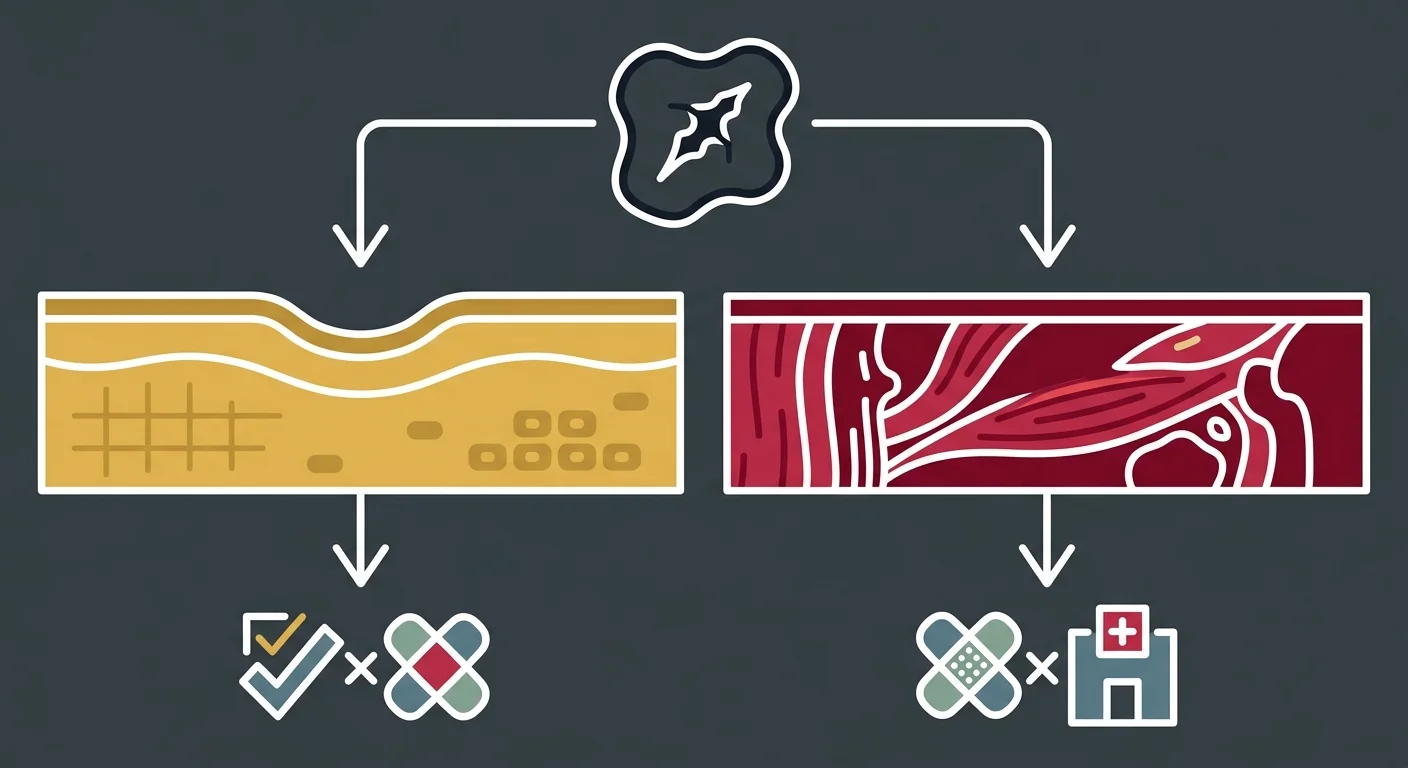
Physics tells you what each wave does. The assessment tells you which one your injury actually needs. Those aren't the same conversation — and only one of them should be driving your protocol.
Here's the real question — not which machine is available, but where does the pathology sit, how deep does it go, and how concentrated does the energy need to be when it arrives?
Those three questions route every case. Radial shockwave disperses across broad, shallow tissue — optimal within 3 to 4 centimeters of the surface. Focused shockwave converges to a precise deep target — driving energy up to 12 centimeters inside the tissue.
Match the geometry to the answers and you have a protocol. Miss it and you're running sessions against a condition the wave can't physically reach.
Most patients who come in for Shockwave Therapy have already tried something. Cortisone is the most common — and for many, cortisone temporarily masked the pain before the injury came back harder.
None of that history included an acoustic wave assessment. That's where the evaluation starts here. Not the machine inventory. Not a default protocol. The injury.
The Clinical Signals That Point to Radial Shockwave
Radial Shockwave Therapy belongs on injuries defined by breadth. The signal isn't just location — it's distribution.
When pain spreads across a wide tissue zone instead of concentrating at a single point, when the pathology lives in the superficial layers, and when the clinical goal is dispersing tension across a broad area rather than fragmenting a localized lesion — that's a radial presentation. The wave geometry fits the injury geometry. Optimal therapeutic depth: within 3 to 4 centimeters of the surface.
Plantar fasciitis spreading across the heel and arch. Upper trapezius trigger points. Generalized shoulder tendinopathy. Those are radial presentations — broad tissue, accessible depth, a dispersing energy pattern that covers the entire affected zone.
Here's a practical test: press along the painful tissue and reproduce pain across a band rather than a point. That's a radial injury. The diffuse pattern isn't a limitation. It's exactly what the condition calls for.
The Clinical Signals That Point to Focused Shockwave
Focused Shockwave Therapy belongs on injuries defined by depth and precision. The signals run opposite to radial.
Pain that concentrates at a single anatomical point. Pathology sitting at a bone-tendon junction or deep skeletal attachment. A structural lesion — calcific deposit, deep tendinopathy, bone stress reaction — located beyond the 3 to 4 centimeter threshold where radial energy has already dissipated.
When those signals are present, focused shockwave isn't a preference. It's the only wave geometry that physically reaches the pathology. The converging wave drives energy up to 12 centimeters inside the tissue. Radial never gets there.
When a patient can point to the exact millimeter of pain — a sharp, localized response to direct palpation at a deep tendon insertion — that's focused territory. The converging wave was built for that presentation: a microscopic focal point up to 12 centimeters inside the tissue, concentrated enough to reach what radial cannot.
The clinical data reflects it. Focused shockwave achieved an 84% success rate in pain reduction compared to 63% for radial shockwave at a 3-month post-treatment evaluation for chronic plantar fasciitis. That 21-point gap isn't a quality difference between equivalent tools. It's what happens when wave geometry matches injury depth.
And what shockwave therapy actually feels like during a focused protocol is a completely different answer than radial — because the wave is doing a completely different thing inside the tissue.
Who This Protocol-Matching Approach Is Not For
This approach isn't for everyone. That's worth saying plainly — before anyone wastes a visit finding out the hard way.
If you want a single-session fix, this isn't the right clinical environment. If you've already decided which protocol you need before the assessment starts — that's not how the decision gets made here.
Patients who arrive having researched 'radial vs focused' and want their answer confirmed aren't going to get confirmation. They're going to get an assessment. The assessment drives the protocol. That's non-negotiable — and it's not going to change based on what you read before walking in.
And if the appeal is a clinic that runs the same machine on every patient and calls it a care plan — this isn't that practice.
At Touch of Wellness Chiropractic, the machine inventory follows the diagnosis. It always has. The protocol selection happens after the injury is assessed, not before.
A provider who selects a wave type before evaluating the injury isn't making a clinical decision. They're making a scheduling decision. Those are not the same thing.
| Clinical Indicator | Signals Radial Shockwave | Signals Focused Shockwave | Assessment Method | Protocol Decision Trigger |
|---|---|---|---|---|
| Pain distribution pattern | Pain spreads across a wide tissue band — difficult to pinpoint to a single spot | Pain concentrates at one precise anatomical location — patient can point to the exact millimeter | Palpation mapping — press along the suspected tissue zone and note whether pain reproduces broadly or at a single point | Broad, distributed pain response routes to radial; sharp, localized point tenderness routes to focused |
| Tissue depth of pathology | Pathology sits within superficial tissue layers — accessible to a dispersing surface wave | Pathology sits at a bone-tendon junction, deep skeletal attachment, or calcific deposit beyond superficial reach | Structural imaging or clinical depth assessment to locate where the lesion actually sits | Shallow, broad pathology routes to radial; deep structural lesion routes to focused |
| Nature of the structural lesion | Muscle tension, fascial restriction, or generalized tendinopathy distributed across a region | Discrete structural lesion — calcific deposit, chronic deep tendinopathy, or bone stress reaction at a specific insertion | Clinical history plus response to prior treatments — did dispersive approaches help or stall? | Dispersible tissue condition routes to radial; discrete structural lesion routes to focused |
| Injury presentation examples | Plantar fasciitis spreading across the heel and arch, upper trapezius trigger points, generalized shoulder tendinopathy | Calcific tendinopathy at a tendon insertion, deep hip pathology, high hamstring tendinopathy, chronic proximal plantar fasciitis | Match the patient's symptom map against known presentation patterns for each wave geometry | Presentation aligning with broad tissue involvement routes to radial; deep insertion or calcific presentation routes to focused |
| Response to direct palpation | Pain reproduces across a band of tissue when pressed — no single point of maximum tenderness | Exquisite point tenderness at a single deep anatomical site — palpation reproduces the exact clinical symptom | Systematic palpation of the suspected region before protocol selection | Band-pattern palpation response routes to radial; single-point deep palpation response routes to focused |
| Clinical goal of treatment | Disperse tension and stimulate healing across a broad, accessible tissue zone | Concentrate acoustic energy precisely at a deep focal point to fragment a structural lesion or trigger deep tissue repair | Define whether the outcome requires broad coverage or pinpoint structural disruption | Goal of broad tension dispersal routes to radial; goal of deep structural fragmentation or focal stimulation routes to focused |
Frequently Asked Questions
Good. Now the specific questions.
These come up most often — and they deserve straight answers.
How do I know if my injury requires focused shockwave instead of radial shockwave?
Palpation tells you before any machine does. Press into the painful tissue. If pain reproduces across a wide band, that's a radial presentation. If it concentrates at a single sharp point — a deep tendon insertion, a bone junction — that's focused territory. The injury geometry tells you which wave fits. The assessment confirms it. That's the order. Assessment first, machine second.
Does focused shockwave therapy require more sessions than radial shockwave to see results?
Session count follows the tissue response. Not the machine. Radial Shockwave Therapy for Achilles tendinopathy typically runs 3 to 4 clinical sessions. Focused protocols vary by depth and structural complexity. Neither type is automatically longer. What drives the number is how your tissue heals — not which wave was selected. And if a provider quotes you a session count before the assessment is finished, that number isn't clinical. It's a scheduling decision dressed up as medicine.
Why do some clinics only offer radial shockwave therapy for deep tissue injuries?
Because most clinics own one machine. That's the honest answer. Radial shockwave devices cost significantly less than focused units. They cover a wide range of superficial conditions. So a clinic acquires one and builds every protocol around it. It's not malpractice. It's a business model. But when a deep-tissue injury walks in, the protocol doesn't change — because the equipment can't. Focused shockwave requires anatomical precision that radial isn't designed to deliver. The machine inventory shapes the clinical offer more than most patients know.
What happens if a clinic applies the wrong shockwave protocol to my chronic tendon pain?
You run sessions against tissue the wave never reaches. That's what actually happens. Radial shockwave disperses in the top layers. If your pathology sits deeper, the energy dissipates before it arrives. You're treating the tissue above the injury. Not the injury itself. Sessions accumulate. Pain doesn't resolve. Then someone tells you Shockwave Therapy didn't work. What didn't work was the protocol match. Wrong wave geometry isn't a minor calibration error. It's a category mismatch — and the outcome reflects it every time.
Can I combine radial and focused shockwave therapy in a single clinical care plan?
Yes — and for some presentations, it's the right call. A single injury can carry both a broad superficial component and a deep focal lesion. Radial Shockwave Therapy addresses the surface tension. Focused Shockwave Therapy reaches the structural pathology underneath. Running them in sequence within one care plan isn't unusual when the assessment identifies both layers. The FDA cleared focused shockwave for chronic proximal plantar fasciitis back in 2000 — that regulatory history reflects how condition-specific this has always been. But combined protocols only work when the assessment accurately identifies both components. Get that read wrong and you're not running a sophisticated plan. You're running two mismatched protocols back to back.
Stop Letting the Machine Decide Your Protocol
The machine doesn't decide. The injury does.
Radial Shockwave Therapy disperses energy across broad, shallow tissue. Focused Shockwave Therapy converges to a precise deep target. Those aren't interchangeable options. They're two different answers to a question only the assessment can ask. And the assessment has to come first.
Here's what the data actually shows. Focused shockwave hit an 84% success rate in pain reduction versus 63% for radial shockwave at a 3-month post-treatment evaluation for chronic plantar fasciitis. That 21-point gap isn't proof that one technology beats the other. It's proof of what happens when wave geometry matches injury depth — and what happens when it doesn't.
Running the wrong protocol isn't a minor calibration error. It's weeks of treatment pointed at a condition the wave can't physically reach.
At Touch of Wellness Chiropractic, the protocol selection happens after the injury is assessed. Not before. That's not a positioning statement — it's the only clinically defensible way to run a Shockwave Therapy program. Dr. Karen Hannah's Zoology-to-systems background means the evaluation starts with the structural biology of the injury: where is the pathology sitting, how deep does the acoustic energy need to travel, and which wave geometry gets there without dissipating before it arrives.
If your previous provider chose a wave type before the assessment was finished, they weren't making a clinical decision. They were making a scheduling decision.
The machine should follow the injury. Find a provider whose protocol selection does exactly that.
If you're not certain the protocol you've been offered actually matches your injury — the depth, the tissue, the structural problem underneath — that's the starting point at Touch of Wellness Chiropractic. The evaluation comes first. The wave geometry follows.