
How does the human nervous system act as the body's master controller?
The human nervous system is the body's live operating system. It transmits electrical signals between your brain, spinal cord, and every cell in your body. Movement, sensation, organ function, breathing, heartbeat—all controlled here.
It splits into two main parts: the Central Nervous System (CNS) and the Peripheral Nervous System (PNS). The CNS is your brain and spinal cord. The PNS is the wiring that carries signals to and from the rest of your body.
Your brain contains approximately 86 billion neurons. These specialized cells generate and conduct signals at speeds up to 120 meters per second. That's near-instantaneous communication across your entire system.
The CNS processes incoming information and issues commands. The PNS executes those commands through motor nerves and reports sensory data back through sensory nerves. The autonomic division of the PNS controls involuntary functions. It splits into the sympathetic system (fight-or-flight response) and the parasympathetic system (rest-and-digest state).
The spinal cord serves as the central highway for these signals. In adults, it measures approximately 45 cm long in men and 43 cm in women. The vertebral column protects it. When spinal alignment is compromised, signal transmission is disrupted.
The body's command system can't function correctly when the hardware running it is misaligned. That's not a metaphor. That's biology. Most treatments chase symptoms while ignoring the system that generated them.
Last Updated: May 16, 2026
- • The Central Command: Brain and Spinal Cord as Your Operating System
- • The Communication Network: How Nerve Signals Control Every Function
- • The Peripheral Network: Connecting Commands to Execution
- • The Autonomic Controller: Functions You Never Think About
- • When the Master Controller Gets Disrupted: What Happens to the System
-
• Frequently Asked Questions
- • How does the brain send signals to the rest of the body?
- • What is the difference between the central and peripheral nervous systems?
- • How does spinal health directly impact the nervous system's control over the body?
- • What happens to the body's control system when a nerve is pinched or damaged?
- • Can chiropractic adjustments improve nervous system function?
- • How do reflexes work without the brain's direct command?
- • The System Runs Everything—And the Spine Runs the System
The Central Command: Brain and Spinal Cord as Your Operating System
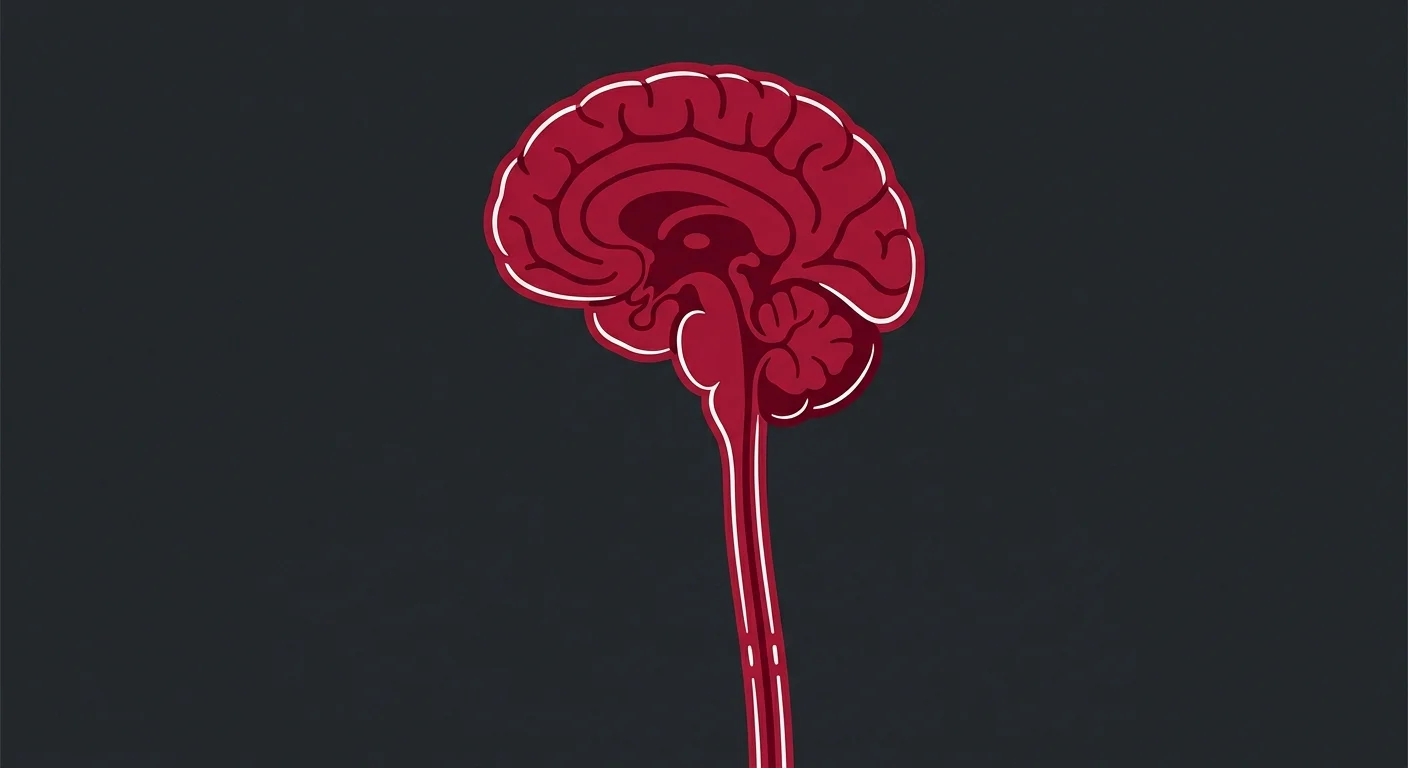
The Central Nervous System (CNS) is where everything runs.
The brain makes the call. The spinal cord delivers it. Every move you make, every sensation you feel, every automatic process keeping you alive—it all passes through this two-part hub.
Most people see the brain and spinal cord as two different things.
They're not.
They're one continuous network of nerve tissue, wrapped in bone and fluid, working as a single command center. Break the line anywhere, and the signal stops.
That's where spinal mechanics stop being about pain and start being about function.
You're not treating a sore back. You're restoring the integrity of the body's central operating system.
The Brain: Where Every Command Originates
Your brain holds roughly 86 billion neurons. Every one of them exists to send, receive, or process a signal.
It's the starting point for voluntary movement, conscious thought, memory, emotion, and sensory interpretation. The brain doesn't just coordinate your body—it's the control tower making split-second decisions based on incoming data from every nerve ending you've got.
But here's what gets missed: the brain can only act on the information it gets and the pathways it has to send commands back out.
If the signal gets distorted or blocked before it reaches the brain—or before the response reaches the muscle or organ—the command fails. The brain's power means nothing if the highway it depends on is broken.
The Spinal Cord: Your Body's Information Highway
The spinal cord extends straight out of the brain, running down the center of your vertebral column and branching at every level to reach the rest of you.
It's not a passive tube. It's an active relay station handling signals in both directions—motor commands going out, sensory data coming in.
When a vertebra shifts out of alignment, it doesn't just create localized pain.
It creates interference in the signal pathway. Your body's master controller is still issuing the orders, but the execution breaks down.
That's why patients come in with one symptom and leave noticing improvements in areas they never mentioned. You didn't treat the symptom. You restored the system running it.
| CNS Component | Primary Function | What It Controls |
|---|---|---|
| Brain | Command center—processes sensory input, generates voluntary movement, controls thought and decision-making | Voluntary movement, conscious thought, memory, sensory interpretation, emotion regulation |
| Spinal Cord | Signal relay—transmits motor commands from brain to body and sensory data from body to brain | Reflex actions, signal transmission to limbs and organs, autonomic nervous system coordination |
| Brainstem | Life-support operations—regulates involuntary survival functions without conscious input | Heartbeat, breathing, blood pressure, sleep-wake cycles, swallowing |
| Cerebellum | Movement coordination—fine-tunes balance, posture, and smooth execution of motor commands | Balance, posture, coordination of complex movements, motor learning |
The Communication Network: How Nerve Signals Control Every Function
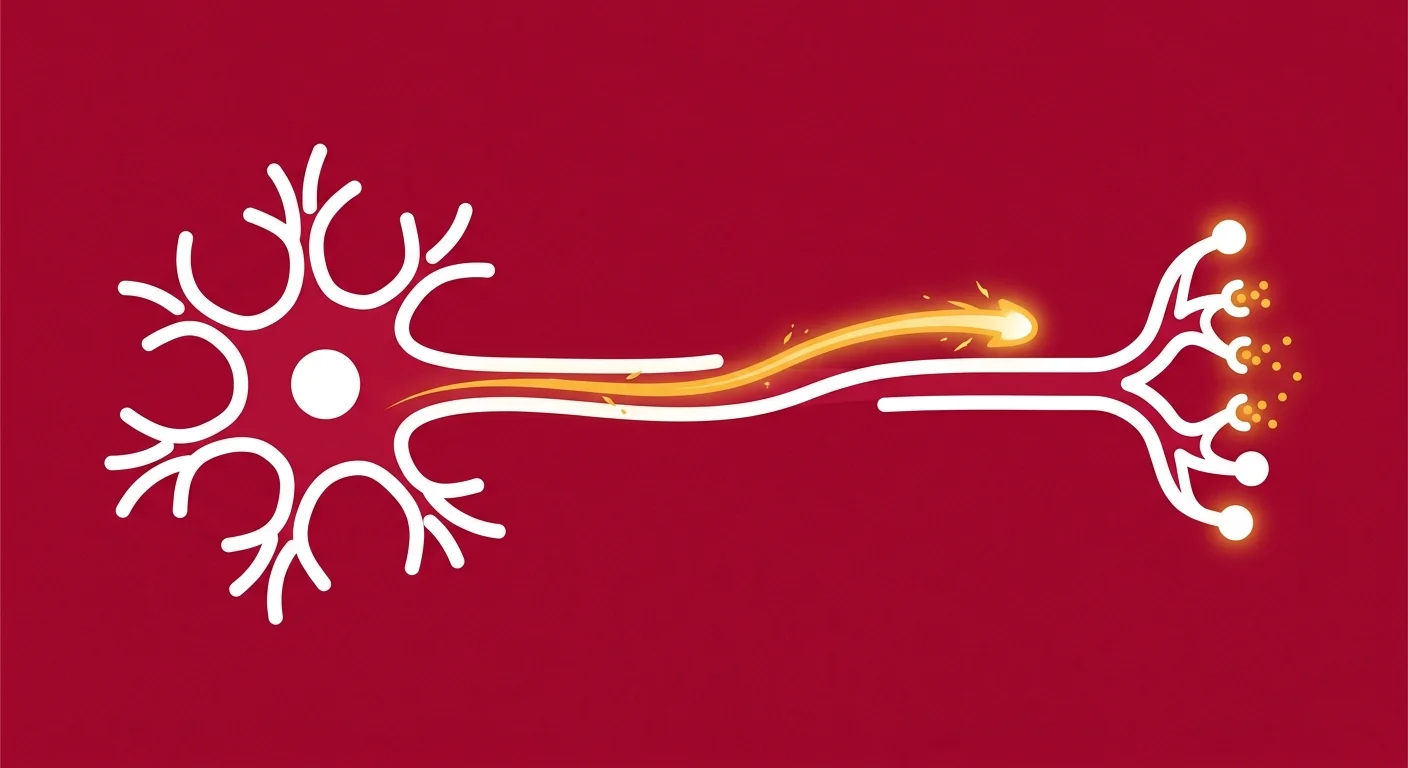
The nervous system doesn't just send signals. It sends them so fast you never notice the gap between thought and action.
Your brain tells your hand to move. Your hand moves. The signal just crossed the length of your arm in a fraction of a second.
That speed is what lets you react in real time.
You yank your hand off a hot stove. You catch something mid-fall. You catch your balance when you trip.
The communication network running those reflexes is the only reason you're not constantly hurting yourself.
But speed means nothing if the signal can't get through.
A nerve pathway blocked by spinal misalignment doesn't transmit slower. It transmits poorly—or not at all. The body's response time isn't the issue.
The interference is.
Speed and Precision: How Fast Your Body Responds
Nerve impulses can travel through myelinated nerve fibers at speeds up to 120 meters per second—over 268 miles per hour.
That's faster than highway traffic. The signal that moves your finger or shifts your weight is hitting that speed every single time.
That precision is why reflexes work.
Your spinal cord handles certain signals locally—no brain consultation required. You pull your hand back from heat before you feel pain. The system is built for survival, and it runs on unobstructed pathways.
When those pathways get compromised, response time doesn't just slow. It collapses. That's the line between a body that adapts and one that compensates.
The Neuron: The Fundamental Unit of Control
Your brain holds about 86 billion neurons. They're not just sitting there.
Every neuron is a specialized cell built to fire electrical impulses and hand them off to the next one in line. That's the foundation of every function your body runs—whether you're aware of it or not.
A neuron picks up a signal, processes it, and fires it down its axon to the next cell. The signal jumps a synapse—a tiny gap between neurons—using chemical messengers.
Then the next neuron repeats the cycle.
That chain is how your brain runs your lungs, your heartbeat, your muscles. It's also why the biology of a chiropractic adjustment isn't just about moving bones. It's about restoring the environment where neurons can transmit without interference.
| Signal Type | Transmission Speed | What It Controls |
|---|---|---|
| Myelinated nerve fibers (motor and sensory) | Up to 120 meters per second (268 miles per hour) | Voluntary movement, rapid reflex responses, sensory information from skin and muscles |
| Neuronal signaling (brain processing) | Brain contains approximately 86 billion neurons generating and conducting signals | Conscious thought, memory, emotion, sensory interpretation, voluntary command initiation |
The Peripheral Network: Connecting Commands to Execution
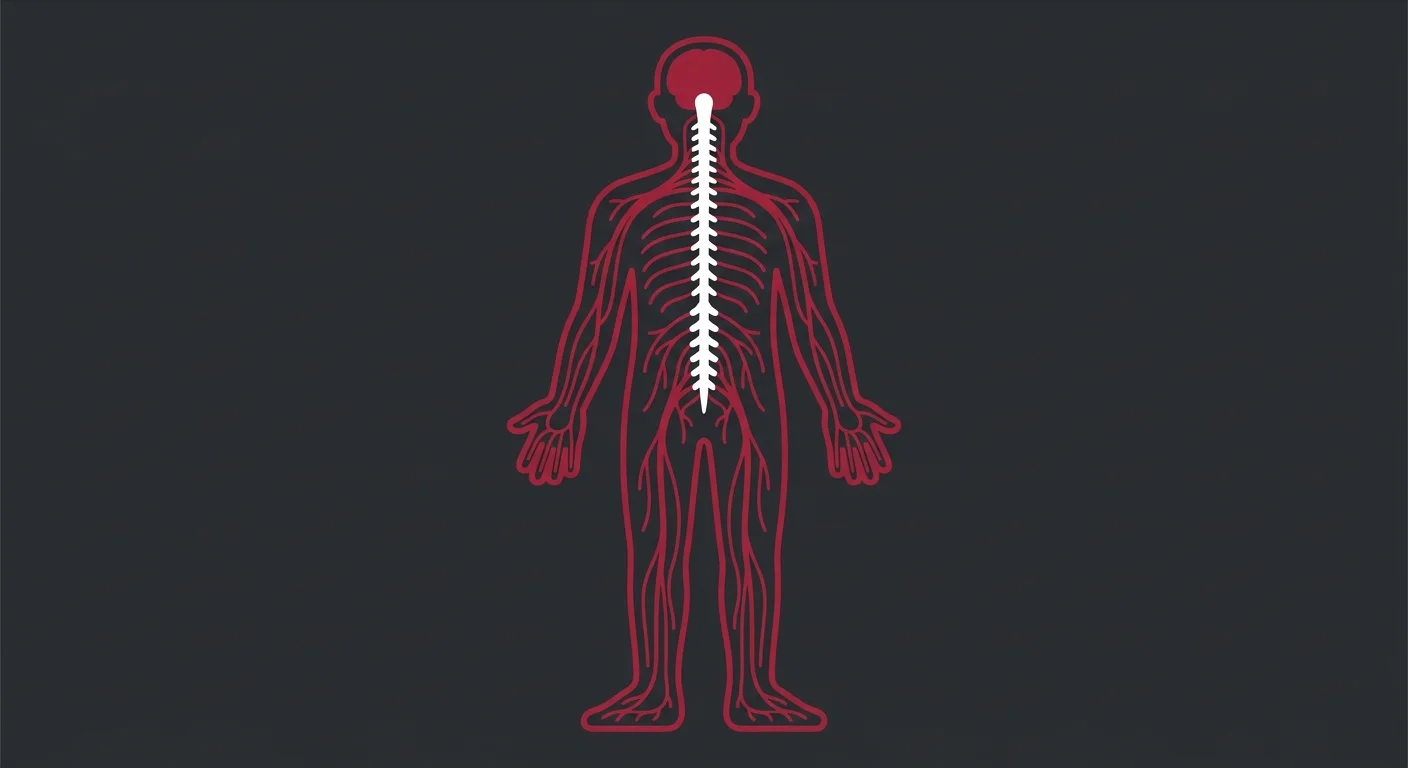
The Peripheral Nervous System (PNS) is everything that isn't your brain or spinal cord.
It's the distribution network—every nerve that connects the CNS to your fingers, your organs, your skin, every muscle fiber you have. The brain's commands never reach their targets without it.
Your spinal cord can process signals perfectly. But if the peripheral network is compromised, execution fails.
This isn't a passive delivery system.
The PNS handles two-way communication—sensory nerves carry information from your body to your CNS, and motor nerves carry commands from your CNS back out to muscles and glands. Every sensation you feel, every movement you make, runs through this network.
When patients walk in with unresolved nerve-related conditions, they're not dealing with a single broken wire. They're dealing with a disrupted distribution channel that's failing at multiple endpoints.
The PNS also includes the autonomic division, which controls involuntary functions like your heartbeat and breathing without your conscious input.
You don't decide to digest food or regulate your blood pressure—the autonomic system does that for you, adjusting in real time based on feedback from your environment and internal state.
But when spinal misalignment interferes with the nerve pathways feeding that system, the body's automatic adjustments stop working correctly. That's why a structural problem can produce systemic symptoms that have nothing to do with pain.
Sensory Nerves: The Input Side of the System
Sensory nerves are the input channels—they detect pressure, temperature, pain, vibration, and position, then relay that data to your CNS for processing.
Touch a hot stove, step on a sharp object, or feel your phone vibrate in your pocket—sensory nerves registered those events and sent the signal upstream before you consciously recognized what happened.
But sensory input isn't just about immediate threats.
It's also how your brain knows where your body is in space—proprioception—and whether your internal systems are working normally. When sensory pathways are disrupted by nerve compression or irritation, the brain receives incomplete or distorted information.
It can't make accurate decisions based on bad data. So the body compensates—and compensation creates new problems downstream.
Motor Nerves: The Output Side That Makes Things Happen
Motor nerves carry commands from the CNS to muscles and glands, triggering contractions, movements, and secretions.
Your brain decides to stand up, and motor nerves fire the signal to your leg muscles in the exact sequence needed to execute that action. The coordination required to perform even simple movements depends on flawless signal transmission through motor pathways.
When motor nerve pathways are compromised—whether by spinal misalignment, inflammation, or structural interference—the command signal weakens or fails to reach its target.
Muscles don't contract with the strength or timing they should. Glands don't release hormones on cue.
The body tries to compensate by recruiting other muscle groups or altering movement patterns. But compensation isn't correction—it's a workaround that produces its own set of dysfunctions.
That's why treating the symptom without addressing the signal pathway produces temporary relief at best.
| Nerve Type | Direction of Signal | Function | Example |
|---|---|---|---|
| Sensory (Afferent) | Body → CNS | Transmits information from receptors to the brain and spinal cord for processing | Temperature sensors in your skin detect cold and send that signal to your brain |
| Motor (Efferent) | CNS → Body | Carries commands from the brain and spinal cord to muscles and glands to trigger action | Your brain sends a signal to your leg muscles to stand up from a chair |
| Autonomic (Sympathetic) | CNS → Organs | Activates the body's stress response—increases heart rate, diverts blood flow, sharpens alertness | Your heart rate spikes when you're startled or under threat |
| Autonomic (Parasympathetic) | CNS → Organs | Activates rest and recovery—slows heart rate, promotes digestion, supports healing processes | Your body shifts into digestion mode after eating a meal |
The Autonomic Controller: Functions You Never Think About
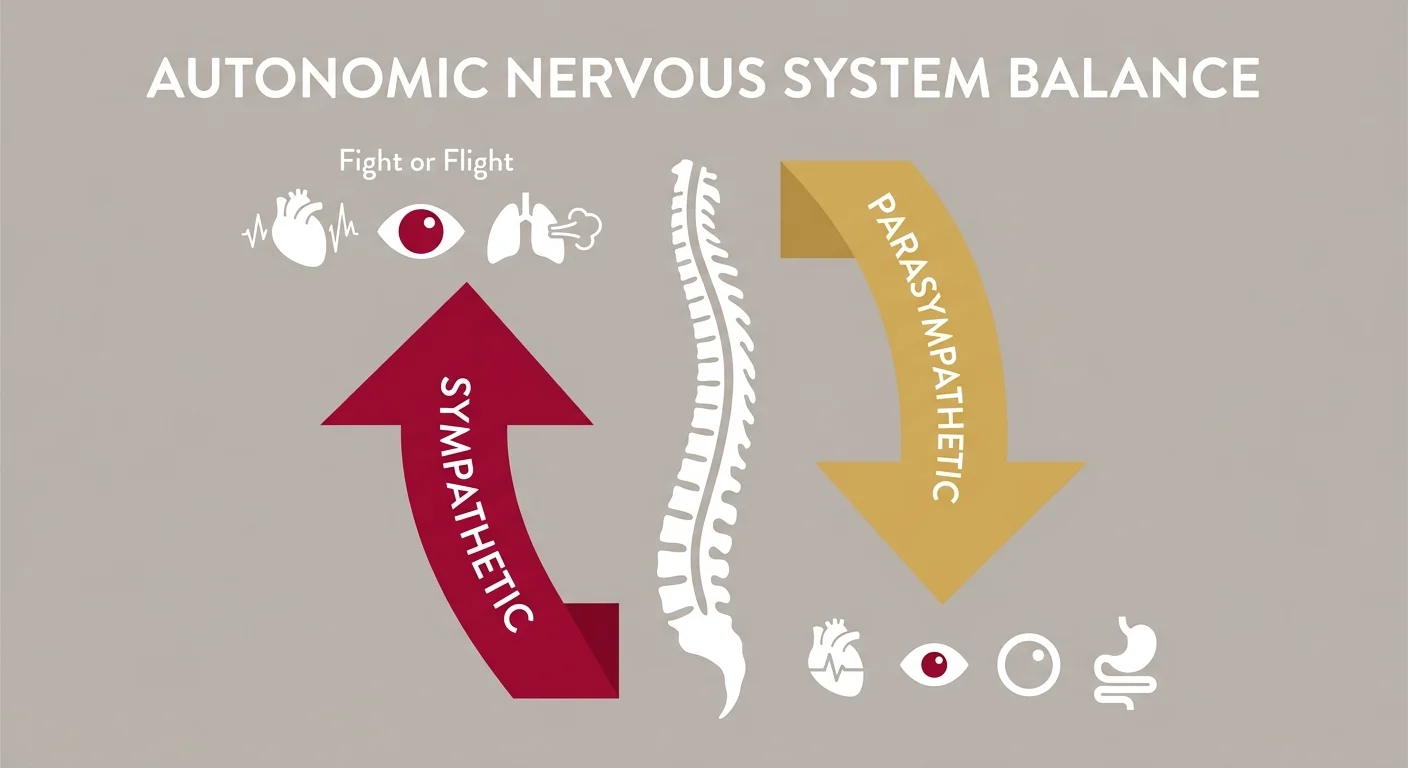
Here's what most people miss: the nervous system isn't just running the movements you control. It's running everything you don't.
The autonomic nervous system is your body's autopilot. It's the part of the Peripheral Nervous System that controls heartbeat, digestion, blood pressure, breathing rate, hormone release, and temperature regulation.
You don't decide to sweat when you overheat. You don't trigger your pupils to dilate in dim light.
The autonomic system handles that without asking.
It's split into two opposing divisions—sympathetic and parasympathetic—and they work like a biological seesaw.
One revs you up. One slows you down.
When both are functioning correctly, your body adapts to stress, recovers from exertion, and maintains the biological connection between spinal alignment and homeostasis. When one gets stuck in the 'on' position, everything downstream breaks.
Sympathetic Division: Your Fight-or-Flight System
The sympathetic division is your body's emergency response system—fight-or-flight.
Your brain detects a threat—real or perceived—and the sympathetic nervous system floods your body with adrenaline. Heart rate spikes. Blood flow redirects to your muscles. Pupils dilate. Non-essential processes like digestion shut down.
You're primed to run or fight.
That response is lifesaving when you're facing actual danger.
But it's not designed to run continuously.
When the sympathetic system stays activated—because of chronic stress, unresolved pain, or nervous system dysfunction—it wears the body down. You don't digest properly. You don't sleep deeply. Your immune system takes a hit.
The system that's supposed to protect you becomes the thing breaking you.
Parasympathetic Division: Your Rest-and-Digest System
The parasympathetic division is the rest-and-digest counterbalance.
It slows your heart rate. It stimulates digestion and nutrient absorption. It triggers repair processes and allows your body to recover from the wear and tear of daily life.
It's the system that lets you heal.
When parasympathetic activity is healthy, you fall asleep easily. You wake up rested. You digest food without issue.
When it's suppressed—because the sympathetic system won't turn off—you end up wired and exhausted at the same time.
Your body never gets the signal that it's safe to recover.
When Autonomic Balance Gets Disrupted
Autonomic dysfunction doesn't announce itself with one clear symptom.
It shows up as a collection of seemingly unrelated problems—digestive issues, sleep disruption, chronic fatigue, heart palpitations, blood pressure swings, and temperature regulation problems.
Patients describe feeling stuck in overdrive. Or like they can't get their system to wake up.
The root cause is often structural.
When spinal misalignment creates interference in the nerve pathways feeding the autonomic system, the brain's commands to shift between sympathetic and parasympathetic modes don't transmit cleanly. The body gets stuck in one state. Or it ping-pongs between extremes.
Treating the symptoms individually doesn't fix the control system generating them. Restoring spinal integrity does.
| Autonomic Division | Primary Role | Bodily Functions Controlled |
|---|---|---|
| Sympathetic Division | Emergency response and activation—fight-or-flight mode | Increases heart rate, dilates pupils, redirects blood flow to muscles, suppresses digestion, releases adrenaline, elevates blood pressure, opens airways |
| Parasympathetic Division | Recovery and maintenance—rest-and-digest mode | Slows heart rate, stimulates digestion and nutrient absorption, promotes cellular repair, triggers sleep onset, lowers blood pressure, constricts pupils |
When the Master Controller Gets Disrupted: What Happens to the System
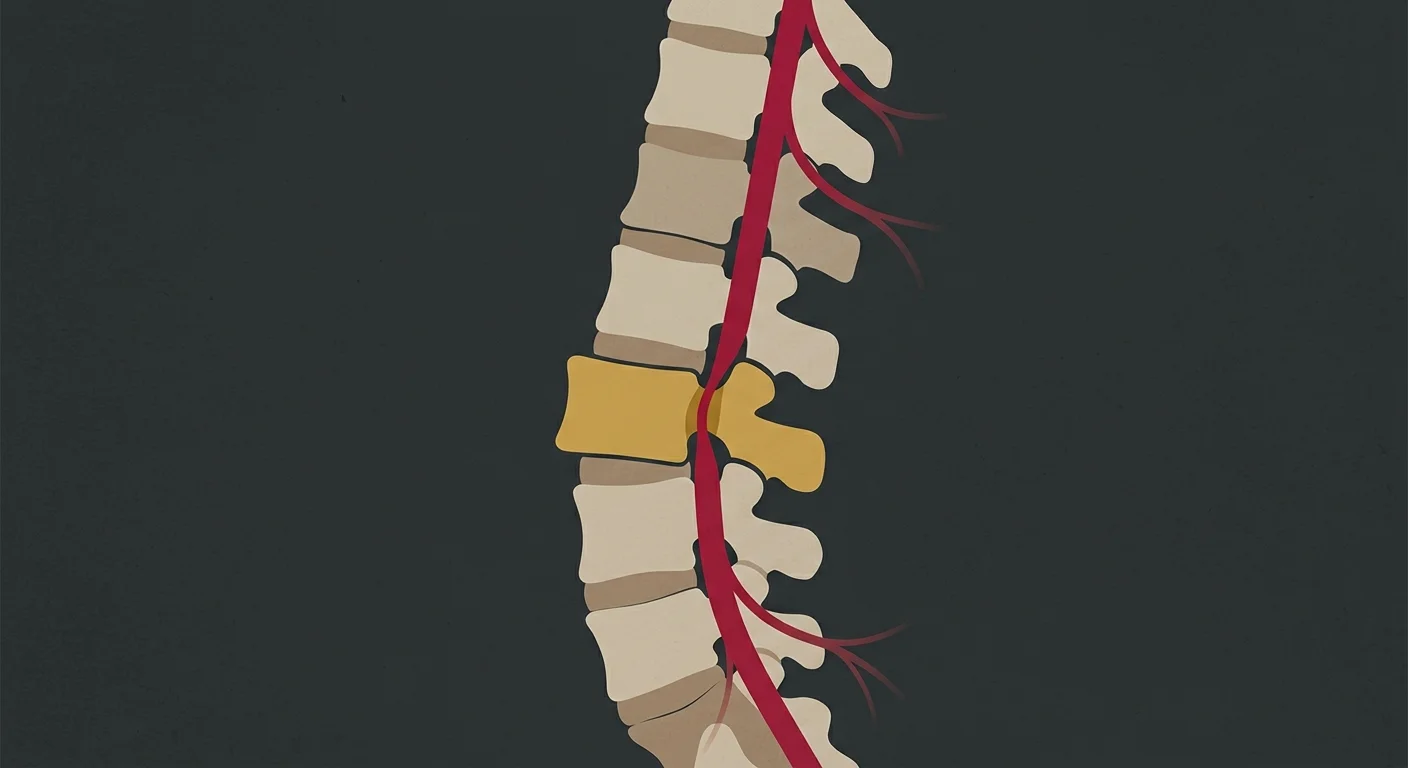
The nervous system doesn't fail gradually.
It compensates.
Your body's designed to adapt to interference, reroute signals, and keep you functional—until it can't. Most people don't notice the problem until compensation breaks down. By that point, the dysfunction's been running for months or years.
The symptoms you feel—pain, numbness, sleep disruption, digestive problems—aren't the failure. They're the alert that the live operating system is operating under duress.
When the Central Nervous System—the brain and the spinal cord working as one unit—runs into structural interference, the body doesn't shut down. It adjusts.
Muscles tighten to protect compromised areas. Movement patterns shift to avoid triggering pain. Autonomic functions recalibrate around incomplete information.
That's how a mechanical issue in your spine produces systemic symptoms that have nothing to do with your back.
This is the gap most treatments miss.
They chase the symptom—prescribe something for the headache, something else for the digestive issue, something for the sleep problem—without asking why the body's control system is generating all three at once.
Root-cause chiropractic care starts with the question those treatments skip: what's disrupting the signal?
Spinal Misalignment: How Mechanical Problems Create Systemic Dysfunction
The spinal cord in adult humans is approximately 45 cm long in men and 43 cm in women. And it's running the show.
It's not just a structural column—it's the primary conduit for every nerve pathway connecting your brain to the rest of your body. When vertebrae shift out of alignment, they don't just affect the bones.
They compress, irritate, or stretch the nerves exiting at that level. And those nerves feed specific organs, muscles, and systems downstream.
A misalignment in your cervical spine can disrupt nerve pathways that control your diaphragm, your blood pressure, and your ability to regulate stress responses.
A problem in your lumbar spine can interfere with signals to your digestive organs, your bladder, and your lower extremities.
The body compensates by recruiting other muscles, altering posture, and shifting autonomic tone—but compensation isn't correction. It's a temporary workaround that eventually produces its own cascade of dysfunction. That's why one structural issue can generate a list of symptoms that seem unrelated.
The Cookie-Cutter Protocol Trap: Why One-Size-Fits-All Fails
Most chiropractic offices run the same protocol on every patient.
Walk in with nerve pain, walk in with a headache, walk in with sciatica—you get the same sequence. When it doesn't work, they run it again.
That's not a care plan. That's a template.
And it fails because the nervous system doesn't respond to templates—it responds to what's actually happening in that specific body at that specific time.
The cookie-cutter model assumes all spinal misalignments are structurally identical and that all nervous systems respond the same way to the same input.
Neither is true.
One patient's C5 misalignment might be compressing a nerve root that feeds their shoulder and diaphragm. Another patient's C5 issue might be irritating the sympathetic chain and keeping them locked in fight-or-flight.
Same vertebra. Different dysfunction. Different care plan.
A protocol that ignores patient-specific presentation isn't clinical care—it's guesswork with an adjustment table.
What Root-Cause Nervous System Care Actually Addresses
Care built from Dr. Karen Hannah's unique clinical lens—forged through cross-species clinical training and a Clinical Response Model grounded in real-time neurological reading—starts with what you're actually reporting. Not what a diagnosis code says you should have.
The assessment identifies which spinal segments are compromised, which nerve pathways are affected, and how the dysfunction is manifesting systemically. Then the care plan is built to restore nervous system function at the structural level—not mask the symptoms it's producing.
That means chiropractic adjustment to restore vertebral alignment and decompress nerve pathways. It means advanced therapy modalities like shockwave therapy to address soft tissue dysfunction that's reinforcing the structural problem.
And it means reassessing and pivoting the approach after a few visits if the initial strategy isn't producing the expected response.
The willingness to change course when something isn't working isn't a weakness—it's the clinical standard. And it's the difference between a practice that treats the nervous system as the live operating system and one that just treats whatever the patient mentioned first.
Frequently Asked Questions
Here's what patients ask when they start connecting spinal health to systemic function.
These aren't textbook questions.
They're the ones that come up when you realize your body's control system has been running under interference and no one bothered to explain why.
How does the brain send signals to the rest of the body?
Your brain sends signals through nerve fibers called neurons. These pathways run through the spinal cord and branch out to every part of your body.
Nerve impulses can hit speeds up to 120 meters per second—over 268 miles per hour. That's how your brain controls movement, sensation, and organ function in real time.
When spinal alignment compromises those pathways, the signal doesn't transmit cleanly. Your brain's sending the command. The interference is blocking it from arriving intact.
What is the difference between the central and peripheral nervous systems?
The Central Nervous System is the brain and the spinal cord. Command center. Where decisions are made and instructions originate.
The Peripheral Nervous System is the network of nerves carrying those instructions to the rest of your body. Distribution system.
The CNS runs the show. The PNS delivers the orders. When structural interference disrupts either one, the body's ability to execute coordinated function breaks down.
How does spinal health directly impact the nervous system's control over the body?
Every nerve pathway connecting your brain to your body runs through or exits from your spine. When vertebrae shift out of alignment, they compress or irritate those pathways.
That interference disrupts signal transmission. Your brain might be sending the correct command, but the message arrives incomplete or distorted.
Spinal health isn't about posture. It's about maintaining the structural integrity of the system controlling everything else.
When the spine's misaligned, nervous system function degrades—and that shows up systemically.
What happens to the body's control system when a nerve is pinched or damaged?
When a nerve's pinched or damaged, the signal it carries is disrupted. That can produce pain, numbness, tingling, or loss of function in the area that nerve supplies.
But the damage isn't limited to sensation. Nerves also control muscle function, organ activity, and autonomic regulation.
A pinched nerve feeding your digestive system doesn't just hurt—it disrupts digestion. The body compensates by recruiting other pathways and altering function. That compensation's temporary.
It breaks down over time, and when it does, the dysfunction spreads.
Can chiropractic adjustments improve nervous system function?
Yes. Chiropractic adjustments restore vertebral alignment and decompress nerve pathways. When structural interference's removed, the nervous system's ability to transmit signals cleanly improves.
That's not about cracking your back. It's about restoring the mechanical integrity of the system your brain relies on to control your body.
Improvement shows up as better movement, reduced pain, clearer autonomic function, and better systemic coordination. When the control system works, everything downstream works better.
How do reflexes work without the brain's direct command?
Reflexes are hardwired responses that bypass the brain. The signal travels from the sensory nerve to the spinal cord and directly back to the muscle.
That's why you pull your hand away from a hot surface before you consciously register the pain. The spinal cord processes the threat and triggers the response instantly.
Reflexes prove the spinal cord isn't just a relay station—it's an active processing center. When spinal health's compromised, even reflex pathways can be disrupted.
The System Runs Everything—And the Spine Runs the System
The nervous system isn't one function among many.
It's the live operating system running all the others.
When it's working correctly, your body adapts to stress, recovers from injury, regulates temperature, digests food, and coordinates movement without you thinking about it. When it's disrupted, nothing works right—and no amount of symptom management changes that.
You can't medicate your way out of a structural control problem.
Most treatments operate on the assumption that symptoms are the problem.
They're not.
Symptoms are the output—the body's way of signaling that the master controller is operating under interference. Pain, numbness, digestive dysfunction, sleep disruption, autonomic imbalance—all downstream effects of a nervous system that can't transmit signals cleanly.
Treating each symptom individually is like closing error windows on a crashing computer and calling it fixed. The operating system is still failing.
Your spine isn't just holding you upright.
It's the structural conduit for every nerve pathway connecting your brain to your body. When vertebral alignment is compromised, nervous system function is compromised—and that shows up everywhere.
Restoring spinal integrity restores the system's ability to do what it was designed to do: control, coordinate, and regulate every function that keeps you alive. That's not pain relief. That's root-cause resolution.
And it's the difference between a body that's compensating and one that's actually running the live operating system the way it was built to run. About Dr. Karen Hannah, DC — her clinical lens is built on a cross-species neurological framework. After witnessing a paralyzed kitten recover complete motor function in four days through spinal recalibration, she recognized that the spine is not just a collection of structural bones, but the central pathway for a live operating system that governs all biological function.
Your nervous system is either transmitting cleanly or it's running under interference. If you've been handed vague timelines, told to wait and see, or treated like your symptoms are separate problems instead of signals from a disrupted control system—that's not care. An honest assessment of your nervous system function starts with what you're actually experiencing and builds a plan that addresses the structural source, not the error messages it's generating.