
How your body communicates through 'medical mystery' symptoms.
Medical mystery symptoms are physical sensations that won't quit despite normal test results and no clear diagnosis. Pain. Numbness. Fatigue. Dizziness. Digestive distress. All real. Often disabling. None explained by conventional medical evaluation. They show up when the nervous system becomes dysregulated and starts amplifying signals in ways that don't match a visible injury or identifiable disease process.
Over one-fifth of U.S. adults experience chronic pain. A significant portion of those cases remain medically unexplained. Functional Neurological Disorder is the second most common reason patients visit neurology clinics. The body produces symptoms the brain can't immediately classify—and it does so frequently.
Central sensitization describes one mechanism. The nervous system enters a persistent state of high reactivity, amplifying pain signals in response to stimuli that wouldn't normally be painful. The symptom isn't the failure. It's the signal that a system upstream is under load.
When traditional diagnostics find nothing structurally damaged, the problem isn't imaginary. The problem is that the communication is happening at the system level—nervous system regulation, spinal interference, chronic stress overload—rather than at the tissue level most imaging and lab work are designed to detect. The body communicates through symptoms the same way an electrical system communicates through a breaker tripping.
Patients with medically unexplained symptoms often feel dismissed by healthcare providers. That dismissal worsens their condition and delays recovery. Dismissal happens because the standard diagnostic lens isn't designed to decode nervous system language. These symptoms aren't mysteries. They're predictable outputs from a biological system operating under abnormal input or sustained interference.
Last Updated: May 16, 2026
- • What 'Medical Mystery' Symptoms Actually Are
- • The Standard Testing Dead End
- • How the Nervous System Creates Real Symptoms Without Damage
- • How a Systems-Biology Lens Decodes the Signal
-
• Frequently Asked Questions
- • Why do doctors say 'it's all in your head' when my physical symptoms feel so real?
- • Can the nervous system create pain and other symptoms without a specific injury or disease?
- • What is the difference between treating a symptom and addressing the root cause of that symptom?
- • How does a chiropractor investigate symptoms that a primary care doctor couldn't explain?
- • If I feel like I've already tried everything for my symptoms, what makes a systems-biology approach different?
- • The Bottom Line
What 'Medical Mystery' Symptoms Actually Are
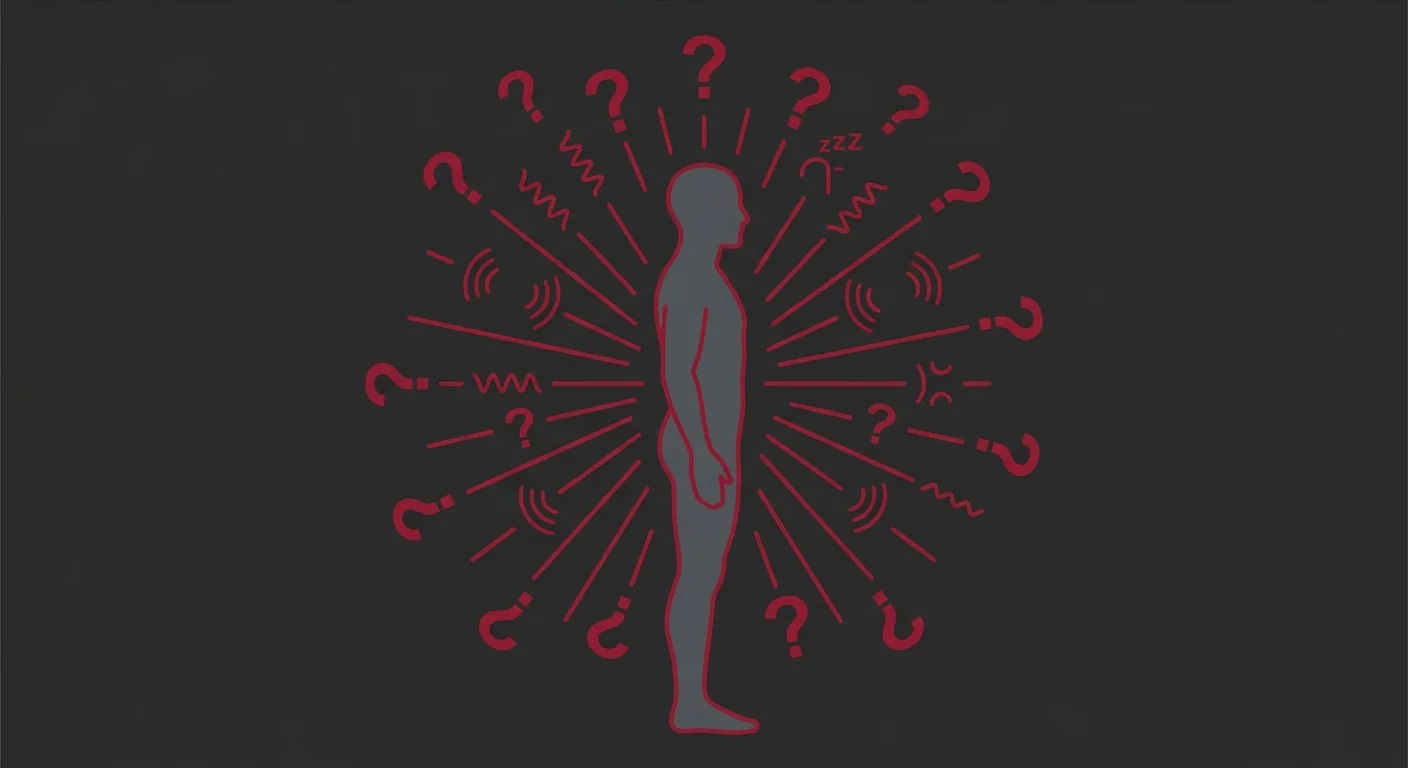
Most patients arrive here because something has been dismissed. Not ignored — dismissed.
A GP ran tests, found nothing on the imaging, and sent them home with instructions to reduce stress. Or manage symptoms with Tylenol.
The pain didn't stop. The numbness didn't resolve. The fatigue kept them from showing up fully at work.
The symptom is still there — just as real, just as disruptive — but the medical file says there's nothing wrong.
That pattern — normal labs, clean scans, persistent symptoms — doesn't mean the body is lying.
It means the diagnostic tools weren't designed to detect what's actually broken.
Standard medical imaging looks for structural damage: herniated discs, tumors, fractures, lesions. Lab work looks for infection, inflammation markers, biochemical abnormalities.
When those tests come back normal, the conclusion is often that nothing is medically wrong. But that conclusion is based on what the test can see. Not what the nervous system is doing.
The body doesn't generate symptoms for no reason. If you're experiencing chronic pain, unexplained numbness, or Medically Unexplained Symptoms that interfere with daily life, your nervous system is broadcasting a signal.
The issue isn't that the symptom is imaginary.
The issue is that the frequency it's transmitting on isn't being monitored. The body is a broadcasting system. Your symptoms aren't noise or mysteries—they're a specific signal on a frequency most providers never tune into.
Why These Symptoms Get Dismissed
Here's why dismissal happens so often.
Primary care medicine operates on a diagnosis-first model. If a symptom doesn't fit a known diagnosis code, it becomes hard to treat within that framework.
Patients who don't fit clean diagnostic categories cycle through specialists. Each runs the same tests again. Each arrives at the same conclusion: nothing shows up.
And the patient is back where they started — except now they've burned time, money, and trust.
Patients with medically unexplained symptoms become high-utilizers of healthcare services while reporting lower satisfaction with care.
That's not a patient problem. That's a systemic failure to investigate what the nervous system is communicating when imaging and labs are silent.
The prevalence of chronic pain in U.S. adults underscores how common this gap is. Over one-fifth of U.S. adults experience chronic pain. A significant portion of those cases remain medically unexplained.
That's not a small subset. That's an epidemic of dismissed symptoms.
And when a provider can't find a diagnosis, the fallback is often psychological.
Patients are told it's stress, anxiety, or psychosomatic. That framing erases the biological reality of what's happening.
Stress does affect the nervous system — that part is true. But the mechanism isn't imaginary.
The symptom is a real output from a dysregulated system that never got the structural or neurological investigation it required. Calling it psychosomatic is not an explanation. It's an admission that the standard diagnostic process has no answer.
| Symptom Type | What Patients Report | What Standard Testing Shows |
|---|---|---|
| Chronic pain with no clear injury | Pain that moves between areas, worsens with stress, or persists long after an initial trigger has healed | Normal imaging—no fractures, no disc herniation, no visible tissue damage |
| Unexplained numbness or tingling | Sensation loss in hands, feet, or face that doesn't follow a single nerve distribution pattern | Normal nerve conduction studies, normal MRI, no evidence of compression or neuropathy |
| Persistent fatigue unresponsive to rest | Exhaustion that doesn't improve with sleep, often accompanied by brain fog or difficulty concentrating | Normal thyroid panels, normal blood counts, no infection markers, no metabolic abnormalities |
| Dizziness or balance issues | Episodes of vertigo, lightheadedness, or feeling unsteady that disrupt daily activities | Normal vestibular testing, normal inner ear exam, no signs of neurological disease |
| Digestive distress with no structural cause | Chronic nausea, bloating, or abdominal pain that doesn't respond to dietary changes or medication | Normal endoscopy, normal ultrasound, no ulcers or obstructions found |
| Headaches or migraines without clear triggers | Recurring head pain that doesn't fit a classic migraine pattern or doesn't respond to standard migraine treatment | Normal CT scan, normal MRI, no vascular abnormalities, no sinus infection |
The Standard Testing Dead End
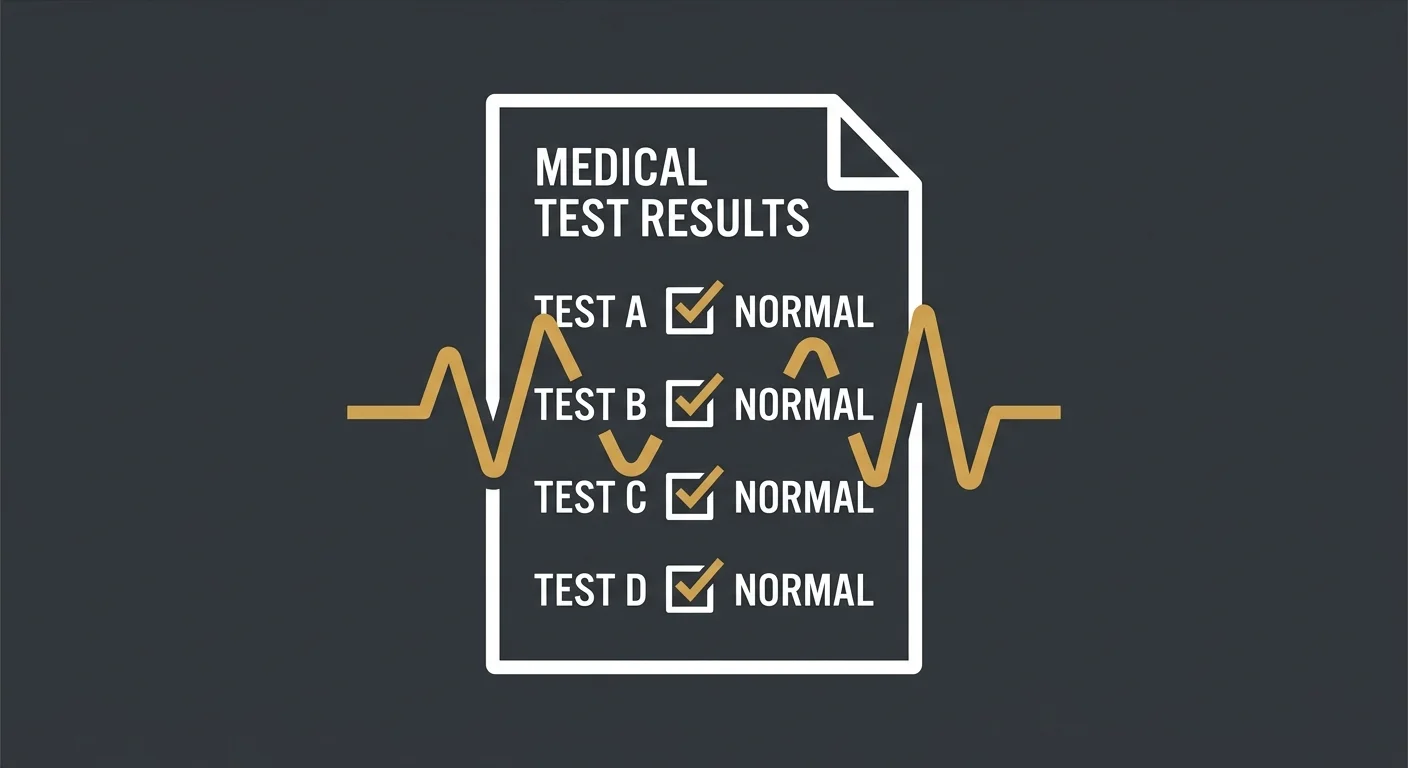
The investigation ends the second the imaging comes back normal.
Your doctor orders an MRI or CT scan. They're hunting for structural damage—herniated discs, spinal fractures, nerve compression visible on film. The scan comes back clean. Nothing alarming.
So the conclusion is that nothing is medically actionable.
Rest. Take ibuprofen. Manage stress. And the symptom keeps going because the test was never designed to detect what's broken.
But the body doesn't broadcast pain, numbness, or functional neurologic disorder symptoms for no reason. When imaging is clean and labs are unremarkable, the signal isn't imaginary.
It's transmitting on a frequency the standard diagnostic toolkit wasn't built to measure.
That's where individualized, root-cause chiropractic care picks up where the testing stops.
Why 'Normal' Test Results Miss the Cause
Normal test results don't mean your body is working right. They mean the specific tests that were ordered didn't detect structural tissue damage or biochemical markers of disease.
Imaging detects what's visible. Lab work detects what's measurable in blood or urine.
Neither tool is designed to assess nervous system regulation, spinal interference, or chronic system overload.
And that's the gap. Patients with medically unexplained symptoms often feel dismissed by healthcare providers, which worsens their condition and delays recovery.
The dismissal isn't personal. It's systemic.
If a symptom doesn't produce a visible lesion or a diagnosable code, the investigation ends. You're left managing symptoms that never got a root-cause evaluation.
Here's the thing. Your symptoms aren't noise. They're a specific signal from a dysregulated nervous system that standard diagnostics weren't designed to decode.
When the breaker keeps tripping and the electrician only checks the outlets, the problem upstream stays invisible.
That's what happens when testing stops at imaging and labs.
| Standard Test | What It Looks For | What It Misses |
|---|---|---|
| MRI or CT scan | Herniated discs, fractures, tumors, visible nerve compression | Nervous system dysregulation, spinal interference that doesn't produce visible structural damage, chronic stress overload affecting system function |
| Blood work (CBC, metabolic panel) | Infection markers, inflammation levels, biochemical abnormalities | Nervous system amplification patterns, central sensitization, functional disruptions that don't show up in blood chemistry |
| X-ray | Bone fractures, joint misalignment visible on film, arthritis progression | Subtle spinal restrictions, nerve pathway interference, soft-tissue dysfunction, mobility issues that don't produce visible bone changes |
| EMG (electromyography) | Nerve conduction velocity, muscle electrical activity, peripheral nerve damage | Central nervous system dysregulation, spinal interference upstream of peripheral nerves, whole-system communication breakdowns |
| Physical exam (primary care) | Range of motion, reflexes, obvious structural abnormalities | Individualized movement patterns, patient-reported symptom triggers, how symptoms change with specific positions or activities over time |
| Referral to psychology or psychiatry | Anxiety, depression, stress as primary diagnosis | Biological nervous system dysfunction that produces real physical symptoms, spinal and structural causes that require manual investigation |
How the Nervous System Creates Real Symptoms Without Damage
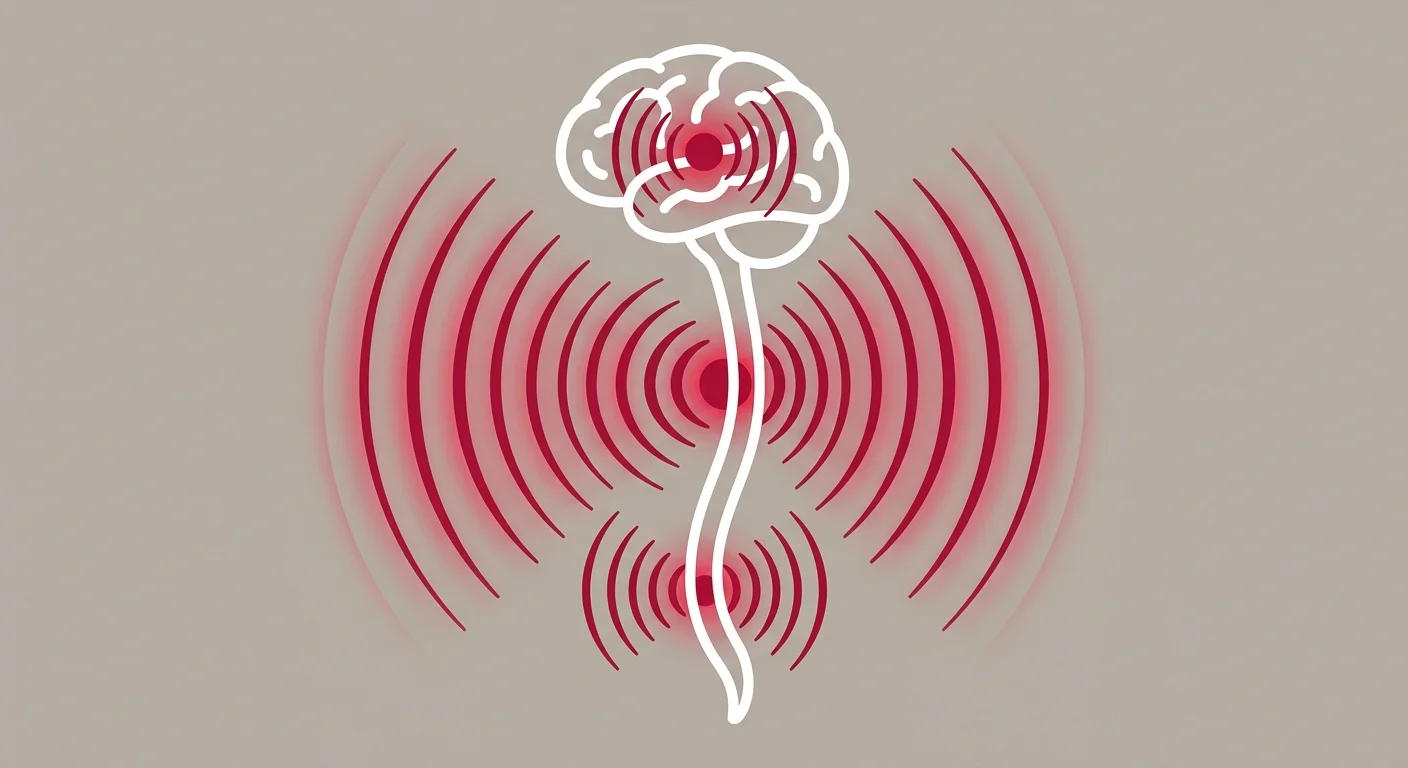
Your nervous system runs everything. Muscle contraction. Digestion. Heart rate. Pain perception. Balance.
When it's working correctly, signals move smoothly from sensors in your tissues to your brain and back. Your body interprets input, adjusts output, maintains equilibrium.
But when that system gets dysregulated, it starts amplifying signals that should be routine. It ignores context that should dampen pain. It treats normal as dangerous.
That's how you end up with real, disabling symptoms that don't match any visible injury.
The tissue looks fine on imaging. The blood work is normal. But the nervous system is treating a minor input like a five-alarm fire.
So when a provider tells you 'the scan is clear,' what they're actually saying is that the damage they were trained to look for isn't there.
They're not saying your pain isn't real.
They're saying the framework they're using can't decode what how the human nervous system acts as the body's master controller is broadcasting.
The symptom is the signal.
And the signal is telling you that somewhere upstream—at the spinal level, at the regulatory level, at the threshold where your brain decides what's dangerous and what's not—the system is stuck in overdrive.
Central Sensitization: The Amplifier
Central sensitization is a persistent state of high reactivity. The nervous system amplifies pain signals in response to stimuli that wouldn't normally hurt.
The system stops responding proportionally.
Light touch, movement, temperature changes — it reads all of it as threat.
This isn't a lack of pain tolerance. It's a recalibration error.
The nervous system's gain knob has been turned up. Now everything hurts more than it should. Patients describe burning pain from clothing, stabbing sensations from gentle pressure, or chronic aching that moves around the body without a clear trigger.
That's not imaginary. That's your body's alarm system firing on stimuli it used to ignore.
And here's what matters—central sensitization is reversible when the nervous system interference is identified and corrected.
But if a provider stops at 'your imaging is normal,' the amplifier never gets addressed. The pain stays. The patient is told to manage it.
The root cause sits untouched.
Functional Neurological Disorder: A Named Pattern
Functional neurologic disorder is the second most common reason patients walk into neurology clinics.
It's a named pattern. Real neurological symptoms — weakness, tremors, seizures, numbness, gait problems — produced by the nervous system without a traditional neurological disease driving them.
The symptoms are real. The mechanism is neurological.
But the diagnostic framework most physicians use can't find the lesion. So the patient gets stuck in limbo. They're told it's functional — which gets misinterpreted as 'it's in your head' or 'it's not serious.'
That framing isn't a diagnosis. It's a diagnostic dead end.
But functional doesn't mean fake.
It means the nervous system is misfiring in a way that imaging and standard neurology protocols weren't designed to detect. That's exactly where a systems-biology lens picks up what conventional medicine misses.
Because the question isn't 'what's damaged.' The question is 'what's dysregulated.'
| Condition | What's Happening in the Nervous System | What the Patient Experiences |
|---|---|---|
| Central Sensitization | The nervous system's gain knob has been turned up — it amplifies routine input and treats minor stimuli as threats | Burning pain from clothing, stabbing sensations from light touch, chronic aching that moves around without a clear trigger |
| Functional Neurological Disorder | The nervous system misfires in a way imaging can't detect — producing real neurological symptoms without a traditional neurological disease | Weakness, tremors, numbness, gait problems, seizures that don't match a diagnosable lesion |
| Sympathetic Overdrive | The fight-or-flight system stays locked in the 'on' position — the body never shifts back to rest and repair mode | Constant muscle tension, disrupted sleep, digestive issues, elevated heart rate at rest, feeling wired and exhausted at the same time |
| Spinal Nerve Interference | Misalignment or fixation at the spinal level disrupts signal flow between the brain and the body — messages get garbled or delayed | Radiating pain, numbness or tingling in limbs, reduced range of motion, symptoms that worsen with specific movements or positions |
| Threshold Dysregulation | The brain's threat assessment system recalibrates incorrectly — it flags safe inputs as dangerous and reacts disproportionately | Pain that doesn't match the severity of the original injury, hypersensitivity to temperature or pressure, flare-ups triggered by stress or activity that used to be routine |
| Chronic Systemic Overload | The nervous system has been running at capacity for too long — it loses the ability to regulate inflammation, recovery, and baseline tone | Fatigue that doesn't improve with rest, brain fog, widespread pain that moves or migrates, inability to recover from minor physical or emotional stress |
How a Systems-Biology Lens Decodes the Signal
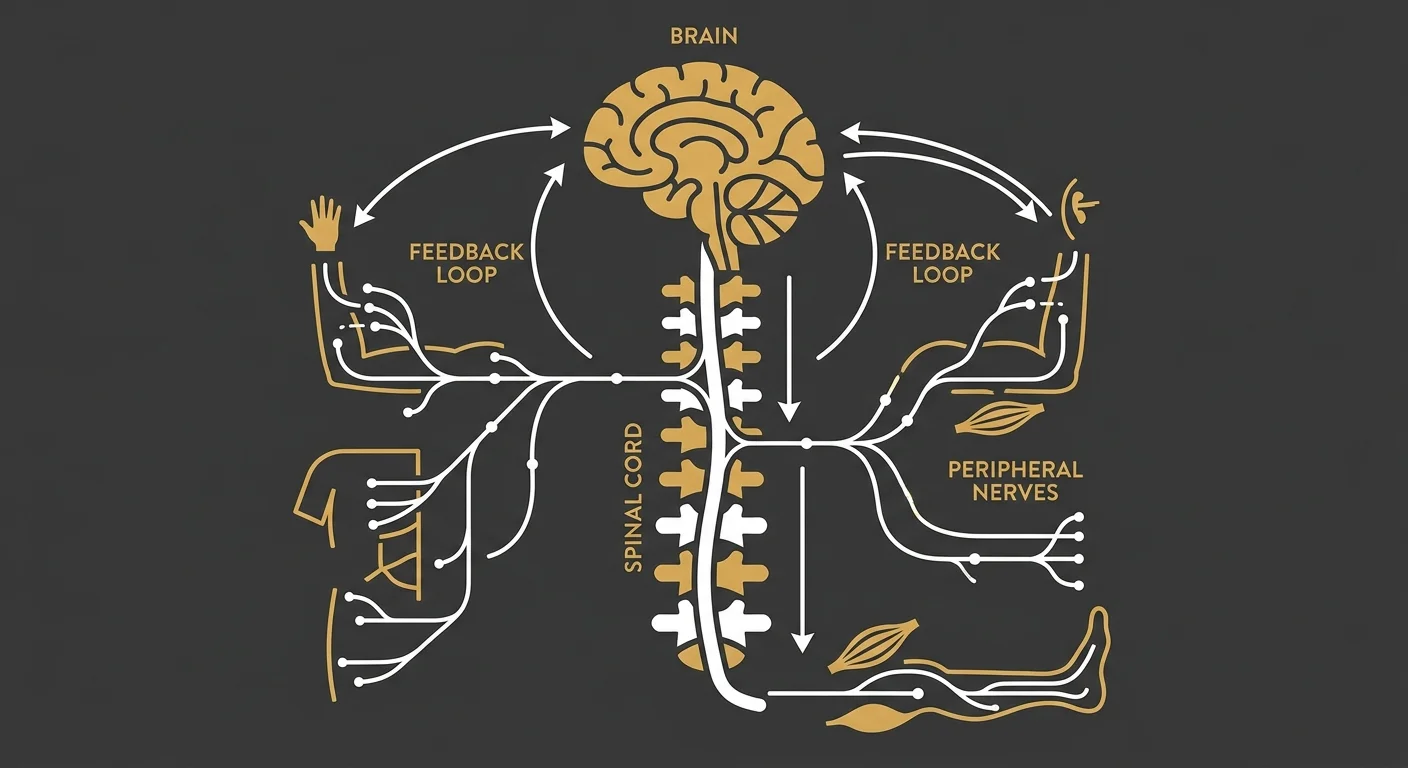
The body is a biological system. Dysregulated systems produce predictable patterns—if you know what you're listening for.
Most providers are trained to diagnose disease. They're hunting for structural breaks or biochemical failures. That works fine when the problem is a herniated disc, a tumor, or blood chemistry gone wrong.
But when the nervous system itself is dysregulated—when the system controlling everything else is stuck in overdrive—their training doesn't give them the tools to decode what's happening.
The training stops where imaging and labs go silent.
A systems-biology lens starts with a different question.
Not 'what disease does this symptom match,' but 'what is this symptom telling us about how the entire system is functioning.'
That shift—from diagnosis-first to system-first—is what allows Dr. Karen Hannah's systems-based approach to pick up patterns that conventional medicine and protocol-driven chiropractic both miss.
The Live Operating System Discovery
Dr. Karen Hannah's clinical framework wasn't built from a textbook.
It was confirmed the day a veterinarian friend called her about a 12-week-old kitten — paralyzed, surrendered for euthanasia. She adjusted that kitten every day for four days. By the end of the week, it was running down her office hallway.
That result proved something no academic setting had made viscerally real: the nervous system isn't a passive structure to be mechanically corrected. It's a live operating system. When structural interference is removed, the body's capacity for self-regulation activates on its own — across species, without coaching, without protocol.
That intervention changed how she evaluates every patient who presents with symptoms that don't fit a clean diagnosis. The instinct isn't to dismiss. It's to ask: what system is dysregulated, where is the interference happening, and what downstream effects would we expect from that upstream disruption.
So when a patient presents with symptoms that don't fit a clean diagnosis, the instinct isn't to dismiss them.
The instinct is to ask: what system is dysregulated, where is the interference happening, and what downstream effects would we expect from that upstream problem.
That's not guesswork. That's biology.
What Gets Investigated When Standard Tests Are Clean
When imaging is clean and labs are unremarkable, the investigation at Touch of Wellness Chiropractic doesn't stop.
It shifts.
The question becomes: where is the nervous system interference, and what's driving the amplification.
- Evaluating spinal alignment, nerve pathway function, movement patterns, tissue tension, and autonomic nervous system regulation
- Asking what the patient actually reports—not what a diagnosis code predicts they should report
- Tracking how symptoms change in response to specific interventions, not running the same protocol regardless of patient response
Patients with persistent and unexplained nerve symptoms often describe their condition improving once someone finally investigates what the nervous system is doing instead of re-running the same imaging that already came back normal.
The relief isn't from a new medication.
It's from a provider who understands that the body doesn't broadcast pain, numbness, or fatigue without cause—and who knows how to decode the signal.
When explanation-driven care leads to better patient recovery, it's because the patient finally understands what's happening in their body and why the care plan is built the way it is.
That's not a bonus feature.
That's part of the clinical standard here.
Why Cookie-Cutter Chiropractic Protocols Fail Here
Most chiropractic offices run the same adjustment sequence on every patient.
Walk in with nerve pain, walk in with a headache, walk in with sciatica—you get the same protocol.
When it doesn't work, they run it again.
That's not a care plan. That's a template.
Cookie-cutter protocols assume every patient's nervous system responds the same way to the same input.
But patients with medically unexplained symptoms often feel dismissed by healthcare providers, which worsens their condition and delays recovery.
A protocol that doesn't adjust based on patient response isn't care—it's repetition with no feedback loop.
The systems-biology lens rejects that model entirely.
If something isn't producing results after a few visits, the care plan changes. Not because the patient failed. Because the initial hypothesis was incomplete, and the investigation needs to go deeper.
That willingness to stop and reassess—to pivot when a treatment isn't working—is the clinical definition of listening to what the nervous system is broadcasting.
| Assessment Focus | Standard Medicine Approach | Systems-Biology Approach |
|---|---|---|
| Primary question asked | What disease does this symptom match? | What is this symptom telling us about how the entire system is functioning? |
| Diagnostic endpoint | Imaging is clear, labs are normal—nothing more to investigate | Imaging and labs rule out structural damage; investigation shifts to nervous system dysregulation |
| Patient history integration | Symptom list matched against diagnosis codes | Patient's actual experience drives clinical hypothesis and directs assessment |
| Response to unclear findings | Symptoms dismissed, referred to pain management, or labeled psychosomatic | Symptoms treated as predictable signals from a dysregulated system requiring further investigation |
| Treatment adjustment protocol | Same protocol repeated regardless of patient response | Care plan changes when treatment isn't producing results—investigation goes deeper |
| Goal of care | Symptom suppression through medication or procedural intervention | Restore nervous system regulation and eliminate the source of signal amplification |
Frequently Asked Questions
The same questions surface again and again. Every one points to the same gap—someone who listens to the system, not just the symptom.
These questions come from people who've been dismissed, tested, and told to wait.
They're not asking for reassurance. They're asking for logic.
Why do doctors say 'it's all in your head' when my physical symptoms feel so real?
That phrase is shorthand for 'I can't find a structural explanation.' When imaging is clean and labs are normal, most providers stop investigating.
They're not saying the pain isn't real. They're saying their diagnostic framework doesn't have a tool for it.
But pain generated by nervous system dysregulation is still physical pain. The nervous system is a physical organ. When it amplifies signals or misinterprets input, your symptoms are neurological—not imaginary.
Patients with medically unexplained symptoms often feel dismissed by healthcare providers, which worsens their condition and delays recovery. That phrase—'it's in your head'—isn't an answer. It's a provider telling you they've hit the limit of their training.
Can the nervous system create pain and other symptoms without a specific injury or disease?
Yes. Central sensitization describes a persistent state of high reactivity where the nervous system amplifies pain signals in response to stimuli that wouldn't normally be painful. The nervous system stops responding proportionally—it interprets routine input as threats.
The body produces real, measurable pain without tissue damage. The pain isn't fake. The mechanism is nervous system dysregulation—not structural injury.
Functional neurologic disorder is the second most common reason patients visit neurology clinics. Real neurological symptoms. No traditional neurological disease. The nervous system is misfiring in a way standard imaging can't detect.
What is the difference between treating a symptom and addressing the root cause of that symptom?
Treating a symptom means reducing pain, numbness, or discomfort temporarily. Addressing the root cause means identifying what's driving the nervous system to produce that symptom—and correcting the upstream interference.
A muscle relaxer reduces tension. But if spinal misalignment is compressing a nerve and driving that tension, the relaxer is masking the signal—not fixing the broadcast.
Root-cause care asks: why is the nervous system stuck in overdrive? What's disrupting the feedback loop? Where's the interference?
The care plan is built to restore normal nervous system function—not just quiet the symptom until it comes back.
How does a chiropractor investigate symptoms that a primary care doctor couldn't explain?
A chiropractor trained in systems biology investigates what the nervous system is doing—not just what the imaging shows. That means evaluating spinal alignment, nerve pathway function, movement patterns, and autonomic nervous system regulation.
The assessment starts with what you actually report. Not what a diagnosis code predicts you should report. And the care plan adapts based on your response—not a pre-built protocol.
When a primary care doctor runs imaging and labs and finds nothing, they stop. A systems-based chiropractor starts there.
The question becomes: if the structure looks normal but the symptoms are real, where is the nervous system dysregulated—and what's amplifying the signal?
If I feel like I've already tried everything for my symptoms, what makes a systems-biology approach different?
Most of what you've tried has been protocol-driven. Same adjustment sequence. Same medication rotation. Same wait-and-see timeline.
None of it adapted to what your body was broadcasting.
A systems-biology approach doesn't assume your nervous system will respond the same way as the last patient's. It doesn't run the same protocol and call it care. It investigates the upstream interference, tracks how your symptoms change in response to specific interventions, and pivots when something isn't producing results.
The difference is feedback. If a treatment isn't working after a few visits, the plan changes.
That willingness to stop and reassess—to decode the signal instead of repeating the same protocol—is what makes the systems-biology lens different from everything you've already tried.
The Bottom Line
Your symptoms aren't a mystery. They're a signal from a dysregulated nervous system that hasn't been decoded yet.
The difference between dismissed and decoded isn't how severe your symptoms are. It's whether the provider investigating them knows how to listen to what the nervous system is broadcasting instead of just looking for structural damage that isn't there.
The body as a broadcasting system—your symptoms aren't noise or mysteries, they're a specific signal on a frequency most providers never tune into.
Standard medicine stops when imaging is clean. Cookie-cutter chiropractic runs the same protocol regardless of what you report.
Both frameworks miss the same thing—the nervous system's ability to amplify, distort, and generate real symptoms without visible injury.
That's not a failure of your body. That's a communication no one's trained to interpret.
The signal is real. The pattern is knowable.
And the question isn't whether your symptoms make sense—it's whether anyone's actually listening.
If you've been told your tests are normal but your pain is still there, that's not the end of the investigation. That's where a systems-biology lens starts asking the right questions. About Dr. Karen Hannah, DC, her clinical lens is built on a cross-species neurological framework. After witnessing a paralyzed kitten recover complete motor function in four days through spinal recalibration, she recognized that the nervous system acts as a live operating system—demanding a whole-body biological systems analysis applied to every case that walks through the door.
The body as a broadcasting system—your symptoms aren't noise or mysteries, they're a specific signal on a frequency most providers never tune into.
If your symptoms have been dismissed, tested clean, and left unresolved — that doesn't mean nothing's wrong. It means no one's listening to what your body's actually broadcasting. The assessment at Touch of Wellness Chiropractic starts with what you report, not a protocol built before you walk in. If you're in Morton, Peoria, or the surrounding area and you're done accepting "nothing's wrong" as the answer, find out what a systems-biology investigation looks like.