
(309) 321-8412 | 1101 W Jackson St, Suite A, Morton, IL 61550
(309) 321-8412 | 1101 W Jackson St, Suite A, Morton, IL 61550
Why Dental-Only TMJ Treatments Fail to Resolve Chronic Neck and Head Pain
Dental-only TMJ treatments fail because the jaw and the upper cervical spine aren't two separate problems. They're one system. Treating only half of it leaves the cause completely untouched.
Temporomandibular disorders affect an estimated 5% to 12% of adults in the United States, with a higher prevalence among women. The standard dental playbook — night guards, bite splints, occlusal adjustments — addresses the jaw in isolation. But up to 70% of patients diagnosed with temporomandibular disorders also exhibit concurrent cervical spine dysfunction and neck pain. That overlap isn't incidental. It's anatomical.
Nerves from spinal levels C1 through C3 feed into the same brainstem nucleus that processes signals from the jaw and face. When the upper neck is misaligned, pain doesn't stay in the neck. It refers directly into the jaw, the temples, and the side of the skull. That's why patients cycle through dental treatment after dental treatment without lasting relief.
The breaker box was never in the mouth.
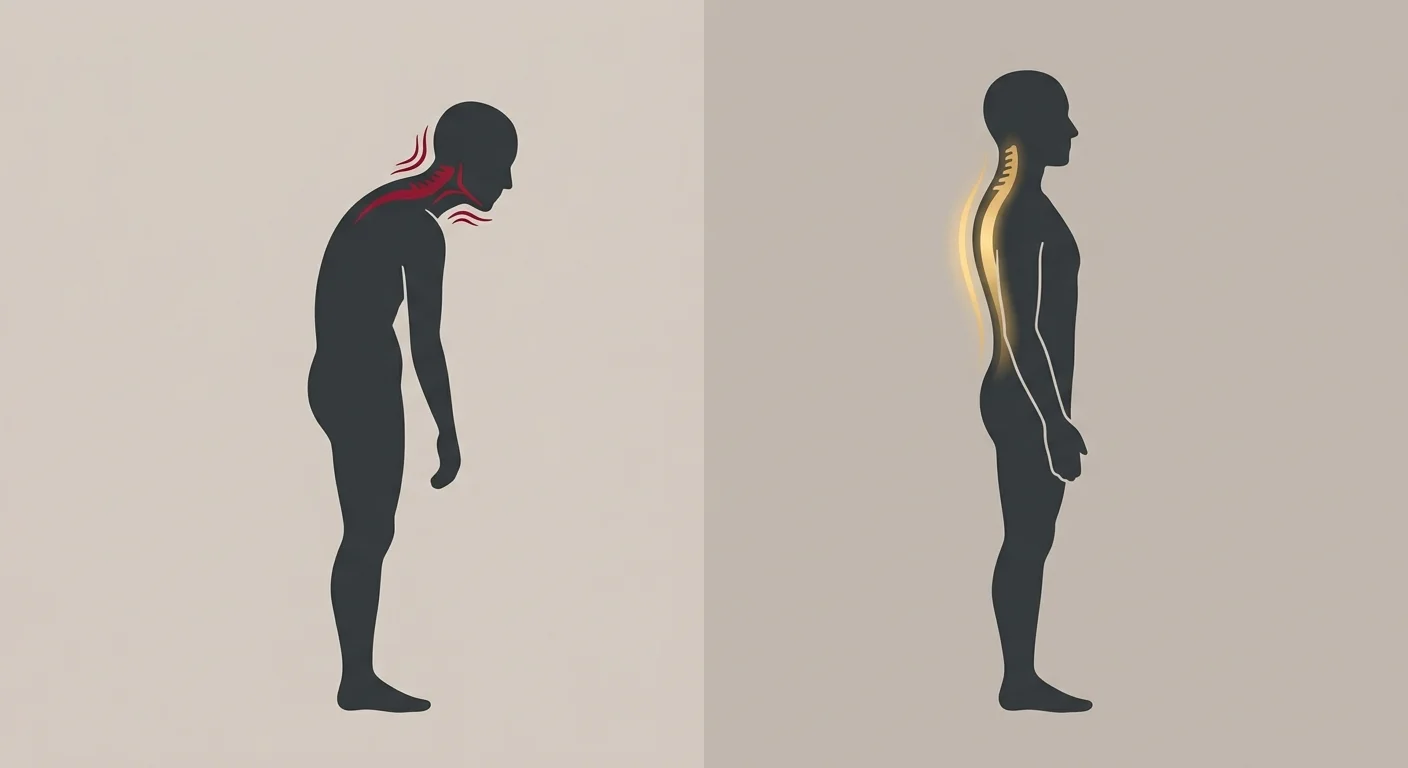
Forward head posture compounds the problem. When the head drifts forward of the shoulders, the mandible's resting position shifts and the jaw muscles compensate continuously — building fatigue and pain that no mouthguard can correct.
The National Institute of Dental and Craniofacial Research explicitly recommends prioritizing conservative, reversible treatments over irreversible bite-altering dental procedures. Cervical spine mobilization targeting upper cervical segments reduces chronic head and jaw pain and increases pressure pain thresholds in patients with temporomandibular disorders.
Resolving chronic TMJ-related neck and head pain requires evaluating the jaw and the spine together. Dental treatment alone only addresses part of the picture.
Last Updated: August 25, 2026
- • What the Dental Model Gets Right — and Where It Stops
- • Why Mouthguards Stop Working (And What That Tells You)
- • The Cervical Spine Connection Dentists Cannot Treat
- • Who This Approach Is — and Is Not — For
-
• Frequently Asked Questions About TMJ and Cervical Spine Care
- • Why does TMJ pain cause severe neck stiffness and headaches?
- • Can a dentist fix TMJ-related cervical spine dysfunction?
- • How does a chiropractic neck adjustment help relieve TMJ pain?
- • Why do mouthguards fail to stop chronic neck tension?
- • Is a cervical spine evaluation necessary if my only symptom is jaw pain?
- • What does a conservative TMJ care plan actually look like without dental intervention?
- • The Jaw Is Not the Problem — The System Is
What the Dental Model Gets Right — and Where It Stops
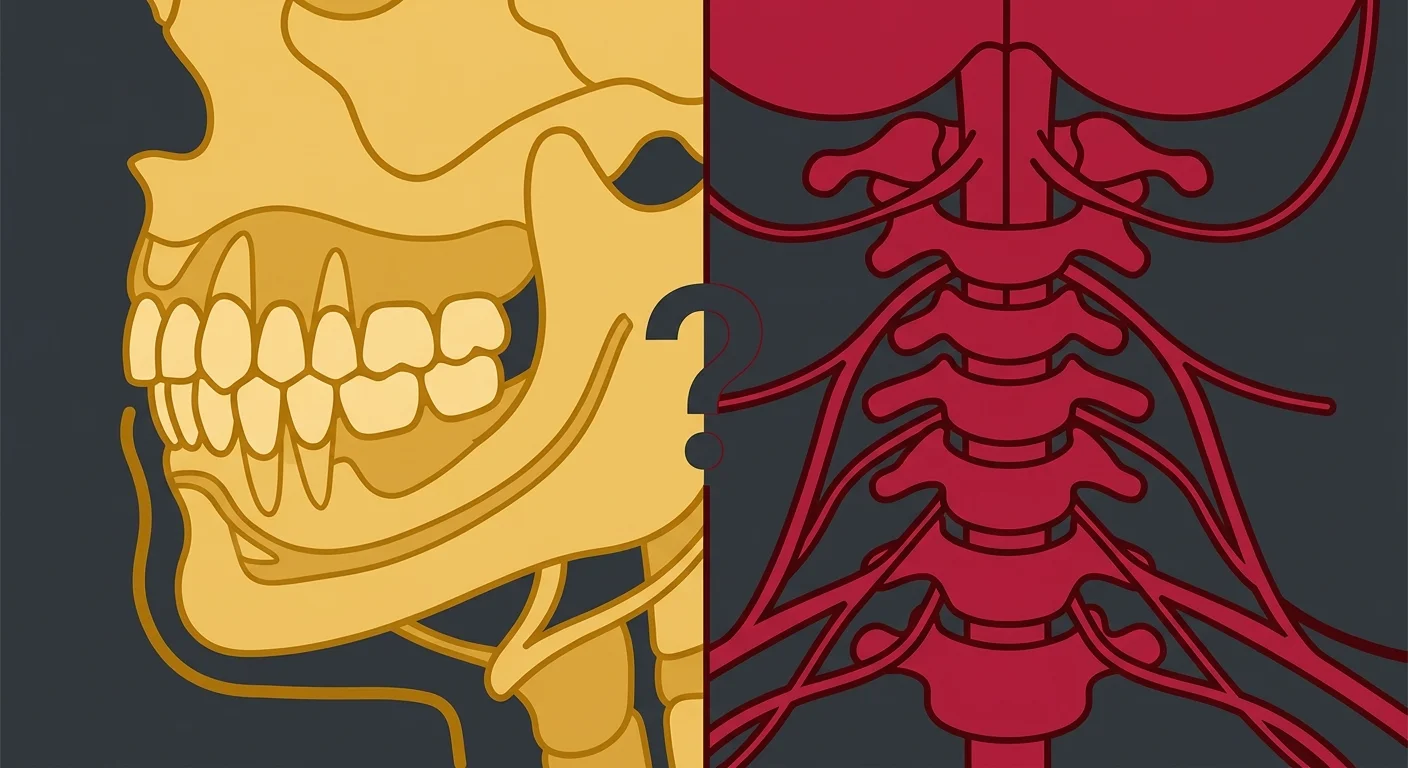
Dental care isn't the villain here. That's worth saying upfront — because what follows isn't a dismissal. It's a boundary.
Dentists know the jaw. They're trained to spot occlusal imbalances, identify structural problems inside the joint, and recognize the bite patterns that drive chronic clenching. For a specific subset of TMJ presentations, that's exactly the right set of eyes on the problem.
The problem isn't that dental care is wrong. It's that it got handed the whole job when it was only ever built for part of it.
The Legitimate Role of Dental Care in TMJ Management
When TMJ dysfunction is genuinely intra-articular — disk displacement, active joint inflammation, a structural problem with the condyle itself — dental intervention belongs in the picture. Night guards reduce mechanical load on an inflamed joint. Bite splints take pressure off overworked musculature and give it a chance to settle. For those presentations, dental care isn't just reasonable. It's correct.
Temporomandibular disorders affect an estimated 5% to 12% of U.S. adults, according to NIH data, with a higher prevalence among women. Within that population, there are genuine cases where the jaw is the primary driver — and dental treatment produces real, lasting improvement. But those outcomes have been used to justify a model that gets applied to everyone. Including the patients it cannot help.
The National Institute of Dental and Craniofacial Research guidelines are worth naming here. The governing body of dental research explicitly recommends conservative, reversible interventions first — mouthguards and physical therapy before any irreversible bite alteration. That's a defensible standard. But conservative dental treatment and complete care are not the same thing. One manages the jaw. The other asks why the jaw became a problem in the first place.
Why the Dental Scope Has a Hard Ceiling
Here's where the model runs out of road. A mouthguard reduces clenching force. It does nothing about the cervical spine misalignment rerouting pain signals into the jaw.
Patients who've cycled through splint adjustments, bite equilibration, and appliance after appliance — and still wake up with a stiff neck and a headache — aren't treatment failures. Their actual problem was never evaluated. Whether dental splints fail certain patients comes down to one question: was the upper cervical spine ever part of the picture?
The dental model has a hard ceiling because the mouth isn't a closed system. The jaw hangs from the skull. The skull sits on the cervical spine. And the cervical spine is governed by postural mechanics that no bite appliance touches. Individualized chiropractic care starts exactly where the dental model stops — at the top of the cervical spine, where the real circuit breaker lives.
| TMJ Symptom | What Dental Treatment Addresses | What Dental Treatment Cannot Address |
|---|---|---|
| Jaw joint pain and clicking | Night guards and bite splints reduce mechanical load on the joint and allow inflamed tissue to settle | Cannot correct upper cervical misalignment that shifts the condyle's resting position through postural mechanics |
| Chronic teeth clenching and grinding | Occlusal appliances reduce clenching force and protect tooth surfaces from further damage | Cannot address the nervous system dysregulation originating from C1–C3 that drives involuntary muscle bracing |
| Morning jaw stiffness | Splints unload the joint overnight and give surrounding musculature brief relief from sustained compression | Cannot correct the forward head posture that forces jaw muscles to compensate against gravity all day |
| Bite imbalance and occlusal asymmetry | Bite equilibration and orthodontic work can redistribute force across the dental arch more evenly | Cannot resolve referred pain from the trigeminocervical pathway when the source is cervical, not dental |
| TMJ headaches | Reducing joint inflammation through conservative dental care may lower one contributing input to headache frequency | Cannot address cervicogenic headaches generated at C1–C2 that mimic or amplify TMJ-origin head pain |
| Chronic neck tension alongside jaw pain | A dentist may note the neck symptoms and refer out — but the referral is not standard protocol | Cannot evaluate or treat the cervical spine dysfunction that is often the primary driver of the entire symptom picture |
Why Mouthguards Stop Working (And What That Tells You)
Most people who ended up with a mouthguard didn't make a bad decision. Their dentist saw clenching, recommended a guard, and for a while — it worked.
Then the relief stopped.
The morning jaw ache came back. The headaches crept back in. The guard hadn't changed, the fit was fine — but the symptoms returned anyway.
That's not a mouthguard problem. That's the cervical spine problem finally outpacing what the appliance can compensate for. Up to 70% of patients with temporomandibular disorders have concurrent cervical spine dysfunction — and a mouthguard has no mechanism to touch that.
What a Mouthguard Actually Does (And What It Cannot)
A mouthguard does one thing well: it reduces load on the temporomandibular joint by buffering clenching and grinding force. When the joint itself is the primary problem, that's genuinely useful. But that's also where its clinical authority ends.
It can't correct posture. It can't restore the resting position of the jaw when the head has drifted forward of the shoulders. And when forward head posture changes how the jaw hangs, the surrounding muscles compensate continuously — recruiting harder, fatiguing faster, generating pain that no appliance in the mouth can interrupt. That mechanism runs through the cervical spine. Not the bite.
Most patients exploring safe cervical care options for TMJ-related symptoms don't know the neck was always part of the picture. Their dental provider just didn't have the tools to look there. According to NIH peer-reviewed research, up to 70% of TMD patients present with concurrent cervical dysfunction. That's not a footnote. That's the majority of the patient population walking out of dental offices with a partial answer.
Why Mouthguard Failures Are a Diagnosis, Not a Dead End
When a mouthguard stops working, most patients assume they need a different appliance. Better fit. Harder material. A bite adjustment. That's the framing the dental model offers — and it's a loop. Every option inside that loop shares the same ceiling, because none of them touch the structure driving the problem.
Here's what the failure is actually telling you: the jaw isn't the driver. The mouthguard worked at first because it reduced load on a joint that was irritated. It stopped working because the structural issue pulling the jaw out of position — forward head posture, upper cervical misalignment, or both — was never addressed. The appliance was managing a symptom. The cause kept compounding.
A mouthguard failure isn't a dead end. It's a redirect. The evaluation needs to go further — past the joint, up through the cervical spine, into the postural mechanics that govern how the jaw sits. That's not a dental conversation. The breaker box was never in the mouth.
| Mouthguard Claim | What Actually Happens | What the Failure Indicates |
|---|---|---|
| Reduces clenching force to protect the joint | Joint load decreases temporarily — surrounding musculature continues compensating for the underlying postural driver | Relief was masking the symptom, not resolving the cause |
| Stops working after initial relief | Cervical spine dysfunction and forward head posture continue pulling the jaw out of its resting position regardless of the appliance | The structural driver was never evaluated — the dental model has reached its ceiling |
| A better-fitted or harder guard will restore relief | Appliance material and fit are irrelevant when the problem originates in spinal mechanics the guard cannot reach | The patient needs a cervical spine evaluation, not a new appliance |
| Morning jaw ache and headaches returning means the guard needs adjustment | Recurring symptoms signal that the upper cervical spine — not the bite — is generating and referring the pain | The jaw is not the primary driver; the diagnosis needs to move up through the neck |
| Bite equilibration or occlusal adjustment will succeed where the guard failed | Occlusal changes still operate inside the mouth — they cannot correct the postural mechanics shifting mandibular resting position | Cycling through dental options produces the same ceiling at each stage |
| Mouthguard failure means the patient is treatment-resistant | The patient responded appropriately — initial load reduction helped — but the evaluation never extended to the cervical spine where the actual problem lives | Treatment failure is a redirection toward spinal assessment, not a clinical dead end |
The Cervical Spine Connection Dentists Cannot Treat
That mouthguard failure wasn't a product problem. It was a map.
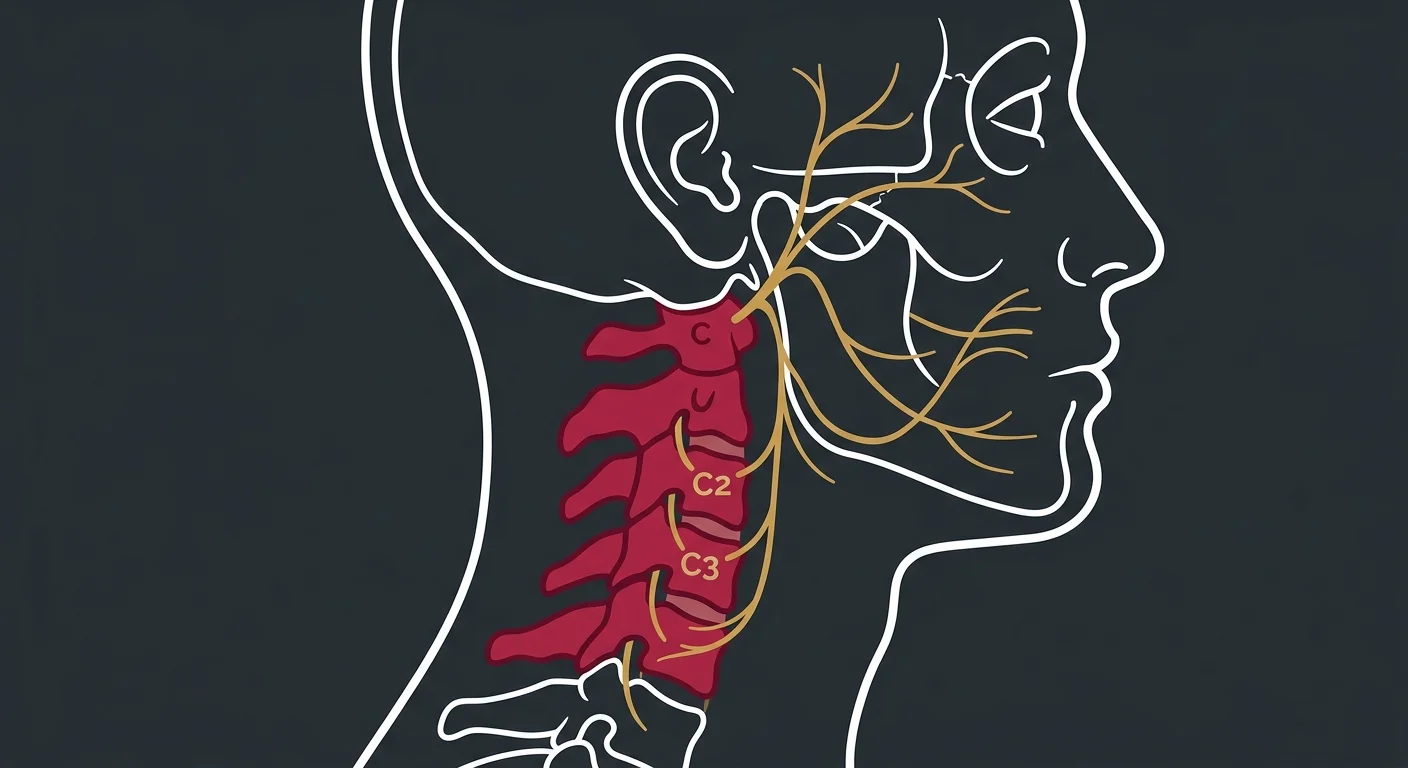
The jaw doesn't float in isolation. It hangs from the skull. The skull sits on the cervical spine. And the cervical spine is governed by postural mechanics that no bite appliance has ever been built to reach. When the upper cervical spine drifts out of alignment, it doesn't just generate neck pain. It physically disrupts how the jaw loads, how it moves, and where it rests at baseline.
Dentists aren't trained to evaluate that relationship. That's not a criticism — it's a scope-of-practice fact. The cervical spine sits entirely outside the dental model. So when patients have done everything the dental model offers and still wake up with a stiff neck and a jaw that aches before their first cup of coffee, the model didn't fail them. It just ran out of road.
How Upper Cervical Misalignment Pulls the Jaw Out of Position
When C1 and C2 drift out of optimal position, the base of the skull tilts. The jaw follows.
The mandible's resting position is partly determined by where the skull sits. Tilt the skull, and the jaw compensates — shifting its resting angle, forcing surrounding muscles to recruit differently, building chronic fatigue in tissues that were never designed to carry that load. That fatigue shows up as jaw pain, morning soreness, and a tension pattern that runs from the base of the skull straight down through the neck.
What clinical research on upper cervical mobilization confirms is direct: addressing C0-C3 spinal segments significantly reduces jaw pain scores and pressure pain thresholds in TMJ patients. The jaw improves — not because anyone worked on the jaw, but because the structural driver pulling it out of position was finally corrected.
The Trigeminocervical Pathway: Why Neck Problems Feel Like Jaw Problems
And that's before the nerve pathway problem even enters the picture.
The nerves from C1 through C3 feed directly into the trigeminocervical nucleus — the same brainstem hub that processes sensory input from the jaw, the temples, and the face. When the upper cervical spine is dysfunctional, pain signals generated in the neck don't stay in the neck. They travel through that shared pathway and register as jaw pain, facial pressure, or a headache centered behind the eye. NIH clinical evidence confirms this convergence as a primary anatomical route for referred pain that mimics primary TMJ disorders at the point of presentation.
So the patient walks in with what looks like classic TMJ dysfunction — jaw ache, clicking, a headache that radiates up from the neck. The dentist treats the jaw, because that's what the presentation suggests and that's where the dental scope stops. The cervical spine never gets evaluated. The pain continues. And the patient eventually concludes that TMJ is just something they'll manage for the rest of their life — when the actual problem is that the right system was never in the room.
| Spinal Segment | Referred Pain Region | Common Misdiagnosis | Clinical Finding |
|---|---|---|---|
| C0 (Occiput) | Base of skull, temples, behind the eyes | Tension headache, migraine, TMJ disorder | Restricted occipital mobility, suboccipital muscle hypertonicity |
| C1 (Atlas) | Jaw, face, forehead, ear region | Primary TMJ dysfunction, ear pain, facial neuralgia | Atlas rotation or lateral tilt altering mandibular resting position |
| C2 (Axis) | Side of the head, jaw, upper neck | Cluster headache, TMJ clicking, chronic jaw ache | C1-C2 instability driving trigeminal nerve sensitization via the trigeminocervical nucleus |
| C3 | Lower jaw, throat, upper trapezius | TMJ-related neck pain, bruxism-driven soreness | Referred muscle guarding in the pterygoid and masseter muscles without intra-articular joint pathology |
Who This Approach Is — and Is Not — For
Not everyone with jaw pain needs a cervical spine evaluation. That's worth saying out loud. Honest qualification is exactly what the dental model stopped offering — which is why it's the right place to start here.
When the jaw joint is the primary problem — true structural damage, acute inflammation, a condyle injury — dental intervention belongs in the picture. A night guard reduces mechanical load on a joint that's genuinely inflamed. A referral to an oral surgeon may be entirely appropriate. That's not the dental model failing. That's the dental model doing exactly what it was built to do.
The failure happens when that model gets applied to every presenting jaw complaint — including patients whose problem originates in the upper cervical spine and whose neck was never once evaluated. Patients locked into dental-only TMJ management for months or years without lasting relief aren't experiencing bad luck. They've hit the hard ceiling of a treatment approach that was never designed to reach the actual driver of their symptoms.
The Patient Who Has Outgrown Dental-Only Care
There's a specific patient this conversation is for. They've had the mouthguard — adjusted, replaced, upgraded. They've tried the bite splint. Some have had bite equilibration. The jaw pain eases for a week, maybe two. Then it comes back. The morning neck stiffness never fully left. And the headache the dentist attributed to clenching is still there — sitting at the base of the skull, waiting every morning.
This is the patient for whom the cervical spine was always part of the answer. Up to 70% of patients diagnosed with temporomandibular disorders have concurrent cervical spine dysfunction — and most of them never received a cervical evaluation because it sits outside the dental scope. For desk workers especially, the tension that builds through the neck and jaw follows postural mechanics that no bite appliance was built to correct. Recurring symptoms, appliances that helped but never resolved it — the problem almost certainly didn't start in the mouth.
The National Institute of Dental and Craniofacial Research is explicit: conservative, reversible treatments come first. Physical therapy. Self-care. Not irreversible bite alteration. A chiropractic cervical evaluation fits squarely inside that framework — it's conservative, it's reversible, and it reaches a system the dental model structurally cannot access. If you've exhausted the reversible dental options and the symptoms haven't resolved, the evaluation needs to go further.
If You're Looking for a Shortcut, This Isn't It
Now for who this isn't for.
If you're expecting one cervical adjustment to undo years of postural dysfunction and jaw compensation — that's not a realistic outcome, and it won't be presented as one here. If you've already decided the cervical spine isn't relevant before any assessment has been completed, the assessment can't help you. And if you want a provider who'll tell you what you want to hear instead of what's actually happening in your body — Touch of Wellness Chiropractic isn't that practice.
What's available here is an honest evaluation of the full picture — jaw mechanics, cervical alignment, postural load, and the nerve pathways that connect them. Safe chiropractic neck adjustments start with assessment, not assumption. If the cervical spine is the driver, that will be clear. If it's not, that will also be clear — and the recommendation will reflect actual findings, not a billing calendar.
| Patient Profile | Key Indicator | Right Next Step |
|---|---|---|
| TMJ patient with recurring symptoms after multiple appliances | Mouthguard helped temporarily, then stopped working; symptoms return within days or weeks of adjustment | Cervical spine evaluation to assess whether upper cervical misalignment is driving jaw compensation |
| Patient with persistent morning neck stiffness alongside jaw pain | Neck tension and jaw ache arrive together — especially upon waking — and neither fully resolves | Postural and spinal assessment that evaluates C1–C3 alignment and its relationship to mandibular resting position |
| Patient with headaches attributed to clenching that don't respond to a night guard | Headache pattern sits at the base of the skull or behind the eye and persists despite appliance compliance | Evaluation of trigeminocervical referral pathways — the cervical spine may be the actual pain source |
| Patient with acute jaw joint injury or confirmed structural joint damage | Sudden onset after trauma, documented condyle damage, or active acute inflammation in the joint itself | Dental or oral surgery referral is appropriate — this is the dental model working as designed |
| Patient who has completed conservative dental options with no lasting relief | Has tried night guards, bite splints, and bite adjustments; symptom ceiling is clear; no cervical evaluation has ever been performed | Cervical spine assessment as the next conservative, reversible step — consistent with NIDCR clinical guidelines |
| Patient expecting single-visit resolution of long-standing postural dysfunction | Unwilling to engage a care plan or follow through on findings from a full assessment | This approach isn't the right fit — partial commitment to a structural problem produces partial results |
Frequently Asked Questions About TMJ and Cervical Spine Care
Most patients who've been through the dental model don't need more explanation. They need someone to answer the questions that never got answered — after the mouthguard, after the second opinion, after the headache came back anyway.
No hedging. No vague timelines. Just straight answers to the questions that a skeptical, explanation-driven patient actually deserves.
Why does TMJ pain cause severe neck stiffness and headaches?
Because the jaw and the upper neck share the same brainstem hub. The trigeminocervical nucleus receives pain signals from both the cervical spine and the jaw — and it doesn't sort them neatly. When C1 or C2 is dysfunctional, that pain doesn't stay in the neck. It travels through the shared pathway and registers as jaw ache, temple pressure, and a headache sitting right at the base of the skull. It looks exactly like TMJ dysfunction. It's not.
The stiffness follows the same logic. Muscles running from the upper cervical spine into the jaw and skull are recruited differently when the top vertebrae aren't in position. They don't get to rest. That constant low-grade recruitment is what patients feel as tightness that never quite clears — no matter how long they sleep or how well the mouthguard fits.
Can a dentist fix TMJ-related cervical spine dysfunction?
Not structurally — and that's a scope-of-practice reality, not a criticism. Dentists are trained to evaluate the jaw joint, the bite, and the surrounding oral structures. The cervical spine sits entirely outside that scope. There's no clinical pathway in dentistry to assess whether C1 and C2 are driving the skull tilt that's pulling the jaw out of position.
Up to 70% of patients with temporomandibular disorders have concurrent cervical spine dysfunction — but that dysfunction never gets evaluated in a dental setting because the tools aren't there. A dentist can reduce mechanical load on the joint. A dentist can address bite discrepancies. What a dentist can't do is assess what's happening at the top of the cervical spine. That requires a different clinical lens entirely.
How does a chiropractic neck adjustment help relieve TMJ pain?
By correcting the structural driver instead of managing the symptom. When the upper cervical vertebrae — C1 through C3 — are mobilized back toward their optimal position, the skull can sit level again. The jaw's resting position normalizes. The surrounding musculature stops recruiting against a compensatory load it was never built to sustain.
The clinical evidence is direct: cervical mobilization targeting C0-C3 segments significantly reduces jaw pain scores and increases pressure pain thresholds in patients with temporomandibular disorders. The jaw improves — not because anyone worked on the jaw, but because the structure pulling it out of position was finally addressed. That's a different intervention from anything the dental model offers. It's also why patients who've hit the ceiling of dental care often respond when the cervical spine is finally part of the evaluation.
Why do mouthguards fail to stop chronic neck tension?
Because they weren't designed to reach the cervical spine. A mouthguard manages mechanical load on the jaw joint — it reduces tooth contact, distributes bite pressure, and gives inflamed structures a chance to settle. That's a legitimate function. It just has a hard ceiling.
If C1 and C2 are misaligned, the skull is tilting, and the jaw is compensating — the mouthguard is managing a downstream symptom while the upstream cause keeps generating it. The neck stiffness persists because the postural load hasn't changed. The headache returns because the referred pain pathway is still active. The appliance didn't fail. It just ran out of road. And no adjustment to the fit, the material, or the bite is going to change that — because the problem was never in the mouth.
Is a cervical spine evaluation necessary if my only symptom is jaw pain?
If dental treatment hasn't fully resolved the jaw pain — yes. The NIDCR is explicit: conservative, reversible treatments come first, before any irreversible bite alteration. A cervical evaluation fits squarely inside that framework. It's conservative. It's reversible. And it reaches a system that dental care was never built to assess.
Up to 70% of TMJ diagnoses come with concurrent cervical spine dysfunction — meaning most patients who present with jaw pain have something happening in the neck that was never evaluated. Jaw pain as the only symptom doesn't rule the cervical spine out. It just means the neck hasn't been ruled in yet. If dental treatment hasn't held, that's the next question worth asking.
What does a conservative TMJ care plan actually look like without dental intervention?
It starts with assessment. No appliance gets prescribed before the clinical picture is understood. No timeline gets handed over before the evaluation is finished. That's not a policy. It's the clinical standard.
At Touch of Wellness Chiropractic, a conservative plan means evaluating cervical spine alignment, identifying postural contributors, and determining whether the upper neck is driving the jaw symptoms. If it is, cervical adjustments target the specific segments — C0 through C3 — that connect directly to the jaw's mechanics and the referred pain pathways. If something isn't producing results, the plan changes. What it doesn't include: a predetermined outcome, a push toward irreversible dental work before reversible structural options have been genuinely exhausted, or a protocol that looks identical regardless of what the assessment actually shows.
The Jaw Is Not the Problem — The System Is
The mouthguard wasn't wrong. It was aimed at the outlet when the breaker box was somewhere else entirely.
The jaw aches. The headache parks at the base of the skull every morning. The stiffness doesn't clear — it dips just below the threshold of complaint and climbs back. Every appliance buys a week, maybe two, before the symptoms return to exactly where they started.
That's not a treatment failure. That's a scope failure.
The dental model had the right instinct and the wrong map. It was treating the jaw when the jaw was never the origin.
The cervical spine was in this from the beginning. The upper neck governs where the skull sits. The skull governs where the jaw hangs. The jaw governs how every surrounding muscle recruits — and whether any of them can ever fully rest.
When C1 and C2 drift, the jaw compensates. The muscles fatigue. The pain refers upward — temples, behind the eye, across the face.
None of that changes with a better-fitted appliance. It can't reach the structure driving the compensation. It never could.
If you've done everything the dental model offers and the symptoms are still there, the circuit isn't broken at the jaw.
The evaluation needs to go higher — past the joint, up through the cervical spine, into the postural mechanics that no bite appliance was ever built to reach. At Touch of Wellness Chiropractic, that's exactly where the assessment starts: the full picture, not just the presenting complaint.
The jaw isn't the problem. It never was.
The breaker box was never in the mouth.
If the jaw pain keeps coming back, the dental work hasn't fixed it. It's bought you time. And now you're here again — same headache at the base of the skull, same morning stiffness, same dead end. The cervical spine hasn't failed you. It just hasn't been looked at yet. At Touch of Wellness Chiropractic, that's where the evaluation starts. Because the breaker box was never in the mouth.
Copyright Touch of Wellness Chiropractic 2026
1101 W Jackson St, Suite A Morton, IL 61550
Web Design by iTech Valet