
(309) 321-8412 | 1101 W Jackson St, Suite A, Morton, IL 61550
(309) 321-8412 | 1101 W Jackson St, Suite A, Morton, IL 61550
Is Chiropractic Neck Adjustment Safe for Patients with Severe TMJ Dysfunction?
Chiropractic neck adjustment is safe for patients with severe TMJ dysfunction. Severe adverse events from cervical spinal adjustment are estimated between 1 in 20,000 and 1 in several million treatments. Minor transient soreness, when it occurs, resolves within 24 to 48 hours. The safety record is not in dispute.
TMJ disorders affect up to 12 million adults in the United States. Clinical data shows that 70% of patients diagnosed with temporomandibular disorders present with concurrent cervical spine pain and dysfunction. The trigeminal and cervical nerve systems converge in the upper neck — a neurological pathway that links jaw pain directly to cervical spine mechanics. When the upper cervical spine is misaligned, that convergence pathway stays active. Jaw pain continues regardless of what occurs at the dental level.
Dental-only occlusal splints do not stabilize cervical postural biomechanics. Ignoring the trigeminal-cervical loop results in chronic headache recurrence. For patients whose TMJ symptoms include persistent headaches and neck tension, splints provide temporary relief at best because the cervical structural source is never addressed.
Upper cervical mobilization addresses that source directly. Observational trials document statistically significant reductions in jaw pain and measurable increases in pain-free jaw opening distance following targeted cervical mobilization. Benign, self-limiting reactions such as localized neck stiffness occur in approximately 50% of chiropractic cases and resolve quickly. No serious structural injuries were reported in large-scale prospective safety monitoring of standard chiropractic treatment.
For patients with severe TMJ dysfunction, the clinical question is not whether cervical chiropractic care is safe. The question is whether continuing to treat only the jaw — while the cervical spine goes unexamined — produces complete or lasting relief.
Last Updated: August 25, 2026
- • What the Trigeminal-Cervical Connection Actually Means for TMJ Pain
- • Why Dental-Only TMJ Protocols Leave the Circuit Open
- • What the Safety Record on Cervical Chiropractic Adjustments Actually Shows
- • How Individualized Upper Cervical Care Differs From a Standard Neck Adjustment
- • Who Is — and Isn't — a Candidate for Cervical Chiropractic With TMJ Dysfunction
- • Frequently Asked Questions
- • The Circuit Doesn't Reset Itself
What the Trigeminal-Cervical Connection Actually Means for TMJ Pain
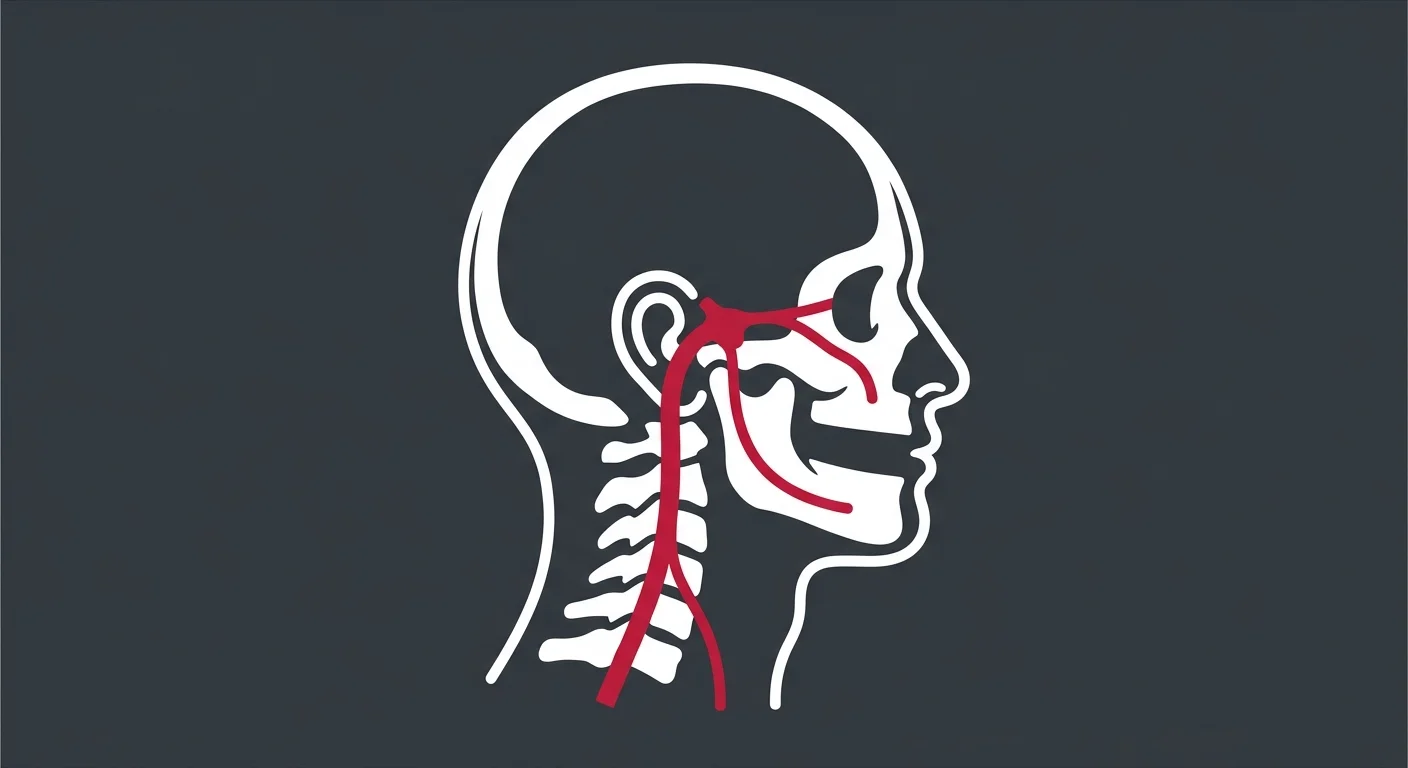
Your jaw isn't broken. Your circuit is.
70% of patients diagnosed with temporomandibular disorders also present with concurrent cervical spine pain and dysfunction. That's not a footnote. That's the diagnosis most TMJ patients never receive.
Dentists don't examine the neck because it's outside their training — not because the neck isn't involved. Those are two very different things.
The trigeminal and cervical nerve systems converge in the upper neck. That convergence is the circuit.
When the cervical spine is misaligned, the circuit stays live — and jaw pain keeps firing regardless of what happens downstream at the dental level. Splints don't reach the breaker. They manage the symptom at the outlet while the source stays hot.
The Neurological Loop Most TMJ Patients Don't Know Exists
Most TMJ patients know the jaw is involved. Almost none know the nerve driving that pain runs straight through their upper neck.
The trigeminal nerve — the primary pain nerve of the face and jaw — doesn't work alone. It converges with the upper cervical nerve roots in a region called the trigeminal-cervical nucleus.
Pain signals from the jaw and pain signals from the neck feed into the same relay station. When that station is overloaded by cervical dysfunction, the brain can't distinguish one source from the other. It reads all of it as jaw pain.
This is why patients who've worn a splint for months still wake up with a locked jaw and a headache. The NIH-published data on this convergence mechanism makes one thing clear: dental-only treatment addresses the output of the loop, not the loop itself.
Until the cervical input is corrected, the neurological loop doesn't close.
Why Your Jaw Pain May Be Starting in Your Neck
Ask a dentist why your jaw hurts. The answer stays in the mouth. Ask someone trained to examine the neck — and the answer changes entirely.
Occlusal splints don't touch the cervical spine. That's not a design flaw — it's a scope limitation. And it's exactly why chronic headaches keep returning in TMJ patients who've faithfully worn their appliance for months.
Patients researching why dental splints fall short for cervical-driven jaw pain find the same pattern every time: temporary relief, then the same symptoms on the same cycle. That's not bad luck. That's a predictable outcome when the cervical spine never gets examined.
The cervical spine isn't a secondary structure in TMJ care. It's the origin point of the neurological signal driving the pain.
Treating the jaw without correcting the neck is like replacing a fuse without fixing the short — the circuit trips again. That's where chiropractic care in Morton IL addresses what dental management can't: the structural source of the signal, not just the joint receiving it.
| Symptom | Typical Patient Assumption | Trigeminal-Cervical Reality | What Gets Missed Without Cervical Assessment |
|---|---|---|---|
| Morning jaw stiffness and locking | Slept wrong or clenched during the night | Upper cervical misalignment keeps the trigeminal-cervical loop active overnight, producing joint restriction by morning regardless of sleep position | Cervical spine mechanics go unexamined while the patient is fitted for another splint |
| Chronic headaches accompanying jaw pain | Jaw tension is radiating upward into the head | Cervical nerve input feeds the same trigeminal-cervical nucleus as jaw pain — the headache originates at the neck, not the joint | Headache recurrence continues because the cervical postural dysfunction driving it is never corrected |
| Neck tightness and limited rotation | Stress is tightening the shoulders and neck muscles | Concurrent cervical spine dysfunction is present in a substantial majority of TMJ patients — the two conditions share the same neurological pathway | Neck restriction is treated as a separate, unrelated complaint rather than a co-driver of jaw symptoms |
| Temporary splint relief that fades within weeks | The splint is wearing out or needs adjustment | Dental appliances address bite mechanics but leave cervical postural biomechanics uncorrected — the loop reactivates because the cervical input never changed | Patients cycle through splint adjustments without ever addressing the structural source maintaining the pain signal |
| Facial pain and ear pressure with no dental cause found | The dentist missed something or the symptoms are stress-related | The trigeminal nerve converges with upper cervical nerve roots — cervical dysfunction produces facial and ear symptoms that are neurologically indistinguishable from joint-origin pain | Without cervical assessment, the structural origin of facial pain is invisible to dental evaluation and goes untreated |
| Pain that worsens with posture changes or screen time | Poor posture is aggravating jaw tension secondarily | Forward head posture loads the upper cervical spine, directly increasing tension through the trigeminal-cervical convergence pathway and amplifying jaw pain signals | Postural correction is recommended but the cervical spine mechanics driving the load are never assessed or addressed structurally |
Why Dental-Only TMJ Protocols Leave the Circuit Open
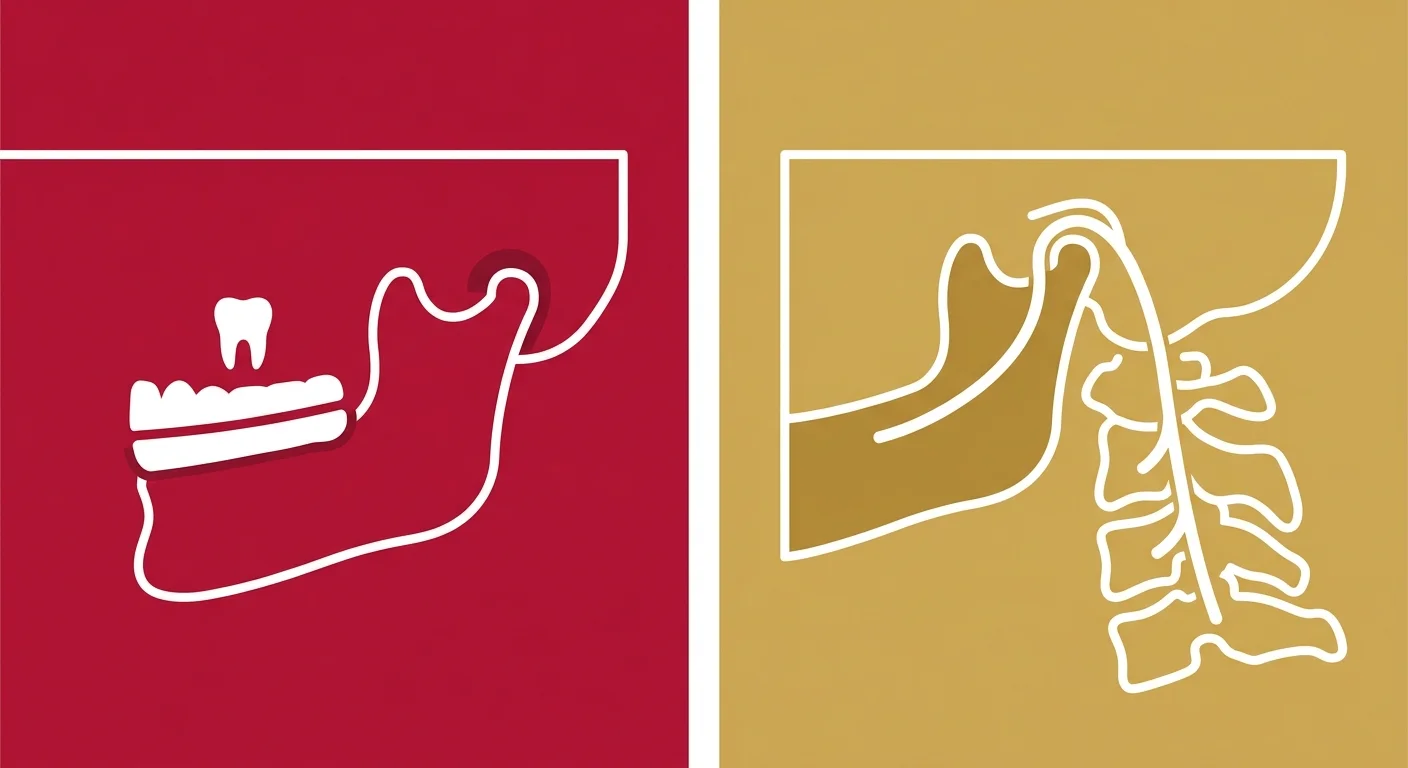
The splint sits in the mouth. The misalignment lives in the neck. Those are two different addresses — and dental management only has a key to one of them.
70% of patients diagnosed with temporomandibular disorders present with concurrent cervical spine pain and dysfunction. That means the majority of patients walking into a dental office for TMJ care are carrying a cervical problem the dental exam won't find. Because the dental exam doesn't look for it.
Occlusal splints don't touch cervical postural biomechanics. They can't. So the trigeminal-cervical loop keeps firing — and the headache keeps coming back. The circuit stays open.
What Occlusal Splints Can and Cannot Do
A splint does one thing well: it reduces mechanical load on the jaw joint by repositioning the bite. For patients whose TMJ dysfunction is purely occlusal — bite misalignment, no cervical involvement — that's often sufficient. But purely occlusal TMJ cases aren't the majority. And the dental intake process rarely determines which kind of case is actually sitting in the chair.
When the pain source runs through the trigeminal-cervical convergence pathway, a splint is addressing the wrong end of the circuit. It's managing the output — reduced jaw loading, less grinding — while the neurological input from the upper neck keeps firing. That's why patients report the splint helps at night but the headache is back by morning.
What why dental-only TMJ treatments fail to address is the physical position of the upper vertebrae — specifically whether a C1 positional fault is keeping the trigeminal-cervical nucleus overloaded. A splint doesn't fix that. It was never designed to.
The Friction Model: Why the Same Protocol Fails the Same Patient Twice
Here's the pattern most TMJ patients know by their third dental appointment. The splint goes in. The symptoms ease — for a while. Then the headaches come back. The dentist adjusts the splint. The cycle repeats. And nobody in that room asks the obvious question: why does the same protocol keep failing the same patient? In a dental-only model, there's no other variable to pull. The jaw is the whole picture. So the jaw keeps getting adjusted — and the neck keeps pulling the jaw back off.
Dental-only TMJ care doesn't fail because dentists are doing something wrong. It fails because the protocol was built for a narrower problem than the one most TMJ patients actually have. Dental management addresses the jaw. It can't address the cervical spine. So when the cervical spine is involved — and the clinical data puts that at 70% of cases — the same protocol keeps producing the same incomplete result. That's not a coincidence. That's a structural ceiling.
That's not a critique of the splint — it's a description of what the splint was built to do. It was engineered for the jaw. The jaw is one node in a larger circuit. Treating one node without looking at the others isn't incomplete care — it's the wrong starting point.
Patients who've been through two or three rounds of splints without lasting relief aren't experiencing bad luck. They're experiencing the predictable result of a protocol that was never designed to close the circuit. The cervical spine doesn't correct itself because the dentist adjusted the bite. And the bite doesn't stay corrected when the neck keeps pulling it off-axis.
This Approach Isn't for Every TMJ Patient — and That's the Point
If you're willing to let a full clinical assessment drive the conversation — this is worth having. If the assessment needs to confirm what you've already decided, it isn't. Assessment comes first here. Before the treatment plan. Before the modality. Before anything.
This approach isn't built for patients who arrive with a list of what their last provider did and need it replicated. It's not built for patients who want one appointment to resolve a structural problem that's been building for months or years. And it's not built for patients whose mind is already closed to the cervical component before the exam is finished.
What it is built for: patients who want to know what's actually driving their symptoms, are willing to let the clinical picture lead the care plan, and can commit once the picture is clear. That's the conversation Touch of Wellness Chiropractic is built around. If that's not where you are right now — that's useful information. Better to know it before the first visit than after.
| Treatment Approach | What It Addresses | What It Misses | Likely Outcome for Cervicogenic TMJ Cases |
|---|---|---|---|
| Dental occlusal splint only | Mechanical load on the jaw joint; bite repositioning; nighttime grinding reduction | Cervical postural biomechanics; trigeminal-cervical convergence pathway; upper vertebral position | Temporary symptom reduction followed by recurring headaches and jaw locking — the circuit stays live |
| Bite adjustment and occlusal equilibration | Tooth-to-tooth contact alignment; surface occlusion balance | Upper cervical nerve root input driving trigeminal-cervical nucleus overload | Improved bite mechanics with persistent neurological pain signal from unaddressed cervical source |
| Dental massage and jaw muscle therapy | Muscular tension at the jaw; localized facial pain relief | Structural misalignment in the upper cervical spine producing downstream muscle guarding | Relief that diminishes as cervical tension continues recruiting jaw musculature back into spasm |
| Upper cervical chiropractic care (standalone) | Vertebral position; trigeminal-cervical nucleus input; cervical postural biomechanics | Direct jaw joint loading if occlusal component is also present | Significant reduction in neurological pain signal; may require coordination with dental care for mixed-origin cases |
| Coordinated cervical and dental care | Both the structural cervical input and the occlusal jaw joint mechanics | Neither end of the circuit is left unexamined | Most complete pathway to lasting relief for patients with true cervicogenic TMJ involvement |
| No treatment — watchful waiting | Nothing structural or neurological | Cervical misalignment, trigeminal-cervical loop activity, and progressive postural deterioration | Symptom escalation over time as the unresolved structural source continues driving the neurological loop |
What the Safety Record on Cervical Chiropractic Adjustments Actually Shows
The safety question around cervical chiropractic care has been studied. Reviewed. Documented across large patient populations. And the clinical record doesn't support the fear.
So let's answer it on its own terms. Not with reassurance. With data.
Here's what the research shows: when cervical care is assessed and delivered clinically, the risk profile is far lower than what most patients have been taught to expect. The numbers make that plain.
Serious Adverse Events: What the Clinical Data Reports
Severe adverse events from cervical chiropractic procedures are extremely rare. NIH safety reviews place the rate of serious complications between 1 in 20,000 and 1 in several million adjustments. That's not a marketing claim. That's the published estimate from systematic review — and it's the number patients almost never hear before they decide to be afraid.
Severe outcomes: 1 in 20,000 to 1 in several million treatments. People accept worse odds from ibuprofen without reading the label. The math isn't close.
The research on upper cervical mobilization outcomes reinforces this: when care is individualized and driven by assessment, the cervical spine responds predictably. The risk profile isn't the real obstacle. The obstacle is the assumption — inherited from a dental-only framework — that neck work carries a danger it simply doesn't.
Transient Reactions: What to Expect and How Long They Last
What patients do commonly experience is transient soreness. It resolves within 24 to 48 hours — the same window most people expect after a hard workout. That's not a clinical event. That's not a complication. That's the body adjusting to a structural correction it needed.
A large-scale prospective study found that benign, self-limiting reactions like localized neck stiffness occur in roughly 50% of chiropractic cases. Zero serious structural injuries were reported in the cohort during monitored follow-up. That's not a buried footnote. That's the headline of the safety record — the one most patients walk in without knowing.
Safety in Context: What the Risk Comparison Looks Like
Risk doesn't exist in isolation. It lives in comparison. The real question for a TMJ patient isn't whether cervical chiropractic care carries any risk — everything does. The question is what that risk looks like against doing nothing. Or against continuing a dental-only protocol that leaves the cervical spine completely unexamined.
Leaving the trigeminal-cervical circuit loaded with unresolved dysfunction has a cost. Chronic headache recurrence. Progressive jaw restriction. Compounding musculoskeletal strain. That's not theoretical. That's the documented outcome when half the circuit goes untreated.
The safety record on cervical chiropractic care doesn't need defending. It needs to be read. Severe adverse events at 1 in 20,000 to 1 in several million. Transient reactions that clear in 24 to 48 hours. Zero serious structural injuries across large-scale prospective monitoring. For a patient who walked in afraid of neck work, that's a very different conversation than the one they were expecting.
| Reaction Type | Estimated Frequency | Onset Timing | Resolution Timeframe | Clinical Classification |
|---|---|---|---|---|
| Severe adverse event | 1 in 20,000 to 1 in several million treatments | Variable | Not applicable — rare serious outcome | CRITICAL (extremely rare) |
| Minor transient soreness | Common | Immediate to within hours post-care | Resolves within 24 to 48 hours | Benign / self-limiting |
| Localized neck stiffness | Approximately 50% of cases | Immediate to within hours post-care | Resolves quickly | Benign / self-limiting |
| Serious structural injury | Zero reported in cohort | Not applicable | Not applicable — none occurred during monitored follow-up | None documented |
How Individualized Upper Cervical Care Differs From a Standard Neck Adjustment
Safe is the floor. Effective is the question that actually matters.
Knowing the risk profile clears the threshold. It doesn't tell you whether the care is targeted enough to do anything. For TMJ patients, that distinction is the whole game.
Not all cervical care is the same. That's not a marketing position. It's a clinical one.
The difference between upper cervical mobilization designed for trigeminal-cervical dysfunction and a standard generalized neck adjustment is the difference between addressing the circuit and missing it entirely.
Structure changes the outcome. The level and direction of mobilization are specific to each patient's presentation — not pulled from a default sequence. And the outcome gets measured against real neurological markers. Not just whether the neck feels looser walking out.
Assessment First: Why the Clinical Picture Drives Everything
The care plan doesn't come first. The assessment does. Always.
Before any cervical work begins, there's a foundational question that has to be answered: is the cervical spine structurally contributing to this patient's TMJ symptoms — and if so, at what level?
That question doesn't get answered at a dental exam. It requires evaluating cervical posture, segmental mobility, upper neck neurological tension, and the full symptom pattern — not just what's happening at the jaw.
For patients who've been asking whether nightguards actually address the root cause, the answer keeps pointing to the same gap: treating the jaw without examining the cervical spine leaves the primary driver untouched in the majority of cases.
Assessment-first isn't a philosophy. It's the only defensible starting point when the symptom pattern spans two anatomical systems.
A care plan built before the clinical picture is complete isn't individualized. It's a guess written in clinical language.
Upper Cervical Mobilization vs. General Cervical Adjustment
Here's the thing about a standard cervical adjustment: it applies broad mobilization across multiple neck segments, often with the same technique regardless of what the patient's presentation actually shows. For general musculoskeletal complaints, that's clinically reasonable.
For TMJ patients with upper cervical dysfunction, it's not precise enough to reach the part of the system that's misfiring.
Upper cervical mobilization for TMJ targets the C1-C2 region — the anatomical zone where the trigeminal-cervical nucleus receives its cervical input. The direction, force, and segmental target come from what the assessment found. Not from a standardized protocol.
Observational trials document statistically significant increases in pain-free active jaw opening distance and marked reductions in visual analog scale jaw pain ratings when care is delivered at this level of specificity.
That outcome difference isn't a coincidence. It's what happens when the mobilization actually reaches the part of the circuit that's driving the problem.
Broad cervical treatment can decompress general tension. Targeted upper cervical mobilization changes the neurological load on the trigeminal-cervical nucleus. For TMJ patients where the cervical spine is the driver, that's not a subtle distinction. That's the entire point.
When Shockwave Therapy Enters the Picture
Shockwave Therapy comes into the picture when chronic tension, adhesions, or restricted soft tissue mobility around the affected cervical and jaw structures don't fully resolve with manual mobilization alone.
It's not a first-line tool. It's a clinical addition for specific presentations — when the soft tissue layer is part of what's keeping the dysfunction in place.
When it's indicated, Shockwave Therapy addresses the muscular and connective tissue components that keep the trigeminal-cervical circuit loaded between visits — the layers that manual care reaches structurally but doesn't always fully reset at the tissue level.
Whether it belongs in the plan depends entirely on what the assessment shows. That decision gets made after the clinical picture is clear. Not before it.
| Clinical Variable | General Cervical Adjustment | Individualized Upper Cervical Mobilization for TMJ |
|---|---|---|
| Assessment Starting Point | Protocol applied at intake — same sequence regardless of patient presentation | Full cervical posture, segmental mobility, and symptom pattern evaluated before any mobilization is selected |
| Anatomical Target | Broad multi-segment cervical mobilization — targets general neck tension | Focused on C1-C2 region where trigeminal-cervical nucleus receives cervical input |
| Technique Selection | Standardized approach used across presenting complaints | Direction, force, and segmental level chosen based on each patient's individual clinical findings |
| TMJ Relevance | Addresses general cervical tension — does not specifically target the trigeminal-cervical convergence zone | Directly addresses the anatomical circuit driving jaw pain when cervical dysfunction is the primary contributor |
| Outcome Measurement | Range of motion and pain reported by patient — general markers | Neurological markers tracked alongside jaw opening distance and pain ratings — real functional benchmarks |
| Plan Adaptability | Protocol repeated consistently session to session | Care plan adjusted based on patient response — if something isn't producing results, the approach changes |
Who Is — and Isn't — a Candidate for Cervical Chiropractic With TMJ Dysfunction
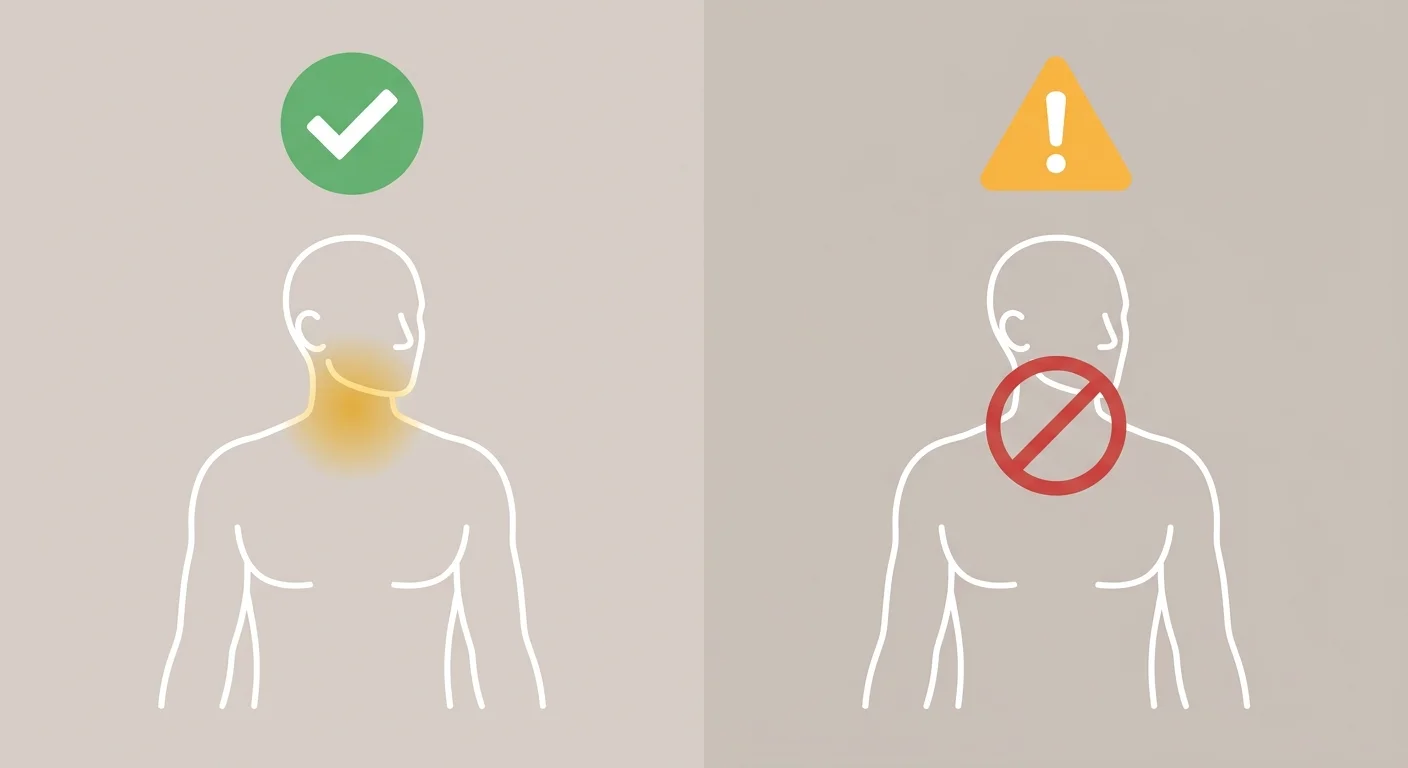
Safe is one question. Right for you is a different one.
And that second question only gets answered one way — through the clinical picture. Not through what worked for someone else. Not through a protocol pulled off a shelf.
NIH research puts TMJ disorders at up to 12 million adults in the United States — more prevalent among women than men. Of those, clinical data shows 70% present with concurrent cervical spine dysfunction.
That's not a small subgroup. That's most of the room.
But majority doesn't mean everyone. The assessment is what determines which side of that line you're on. And that answer has to come before any care plan does.
You can't trip a breaker that isn't part of your circuit.
If the cervical spine isn't structurally contributing to the TMJ pattern, upper cervical mobilization isn't the answer. The assessment will tell you that plainly — and it won't pretend the cervical spine is the driver when it isn't.
Presentations Where Cervical Chiropractic Is Clinically Indicated
Cervical chiropractic care is most clearly indicated when the TMJ symptom pattern comes with a cervical signature attached.
Headaches that start at the base of the skull. Postural neck tension that tracks alongside jaw pain. Restricted upper neck range of motion. Nerve symptoms that radiate from the neck toward the jaw or temple.
Those aren't incidental findings. They're the circuit showing its hand.
It's also indicated when dental-only management has been tried and the symptoms keep returning.
If the nightguard reduced the jaw load and the headaches didn't move — the cervical spine is almost certainly part of the circuit. That's not a mystery. It's what happens when 70% of TMD patients carry concurrent cervical dysfunction and only the downstream joint gets treated.
The splint did its job. It just wasn't the right job for this patient.
Patients who do well here share one trait: they follow the clinical picture wherever it leads.
That means showing up to the assessment without a predetermined outcome. Building a care plan from their actual presentation — not their last provider's habit loop. And giving the process enough runway to work.
Remember: NIH research shows 70% of TMD patients carry concurrent cervical dysfunction. That's a structural reality, not a timeline suggestion. The circuit doesn't reset in a single visit. Patients who understand that get results. Patients who don't leave before anything changes.
Contraindications and When a Different Path Comes First
Not every TMJ presentation starts here.
Active joint inflammation, recent jaw trauma, suspected internal disc displacement with locking — those may need imaging or specialist coordination before any manual cervical work begins. Acute-phase presentations with significant swelling fall in the same category.
The assessment catches those early. When it does, the clinical path changes. That's not a barrier. It's the sequence doing its job.
Here's the thing about contraindications: they're not a reason to avoid care. They're a reason to sequence it correctly.
Active cervical instability or a history of vascular involvement in the neck doesn't automatically disqualify someone from upper cervical care. But those findings have to be addressed in the right order, with the right clinical coordination.
The path still gets there. It just doesn't skip steps.
And if you're arriving with a list of what your last provider did — expecting it to be replicated before the assessment is finished — this isn't the right fit.
The assessment drives the care plan here. Not the other way around.
That's not a policy. That's what makes individualized care different from guesswork.
| Patient Presentation | Cervical Chiropractic Indicated? | Clinical Rationale | First Step |
|---|---|---|---|
| TMJ pain with headaches originating at the base of the skull | Yes — strongly indicated | Suboccipital headache pattern is a hallmark of upper cervical involvement; trigeminal-cervical nucleus receives input at C1–C2, making the cervical spine a primary driver of this symptom cluster | Full cervical and TMJ assessment to confirm upper neck as the structural source before care begins |
| Jaw pain that persists after consistent nightguard use | Yes — indicated | Dental-only management addresses downstream occlusal load but leaves the cervical circuit intact; returning symptoms after splint compliance signal an upstream structural driver that hasn't been reached | Cervical postural and segmental mobility evaluation to identify the unaddressed driver |
| TMJ dysfunction with concurrent restricted upper neck range of motion | Yes — indicated | Restricted C1–C2 mobility alters trigeminal-cervical input directly; jaw pain and limited neck rotation appearing together point to a shared structural source, not two separate problems | Segmental cervical assessment mapping restriction level and direction before any mobilization |
| Nerve symptoms radiating from the neck toward the jaw or temple | Yes — indicated | Radiating nerve patterns from the upper cervical region follow trigeminal-cervical pathways; this presentation confirms the circuit is live and the cervical spine is actively contributing to the symptom load | Neurological tension assessment and full cervical evaluation before care plan is built |
| Active jaw inflammation or acute-phase swelling | Not yet — sequencing required | Acute inflammatory states may require specialist coordination or imaging before manual cervical work begins; assessment flags this early and changes the clinical path accordingly | Coordination with appropriate specialist or imaging to rule out contraindications before cervical care is introduced |
| Suspected internal disc displacement with jaw locking | Not yet — imaging first | Mechanical locking suggests possible internal disc displacement that must be assessed before manual cervical work is added to the clinical picture; the assessment determines whether cervical care is premature | Imaging and specialist evaluation to clarify joint status before any cervical mobilization begins |
| TMJ symptoms with no cervical signature — no neck tension, no postural finding, no upper neck restriction | Not indicated as primary approach | If the cervical spine isn't structurally contributing to the pattern, upper cervical mobilization isn't the answer; the assessment will identify this clearly and direct care to the actual driver | Honest clinical conversation about what the assessment found and what care pathway fits the actual presentation |
| Patient expecting care plan replication from a previous provider before assessment is complete | Not a fit for this model | Individualized care is built from the clinical picture — not from a prior provider's protocol; the assessment drives the plan here, and that sequence isn't negotiable regardless of prior treatment history | Assessment must come first; patients unwilling to let the clinical picture lead are better served elsewhere |
Frequently Asked Questions
Patients don't walk in asking about trigeminal-cervical convergence. They walk in asking if the neck work is going to hurt them, why their jaw hurts when their neck is the problem, and how long this is going to take. Those are the right questions. They deserve straight answers.
Here's what the answers look like when no one's softening them.
Can a neck adjustment make my TMJ worse?
Done correctly, it doesn't. It does the opposite.
Precise upper cervical mobilization reduces the neurological load feeding the TMJ — it doesn't add to it. The concern is understandable. But it's conflating broad cervical treatment with targeted upper cervical work. Those aren't the same procedure, and the distinction matters clinically.
Transient soreness after a cervical visit is common. Benign, self-limiting reactions occur in roughly 50% of cases. They resolve quickly — not a sign of damage, not evidence the jaw got worse. That's the body responding to a structural correction it needed. Severe adverse events from cervical care are extraordinarily rare — estimated between 1 in 20,000 and 1 in several million treatments. That's not reassurance. That's the published data.
What can make TMJ worse is treating the neck without an assessment first. The clinical picture comes before anything else. When the cervical spine is the structural driver, mobilizing it precisely reduces the input that's been keeping jaw pain active. The direction of the effect runs the other way.
Why does my jaw hurt when my neck is misaligned?
Because they share the same neurological processing center.
The trigeminal nerve — the primary pain nerve of the face and jaw — converges with cervical nerve roots at a relay station in the upper spinal cord. Pain signals from the jaw and pain signals from the neck feed into the same hub. When the upper cervical spine is misaligned, it floods that hub with structural input. The brain can't always sort out where the signal is coming from. So it reads all of it as jaw pain.
That's not a theory. Clinical data shows 70% of TMD patients present with concurrent cervical spine dysfunction. That pattern keeps showing up in the same population for one reason: the same convergence pathway keeps expressing itself the same way.
The jaw isn't broken. The circuit is.
Is it safe to have my neck adjusted if I have lockjaw?
Significant jaw restriction doesn't disqualify upper cervical care. But it changes the sequencing.
Active joint locking with suspected internal disc displacement may need imaging or specialist coordination before any manual cervical work begins. That's the assessment doing its job — flagging what has to be ruled out first. Not a barrier. The correct order.
Once the clinical picture is clear, upper cervical mobilization is well-tolerated. Severe adverse events from cervical care are extremely rare — estimated between 1 in 20,000 and 1 in several million treatments. The assessment determines whether this is the right moment and the right approach. That's what makes the process safe — not reassurance. Clinical order.
How many chiropractic visits does it take to relieve TMJ pain?
No honest answer exists before the assessment is done. Anyone who gives you a number on the first visit — before your cervical presentation has been evaluated — is working from a billing calendar. Not a clinical picture.
What the research shows: upper cervical mobilization produces statistically significant improvement in jaw range of motion and measurable pain reduction. How many visits it takes depends on how long the dysfunction has been present, how the cervical spine responds, and whether additional modalities are indicated.
The goal isn't indefinite maintenance. It's resolution. The care plan changes when the clinical picture changes. And when the work is done, it's done — not extended to fill a schedule.
What are the risks of ignoring cervical spine issues in my TMJ treatment?
The trigeminal-cervical loop doesn't resolve on its own. If the cervical spine is structurally contributing to TMJ pain and goes unexamined, the jaw keeps reacting to input it can't control. Nightguards manage the downstream joint. They don't touch the upstream driver.
That's not a minor gap. Clinical data shows 70% of TMD patients carry concurrent cervical spine dysfunction. Leaving that untreated keeps the circuit live — and the symptoms follow. Chronic headaches, persistent jaw tension, pain that returns after every dental adjustment. Consistent, predictable outcomes when the cervical component never gets addressed.
Ignoring it doesn't make it smaller. It keeps the input running while treatment addresses the output. Eventually the downstream interventions stop producing even temporary relief. Because the structural driver never changed.
The circuit stays live until someone trips the breaker.
The Circuit Doesn't Reset Itself
If you've been wearing a nightguard for months and the headaches keep coming back — the cervical spine is the part of the circuit nobody has touched. That's not a gap in your effort. It's a gap in the model.
The trigeminal-cervical loop doesn't care how precisely the jaw joint is managed downstream. If the structural input from the upper neck stays live, the pain stays live.
That's not the splint failing. That's the predictable outcome of treating one node in a two-node circuit.
Targeted cervical care isn't a replacement for dental treatment. It's what addresses the part of the circuit dental treatment can't reach.
At Touch of Wellness Chiropractic, Dr. Karen Hannah's approach starts with the assessment — not a protocol — because the clinical picture has to come before the care plan. Every time.
When the cervical spine is the driver, upper cervical mobilization trips the breaker at the source. That's not a metaphor. That's the mechanism.
For patients who've spent months treating only what they can see in the mirror — more adjustments to the splint, more jaw exercises, same symptoms on the same cycle — the answer isn't more of the same.
It's addressing the input the jaw has been reacting to all along.
The circuit stays live until someone trips the breaker. And the breaker has never been in the dental office.
The splint didn't fail you. The model did. If the headaches keep returning after every dental adjustment, the cervical spine is the part of the circuit no one has touched. That's not bad luck. That's a structural gap with a predictable outcome. The circuit stays live until someone trips the breaker. That conversation starts with a cervical assessment — not another nightguard fitting.
Copyright Touch of Wellness Chiropractic 2026
1101 W Jackson St, Suite A Morton, IL 61550
Web Design by iTech Valet