
(309) 321-8412 | 1101 W Jackson St, Suite A, Morton, IL 61550
(309) 321-8412 | 1101 W Jackson St, Suite A, Morton, IL 61550
Can Chiropractic Care Resolve TMJ and Cervicogenic Headaches When Dental Splints Fail?
Chiropractic care can resolve TMJ pain and cervicogenic headaches when dental splints have failed — but only when the evaluation targets the actual source, not just the location of the pain.
Temporomandibular disorder affects over 10 million Americans. A significant portion of those cases involve headaches that do not originate in the jaw at all. They originate in the upper cervical spine.
Cervicogenic headaches — headaches arising from dysfunction in the C1-C3 vertebral segments — account for up to 22% of all chronic headache presentations. The jaw and the neck share a common neurological relay: the trigeminocervical nucleus. When the upper cervical spine is dysfunctional, that relay transmits pain signals into the jaw, face, and skull. The jaw does not cause this. The neck does.
A dental splint addresses the jaw. It does nothing for the cervical dysfunction generating the signal. That is why splint-only protocols produce temporary relief at best — the bite guard repositions the jaw, the cervical spine keeps firing, and the headaches return.
Spinal manipulative therapy targeting the upper cervical segments has demonstrated a 50% reduction in headache pain intensity in clinical trials — achieved in 18 sessions over 6 weeks. Manual therapy directed at the temporomandibular joint structures produces measurable structural change: an average improvement of 4.5 mm in maximal mouth opening. These outcomes reflect what happens when the neuromusculoskeletal system is treated as a connected system, not a collection of isolated complaint sites.
Conservative, reversible treatments are the clinically established standard for TMD. Chiropractic evaluation of the upper cervical spine fits that standard precisely — non-invasive, adjustable based on patient response, and aimed at the structural root rather than the symptomatic surface.
When TMJ pain and cervicogenic headaches coexist, the clinical question is not whether the jaw or the neck is causing the problem. It is whether anyone has evaluated the full neuromusculoskeletal system. A splint that fails is not evidence the condition is untreatable. It is evidence the source has not been correctly identified yet.
Last Updated: August 25, 2026
- • Why Dental Splints Are the Starting Point — Not the Full Answer
- • The Cervical Connection: How Your Neck Drives Jaw Pain and Headaches
- • What a Chiropractic Evaluation Actually Looks Like for TMJ and Headache Patients
- • Realistic Timelines and What the Evidence Shows
- • Comparing the Approaches: Dental Splint vs. Chiropractic Care for TMJ and Cervicogenic Headaches
-
• Frequently Asked Questions
- • Why do dental splints often fail to resolve TMJ pain and headaches?
- • How does a problem in the neck cause pain in the jaw and head at the same time?
- • What does chiropractic care for TMJ and cervicogenic headaches actually look like?
- • How many chiropractic sessions are typically needed to see TMJ or headache relief?
- • Can chiropractic care make TMJ symptoms worse?
- • The Clinical Pivot That Changes the Outcome
Why Dental Splints Are the Starting Point — Not the Full Answer
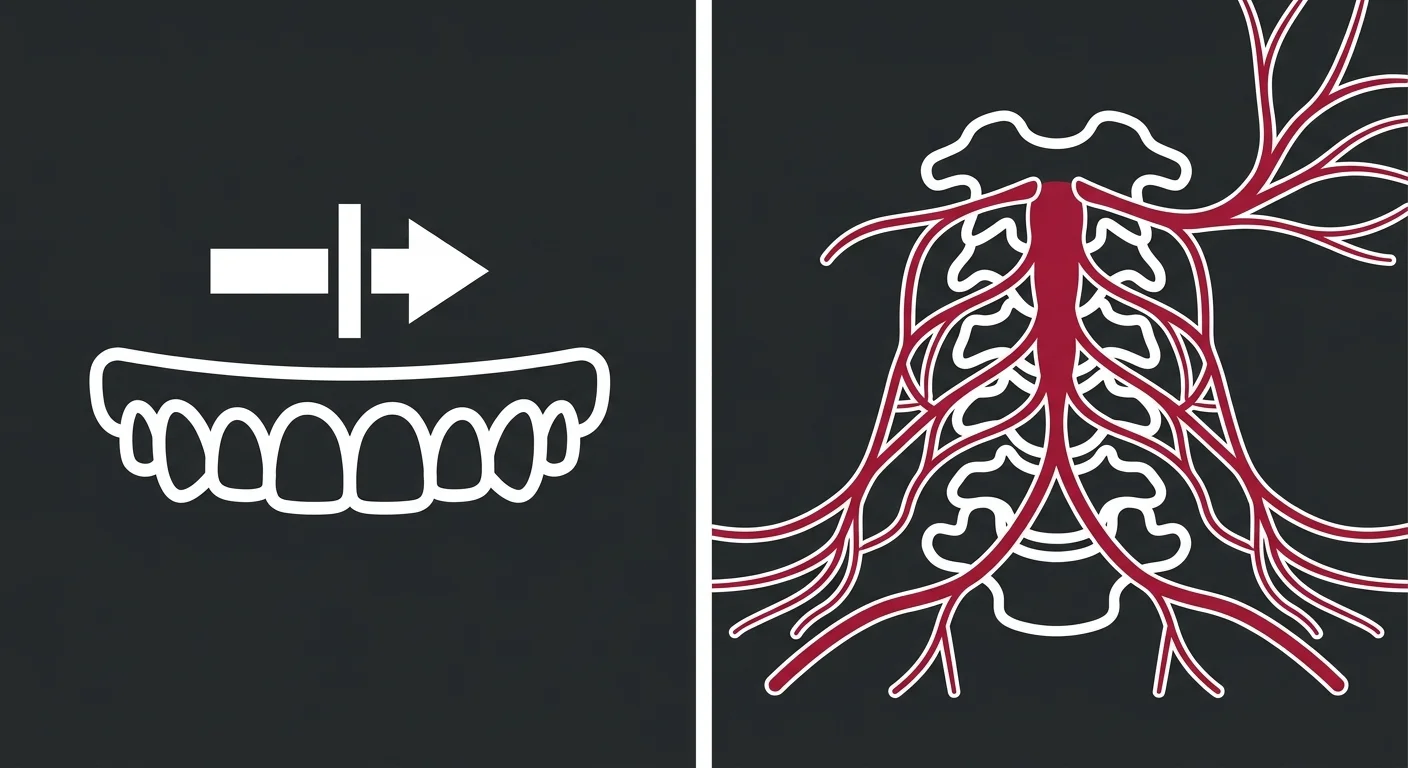
Dental splints do one thing well: they reposition the jaw and reduce mechanical load on the joint. That's a real clinical tool. But it's a tool with a ceiling — and for over 10 million Americans dealing with TMD, that ceiling shows up fast.
The splint treats the jaw. It doesn't treat the system behind the jaw problem. When the dysfunction sits upstream — in the upper cervical spine — no amount of bite repositioning reaches it.
That's the gap. Not a failure of the splint to do its job. A failure to identify what the job actually needs to be.
Why Most Splint-Only Protocols Miss the Real Driver
Here's what dentists are trained to see: the jaw — the bite, the disc, the joint mechanics. That's appropriate for what dentistry does. But jaw pain driven by upper cervical spine dysfunction doesn't originate in the jaw. It arrives there.
The trigeminocervical nucleus is the relay. Dysfunction at C1, C2, or C3 fires directly into it — and the signal lands in the jaw, the face, the skull. The jaw feels it. The cervical spine generates it. Those are two different problems, and a splint only addresses one of them.
The splint-only protocol treats where the signal lands. It doesn't touch where the signal originates. So patients with real cervicogenic involvement get temporary relief — and then they plateau. The cervical dysfunction keeps transmitting. The symptoms rebuild. The splint gets the credit for the first two weeks and none of the blame for everything after.
The National Institute of Dental and Craniofacial Research is direct on this: conservative, reversible treatments are the established clinical standard for TMD. Irreversible interventions can permanently alter bite alignment — without proven outcomes to justify it.
Chiropractic evaluation fits that standard. The splint-only protocol, repeated indefinitely without structural reassessment, does not.
At Touch of Wellness Chiropractic in Morton, IL, the evaluation doesn't stop at the jaw. Because the jaw is often the last place to look — it's where patients feel the problem, not where the problem lives.
Knowing why jaw pain frequently traces back to the upper cervical spine is the clinical pivot that changes what gets evaluated — and what actually gets resolved.
| Treatment Approach | What It Targets | What It Cannot Address | Best Suited For |
|---|---|---|---|
| Dental splint (occlusal guard) | Jaw position and bite mechanics — reduces mechanical load on the temporomandibular joint | Upper cervical spine dysfunction; trigeminocervical relay pathways; cervicogenic headache signals originating at C1-C3 | Patients whose TMD is driven by localized bite imbalance with no upstream cervical involvement |
| Splint-only protocol (repeated, unmodified) | Symptom location — the jaw, the disc, the joint surface | The neurological source generating the signal; cervical misalignment transmitting pain into the jaw and skull | Short-term mechanical offloading — not long-term resolution when cervicogenic involvement is present |
| Upper cervical chiropractic evaluation | The C1-C3 vertebral segments and the neuromusculoskeletal system as a connected whole | Cannot reposition the bite or directly address localized disc mechanics within the temporomandibular joint | Patients with cervicogenic headaches, neck-driven jaw pain, or TMD symptoms that have plateaued under splint care |
| Combined cervical and jaw evaluation | Both the structural source (upper cervical spine) and the symptom site (temporomandibular joint) simultaneously | Does not replace dental oversight of bite and disc pathology — coordination with the treating dentist is still appropriate | Patients with coexisting TMD and cervicogenic headaches who have not responded to a single-system approach |
| Invasive / irreversible TMD interventions | Permanent alteration of bite alignment or joint structure | Cannot be undone if outcomes are not achieved — permanently alters the system it was meant to correct | Clinically disfavored as a first-line response; conservative, reversible options are the established standard |
The Cervical Connection: How Your Neck Drives Jaw Pain and Headaches
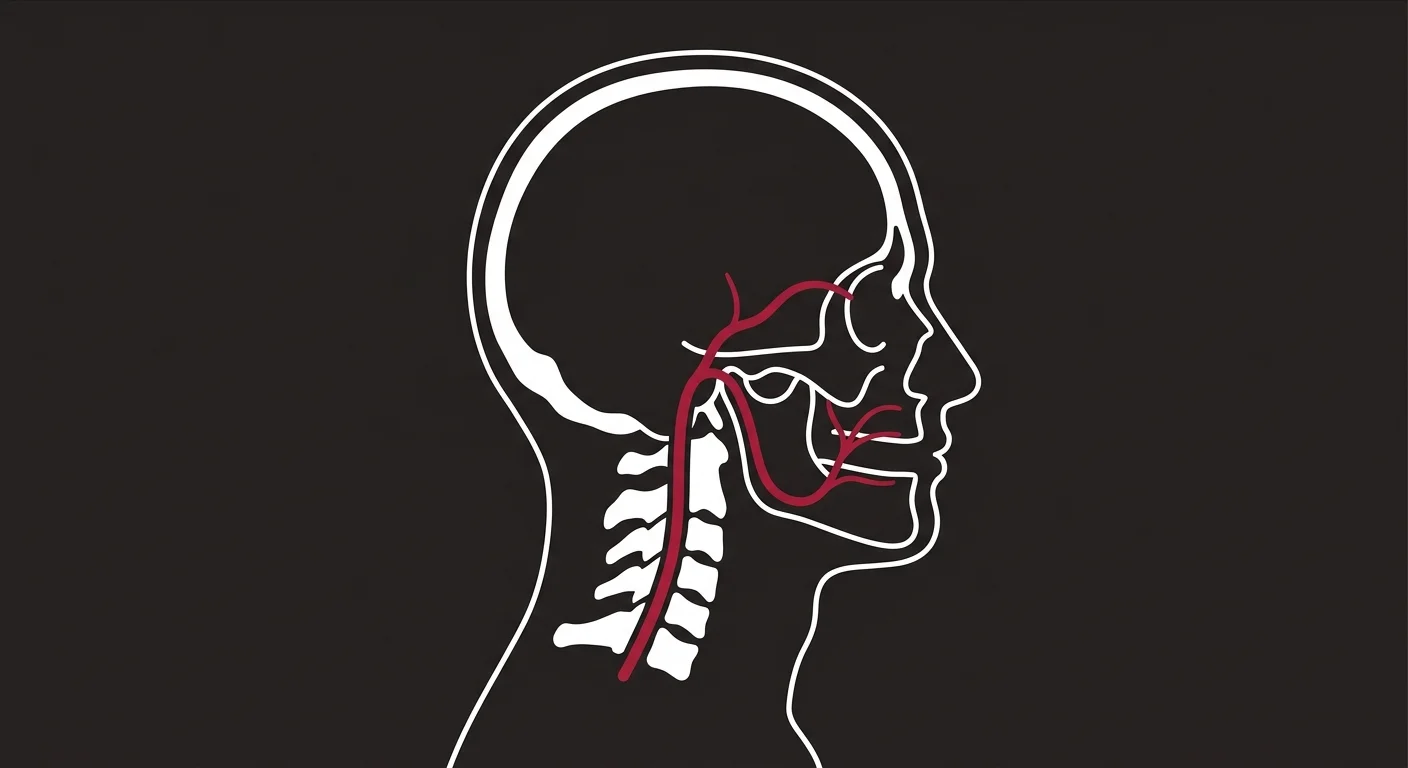
The bite is stable. The splint is in. The headaches are still there.
So now what?
That's not a mystery. It's anatomy.
The jaw and the neck aren't separate systems. They share a neurological relay. And when that relay is under load from cervical dysfunction, no amount of bite repositioning quiets it.
Understanding how neck tension drives chronic jaw pain through a shared neurological pathway changes the entire clinical question. It's no longer "what's wrong with the jaw." It's "what's generating the signal the jaw keeps receiving."
The Trigeminocervical Pathway: One Relay, Two Symptom Sites
The trigeminocervical nucleus is where jaw meets neck — neurologically. Upper cervical input and trigeminal input converge there. When the cervical spine is dysfunctional, that dysfunction doesn't stay local.
It fires into the jaw. Into the face. Into the skull.
The nervous system doesn't organize pain by where you feel it. It organizes pain by the pathways carrying the signal. That's a critical distinction most bite-focused treatments ignore entirely.
So when a patient walks in with jaw pain and a headache the splint hasn't touched, the trigeminocervical relay is the first system to evaluate. Not the last.
Clinical manual therapies that target this shared pathway produce integrated pain relief for co-existing jaw and neck syndromes. Two symptom sites. One relay. That's what makes a systems-level evaluation non-negotiable — not optional, not supplemental.
C1–C3: Where Cervicogenic Headaches Begin
Cervicogenic headaches originate from the upper three cervical segments — C1, C2, and C3. According to NIH research, they account for up to 22% of all chronic headache presentations.
That's not a rare edge case. That's a significant share of chronic headache patients who've never had their cervical spine evaluated as the source — because no one thought to look there.
When C1–C3 are restricted — from joint dysfunction, soft tissue loading, or postural breakdown — they feed directly into the trigeminocervical nucleus. And the nucleus doesn't distinguish cervical pain from jaw pain. It transmits the load as facial pain, headache, or jaw tension, depending on where the individual's system breaks down first.
The splint-only protocol never touches C1–C3. It never evaluates the relay. It treats the output and leaves the generator running.
That's why the cervical spine is where a meaningful TMJ and cervicogenic headache evaluation has to start. Not as an afterthought. As the primary question.
| Symptom | Common Assumed Cause | Cervical Root Cause | Clinical Significance |
|---|---|---|---|
| Jaw pain with no clear dental cause | Disc displacement or bite misalignment | C1–C3 dysfunction feeding into the trigeminocervical nucleus | Splint-only treatment leaves the cervical generator untouched — symptoms rebuild |
| Headache at the base of the skull or behind the eyes | Tension headache or migraine variant | Upper cervical joint restriction transmitting pain through the trigeminocervical relay | Without cervical evaluation, the origin goes unaddressed regardless of headache medication or splint use |
| Facial pain and jaw tension that worsens under stress | Bruxism or jaw clenching driven by anxiety | Postural loading on C1–C3 amplifying trigeminal input | Cervical dysfunction escalates under the same conditions as stress — the two sources are clinically inseparable |
| Limited mouth opening that doesn't respond to splint therapy | Joint disc restriction or localized TMJ inflammation | Upper cervical misalignment altering jaw mechanics indirectly through muscle and nerve loading | Jaw range of motion improves when the cervical spine is treated — not just when the joint itself is targeted |
| Recurring headaches after short-term splint relief | Splint compliance issue or incomplete bite correction | Splint resolves mechanical jaw load but cervical dysfunction continues transmitting through the shared relay | Recurrence is the expected outcome when the cervical source is never evaluated or treated |
What a Chiropractic Evaluation Actually Looks Like for TMJ and Headache Patients
Most patients who've been through the splint-only protocol know what didn't work. What they don't know is what was never looked at.
A systems-level chiropractic evaluation doesn't start at the jaw. It starts at C1, C2, C3 — because that's where the signal originates. The jaw is where the patient feels it. That's not the same thing as where the problem lives.
What makes this evaluation different isn't the tools. It's the question. Not 'what's wrong with the jaw.' But: 'what's generating the signal the jaw keeps receiving?' That's a different evaluation entirely.
Assessment First, Always
Assessment is the non-negotiable first step. Not a protocol. Not a predetermined sequence handed down from a billing calendar. What you report drives what gets evaluated — and that principle doesn't bend.
The evaluation maps cervical joint mobility, soft tissue loading, and postural mechanics at the upper spine. It also assesses jaw range of motion and the mechanical relationship between cervical alignment and jaw position — because those two systems are functionally inseparable. NIH-documented evidence confirms that targeted manual therapy directed at temporomandibular joint structures produces an average improvement of 4.5 mm in maximal mouth opening. That's a measurable structural outcome. Not a subjective rating scale.
There's a real difference between repositioning the output and targeting the generator — and the assessment is what determines which approach, or which combination, actually fits this patient's clinical picture. Not the assumed one. Not the one the last provider used.
What Changes After the Assessment
The care plan follows the findings. That's the whole model. If the upper cervical spine is driving the problem, that's where the clinical work goes. If the jaw is involved too, it gets addressed as part of one picture — not handed off to a separate track running on its own timeline.
When the trigeminocervical pathway is the target, the treatment doesn't split into jaw work and neck work. It's one approach resolving shared pain pathways at the source. Conservative. Reversible. And clinically, that's exactly what the evidence supports — not because it's the cautious option, but because it's the one that holds.
And if something in the plan isn't producing results after a reasonable number of visits, it changes. That's not optional. Repeating a protocol that isn't working isn't persistence. It's the definition of failure.
Who Chiropractic Care for TMJ and Cervicogenic Headaches Is Not For
Here's something worth saying clearly: this isn't for everyone. That's not a hedge. It's a time-saver for both parties.
If you're arriving with a list of what your previous provider did and you need it replicated before the assessment is finished, this isn't the right fit. The assessment drives the care plan here. Not your prior provider's habits. Not a preferred sequence. If that's a problem before we've started, that's important information for both of us.
If you want a one-visit resolution, or you're willing to follow pieces of a care plan while skipping others, the outcomes you're looking for aren't available on those terms. Partial commitment produces partial results. And for a condition rooted in upper cervical dysfunction and trigeminocervical relay disruption, partial results means the symptoms rebuild. The patients who get their lives back are the ones who stay in long enough for the system to actually change.
| Assessment Component | What Is Evaluated | Why It Matters for TMJ and Headache Patients |
|---|---|---|
| Upper Cervical Spine Mobility (C1–C3) | Joint restriction, range of motion, and segmental dysfunction at the top three cervical vertebrae | C1–C3 are the primary signal generators for cervicogenic headaches and trigeminocervical relay overload — evaluating them first determines whether the jaw is the source or the recipient of the pain |
| Soft Tissue Loading Patterns | Tension, guarding, and mechanical load distribution across the suboccipital and cervical musculature | Chronic soft tissue overload at the upper cervical spine sustains trigeminocervical nucleus activity long after a splint has repositioned the bite — identifying it explains why headache persists despite dental intervention |
| Postural Mechanics | Head position, forward head carriage, and the structural relationship between the skull, cervical spine, and shoulders | Postural breakdown shifts mechanical load onto C1–C3 continuously — without correcting the postural driver, cervical joint restriction returns and symptoms rebuild |
| Jaw Range of Motion and Mechanical Relationship | Mouth opening, lateral excursion, and the functional connection between cervical alignment and jaw position | The jaw and cervical spine are mechanically linked — restricted jaw movement can reflect upstream cervical dysfunction rather than a primary jaw disorder, and targeted manual therapy directed at temporomandibular structures produces measurable structural improvement in mouth opening |
| Trigeminocervical Pathway Assessment | The integrated neurological relationship between upper cervical input and trigeminal nerve distribution | The trigeminocervical nucleus does not distinguish cervical pain from jaw pain — mapping this shared pathway identifies whether symptoms are being generated centrally at the relay or locally at the jaw, and determines which clinical approach addresses the actual source |
| Patient-Reported Symptom Pattern | What the patient actually reports — symptom location, frequency, triggers, history of prior interventions, and what has and has not produced lasting change | The care plan is built from what you report, not from a standard intake template — symptom history reveals whether the presentation fits a cervicogenic pattern, a primary TMJ pattern, or a combined neuromusculoskeletal picture that requires a unified approach |
Realistic Timelines and What the Evidence Shows
Here's what nobody gives you a straight answer on: how long does this actually take?
The fear-based treatment timeline is a billing model wearing a clinical costume. A provider who hands you a 12-month plan before the assessment is finished isn't practicing medicine. They're selling retention.
Honest timelines come from two things: what the research actually shows, and what your individual clinical picture produces. Those two inputs. Nothing else.
Here's what the research actually shows.
What the Research on Cervicogenic Headaches and Spinal Care Actually Says
A randomized controlled trial on spinal manipulative therapy for cervicogenic headaches — documented in NIH peer-reviewed research — found that 18 sessions over 6 weeks produced a 50% reduction in headache pain intensity.
That's a finite window. A beginning and an end. Not an open-ended plan handed to you before anyone looked at your spine.
Cervicogenic headaches originate from C1, C2, and C3 — the upper three cervical segments — and account for up to 22% of all chronic headache presentations.
That's not a niche finding. That's a substantial share of chronic headache patients who cycled through every jaw-focused protocol without relief — because the jaw was never the source.
Manual therapy directed at the temporomandibular joint structures produces an average improvement of 4.5 mm in maximal mouth opening. That's a structural outcome with a documented evidence base — not a subjective pain rating, not a feeling.
And for desk workers whose jaw clicking and tension headaches trace to the same upstream cervical dysfunction, those numbers apply directly. The driver is the same system.
What Honest Timelines Look Like — and Why Indefinite Plans Are a Red Flag
An honest care plan has a beginning, a middle, and a defined reassessment point. If headache frequency, jaw function, or pain intensity aren't shifting within a reasonable window, the plan changes.
Not extends. Changes. That's not a concession — that's the baseline standard for competent care.
The fear-based sales model runs in the exact opposite direction. The long timeline comes first — before the assessment wraps — because the timeline is the product.
Patients who've been through it know it the moment they see it again. It doesn't feel like a care plan. It feels like a subscription.
When the upper cervical spine is the confirmed primary driver, adjunct modalities like Shockwave Therapy and Cold Laser Therapy can be folded into a plan that targets the system — not just wherever the pain is loudest today.
The goal is resolution. Always resolution.
A provider who can't tell you what progress looks like at six weeks isn't running a care plan. They're running a schedule.
| Clinical Outcome | Evidence Source | Sessions / Duration | Measured Improvement |
|---|---|---|---|
| Cervicogenic headache pain reduction | NIH peer-reviewed RCT (PubMed) | 18 sessions over 6 weeks | 50% reduction in headache pain intensity |
| Jaw range-of-motion improvement via manual therapy | NIH clinical evidence (PMC7434033) | Targeted manual therapy course | Average 4.5 mm improvement in maximal mouth opening |
| Cervicogenic headache prevalence in chronic headache population | NIH anatomical and clinical overview (PMC3201065) | Chronic presentation — not a single-session metric | Up to 22% of all chronic headache presentations trace to C1–C3 origin |
Comparing the Approaches: Dental Splint vs. Chiropractic Care for TMJ and Cervicogenic Headaches
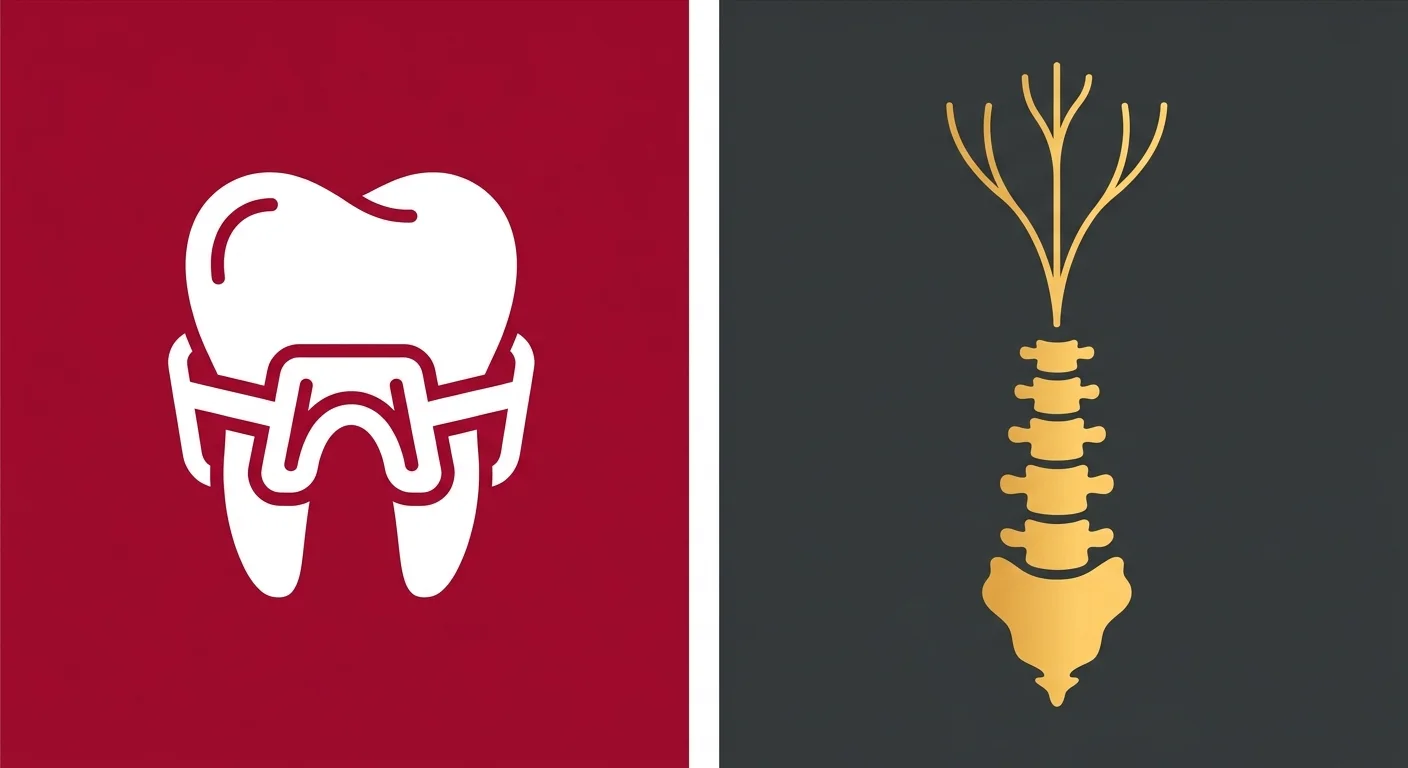
A dental splint and chiropractic care aren't competing for the same patient. They're built for different problems. The only question that matters: which problem do you actually have?
TMD affects over 10 million Americans — and most of them have been handed the same solution regardless of what's driving their symptoms. A splint. Not because a splint was the right call. Because it was the default call. Splints have a real role in care. The problem is they get deployed before anyone has determined whether the jaw is even the source.
That's why distinguishing a migraine from TMD from a cervicogenic headache has to happen before any treatment decision gets made. The right tool depends entirely on identifying the right source. What follows is where each approach fits — and where it doesn't.
When a Splint Is the Right Tool
A splint works when the primary driver is localized jaw mechanics — bruxism, disc displacement, measurable joint load from malocclusion. When the jaw itself is the problem, repositioning it reduces stress on inflamed tissue and gives it a window to recover. That's a real outcome. That's the tool doing exactly what it was designed to do.
The NIDCR is direct on this: conservative and reversible treatments are the clinically preferred standard for TMD. Irreversible interventions can permanently alter bite alignment without proven outcomes. A properly fitted, reversible splint clears that bar — when the jaw is the actual source.
But when C1, C2, and C3 are dysfunctional and loading the trigeminocervical nucleus, the splint isn't touching the source. It's managing the output of a system it was never designed to evaluate. That's not a criticism of splints. That's an accurate description of their scope.
When Chiropractic Care Is the Missing Piece
Chiropractic care is the missing piece when the upper cervical spine is the primary driver and the jaw is just where the patient feels it. That's the distinction the splint-only protocol never makes — because it never evaluates the cervical spine. The jaw isn't causing this. The neck is.
The research on spinal manipulative therapy for cervicogenic headaches is direct: 18 sessions over 6 weeks produced a 50% reduction in headache pain intensity. That's a finite intervention with a defined outcome. Not an open-ended retention plan. Not a number invented before the assessment is finished.
When chiropractic care is the right tool, the approach is conservative, reversible, and built from what the patient actually reports. It doesn't replace a well-fitted splint where one is clinically warranted. It fills the gap the splint was never built to close. Two tools. Different jobs. The real failure isn't the splint. It's that no one stopped to identify which job actually needed doing.
| Factor | Dental Splint | Chiropractic Care | Combined Approach |
|---|---|---|---|
| Primary Target | Jaw joint mechanics and bite positioning | Upper cervical spine (C1–C3) and trigeminocervical nervous system | Jaw mechanics and cervical root cause addressed simultaneously |
| What It Evaluates | Occlusion, disc displacement, and bruxism patterns | Spinal alignment, nerve function, and postural load on the cervical spine | Full neuromusculoskeletal picture — jaw and cervical spine assessed together |
| What It Leaves Unaddressed | Cervical spine dysfunction feeding pain into the jaw and head | Localized jaw mechanics when disc or occlusal pathology is the primary driver | Nothing left unaddressed — each gap fills the other |
| Appropriate When | Jaw is the confirmed primary pain source — bruxism, disc displacement, or malocclusion | Cervical spine is the confirmed primary driver of headache and referred jaw pain | Both jaw mechanics and cervical dysfunction are contributing to the clinical picture |
| Reversibility | Reversible when properly fitted and used as a conservative tool | Fully conservative and reversible — no structural alteration to bite or jaw | Both interventions remain conservative and reversible throughout |
| Reassessment Built In | Rarely — splint-only protocols tend to continue without defined progress benchmarks | Yes — clinical picture drives the plan; if results aren't measurable, the plan changes | Yes — combined plans include defined checkpoints for both jaw and cervical outcomes |
Frequently Asked Questions
Patients who've been through the splint cycle show up with specific questions. They deserve specific answers.
Here are the ones that come up most.
Why do dental splints often fail to resolve TMJ pain and headaches?
Splints are built for jaw mechanics — bruxism, disc displacement, localized joint loading. That's a legitimate clinical scope. But it's a limited one.
A splint doesn't evaluate the cervical spine. It doesn't reach the trigeminocervical nucleus. When headache and jaw pain originate from dysfunction at C1, C2, or C3, the splint is managing downstream output from a system it was never designed to touch.
That's not a failure of the splint. That's its boundary. The problem isn't the tool — it's that the wrong problem got handed to it.
How does a problem in the neck cause pain in the jaw and head at the same time?
The jaw and the upper cervical spine share a neurological relay — the trigeminocervical nucleus. Sensory input from C1, C2, and C3 converges at the same processing point as input from the trigeminal nerve, which serves the jaw, face, and head.
When those upper cervical segments aren't functioning right, the signal doesn't stay local. It feeds into that shared relay and surfaces as jaw tension, facial pain, and headache.
Cervicogenic headaches originate from exactly those segments — C1, C2, and C3 — and account for up to 22% of all chronic headache presentations. The neck isn't a bystander. It's the source.
What does chiropractic care for TMJ and cervicogenic headaches actually look like?
It starts with an assessment. Not a protocol, not a predetermined sequence, not a care plan handed over before the clinical picture exists.
What you actually report drives what gets evaluated — headache location, frequency, jaw function, postural history, what's been tried, what worked, what didn't. From there, care targets where the dysfunction is confirmed: the upper cervical spine, the neurological generator, not the symptom location.
Targeted manual therapy directed at temporomandibular joint structures produces an average improvement of 4.5 mm in maximal mouth opening. That's a measurable structural outcome — not a subjective comfort score.
When the clinical picture supports it, adjunct modalities like Cold Laser Therapy get integrated into a single unified plan. The plan has a defined reassessment point. It doesn't run indefinitely.
How many chiropractic sessions are typically needed to see TMJ or headache relief?
The research on spinal manipulative therapy for cervicogenic headaches is specific: 18 sessions over 6 weeks produced a 50% reduction in headache pain intensity. That's a finite, structured window — not an open-ended retention plan.
Individual clinical pictures vary. But if a provider can't tell you what measurable progress looks like at six weeks, they're not running a care plan — they're running a schedule.
If changes in headache frequency, jaw function, or pain intensity aren't showing up within a defined window, the plan changes. It doesn't extend. That's not a concession. That's the standard.
Can chiropractic care make TMJ symptoms worse?
A proper upper cervical assessment doesn't skip the clinical picture to jump straight to the adjustment. What you report determines what gets evaluated. What gets evaluated determines what gets treated.
When dysfunction at C1, C2, or C3 is confirmed as the primary driver, care targets the generator — not the symptom location. That's a different thing than running a fixed sequence on whoever walks through the door.
Patients who report worsening after chiropractic care are often the ones whose cervical dysfunction wasn't assessed before care started. Or whose provider ran the same protocol regardless of what the evaluation showed. That's the cookie-cutter protocol problem — and it's a provider failure, not a chiropractic failure.
Assessment-driven care, with honest reassessment checkpoints built in, doesn't work that way. If something isn't producing results, it changes. That's not optional. That's the standard.
The Clinical Pivot That Changes the Outcome
Here's what the splint never accounts for: the jaw doesn't operate in isolation.
It shares a neurological relay — the trigeminocervical nucleus — with the upper cervical spine. When C1, C2, and C3 are dysfunctional, that signal doesn't stay in the neck. It travels downstream. It shows up as jaw pain, facial tension, and headaches that no amount of bite repositioning will ever reach.
So the pivot is this: stop treating where it hurts and start treating what's driving it.
A splint addresses the output. Chiropractic care rooted in a real upper cervical evaluation addresses the generator. Patients who've cycled through years of splint adjustments and gotten two weeks of relief aren't failing treatment. They're receiving a treatment that was never designed to reach their actual problem.
At Touch of Wellness Chiropractic, the assessment determines which part of the system is running the pattern. The care plan follows that finding — not a fixed template, not a billing calendar, not whatever the last provider tried and gave up on.
The patients who recover are the ones whose providers looked at both.
Not the ones who stayed longest. Not the ones who committed to the most visits. The ones who got an honest evaluation of the full system — jaw mechanics and upper cervical function together — and built a care plan around what that evaluation actually found.
That's the difference between managing a pattern indefinitely and breaking it. The jaw doesn't cause this. The neck does. And if no one has evaluated the neck, the pattern isn't going to break.
The jaw isn't the problem. The neck is. And if no one has looked there, nothing is going to change. Touch of Wellness Chiropractic starts with what you actually report — not a fixed sequence, not a replay of what the last provider tried. If the upper cervical spine is driving your symptoms, the assessment will show it. If you're done waiting for a different result from the same approach, Book Appointment.
Copyright Touch of Wellness Chiropractic 2026
1101 W Jackson St, Suite A Morton, IL 61550
Web Design by iTech Valet