
(309) 321-8412 | 1101 W Jackson St, Suite A, Morton, IL 61550
(309) 321-8412 | 1101 W Jackson St, Suite A, Morton, IL 61550
How Veterinarians and AVCA Certified Chiropractors Collaborate on Non-Surgical Care
Animal chiropractic care and veterinary medicine are not two separate tracks running in parallel. They are one structured clinical handoff — a relay race, not a solo sprint.
The veterinarian goes first. Diagnosis, clinical assessment, referral. Under Illinois law, animal spinal manipulation must be performed under the direct referral or supervision of a licensed veterinarian. That is not a recommendation. It is the legal framework the entire collaboration operates inside.
The chiropractor does not enter the case until that handoff is complete.
Once the referral is in place, the AVCA-certified chiropractor brings a clinical specialty the veterinarian's training does not cover. AVCA certification requires a minimum of 210 hours of postgraduate training in spinal mechanics, neurological pathways, and safe force application across animal species. This is a credentialed specialty with documented clinical standards — not a wellness add-on.
The adjustment itself is precise. Biomechanical spinal work restricts mobilization forces within the normal physiological range of motion without exceeding the anatomical limit of the joint. Nothing is forced past the body's own boundaries. The target is restored movement at specific vertebral segments.
Complementary manual therapies in this model are legally framed as support mechanisms — not replacements for primary veterinary medicine. The veterinarian holds diagnostic authority throughout. The chiropractor addresses musculoskeletal and neurological dysfunction, then hands the baton back.
The outcomes are documented. Non-surgical spinal therapies contribute to measurable improvements in gait and movement in animals undergoing rehabilitation. Spinal manipulation produces measurable changes in pressure pain thresholds across multiple vertebral levels.
Neither practitioner replaces the other. The animal's recovery depends on both doing their part — in the right order, inside the right legal structure.
Last Updated: August 18, 2026
- • Why the Veterinary Referral Requirement Exists — and What It Actually Protects
- • How the AVCA Certification Standard Shapes the Chiropractor's Role
- • What the Collaboration Looks Like at Each Stage of Care
- • Who This Collaboration Is and Is Not Built For
-
• Frequently Asked Questions
- • Do veterinarians and animal chiropractors work together legally in Illinois?
- • Why is a veterinary referral required before an animal receives a chiropractic adjustment?
- • How does Dr. Karen Hannah's Zoology background influence animal chiropractic care at Touch of Wellness Chiropractic?
- • What is the difference between 'veterinary chiropractic' and an AVCA-certified animal chiropractor?
- • How do veterinarians and animal chiropractors divide diagnostic and treatment responsibilities?
- • The Relay Race Only Works When Both Runners Show Up
Why the Veterinary Referral Requirement Exists — and What It Actually Protects
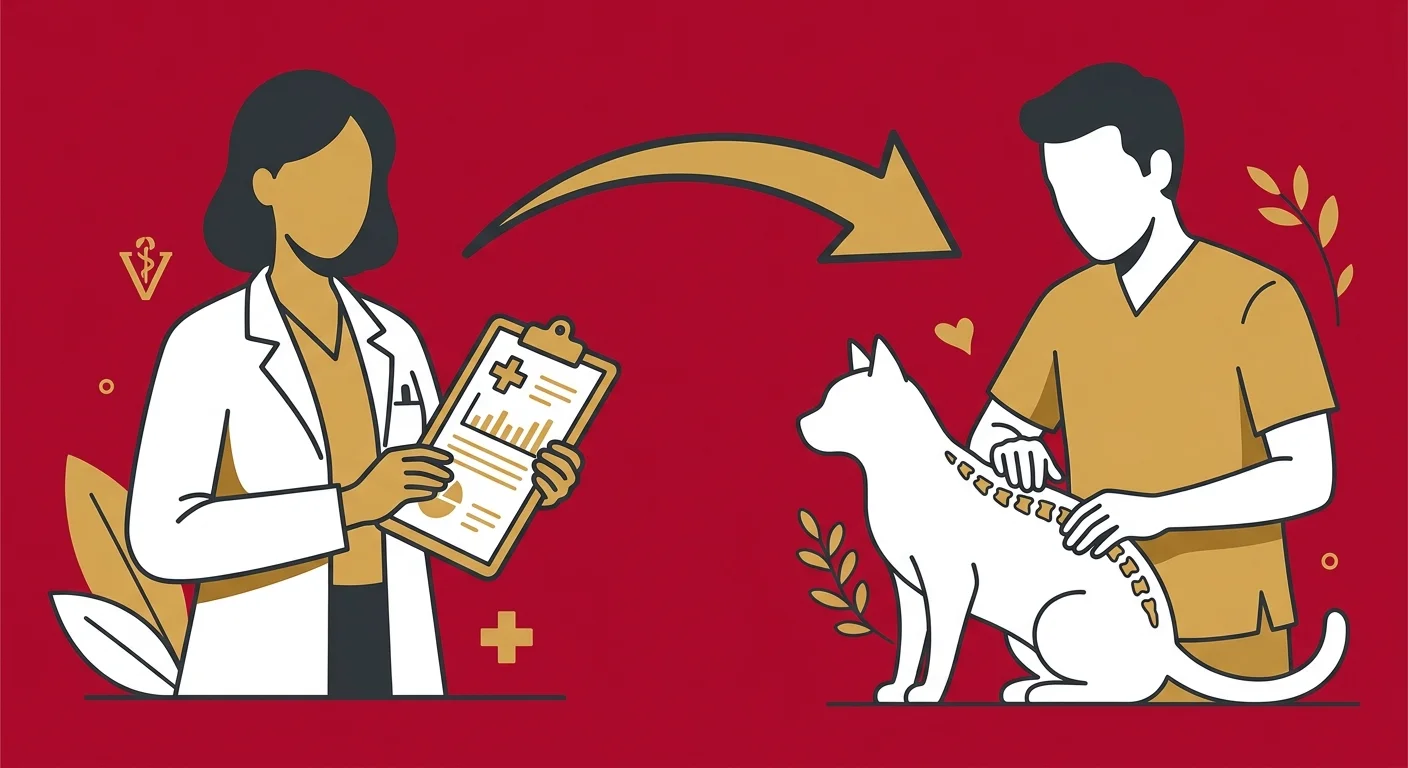
The veterinary referral requirement isn't red tape. It's the clinical and legal foundation the entire collaboration stands on.
Under Section 10 of the Illinois Veterinary Medicine and Surgery Practice Act, animal spinal manipulation must be performed under the direct referral or supervision of a licensed veterinarian. That referral is the legal trigger. Without it, the chiropractor has no authority to act — and the animal has no protection.
Spinal care isn't a wellness add-on you drop into a treatment menu. It's a clinical intervention that only makes sense inside a diagnostic picture — one the veterinarian already owns.
The Legal Architecture Behind the Partnership
Illinois law doesn't treat animal spinal manipulation as a wellness service a certified practitioner can offer on their own. The Illinois Veterinary Medicine and Surgery Practice Act makes this explicit — referral or supervision by a licensed veterinarian is the legal threshold. The published legislative record doesn't frame this as a coordination courtesy. Not a formality. The threshold.
What the law is protecting is the diagnostic chain. The veterinarian examines the animal first. Rules out the conditions that make spinal care dangerous — fractures, tumors, active infections. Confirms the referral is clinically appropriate before anyone's hands touch the spine.
Skip that step and spinal work gets applied to an unknown clinical picture. That's not complementary care. That's risk with no floor beneath it.
Once that floor is established, the certified chiropractor operates inside the veterinarian's diagnostic authority. NIH-indexed veterinary research confirms what the law already requires: complementary manual therapies are support mechanisms. They don't replace primary veterinary medicine. They work because the primary medicine is already in place.
That distinction is the legal architecture the whole partnership runs on.
Why Cookie-Cutter Animal Wellness Add-Ons Fail the Standard
The practices that fail this standard skip the referral step. They market animal chiropractic as a wellness service — available on request, no diagnostic workup, no veterinary sign-off.
That model doesn't bend the legal structure. It collapses it. No veterinary referral means no confirmed diagnosis. No ruling-out of contraindications. No supervising clinician accountable for what happens next.
What's left is a spinal adjustment applied to an animal nobody has clinically cleared. That's not a care model. That's an exposure.
Practitioner qualification is a separate question — and it matters too. Owners evaluating their options need to understand what AVCA certification actually requires — the training hours, the species-specific biomechanics, the credentialing exam.
But credential alone doesn't satisfy the referral requirement. Both must be present. One without the other isn't a partial solution. It's still a gap.
The veterinarian goes first. Always. An animal wellness add-on that skips that step isn't a streamlined path to care. It's a broken one.
| Requirement | Who It Applies To | Legal Basis | Clinical Purpose |
|---|---|---|---|
| Veterinary referral or supervision before spinal care begins | AVCA-certified animal chiropractors practicing in Illinois | Illinois Veterinary Medicine and Surgery Practice Act, Section 10 | Establishes that spinal manipulation is a medical act — not a standalone wellness service — and requires a licensed veterinarian to determine clinical appropriateness before any spinal work begins |
| Diagnostic ruling-out of contraindications | Veterinarian conducting the initial examination | Standard of veterinary clinical care; prerequisite to safe referral | Protects the animal from spinal intervention applied to undiagnosed pathologies — fractures, tumors, infections — that contraindicate manual therapy |
| Framing manual therapy as supportive care, not primary treatment | Certified animal chiropractors operating within the veterinary partnership | NIH-indexed veterinary medicine research on complementary care protocols | Keeps diagnostic authority with the veterinarian; the chiropractor addresses musculoskeletal and neurological dysfunction within a confirmed clinical picture, not independent of it |
| Ongoing veterinary oversight after chiropractic care is applied | Primary veterinarian responsible for the animal's long-term care | Collaborative care model consistent with Illinois licensing framework | Ensures the animal's response to spinal care is monitored by the clinician accountable for the full diagnostic picture — closing the relay race loop |
| AVCA certification as the minimum credentialing standard for the chiropractor's role | Any practitioner performing animal spinal manipulation | American Veterinary Chiropractic Association credentialing standards; species-specific postgraduate training requirement | Confirms that the practitioner entering the case has species-specific biomechanical training — a credential distinct from general chiropractic licensure and required for safe force application across animal anatomy |
How the AVCA Certification Standard Shapes the Chiropractor's Role
AVCA certification exists to draw a hard line. One side of that line is a qualified clinical practitioner. The other side is someone who isn't.
That line exists for a reason.
A certified animal chiropractor enters a case after the veterinarian has diagnosed and referred. That means working on a known clinical picture — a specific musculoskeletal or neurological target — inside a formal collaborative structure. The baton doesn't arrive until the first runner finishes their leg. That sequence isn't a formality. It's the architecture.
Owners and referring veterinarians confirm that readiness through credential verification — not by taking a practitioner's word for it.
Knowing how to verify AVCA credentials is the first quality check in this model. Before the collaboration begins, both parties in the referral chain need to know exactly who they're working with.
What 210 Hours of Postgraduate Training Actually Covers
AVCA certification requires a minimum of 210 hours of postgraduate training in animal chiropractic. That is not a continuing education add-on. It is a structured specialty curriculum built around the biomechanical demands of working across multiple animal species.
That coursework covers spinal mechanics specific to animal anatomy, neurological pathway mapping across species, and controlled force application to individual vertebral segments.
None of that transfers from human practice without dedicated retraining. A dog's spinal geometry is not a human's. A horse's weight distribution and muscle mass demand completely different clinical decisions. The 210-hour benchmark reflects that reality — and enforces it.
The training protects the animal. But it also protects the structure of the collaboration.
A practitioner who completes that curriculum arrives at the referral step ready to execute their role without the veterinarian managing every technical call. That independence is what makes the partnership functional. Each runner equipped to run their own leg — that's the whole model.
The Biomechanical Scope: What a Certified Animal Chiropractor Is and Is Not Authorized to Do
The certified animal chiropractor's scope is precise — and it doesn't flex.
Their authority is biomechanical: identify restricted motion segments, apply controlled forces to restore normal movement at specific vertebral levels, report outcomes back to the referring veterinarian. That's the lane. They run it well. They don't cross into the next one.
The adjustment stays inside strict mechanical limits. NIH-documented spinal research confirms that biomechanical spinal work restricts mobilization forces within the normal physiological range of motion — without exceeding the anatomical limit of the joint.
Nothing is forced past what the joint can safely accept. Forces are applied directly to individual vertebral segments: targeted, measured, and reversible.
What the certified animal chiropractor is not authorized to do is just as clear.
Diagnosis belongs to the veterinarian. Ruling out contraindications belongs to the veterinarian. Determining whether spinal care is appropriate for a given animal, on a given visit, belongs to the veterinarian.
The animal chiropractic specialty operates inside that diagnostic authority — never around it. That boundary is what keeps the relay race intact.
| Training Domain | What It Covers | Why It Matters in the Collaboration |
|---|---|---|
| Species-Specific Spinal Anatomy | Structural differences in vertebral geometry, muscle mass, and weight distribution across animal species — dogs, horses, and others each require distinct biomechanical approaches | Prevents a practitioner from applying human-calibrated techniques to animal physiology; ensures the referring veterinarian receives a competent second runner, not a generalist improvising |
| Neurological Pathway Mapping | How nerve roots, spinal cord segments, and peripheral pathways are organized across different animal species — and how dysfunction at one segment presents in each | Allows the certified chiropractor to identify the specific neurological targets the veterinarian's referral points to, and to report findings back in clinically meaningful terms |
| Controlled Force Application | Techniques for delivering precise mobilization forces to individual vertebral segments without exceeding the anatomical range of motion — species-calibrated, not force-generic | Keeps every adjustment within the legal and clinical boundaries the collaboration model depends on; protects the animal and protects the veterinarian's diagnostic authority |
| Contraindication Recognition | Identifying conditions — fractures, active infection, neoplasia, instability — that make spinal care inappropriate, and knowing when to halt and refer back immediately | Reinforces the veterinarian's first-leg diagnostic work; the certified chiropractor must recognize when the clinical picture has changed and the baton needs to go back before the second leg is complete |
| Scope-of-Practice Boundaries | The explicit legal and clinical lines between what a certified animal chiropractor is authorized to perform and what belongs exclusively to the supervising veterinarian | Keeps the relay race structurally intact; a practitioner who understands exactly where their authority ends is the only practitioner a referring veterinarian can trust with the handoff |
What the Collaboration Looks Like at Each Stage of Care
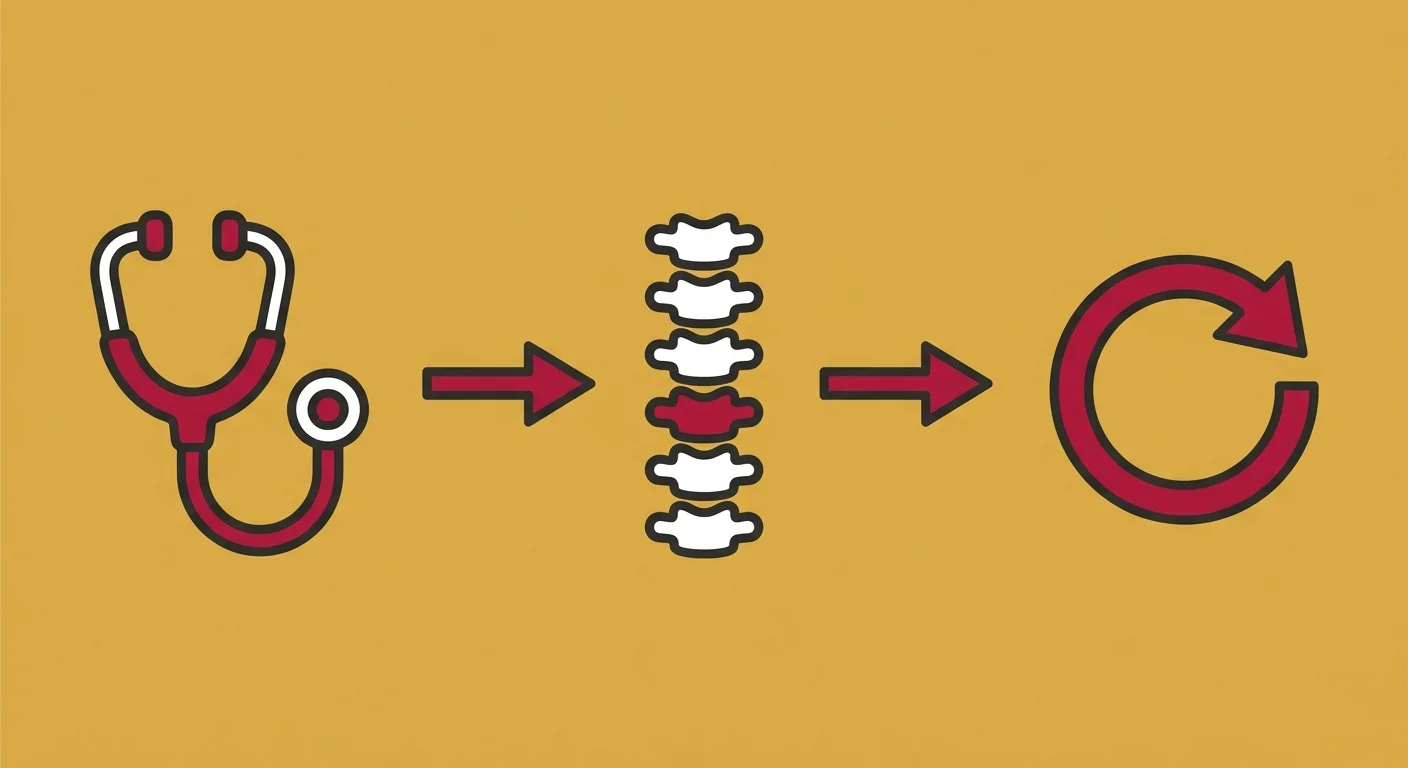
Credentials answer who belongs in the relay race. They don't show you how the race runs.
That's what the stages are for.
The vet and the AVCA-certified animal chiropractor don't just share a patient. They share a sequence. Each stage has one owner. Each handoff has one trigger. That structure is what makes the collaboration clinical instead of casual.
When every stage holds, the animal gets targeted spinal care inside a diagnostically sound framework. Skip a stage, and that foundation disappears. There's no version of that shortcut that doesn't cost the animal something.
Stage One: The Veterinary Diagnostic Assessment and Referral Decision
The veterinarian owns this stage entirely. No certified animal chiropractor enters the picture until the veterinarian has completed a full diagnostic evaluation: physical examination, neurological screening, imaging where indicated, and a ruling-out of every condition that would contraindicate spinal work.
That is not a courtesy step. It is the clinical foundation everything else builds on.
Fractures, spinal tumors, active infections, certain disc conditions — these require medical management. Apply spinal work to any one of them and you're not delivering complementary care. You're creating a clinical hazard.
The referral decision is the veterinarian separating those two outcomes. That's Stage One's entire job.
Under Section 10 of the Illinois Veterinary Medicine and Surgery Practice Act, animal spinal manipulation requires direct veterinary referral or supervision. That's not a technicality. It's both the legal trigger and the clinical one.
The baton doesn't move until the veterinarian confirms the animal is an appropriate candidate. No referral, no Stage Two. Full stop.
Stage Two: The Chiropractor's Biomechanical Evaluation and Adjustment Protocol
The AVCA-certified animal chiropractor begins with their own evaluation. Biomechanical assessment of motion restriction, vertebral segment function, and postural compensation patterns across the animal's spine.
This is not a repeat of the veterinary exam. It is a discipline-specific lens applied to the clinical picture the veterinarian has already established. Different expertise, same animal, same goal.
The adjustment follows directly from that assessment. Forces go to specific vertebral segments to restore normal movement range — targeted, measured, and kept within what the joint can safely accept.
Spinal manipulation produces measurable improvements in pressure pain thresholds across multiple vertebral levels. That's a documented outcome, not a theoretical one. The findings get recorded and passed back to the referring veterinarian.
Stage Two is where the credential gap becomes impossible to hide. A lay practitioner has no structured pathway for integrating their work into a veterinarian's diagnostic framework — and the safety and legal differences between certified and uncredentialed practitioners show exactly what that gap costs.
The AVCA-certified chiropractor arrives at Stage Two already inside the veterinarian's diagnostic authority. That integration is the whole point of this stage.
Stage Three: Ongoing Monitoring and Communication Between Both Providers
The baton passes back after every session. The AVCA-certified animal chiropractor reports to the referring veterinarian — what was addressed, what changed, what warrants watching.
Non-surgical spinal therapies produce measurable improvements in gait and movement during rehabilitation. Tracking those changes requires both providers watching the same animal from their own vantage points. One report. Two clinical perspectives. One animal moving forward.
That reporting loop is where the collaboration either holds or falls apart. A certified chiropractor who reports back keeps the veterinarian in the diagnostic seat. One who doesn't breaks the chain — and leaves the animal's outcome unmonitored between two providers who are no longer actually working together.
The model only works when the baton keeps moving in both directions. Every stage. Every session. Every time.
| Stage | Primary Responsibility | Provider Role | Clinical Output |
|---|---|---|---|
| Stage One: Veterinary Diagnosis & Referral | Veterinarian | Conducts full physical and neurological examination; rules out contraindications; issues formal referral authorizing spinal work | Clinically cleared referral confirming the animal is an appropriate candidate for chiropractic involvement |
| Stage Two: Biomechanical Assessment | AVCA-Certified Animal Chiropractor | Performs discipline-specific evaluation of motion restriction, vertebral segment function, and postural compensation patterns | Species-appropriate adjustment protocol targeting identified restricted segments within the established diagnostic framework |
| Stage Three: Adjustment & Documentation | AVCA-Certified Animal Chiropractor | Applies controlled forces to specific vertebral segments within safe physiological range; documents session findings and animal response | Session record capturing what was addressed, what changed, and any observations flagged for veterinary review |
| Stage Four: Progress Monitoring & Reporting | Both Providers (shared accountability) | Certified chiropractor reports back to the referring veterinarian after each session; veterinarian monitors overall clinical trajectory | Ongoing case communication confirming gait, pain response, and movement changes are being tracked by both providers |
| Stage Five: Care Plan Continuation or Discharge | Veterinarian (decision authority) | Evaluates cumulative progress against diagnostic baseline; determines whether spinal care continues, modifies, or concludes | Clinical decision grounded in combined input from veterinary monitoring and chiropractor session reports |
Who This Collaboration Is and Is Not Built For
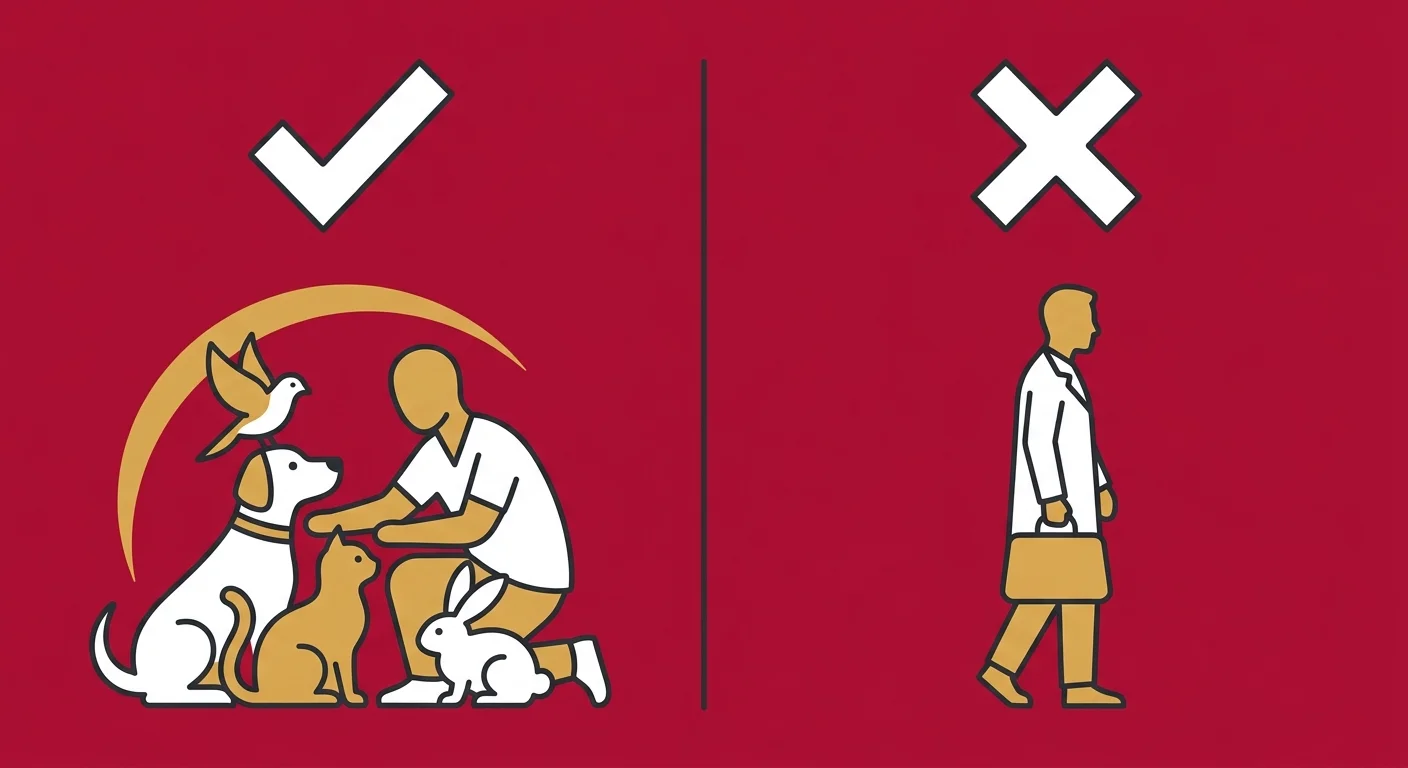
But knowing how it works doesn't mean it works for everyone.
Not every owner, not every animal, and not every presentation fits this model.
This structure has one entry point: a veterinary referral. That's not a formality — it's the thing that makes the collaboration legal and clinically sound.
Skip it, and there's no collaboration. There's just someone working on an animal's spine without knowing what's underneath.
Bad outcomes you can see are fixable. Unmonitored ones are not.
That's the real risk when the referral step disappears.
Animal Presentations That Fit the Collaborative Non-Surgical Model
Animals presenting with musculoskeletal restriction, postural compensation, reduced range of motion, or movement asymmetry — after a clear veterinary workup — are the core candidates.
These are cases where the veterinarian has ruled out contraindications and confirmed the underlying issue is biomechanical. Not pathological. Not infectious. Not surgical.
Dogs recovering from soft tissue injury or neurological episodes where surgery has been ruled out are a strong fit. Non-surgical spinal care produces measurable improvements in gait and kinetic movement parameters in canine subjects — but that outcome data exists because the intervention ran inside a monitored, multimodal framework.
The relay race was running correctly. That's what made the result possible.
Equine and performance animals with mobility restrictions are also within scope — once the referring veterinarian has cleared the case.
The biomechanical work stays within the normal physiological range of motion without exceeding the anatomical limit of any joint. That constraint matters specifically for working animals. Their structural integrity is not something you can afford to compromise mid-season.
Owners managing long-term arthritic conditions should also understand the risks that come with chronic pharmaceutical pain management before deciding spinal care is off the table.
What the Wrong Approach Looks Like — and Who It Harms
Here's what the wrong approach looks like in practice.
An owner skips the veterinary referral — either because they assume the chiropractor can assess the animal independently, or because they found a practitioner willing to work without one. Both assumptions are wrong. And both leave the animal exposed.
That's not a shortcut. It's a breakdown of the whole system.
Complementary manual therapies are legally framed as support mechanisms — not replacements for primary veterinary medicine. That framing reflects clinical reality, not bureaucratic caution.
A chiropractor working without a veterinary diagnosis is applying biomechanical forces to a case they cannot fully see.
And then there's the owner who wants a pharmaceutical-free protocol and bypasses veterinary oversight entirely because they distrust conventional medicine. That's also the wrong fit.
This collaboration does not exist to circumvent diagnosis. It exists to act on it.
An owner unwilling to engage the veterinary side of this is asking the second runner to cover the whole course alone. That is not what this model does.
When the wrong approach runs, the animal pays for it. Every time.
The difference between a credentialed practitioner operating inside the legal framework and someone working outside it is exactly what the lay practitioners safety and legal differences resource covers.
The relay race only holds when both runners are qualified, both are present, and the baton moves the right direction.
| Presentation Type | Collaborative Care Appropriate | Veterinary-Only Required | Notes for Animal Owners |
|---|---|---|---|
| Musculoskeletal restriction or postural compensation after full veterinary workup | Yes — veterinary referral in place, contraindications ruled out | No — provided the veterinarian has cleared the case for spinal work | This is the core candidate. The veterinarian has already established the diagnostic picture; the certified chiropractor applies biomechanical expertise to what is already known. |
| Canine spinal rehabilitation — soft tissue injury or post-neurological episode where surgery is ruled out | Yes — multimodal rehab framework with active veterinary monitoring | No — surgical option already evaluated and excluded by the veterinarian | Gait and kinetic movement improvements are documented in monitored, collaborative frameworks. The relay race must stay intact throughout recovery. |
| Equine or performance animal with mobility restriction, veterinary clearance confirmed | Yes — biomechanical work stays within safe joint range under AVCA-certified protocols | No — provided the referring veterinarian has cleared structural integrity and ruled out contraindications | Working animals require preserved structural integrity. This is appropriate only when the veterinarian has confirmed the case is biomechanical, not pathological. |
| Animal presenting with undiagnosed lameness, neurological signs, or suspected fracture | No — spinal work is contraindicated until the veterinarian completes diagnosis | Yes — veterinary diagnostic evaluation must happen first, period | Applying biomechanical forces to an undiagnosed case removes the clinical floor entirely. No referral means no collaboration — it means an unmonitored intervention. |
| Owner seeking to bypass veterinary diagnosis in favor of a pharmaceutical-free protocol | No — this model does not exist to circumvent diagnosis; it exists to act on it | Yes — the veterinary diagnostic step is non-negotiable regardless of the owner's treatment preferences | An owner unwilling to complete the veterinary side of the relay race is asking the second runner to go it alone. The structure is not built for that — and the animal carries the risk. |
| Animal with active infection, spinal tumor, or condition requiring medical management | No — these presentations are medical contraindications to spinal work | Yes — primary veterinary management is required before any complementary care is considered | The veterinarian's ruling-out step exists precisely for cases like this. A contraindication missed at the referral stage becomes a harm delivered at the adjustment stage. |
Frequently Asked Questions
Good. Ask them.
What does Illinois law actually require? Why does the referral matter before anyone touches the spine? And what does a Zoology background change at the biomechanical level — practically, not on paper?
These aren't hypotheticals. They're what owners ask before they hand their animal to a two-provider structure they've never seen before.
Do veterinarians and animal chiropractors work together legally in Illinois?
Yes — and the legal structure is specific.
Under Section 10 of the Illinois Veterinary Medicine and Surgery Practice Act, animal spinal manipulation must be performed under the direct referral or supervision of a licensed veterinarian. That is not a recommendation. It is the law.
The chiropractor cannot initiate care without that referral. In Illinois, the clinical framework and the legal framework are the same framework. They run together — and neither one is optional.
Why is a veterinary referral required before an animal receives a chiropractic adjustment?
Because the veterinarian is the only one legally and clinically equipped to rule out what makes spinal work dangerous.
Fractures. Spinal tumors. Active infections. Disc conditions that need surgery, not an adjustment. Those are hard contraindications — and identifying them is not the chiropractor's role. The referral is the clearance that says none of those conditions are present. Without it, there is no safe intervention.
A certified animal chiropractor brings biomechanical expertise to a case the veterinarian has already assessed. The referral is what separates a sound intervention from a hazardous one. That line is not flexible.
How does Dr. Karen Hannah's Zoology background influence animal chiropractic care at Touch of Wellness Chiropractic?
Here's the thing — animal chiropractic is not human chiropractic applied to a different body. The anatomy differs. The biomechanics differ. The movement patterns differ across species in ways a human clinical model doesn't account for.
Dr. Hannah's undergraduate training in Zoology — the study of whole-body biological systems across species — gives her a structural perspective most practitioners in this space don't have. She approaches each animal's spine as part of an integrated biological system, not as a scaled version of a human case.
At Touch of Wellness Chiropractic, that systems-level analysis is the foundation every animal assessment is built on.
What is the difference between 'veterinary chiropractic' and an AVCA-certified animal chiropractor?
The term 'veterinary chiropractic' implies the practitioner is a veterinarian doing chiropractic work. That is not what an AVCA-certified animal chiropractor is — and the distinction matters.
Dr. Hannah is a Doctor of Chiropractic. A human practitioner who completed a minimum of 210 hours of postgraduate training in animal chiropractic and passed the AVCA certification exam. The credential is a chiropractic credential, not a veterinary one.
Using 'veterinary chiropractic' misclassifies both the training pathway and the scope of practice. The correct term is animal chiropractic — performed by a certified practitioner who works alongside a veterinarian, not in place of one.
How do veterinarians and animal chiropractors divide diagnostic and treatment responsibilities?
The division is clear — and it is not negotiable.
The veterinarian owns the diagnostic function: imaging, physical examination, neurological screening, and the determination of whether spinal work is appropriate. That's the first leg. The referral is the handoff.
The AVCA-certified animal chiropractor then runs the second leg — biomechanical assessment, motion restriction analysis, vertebral segment function, postural compensation — and applies targeted spinal work within the joint's normal physiological range. Not beyond it.
After each session, the baton passes back. The chiropractor reports findings to the referring veterinarian. The veterinarian monitors the clinical picture. Diagnosis, referral, adjustment, report. That is the relay race — and both runners have to show up for it to hold.
The Relay Race Only Works When Both Runners Show Up
Here's what the two-runner model actually builds.
The veterinarian diagnoses, refers, and monitors. The AVCA-certified animal chiropractor assesses the biomechanics, adjusts, and reports back. Neither one produces this alone. Together, they produce targeted spinal care inside a diagnostically sound framework — with someone watching the clinical picture from both ends.
That's the whole model. And when it runs correctly, the animal is the one who benefits.
Drop one runner and the race breaks.
A veterinarian who refers without follow-up monitoring leaves the chiropractor working blind — no clinical checkpoint, no second set of eyes on what's changing. A chiropractor who operates without a referral is applying biomechanical force to a case they cannot fully see. No diagnosis behind them. No supervising clinician accountable for what comes next.
The animal doesn't benefit from either version of that breakdown. It absorbs the cost of it.
Dr. Karen Hannah holds this line every time the model comes up: animal chiropractic is not a standalone service, and it was never designed to be. It is the second leg of a relay race that starts with a veterinarian and ends with a monitored outcome.
Touch of Wellness Chiropractic runs that second leg — inside the legal framework, inside the diagnostic structure, and only when the baton has been properly passed.
A relay race, not a solo sprint. If the first leg hasn't been run, the second leg doesn't start here.
Your vet has already done the diagnostic work. The referral exists. The next step is the adjustment — and that's where schedule an animal chiropractic assessment with Dr. Karen Hannah comes in. She runs the second leg. Not the first. Not both.
Copyright Touch of Wellness Chiropractic 2026
1101 W Jackson St, Suite A Morton, IL 61550
Web Design by iTech Valet