
(309) 321-8412 | 1101 W Jackson St, Suite A, Morton, IL 61550
(309) 321-8412 | 1101 W Jackson St, Suite A, Morton, IL 61550
The Hidden Risks of Long-Term NSAID Use for Arthritic Dogs and Cats
Long-term NSAIDs don't just manage arthritis pain — they trade short-term comfort for long-term organ cost.
The FDA documents that adverse drug experiences associated with veterinary NSAIDs commonly include vomiting, diarrhea, depression, and kidney or liver failure. These aren't rare reactions. They're the most frequently reported outcomes on record.
For dogs, extended NSAID therapy can produce clinically significant elevations in liver enzymes. Veterinarians require baseline and periodic blood panels throughout treatment. The monitoring exists because the damage accumulates quietly.
Cats face a sharper risk. They lack the liver enzymes required to metabolize certain pain medications, which makes some formulations — including many human NSAIDs — rapidly toxic. Research estimates that 60–90% of cats are affected by osteoarthritis, meaning a large portion of the feline population faces a pain management problem that cannot be safely addressed without careful, ongoing renal monitoring.
The FDA requires manufacturers to include a Client Information Sheet with every NSAID prescription — specifically to disclose the potential for life-threatening side effects. Most owners file it away. The side effects accumulate anyway.
NSAIDs don't fix anything structural. They reduce inflammation and suppress pain signals. They don't arrest joint degeneration or resolve the biomechanical restrictions driving it. A pet moves more comfortably for a period while the underlying problem keeps advancing.
That's the trade-off rarely named at the first prescription — short-term comfort, long-term cost, with no structural progress made. For owners weighing long-term options, understanding what NSAIDs do and what they don't do is where any honest conversation about joint health has to start.
Last Updated: August 18, 2026
- • What NSAIDs Actually Do — And What They Don't
- • The Organ Toll — Where Long-Term NSAID Use Does Its Damage
- • Why Cats Face a Uniquely High NSAID Risk
- • What Monitoring Protocols Reveal About NSAID Dependency
- • Addressing the Structural Problem NSAIDs Leave Untouched
-
• Frequently Asked Questions About NSAID Risks in Dogs and Cats
- • What are the long-term side effects of NSAIDs in dogs and cats?
- • How does animal chiropractic help manage arthritis in pets without drugs?
- • Can cats take canine NSAIDs safely?
- • What are the warning signs of NSAID toxicity in dogs?
- • How often should a pet on long-term NSAIDs have bloodwork done?
- • The Quiet Trade-Off You Didn't Know You Were Making
What NSAIDs Actually Do — And What They Don't
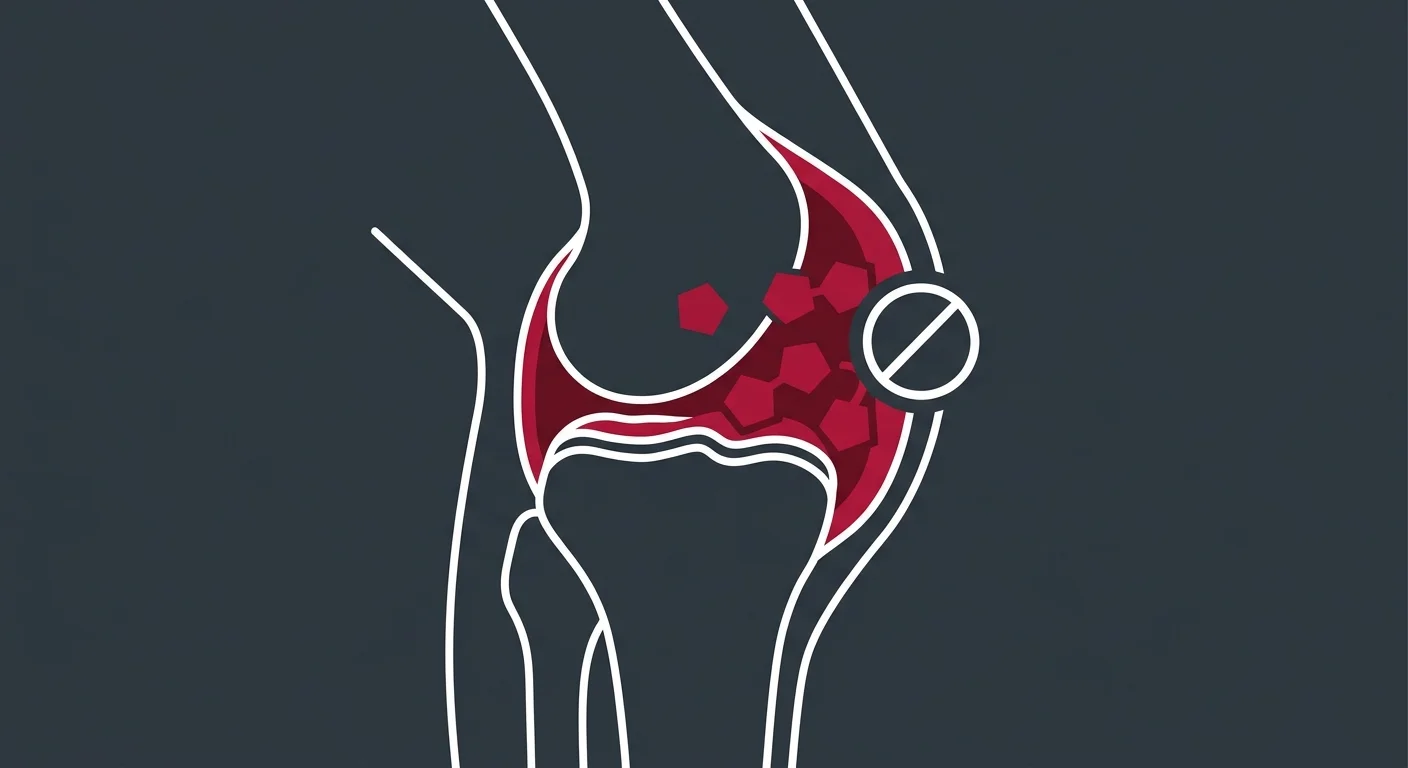
NSAIDs block two enzymes — COX-1 and COX-2 — that produce the chemical messengers behind inflammation and pain. Suppress those messengers, the pain signal goes quiet. Short term, that works. Nobody's arguing otherwise.
But that's the ceiling. The FDA documents that adverse drug experiences reported for veterinary NSAIDs commonly include vomiting, diarrhea, depression, and kidney or liver failure — not as rare outliers, but as the most frequently logged reactions on record. The drug does exactly what it's designed to do. The organ cost is part of the package.
That's the trade nobody names at the prescription counter. Every dose buys a few hours of muffled pain signal. It spends hepatic and renal reserve your pet cannot get back.
How NSAIDs Work in the Body
Here's the thing about prostaglandins: they don't just carry pain signals. They protect the gastrointestinal lining, regulate blood flow to the kidneys, and support normal platelet function. When NSAIDs suppress COX enzymes broadly, they don't simply turn the pain down. They strip the protective layer off organs that depend on those exact same chemical pathways.
That's why the risk profile for veterinary NSAIDs includes gastrointestinal ulcers, perforation, and renal failure. The pathways being blocked for pain relief are the ones keeping those systems running.
For a pet on long-term therapy, this isn't theoretical. It's cumulative. Aging kidneys don't process each dose in isolation — they absorb it on top of every dose that came before. That's when the question owners need to ask changes. It stops being 'is this safe today?' and starts being 'what is this costing the body over a year, or three?' Whether AVCA-certified animal chiropractic belongs in that conversation is worth examining — not as a replacement for every clinical tool, but as a structurally different answer to the same underlying problem.
What NSAIDs Cannot Do
Here's what NSAIDs don't do: they don't touch the structural problem. Pain quiets. Inflammation drops. Joint degeneration keeps advancing. The owner just stops hearing the signal.
A pet moving more comfortably on NSAIDs isn't a pet whose joints are healing. The compensatory loading patterns, the reduced range of motion, the spinal misalignment compounding joint stress — none of that responds to a COX inhibitor. That's exactly where the chiropractic care conversation belongs. Those restrictions need a structural answer, not a chemical one.
So the calculus over a lifetime of arthritis management looks like this: mounting organ cost on one side, zero structural progress on the other. That's not an argument against NSAIDs. It's an argument for honesty about what you're actually managing — and what's being left untouched.
| NSAID Action | Target Mechanism | What It Addresses | What It Leaves Untouched |
|---|---|---|---|
| COX enzyme inhibition | Blocks prostaglandin production at the source | Reduces inflammation and temporarily quiets pain signals | Underlying joint degeneration, biomechanical restrictions, compensatory loading patterns |
| Pain signal suppression | Interrupts the chemical pathway that transmits pain to the brain | Short-term comfort and improved observable mobility | Structural wear progression, spinal misalignment, reduced range of motion |
| Anti-inflammatory effect | Lowers inflammatory response in and around affected joints | Decreased swelling, localized heat, and associated soft tissue irritation | Root cause of joint stress — the biomechanical imbalance driving accelerated degeneration |
| Systemic circulation | Drug distributes through bloodstream to reach target tissues | Broad reach across multiple affected joints simultaneously | Organ reserve — hepatic and renal function are taxed as part of the same pathway |
| Prostaglandin suppression (broad) | Reduces both pain-transmitting and protective prostaglandins | Symptom relief measurable within hours of dosing | GI lining integrity, renal blood flow regulation, normal platelet support — all dependent on the same suppressed pathway |
The Organ Toll — Where Long-Term NSAID Use Does Its Damage
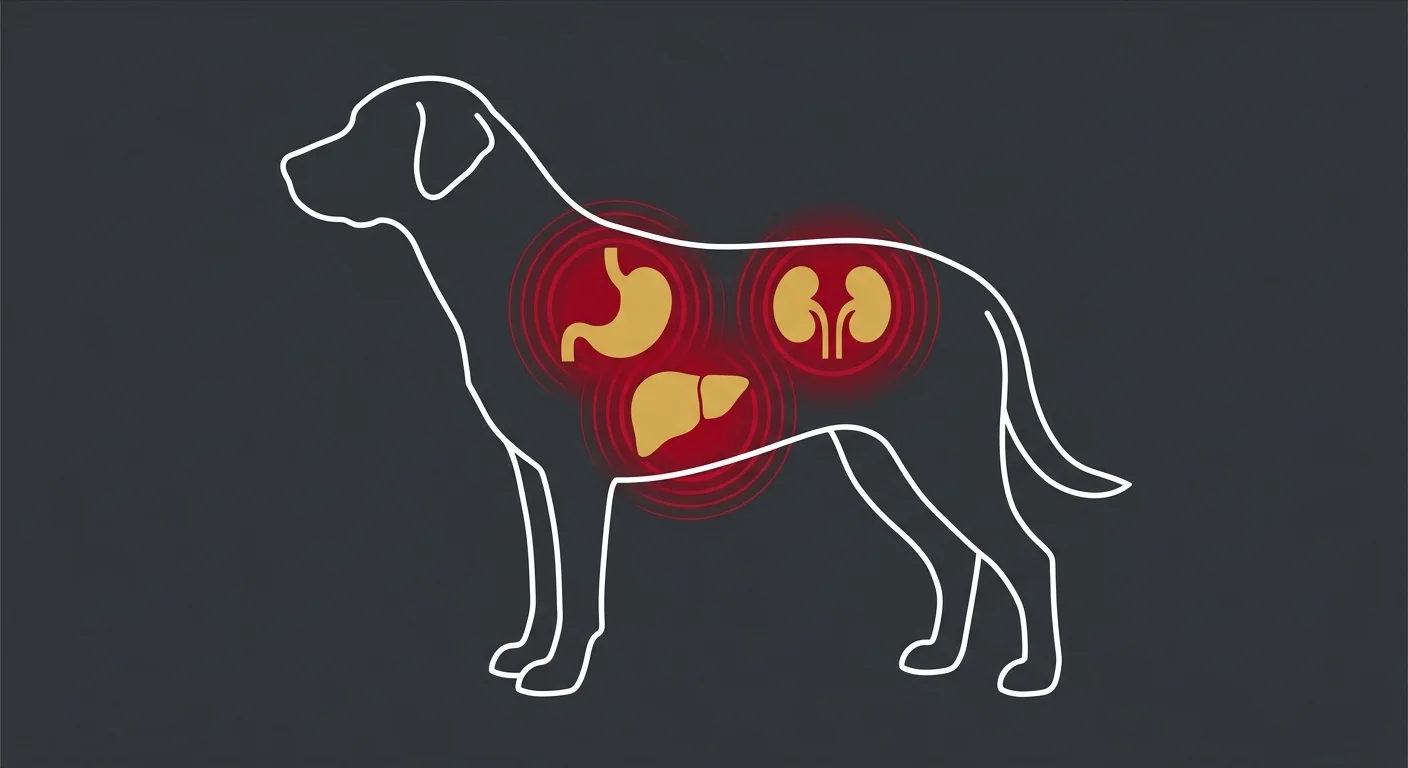
Here's what matters: not how NSAIDs work, but where the damage shows up. For pets on long-term therapy, it shows up in the organs keeping them alive.
Every dose is short-term comfort, long-term cost. That cost doesn't show up on a walk around the yard. It shows up on a blood panel months later. Or it doesn't show up until it's a crisis.
Gastrointestinal Damage: The First System to Feel It
The GI system is usually first to feel it. NSAIDs suppress COX-1 — the enzyme that maintains the protective mucus lining of the stomach and intestines. Pull that protection away long enough and the tissue underneath starts to erode. That's not a side effect. It's a predictable consequence of how the drug works.
The FDA warning labels on every veterinary NSAID prescription exist because of this exact mechanism. Gastrointestinal ulcers and perforation aren't listed as rare complications — they're among the most frequently documented adverse effects on record. That's not a theoretical risk. That's the most common way these drugs cause serious harm.
Most owners watching an arthritic dog are tracking gait changes and stiffness. Vomiting and diarrhea don't register as medication signals — but those are the body's clearest early warnings that the GI lining is under pressure. And it compounds: a dog already compensating for pain through altered movement — the kind of postural shifts that let you recognize canine spinal misalignment before the problem deepens — can mask GI distress the same way it masks joint pain. Two systems suffering. One visible.
Kidney and Liver: The Silent Organ Risks
Kidneys and liver take longer to show the strain — and that's what makes them more dangerous to miss. Prostaglandins regulate blood flow to the kidneys. When NSAIDs suppress those pathways, renal perfusion drops. The kidneys work against reduced support with every dose. And every dose before that one already counted.
Renal failure is among the most serious adverse events the FDA has documented for veterinary NSAIDs. For aging pets whose kidney function is already declining — which describes most of the arthritic population — the margin for error gets thinner with every passing year on the drug.
The liver carries a parallel burden. Long-term NSAID use can produce clinically significant elevations in liver enzymes — which is why baseline bloodwork and periodic monitoring aren't optional extras. They're the only early warning system the protocol has. The FDA requires that every NSAID prescription include a Client Information Sheet disclosing these life-threatening risks. Most pet owners receive it. Far fewer understand that the monitoring requirement exists because the organ damage is real, cumulative, and not always reversible.
| Organ System | Documented Adverse Event | How It Presents | Monitoring Required |
|---|---|---|---|
| Gastrointestinal System | Ulcers and perforation of stomach and intestinal lining | Vomiting, diarrhea, loss of appetite, dark or tarry stools | Clinical exam at every visit; discontinue at first GI symptoms |
| Kidneys (Renal System) | Renal failure from reduced prostaglandin-mediated blood flow | Increased thirst and urination, lethargy, decreased appetite | Baseline urinalysis and bloodwork; periodic renal panels throughout therapy |
| Liver (Hepatic System) | Clinically significant elevations in liver enzymes from long-term NSAID administration | Often asymptomatic until advanced; may present as jaundice or lethargy | Baseline blood panel before starting therapy; periodic liver enzyme monitoring throughout |
| Systemic (All Organs) | Life-threatening side effects requiring mandatory owner disclosure | Variable by organ system — GI distress, renal symptoms, or hepatic signs | FDA-mandated Client Information Sheet provided with every NSAID prescription |
Why Cats Face a Uniquely High NSAID Risk

Cats aren't smaller dogs. That distinction isn't about dose — it's about biology. And the biology here is categorically different from the start.
The danger isn't owner error. It isn't a wrong prescription. It's a metabolic deficiency built into feline biology — one that makes the standard pharmaceutical approach far more dangerous than most owners realize when they walk out of the clinic with a bottle.
The Species Difference That Changes Everything
Cats lack the liver enzymes needed to break down certain pain medications. Specifically, they don't produce adequate glucuronyl transferase — the enzyme the liver uses to metabolize and clear NSAIDs safely. Without it, the drug doesn't clear. It builds up.
The FDA cautions that this enzyme deficiency makes human NSAIDs rapidly toxic in cats — and even some veterinary formulations carry an elevated risk compared to what the same compound does in a dog. The margin between a therapeutic dose and a dangerous one is narrower in cats than in almost any other companion animal. That's not a footnote buried in the package insert. That's the clinical reality owners are rarely handed in plain language.
This isn't fine print. It's a biological fact that rewrites the entire risk-benefit calculation for long-term pain management in cats. When a cat is on chronic NSAID therapy for arthritis, the monitoring requirement isn't extra caution — it's structural necessity. The organ cost accumulates whether the cat appears comfortable or not. That's exactly why identifying what's actually driving the pain — through a systematic process like a canine chiropractic exam — matters before committing to a long-term pharmaceutical protocol.
Feline Arthritis Prevalence and the Pain Management Bind
Here's the bind. Cats need pain management, but they can't safely tolerate many of the options that work for dogs. NIH research documents that up to 60–90% of cats are affected by osteoarthritis — making feline joint disease one of the most prevalent chronic conditions in companion animal care, and one of the most underdiagnosed. A significant portion of the feline population is living with a pain problem that's hard to treat safely and harder still to catch early.
Cats are stoic. They don't limp the way dogs do. They stop jumping. They groom less. They pull back from activity quietly — and most owners read those changes as aging, not pain. By the time arthritis is caught and a pharmaceutical protocol is started, the disease has often been progressing silently for a long time.
So the feline pain management problem stacks three layers at once: widespread joint disease, biological vulnerability to the primary drugs used to treat it, and a pain presentation that makes late diagnosis the norm. Long-term NSAIDs can deliver real short-term comfort — but for cats, that comfort comes with a renal and hepatic cost that adds up with every dose, in a species already less equipped to absorb it. That's not an argument against pharmaceutical support. It's an argument for honesty about what it costs — and what it doesn't fix.
| Species | Metabolic Factor | NSAID Risk Level | Primary Risk Organ | Safe Human NSAIDs? |
|---|---|---|---|---|
| Cat | Deficient in glucuronyl transferase — cannot metabolize NSAIDs through normal hepatic clearance pathways | High — narrow margin between therapeutic and toxic dose | Liver and kidneys | No — rapidly toxic |
| Cat | Up to 60–90% prevalence of osteoarthritis compounds long-term pharmaceutical demand on already-vulnerable organs | High — chronic use accelerates renal and hepatic accumulation risk | Kidneys (CKD risk) | No |
What Monitoring Protocols Reveal About NSAID Dependency

Those monitoring requirements aren't there because drug companies are being careful. They're there because the organ damage is real, documented, and predictable enough that the FDA built a mandatory disclosure system around it.
Here's what that monitoring protocol is actually saying: the drug your pet is on requires periodic bloodwork because the harm it can cause isn't always visible until it's already advanced. That's not fine print. That's the admission built into every NSAID prescription your veterinarian hands you.
What the FDA Requires — And Why That Matters
The FDA requires manufacturers to include a Client Information Sheet with every veterinary NSAID prescription. That sheet warns owners about life-threatening side effects — not inconvenient ones. Not "may cause drowsiness." Life-threatening. The regulatory bar sits that high because the documented risk earned it.
This isn't a dog-specific problem. The same dynamic shows up in equine medicine — where pain suppression quietly masks spinal misalignment and joint dysfunction rather than resolving it. A dog moving more comfortably on a COX inhibitor is in the same position: the gait improves, the structural cause doesn't move an inch, and the underlying degeneration keeps advancing.
That mandate isn't optional paperwork. It's the FDA saying, in regulatory language, that hepatic and renal risks from long-term use are serious enough that owners need to know before the prescription is filled. Most pet owners receive the sheet. Most read it the way they read terms of service — quickly, if at all. And most don't understand what the monitoring schedule is actually watching for until something shows up in a blood panel.
Reading Bloodwork: What Changes to Watch For
Baseline bloodwork before starting an NSAID protocol isn't a formality. It's a reference point — and without it, there's no way to know what the drug is doing to the organ. You can't measure change from a starting point you never recorded.
Periodic panels after that aren't routine checkups. They're the early warning system the entire protocol depends on. Hepatic and renal changes accumulate before they become symptomatic — which means a pet that appears comfortable and mobile on NSAIDs can be developing measurable organ stress that won't show up on a walk around the yard. It shows up in a blood panel, if you're doing them consistently.
Here's the trade-off, paid out in full: the owner sees a dog moving better and reads that as success. The bloodwork, if it's being done consistently, tells a different story — one where organ cost is compounding in the background while the structural source of the pain hasn't moved an inch. A canine chiropractic exam addresses what pharmaceutical protocols can't: the biomechanical origin the drug was never designed to reach. Monitoring doesn't fix that. It just makes the cost visible before it becomes irreversible.
| Monitoring Interval | Test Required | What It Detects | What a Flagged Result Means |
|---|---|---|---|
| Before starting NSAIDs | Baseline blood panel — kidney and liver values | Establishes pre-treatment organ function as a reference point | No action needed — this is the baseline; any future change is measured against it |
| Within the first 1–2 months of use | Follow-up chemistry panel | Early hepatic or renal stress that may not yet produce visible symptoms | Dose adjustment, protocol reassessment, or discontinuation depending on the degree of change from baseline |
| Every few months during ongoing use | Periodic full chemistry panel | Cumulative organ changes developing silently over the course of long-term therapy | Escalating concern — the longer the change goes undetected, the less reversible it becomes |
| Any time GI symptoms appear | Veterinary evaluation — bloodwork and physical exam | Active gastrointestinal distress signaling that the GI lining or organ function is under pressure | Immediate clinical review; symptoms are the body's earliest visible signal that the drug cost is outpacing the benefit |
| Any time the pet appears less comfortable despite current dosing | Full diagnostic evaluation including structural assessment | Whether pain is returning because the organ load is shifting dosing tolerance — or because the underlying structural cause was never addressed | Prompt reassessment of the entire pain management approach, not just the pharmaceutical dose |
Addressing the Structural Problem NSAIDs Leave Untouched
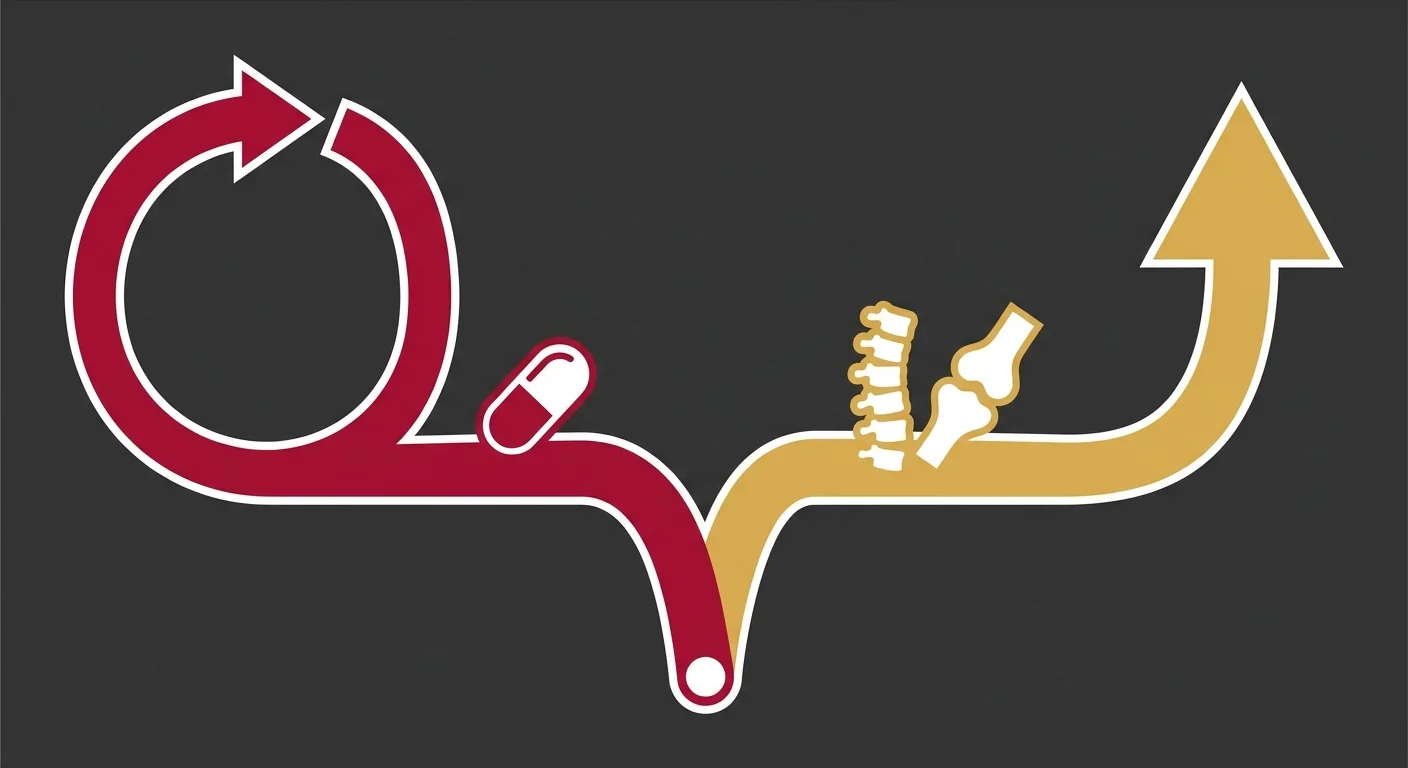
NSAIDs don't fix joints. That's the fact the prescription counter skips.
Research confirms NSAIDs reduce pain and inflammation. They do not stop joint degeneration from advancing. The biomechanical restriction doing the actual damage — the misalignment shifting load, changing gait, accelerating wear — keeps moving forward while the pet moves more comfortably on the drug.
The drug quiets the signal. It doesn't touch what's generating it.
And the longer the protocol runs, the wider that gap gets. Every month without a structural assessment is another month the biomechanical cause advances — unaddressed — while the organ cost of the pharmaceutical builds in parallel.
Two problems compounding. Neither one being solved.
Who Should Not Be on Long-Term NSAIDs Without Structural Assessment
Here's the thing: that framing isn't for every owner. Worth saying plainly.
If you're looking for a provider who'll validate a pharmaceutical-only protocol without asking what's structurally driving the pain, this isn't that. If you want the prescription renewed without a conversation about what the bloodwork is showing — or whether the joint restriction has ever been evaluated — that's the wrong expectation to bring here.
The assessment drives the recommendation. Not the other way around.
The pets who benefit most from adding structural care aren't the ones avoiding pharmaceuticals. They're the ones already on long-term NSAIDs — where the drug is managing symptoms while the underlying degeneration keeps moving.
Those are the cases where a structural evaluation isn't optional. It's the part of the care plan that's been missing all along.
What Animal Chiropractic Targets That Pharmaceuticals Cannot
Animal chiropractic targets what pharmaceuticals can't reach: the biomechanical misalignment driving uneven joint loading, compensatory movement patterns, and progressive structural breakdown.
When a joint is misaligned, surrounding tissue compensates. Gait shifts. Load transfers to adjacent structures. The animal moves — sometimes reasonably well on an NSAID — while the restriction underneath keeps generating the wear pattern that caused the pain to begin with.
That's the structural level animal chiropractic works at: restoring mobility to restricted joints, reducing compensatory loading, addressing the biomechanical driver instead of muffling its output.
That's the difference between treating the signal and treating the source. NSAIDs are a chemistry intervention on a structural problem. They have a role — especially in acute pain — but for a pet managing chronic arthritis, long-term pharmaceutical use without a structural assessment means the organ cost keeps rising while the underlying cause keeps advancing.
Short-term comfort, long-term cost. The monitoring bloodwork tracks the price. A structural approach is what changes it.
| Approach | Target | Addresses Inflammation | Addresses Joint Restriction | Organ Risk | Requires Monitoring |
|---|---|---|---|---|---|
| Veterinary NSAID (long-term) | Inflammatory pathway — blocks COX enzymes to reduce pain signaling | Yes — reduces pain and swelling | No — joint restriction continues unchanged | Gastrointestinal, hepatic, and renal accumulation with ongoing use | Yes — baseline and periodic bloodwork required |
| Animal Chiropractic | Biomechanical structure — restores mobility to restricted joints and reduces compensatory loading | Indirectly — removing restriction reduces inflammation driven by abnormal joint stress | Yes — directly addresses the misalignment generating uneven load and progressive wear | None associated with the adjustment itself | No organ monitoring required |
| Combined Protocol (NSAID + Structural Care) | Both the inflammatory signal and the structural source driving it | Yes — pharmaceutical component manages acute and chronic inflammation | Yes — structural component addresses the restriction the NSAID cannot reach | Reduced over time as structural correction may lower pharmaceutical dependency | Yes — ongoing bloodwork appropriate while NSAID remains part of the protocol |
Frequently Asked Questions About NSAID Risks in Dogs and Cats
These are the questions most pet owners never get to ask. Here's what the prescription counter leaves out.
If your dog or cat is already on a long-term NSAID protocol, this is the part of the conversation your vet probably skipped.
What are the long-term side effects of NSAIDs in dogs and cats?
The FDA's documented adverse drug experiences for veterinary NSAIDs include vomiting, diarrhea, depression, and kidney or liver failure. Gastrointestinal ulcers, perforation, and renal failure are among the most frequently reported outcomes on record. These aren't rare edge cases. They're common enough that the FDA requires a Client Information Sheet with every prescription — specifically to warn about life-threatening side effects.
The longer the protocol runs, the more hepatic and renal risk stacks up. That's not a reason to stop everything. It's a reason to monitor consistently — and to ask whether anyone has ever actually looked at what's structurally driving the pain.
How does animal chiropractic help manage arthritis in pets without drugs?
Animal chiropractic works at a level NSAIDs don't reach: the biomechanical restriction driving uneven joint loading, compensatory movement, and progressive structural breakdown.
Here's what that means in practice. When a joint is misaligned, surrounding tissue compensates. Gait shifts. Adjacent structures absorb load they weren't designed to carry. The animal moves reasonably well on the NSAID — while the underlying restriction keeps generating the wear pattern that caused the pain in the first place.
Animal chiropractic addresses that restriction directly. It restores mobility to the affected joint, reduces the compensatory pattern, and targets the source instead of muffling the signal. For pets already on long-term NSAIDs, a structural evaluation isn't a replacement for pharmaceutical support. It's the piece of the care plan that's been missing.
Can cats take canine NSAIDs safely?
No. Cats can't safely take canine NSAIDs — and they can't safely take human ones either.
The FDA is direct about this: cats lack certain liver enzymes required to metabolize these drugs, making even small doses rapidly toxic. The specific deficiency is glucuronyl transferase — the enzyme responsible for clearing NSAIDs through the liver's normal pathway. Without it, the drug doesn't clear. It accumulates. The result isn't a mild reaction. It's organ failure.
Any NSAID a cat receives needs to be prescribed and dosed specifically for cats, with hepatic and renal function monitored throughout. Don't substitute. Don't estimate. Don't assume a smaller dose of a canine or human NSAID is safe. It isn't.
What are the warning signs of NSAID toxicity in dogs?
The FDA's documented warning signs include vomiting, diarrhea, changes in drinking or urination, yellowing of the skin or eyes, behavioral changes, and loss of appetite.
Some of these are easy to miss. Subtle shifts in water intake and behavioral withdrawal don't always register as drug reactions — they read as aging, or a bad day. The more serious signs — jaundice, dark urine, significant lethargy — indicate hepatic or renal involvement that's already advanced.
If you see any of these while your dog is on an NSAID, stop the medication and contact your veterinarian immediately. Don't wait to see if it resolves on its own.
How often should a pet on long-term NSAIDs have bloodwork done?
Baseline bloodwork before starting the protocol isn't optional — it establishes what normal looks like for your specific pet. Without a pre-treatment reference point, there's no way to measure what the drug is doing to organ function over time.
After that, the frequency depends on the drug, the dose, and your pet's underlying health. But periodic panels throughout long-term use aren't extra caution — they're what the entire protocol depends on. For cats, the stakes are higher. Research documents that up to 60–90% of cats are affected by osteoarthritis, and consistent renal monitoring isn't optional for feline patients. It's structural to the protocol.
A pet that looks and moves well on NSAIDs can be developing measurable organ stress that only bloodwork will catch. The monitoring isn't a formality. It's the only window into a process your pet can't report and you can't see.
The Quiet Trade-Off You Didn't Know You Were Making
Every dose was a trade.
Short-term comfort — real, visible, measurable — exchanged against an organ cost that builds where no one can see it. The monitoring bloodwork isn't a formality. It's the only window into a process your pet can't report and you can't observe.
That trade compounds over years of arthritis management. The gastrointestinal, hepatic, and renal risks don't reset between prescriptions. They stack.
And the structural cause — the biomechanical misalignment driving compensatory movement, uneven joint loading, progressive degeneration — hasn't moved an inch while the drug quiets the signal.
That's what a pharmaceutical-only protocol actually costs: two problems running in parallel, neither one being solved. The chemistry intervention manages the symptom. The structural driver keeps progressing.
At Touch of Wellness Chiropractic, Dr. Karen Hannah starts with what the drug can't reach — the misalignment generating the wear in the first place. AVCA-certified animal chiropractic works at the source, not the signal.
The quiet trade-off isn't inevitable. It's the default — for pets whose structural picture was never assessed, whose joint restrictions were never addressed, whose care plan was built entirely around managing what the body was already signaling would get worse.
A structural evaluation doesn't replace pharmaceutical support when it's genuinely needed. It changes what the long-term plan is actually trying to accomplish.
Every dose has been short-term comfort, long-term cost. The question isn't whether that trade has been happening. It's whether you're ready to stop making it.
Your pet can't tell you their kidneys are under stress. They can't tell you the drug is masking a structural problem that's getting worse. But you can ask a different question — not just 'is the pain controlled?' but 'what's actually causing it?' If no one has assessed the biomechanics driving that joint pain, that's the conversation that hasn't happened yet. Book that assessment.
Copyright Touch of Wellness Chiropractic 2026
1101 W Jackson St, Suite A Morton, IL 61550
Web Design by iTech Valet