
(309) 321-8412 | 1101 W Jackson St, Suite A, Morton, IL 61550
(309) 321-8412 | 1101 W Jackson St, Suite A, Morton, IL 61550
Why Cortisone Injections Fail for Chronic Tendon Pain: The Shockwave Therapy Alternative
Cortisone injections and shockwave therapy both treat chronic tendon pain. They work through opposite biological mechanisms — and only one of them actually repairs damaged tissue.
Cortisone is a corticosteroid. It suppresses inflammation by chemically interrupting the body's repair signaling. Pain drops — sometimes dramatically — within days of an injection. But the tissue doesn't heal. Corticosteroid administration directly reduces the mechanical load-bearing capacity of tendons and increases the risk of rupture with continued use. Within 48 hours of injection, tendon cell viability decreases and collagen synthesis stops. The pain is quieter. The tendon is weaker.
Shockwave therapy works through mechanical energy, not chemistry. Acoustic waves delivered to the affected tissue stimulate regional neovascularization and trigger biological expression that initiates structural collagen remodeling. New blood supply reaches the damaged area. Collagen fibers reorganize. The tissue becomes structurally stronger — not just symptom-free. Clinical research shows radial extracorporeal shockwave therapy achieves a success rate of up to 80% for chronic tendinopathies. In direct comparisons for plantar fasciitis, shockwave therapy produces superior long-term functional recovery with lower recurrence rates at 24 weeks.
This is a massive clinical problem. An estimated 20.9% of U.S. adults — approximately 51.6 million people — live with chronic pain. Many cycle through cortisone injections repeatedly. Temporary relief. Return of symptoms. Each injection compounding the structural damage that caused the problem in the first place.
That's the fork. Cortisone suppresses the symptom while degrading the structure. Shockwave therapy initiates actual tissue repair. For patients with chronic tendon conditions that haven't resolved through repeated injection cycles, shockwave therapy is a mechanistically different answer — one that addresses the structural root of the problem rather than masking its signal.
Last Updated: July 29, 2026
- • What Cortisone Actually Does Inside a Tendon
- • Why the Short-Term Relief Is the Problem
- • How Shockwave Therapy Works on Damaged Tendon Tissue
- • Comparing Outcomes: What the Clinical Evidence Shows
-
• Frequently Asked Questions
- • Why does tendon pain return weeks after a cortisone injection?
- • Can repeated corticosteroid injections cause permanent tendon damage?
- • How does shockwave therapy repair tissue without surgery or drugs?
- • What is the recovery timeline for shockwave therapy compared to cortisone?
- • How many shockwave therapy sessions are typically needed for chronic tendon pain?
- • The Fork in the Road: Which Path Actually Heals You
What Cortisone Actually Does Inside a Tendon
Cortisone doesn't fix anything. It interrupts the body's inflammatory signaling — and that interruption is what registers as relief.
But inflammation at a tendon site isn't random noise. It's the body running its repair program.
Within 48 hours of a corticosteroid injection, tendon cell viability drops and collagen synthesis shuts down. The cells responsible for rebuilding damaged tissue aren't slowed. They're chemically switched off at the exact moment the tendon needs them most.
That's the fork. One path quiets the signal. The other answers it.
Cortisone moves the body further from repair — and NIH research on tendon degradation documents what that suppression costs at the cellular level. The pain feels managed. The tissue is getting worse.
The Inflammation Cortisone Is Suppressing Is Not the Enemy
Inflammation has a reputation problem. Patients hear the word and want it gone. But at a damaged tendon, acute inflammation is the repair signal — not the problem. It routes resources to the injury site, triggers cell division, and launches the collagen cascade that actually rebuilds tissue.
Cortisone doesn't distinguish between helpful inflammation and harmful inflammation. It suppresses both.
So while the swelling backs off and the pain quiets, the cellular repair machinery goes quiet too. The body's attempt to fix itself gets overridden.
Shutting that process down doesn't produce recovery. It produces a quieter version of the same injury — one that looks calm on the surface while the underlying damage sits untouched. That's the difference between suppressing a signal and fixing the source.
Why Repeating Injections Accelerates the Damage
The first injection can produce real, noticeable relief. That part isn't in dispute. But the structural damage that caused the pain is still there — and corticosteroids directly reduce the mechanical load-bearing capacity of tendons. Each subsequent injection starts from a weaker baseline than the one before it.
The NIH-documented tendon rupture risk isn't a rare worst-case. It's the predictable result of repeatedly suppressing repair in tissue that was already compromised. Each injection cycle compounds the last. The pain gets quieter. The tendon gets structurally weaker. Those two things are moving in opposite directions — and most patients don't find out which one wins until something gives.
Patients who've been through three, four, five rounds of cortisone and still can't resolve their tendon pain aren't unlucky. The biology predicted exactly this. Repeated injections don't get more effective — they make tissue less capable of tolerating load and less capable of healing on its own.
| Biological Process | What Cortisone Does to It | Clinical Consequence |
|---|---|---|
| Inflammatory signaling | Chemically suppressed — the body's repair cascade is interrupted at the source | Pain decreases, but the cellular machinery that rebuilds damaged tissue goes quiet at the same time |
| Tendon cell viability | Decreases within 48 hours of injection — the cells responsible for tissue repair are directly impaired | The tendon loses its capacity to self-regenerate precisely when regeneration is most needed |
| Collagen synthesis | Inhibited — the production of new structural collagen fibers is chemically blocked | Existing collagen damage goes unrepaired; structural integrity continues to decline between injection cycles |
| Mechanical load-bearing capacity | Reduced — corticosteroids directly degrade the tendon's ability to handle physical stress | Each subsequent injection starts from a weaker structural baseline, increasing the risk of catastrophic rupture |
| Neovascularization (blood supply to damaged tissue) | Not stimulated — cortisone does not trigger new blood vessel growth into the injured area | The damaged tissue remains under-supplied with the nutrients and oxygen required for structural healing |
| Symptom vs. structure relationship | Decoupled — pain signal is suppressed while underlying tissue damage persists or worsens | Patients experience apparent improvement while the biological conditions causing the injury remain unaddressed |
Why the Short-Term Relief Is the Problem
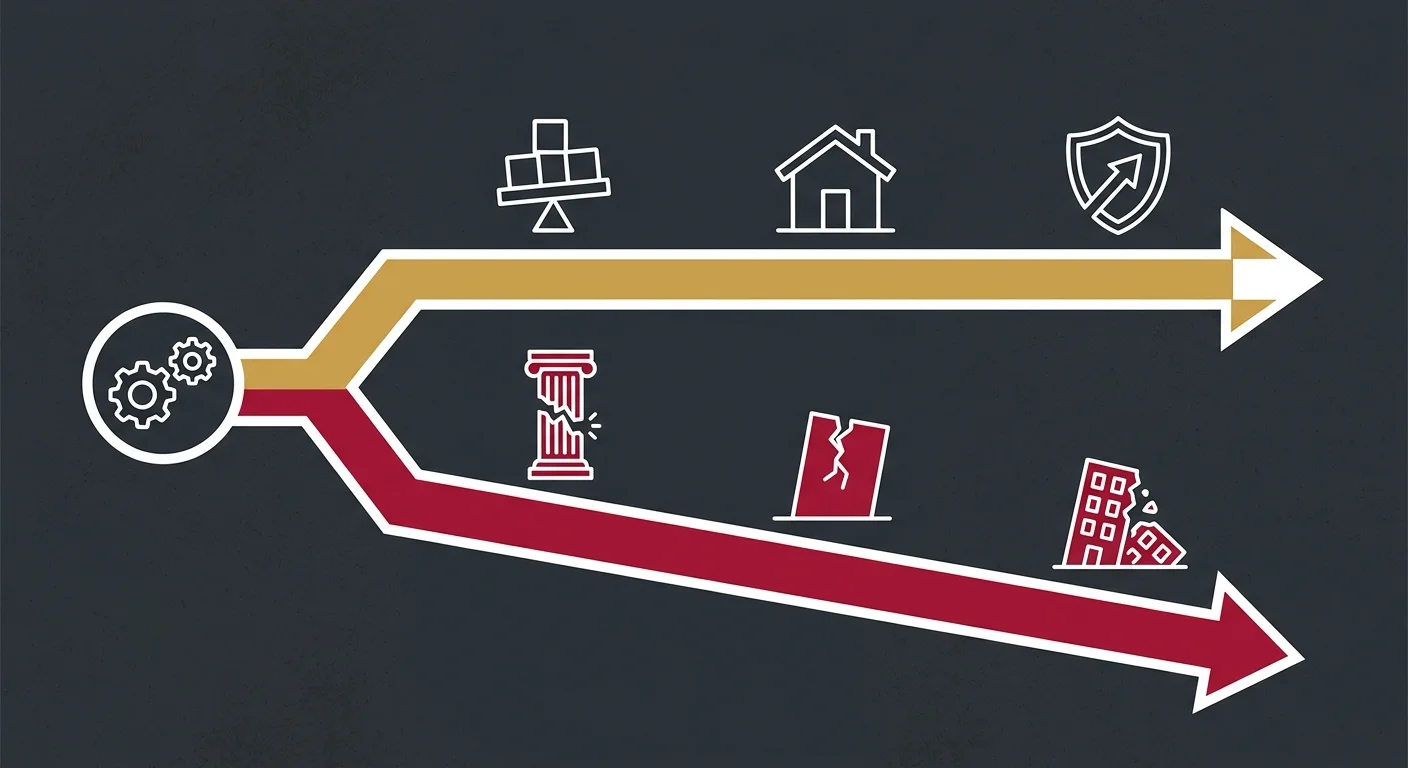
The relief is real. That's what makes this so hard to argue against.
Cortisone does reduce pain — often within days. Patients feel better, move better, sleep better. They reasonably assume that means they're getting better.
They're not. Pain dropping and tissue recovering are two completely different biological events.
What cortisone actually does is silence the distress call.
The tendon is still damaged. The inflammatory signaling that makes the pain noticeable gets chemically overridden — so the symptom disappears while the injury compounds underneath.
That's the clinical trap. The signal stops. The problem doesn't.
This is a biological fork in the road. One path manages the signal. The other repairs the tissue. Cortisone takes the body further from repair — and CDC survey data makes clear how many people are caught in this cycle.
An estimated 20.9% of U.S. adults — approximately 51.6 million people — live with chronic pain. A meaningful share of them are cycling through injection after injection, never getting structurally better.
The injections aren't failing because patients are doing something wrong. They're failing because suppressing the symptom was never the same thing as treating the cause.
The Clinical Pattern Behind the Returning Pain
The returning pain isn't a mystery. It's a biological receipt.
When cortisone wears off — usually weeks to a few months later — the symptoms come back because the underlying tissue was never repaired. The inflammatory signaling resumes because the structural problem is still there.
Nothing was fixed. The clock just paused.
And the second injection starts from a weaker baseline than the first.
Corticosteroids directly reduce the mechanical load-bearing capacity of tendons. Each subsequent dose increases the risk of rupture. So the cycle isn't neutral — it's degenerative.
Every round of temporary relief leaves the tendon less capable of handling normal load than the round before.
Here's what's actually happening at the tissue level — and understanding how acoustic waves remodel collagen makes the contrast impossible to ignore.
Within 48 hours of a corticosteroid injection, tendon cell viability drops and collagen synthesis is inhibited. The cells responsible for rebuilding the damaged structure aren't just slowed down.
They're chemically shut off at the exact moment the tendon needs them most.
Who Should Not Keep Getting Cortisone Injections
This isn't an argument against a first cortisone injection for an acute flare. That's a different clinical conversation.
But multiple injection cycles with pain that keeps coming back? That's the biology telling you something the injections were never designed to fix.
Patients who keep returning for cortisone aren't failing at recovery. They're being failed by a model built for short-term suppression — not structural repair.
The injection cycle continues not because it's working. It continues because it temporarily removes the symptom that would otherwise force a different clinical decision.
Three or more injection cycles with returning pain? The structure is almost certainly more compromised than when you started.
Not because you did something wrong. Because repeated corticosteroid exposure reduces the mechanical load-bearing capacity of tendon tissue and blocks the collagen synthesis required to rebuild it.
More cortisone won't reverse that trajectory. It continues it.
| Injection Number | Typical Short-Term Relief Window | Cumulative Tissue Risk |
|---|---|---|
| First injection | Noticeable pain reduction, often within days — inflammatory signaling suppressed, swelling decreases | Baseline tissue integrity is reduced; collagen synthesis inhibited at a critical repair window |
| Second injection | Moderate relief — often shorter duration than the first as the tissue has begun to adapt to suppression | Load-bearing capacity has decreased from the first cycle; structural deficit compounds |
| Third injection | Diminishing relief window — the underlying structural damage is more advanced and less responsive to chemical suppression | Tendon tissue is meaningfully weaker; risk of rupture under normal load increases with each dose |
| Fourth injection and beyond | Symptom suppression becomes unreliable — the tendon's distress signal is louder than the injection can quiet | Cumulative degradation makes the tissue progressively less capable of self-repair; the biological window for conservative recovery narrows |
| Ongoing injection cycle | Pain relief is no longer the outcome — patients report the injections 'don't work anymore' | Structural failure risk is at its highest; the tissue has been chemically prevented from rebuilding across multiple repair cycles |
How Shockwave Therapy Works on Damaged Tendon Tissue
Shockwave therapy doesn't silence the problem. It forces the body to fix it.
That's not a subtle distinction. It's a completely different biological event.
Where cortisone silences the tissue's distress signal, Shockwave Therapy answers it. Acoustic waves go directly to the damaged tendon site. They create a mechanical stimulus the tissue can't ignore — and the body responds by initiating the exact repair cascade that cortisone was chemically shutting down.
One path overrides the repair process. The other amplifies it. NIH clinical research documents what that amplification produces — a clinical success rate of up to 80% for chronic tendinopathies.
Not symptom management. Structural recovery.
The Mechanical Signal That Triggers Real Tissue Repair
Here's the thing about the mechanism. Acoustic wave energy creates a controlled pressure event directly at the tissue level — brief, targeted, precise.
That pressure signal is what the damaged tendon has been waiting for.
The body reads that acoustic signal as a structural load event. New blood supply routes to the area. TGF-beta-1 expression fires — the biological switch that initiates structural collagen remodeling. New vessels form. Collagen fibers start reorganizing along functional lines.
The tendon becomes load-bearing again. Not just pain-free. Actually stronger.
The progression plantar fasciitis patients experience across treatment sessions maps exactly how this repair sequence unfolds. The biology is consistent across tendon sites. Mechanical stimulus in. Structural repair out.
What Happens at the Cellular Level During Treatment
So what's actually happening during a shockwave session? The acoustic waves penetrate the tissue and create controlled microtrauma at the cellular level. That's not damage — that's a signal. The kind that activates the body's repair machinery instead of suppressing it.
That signal triggers TGF-beta-1 expression — a key growth factor in the collagen remodeling cascade. New collagen fibers synthesize. Existing disorganized fibers, the hallmark of chronic tendinopathy, begin realigning along functional lines.
Structural integrity increases with each treatment cycle. The tendon isn't just feeling better. It's becoming mechanically stronger.
This is why radial extracorporeal shockwave therapy achieves up to 80% clinical success rates for chronic tendinopathies — and why that number holds across multiple tendon sites. It's not a drug effect that clears from the system. It's a biological process that continues after the session ends.
The tissue keeps remodeling. The repair doesn't stop when you leave the treatment room.
That's the part cortisone can't replicate.
| Mechanism | Cortisone Injection | Shockwave Therapy |
|---|---|---|
| Primary action on tissue | Chemically suppresses the inflammatory signaling cascade | Delivers a mechanical stimulus that activates the repair cascade |
| Effect on collagen synthesis | Inhibits collagen-producing cells at the exact moment repair is needed | Triggers TGF-beta-1 expression to initiate structural collagen remodeling |
| Blood supply response | Does not stimulate new vascular growth to the damaged site | Stimulates regional neovascularization — new vessels form to support healing |
| Structural integrity over time | Reduces the tendon's mechanical load-bearing capacity with repeated use | Increases load-bearing capacity as collagen fibers reorganize along functional lines |
| What happens after treatment ends | Inflammatory signaling resumes because the underlying damage was never repaired | Biological remodeling continues — the repair process doesn't stop when the session ends |
| Trajectory with repeated cycles | Each cycle compounds structural degradation from the last | Each session builds on the previous repair cycle — cumulative structural recovery |
Comparing Outcomes: What the Clinical Evidence Shows
Biology explains the mechanism. Evidence ends the argument.
Track both treatments across real patients at real time intervals and the divergence isn't subtle. It's definitive.
Cortisone produces faster initial relief. That's not disputed.
But the clinically relevant question isn't what happens in week two. It's what happens at week 24 — when the chemical has cleared and the underlying structure has to carry load on its own again.
That's where the two paths fully separate.
And the clinical evidence doesn't leave room for interpretation on which one holds.
Success Rates, Recurrence, and What the 24-Week Mark Reveals
At 24 weeks, shockwave therapy leads to superior long-term functional recovery compared to cortisone injections for plantar fasciitis — with significantly lower recurrence rates. NIH outcome data documents this comparison directly.
That's not a marginal difference. That's the difference between a tissue that's been structurally rebuilt and one that's been chemically suppressed until the chemistry ran out.
The recurrence gap tells the real story.
When cortisone wears off and the pain comes back, that's not bad luck. It's exactly what happens when a structural problem never gets touched. The injection managed the signal. It didn't change the tissue. When the chemical clears, the original injury is still there — running the same distress cycle it was running before the first shot. The structure was never rebuilt. It was silenced.
Shockwave's recurrence numbers look different because the underlying biology is different.
When collagen fibers have been remodeled and regional blood supply has been restored, there's no degraded structural baseline waiting to reassert itself. The tissue that was broken has been rebuilt. That's why radial extracorporeal shockwave therapy reaches a clinical success rate of up to 80% for chronic tendinopathies — and why that number holds across sites. The repair is structural, not chemical. Patients who want to push those gains further and explore combining shockwave with other modalities often find the structural recovery compounds even faster.
The Conditions Where Shockwave Has Demonstrated Consistent Results
That 80% clinical success rate for chronic tendinopathies isn't tied to one condition.
It holds across multiple tendon sites. That matters — because the patients cycling through cortisone aren't all dealing with the same anatomy.
Plantar fasciitis. Achilles tendinopathy. Rotator cuff tendinosis. Lateral epicondylitis.
These are the conditions where the cortisone cycle is most common — and where the clinical evidence for shockwave is most consistently documented. The shared thread isn't the anatomy. It's the biology: chronic, load-bearing tendon tissue that's been structurally degraded and can't self-repair without a mechanical stimulus to restart the process.
If you want to see how that plays out in a specific condition, what to expect during shockwave therapy maps the progression session by session.
An estimated 20.9% of U.S. adults — approximately 51.6 million people — live with chronic pain. A meaningful share of them are carrying one of these tendon conditions through repeated injection cycles that trade temporary relief for structural decline.
The fork in the road has been documented for years. The clinical evidence showing which path actually leads out has been building just as long. Most of them just haven't been told which fork they're on.
| Outcome Measure | Cortisone Injection | Shockwave Therapy | Time Point |
|---|---|---|---|
| Long-term functional recovery | Inferior — structural baseline unaddressed | Superior — tissue structurally rebuilt | 24 weeks |
| Recurrence rate | Significantly higher — underlying damage persists | Significantly lower — collagen remodeled at tissue level | 24 weeks |
| Clinical success rate for chronic tendinopathies | Temporary symptom suppression only — no structural repair | Up to 80% clinical success across multiple tendon sites | Across treatment course |
| Breadth of tendon sites with documented evidence | Commonly applied but structurally degrades tissue over repeat use | Proven effective across various chronic tendon sites | Multiple published trials |
| Population living with chronic pain addressed by these approaches | 20.9% of U.S. adults — approximately 51.6 million people — cycling through suppression-only protocols | Same population — now with a structural repair pathway available | Current national data |
Frequently Asked Questions
The biology is clear. But patients don't walk in asking about TGF-beta-1 expression.
They walk in asking what happened last time, whether the injections made things worse, and what shockwave actually feels like across a full course of treatment.
These are the questions that show up when someone's finally done cycling through injections and ready to hear a straight answer.
Why does tendon pain return weeks after a cortisone injection?
Because cortisone never touched the structural problem.
It suppressed the inflammatory signal — the one that tells the body to rebuild. When the chemical clears, the original injury is still there. The tissue wasn't repaired. It was silenced.
So the pain restarts because the degraded structure is still carrying load it can't handle. That's not a treatment failure in the traditional sense. It's the predictable outcome of a chemical that masks without repairing.
Can repeated corticosteroid injections cause permanent tendon damage?
Yes — and the research is specific about the mechanism.
Corticosteroid injections can lead to a significant decrease in tendon cell viability and collagen synthesis within 48 hours of administration. The biological machinery for rebuilding doesn't just slow down. It gets suppressed at the exact moment the tendon needs it most.
Each injection compounds that baseline. What starts as temporary relief can leave behind a tendon that's structurally weaker than before the first shot. That's not a rare outcome. It's a documented biological consequence of repeated exposure.
How does shockwave therapy repair tissue without surgery or drugs?
Shockwave delivers mechanical energy directly to the damaged tissue. The body reads that as a structural load event and kicks off its own repair cascade — no drugs, no incision.
Acoustic wave energy stimulates new blood vessel growth and triggers TGF-beta-1 expression, which initiates collagen remodeling at the structural level. New blood supply routes into the area. Collagen fibers start reorganizing along functional lines.
That's not pain masking. That's restarting the exact biological process cortisone was chemically shutting down.
What is the recovery timeline for shockwave therapy compared to cortisone?
Cortisone delivers faster initial relief. That part is real and nobody's disputing it.
But the clinically relevant question isn't what happens in week two. It's what happens at week 24 — when the chemical has cleared and the underlying structure has to carry load on its own again.
Shockwave therapy produces superior long-term functional recovery for plantar fasciitis, with significantly lower recurrence rates at the 24-week mark. The repair takes longer to feel because actual tissue remodeling takes longer than chemical suppression. But what you're building is structural. So the comparison isn't speed — it's what's left when the treatment ends.
How many shockwave therapy sessions are typically needed for chronic tendon pain?
Most chronic tendinopathy cases require a multi-session protocol. That's not a billing strategy — that's the biology. Collagen remodeling doesn't happen in a single visit.
Radial extracorporeal shockwave therapy shows a clinical success rate of up to 80% for chronic tendinopathies. Those outcomes are built across a full course of treatment, not front-loaded into one session.
How many sessions? That's determined after a clinical assessment at Touch of Wellness Chiropractic. There's no standard protocol handed over before the evaluation is done. The assessment drives the plan — not the other way around.
The Fork in the Road: Which Path Actually Heals You
Both paths are on the table. Now pick one.
Cortisone suppresses the signal. It shuts down the inflammation that tells your body to rebuild, kills the collagen synthesis that restores load-bearing capacity, and leaves a tendon that's chemically silenced — and structurally weaker after every cycle.
Shockwave answers the signal. Blood supply restored. Collagen remodeling triggered. A tendon that can carry load again — not one that's been told to stop complaining.
The fork has always been there. The clinical data just makes the outcome impossible to argue with.
At 24 weeks, shockwave therapy delivers superior long-term functional recovery and significantly lower recurrence rates than cortisone — because the tissue has been structurally rebuilt, not repeatedly suppressed.
That's not a marginal win. That's the difference between a problem that's been resolved and one that's been quietly managed into a worse version of itself.
At Touch of Wellness Chiropractic, that distinction isn't a talking point. It drives every clinical decision.
If your tendon pain has survived the injection cycle and keeps coming back, that's not bad luck. That's the biology confirming what the cortisone was never designed to answer.
You're standing at a biological fork in the road — and the path that keeps leading back to the same injection room isn't the one that leads out.
Here's where most people go back for another injection. Don't. If the pain keeps coming back, the injection isn't the answer — it never was. What you actually need is a clinical look at what's driving the problem in the first place. That's what a first assessment at Touch of Wellness Chiropractic is built to find out.
Copyright Touch of Wellness Chiropractic 2026
1101 W Jackson St, Suite A Morton, IL 61550
Web Design by iTech Valet