
(309) 321-8412 | 1101 W Jackson St, Suite A, Morton, IL 61550
(309) 321-8412 | 1101 W Jackson St, Suite A, Morton, IL 61550
Why 'Masking the Pain' Prevents Real Long-Term Functional Recovery
Masking chronic back pain doesn't produce recovery. It removes the alarm while the fire keeps burning.
Pain is a signal. It isn't the problem — it's the body reporting one. When that signal gets chemically suppressed or passively bypassed, the structural and neurological dysfunction driving it continues undisturbed. The nervous system depends on accurate sensory feedback to coordinate movement, distribute load, and stabilize joints. Chronic low back pain patients can show up to a 40% deficit in lumbar proprioceptive accuracy — the body's internal sense of position and movement. Muting the signal without restoring the biomechanics makes that deficit worse.
NSAIDs are one of the most commonly recommended short-term interventions for back pain. But they work by inhibiting COX pathways — the same inflammatory mechanisms that initiate tissue repair. That inhibition can delay the proliferation stage of muscle and tendon regeneration. The tissue that needs to rebuild is stalled. The pain signal that would have prompted movement correction is switched off. The FDA has warned that non-aspirin NSAIDs increase the risk of serious cardiovascular events — including heart attacks and strokes — when used continuously.
The CDC's clinical guidelines reflect this directly. Non-pharmacological therapies are the recommended approach for chronic pain because opioid therapy does not demonstrate sustained long-term functional recovery compared to non-opioid alternatives.
Active, systems-based rehabilitation produces measurably different outcomes. Active therapy structures yield a 30% greater improvement on the Oswestry Disability Index at 12 months than passive management modalities. That gap reflects what happens when care addresses the root mechanical and neurological cause instead of temporarily quieting its symptoms.
A genuine functional rebirth means following the pain signal back to its source — identifying where the nervous system's feedback loops have broken down, correcting the structural faults sustaining that breakdown, and rebuilding the proprioceptive accuracy that passive pain management steadily erodes. Removing the alarm never puts out the fire.
Last Updated: July 20, 2026
- • What 'Masking the Pain' Actually Does to Your Nervous System
- • Why the Feedback Loop Is the Real Target
- • The Hidden Cost of Passive Pain Management
- • What Genuine Functional Recovery Actually Requires
-
• Frequently Asked Questions
- • How long does it realistically take to transition from temporary symptom relief to true functional recovery?
- • What are the common failure points when trying to resolve chronic back pain without daily anti-inflammatories?
- • If standard physical therapy hasn't restored my mobility, how does a systems-based chiropractic care plan differ?
- • What is the real cost comparison between ongoing pain-masking medications and a structured corrective care plan?
- • How do I know if my current treatment plan is addressing the root cause or just suppressing my nervous system?
- • The Smoke Clears When You Stop Covering the Detector
What 'Masking the Pain' Actually Does to Your Nervous System
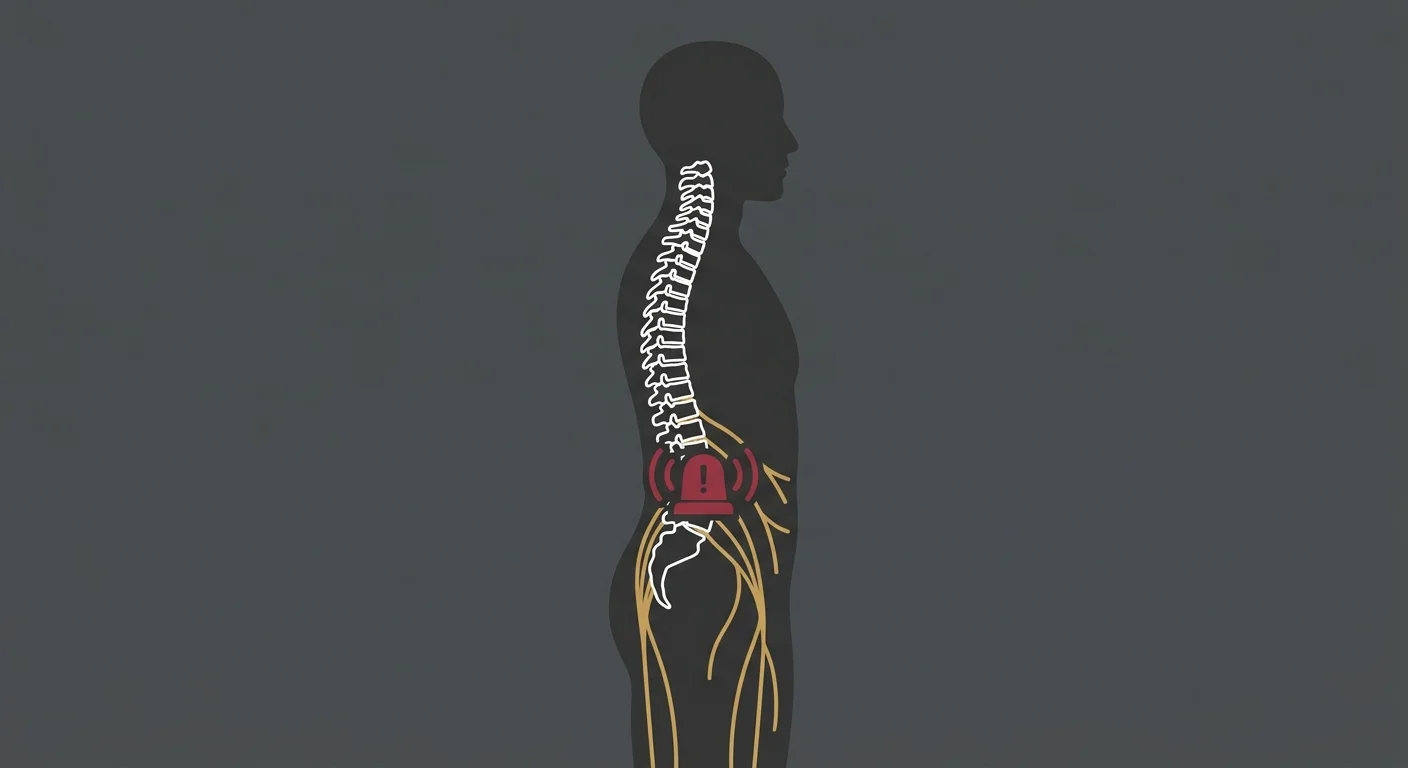
Your nervous system runs everything. When it's disrupted, nothing downstream works right.
Think of pain as a smoke detector. It doesn't fire because it's broken — it fires because something is burning. Chemically silencing that alarm doesn't put out the fire. It just means you stop hearing it while the damage keeps running.
That's not a metaphor. That's the clinical sequence of pain masking. The mechanical fault keeps loading the joint. The nerve keeps misfiring. The proprioceptive feedback loop that should trigger a movement correction stays broken — quietly, invisibly, every single day.
Pain Is a Signal, Not the Problem
Pain is accurate information. It's the nervous system flagging a structural problem it can't resolve on its own — a joint that's stopped loading evenly, a spinal segment that's lost its range and compensating into surrounding tissue. The signal isn't the enemy. It's the only honest report you're getting.
Suppress that signal chemically, and the information disappears. The problem doesn't. CDC guidelines are unambiguous on this: non-pharmacological therapies are the recommended approach for chronic pain because opioid therapy doesn't produce sustained long-term functional recovery. The alarm was never the problem. The fire was.
NSAIDs compound this further. They inhibit COX pathways — the same early inflammatory mechanisms that kick off structural tissue repair. According to NIH research, that inhibition can delay the proliferation stage of muscle and tendon regeneration. So the tissue that needs to rebuild is left waiting while the pain signal that would have prompted correction has already been switched off. And the FDA has warned separately that non-aspirin NSAIDs increase the risk of serious cardiovascular events — including heart attacks and strokes — when used continuously. That's not a side effect to weigh against the benefit. That's the mechanism of the model.
Why the Cookie-Cutter Protocol Gets This Wrong
Most pain management protocols run the same sequence on every patient. Walk in with nerve pain, a herniated disc, or sciatica that's been there three years — you get the same template. Every time.
When that template doesn't work, the standard response is to run it again. Or hand the patient something that quiets the signal. Neither move asks the question that actually matters: where, specifically, has this patient's nervous system lost its feedback accuracy, and what structural correction will restore it? That question doesn't fit inside a template. So the template skips it.
That's the gap. Patients who've cycled through physical therapy, injections, and medication — often for years — arrive having never had that question seriously asked. Passive and generic approaches leave the root neurological dysfunction completely untouched. What those patients actually need is a functional rebirth protocol built around their specific presentation — not another round of managing symptoms while the cause keeps running.
At Touch of Wellness Chiropractic, the care plan starts with what you actually report — not a diagnosis code, not a protocol inherited from your last provider. If something isn't producing measurable change after a few visits, it changes. Not because that's a philosophy. Because continuing something that isn't working is the clinical definition of failure. That's the direct opposite of the cookie-cutter model, and it's what individualized chiropractic care in Morton actually looks like in practice.
| Pain Signal Type | What It Communicates | What Masking Suppresses | What Gets Left Unaddressed |
|---|---|---|---|
| Acute structural pain (e.g., compressed nerve root) | A specific spinal segment is loading a nerve abnormally — positional correction is needed | The urgency signal that prompts the body to offload the affected joint and seek correction | The mechanical compression causing nerve irritation; joint continues misfiring without correction |
| Proprioceptive feedback signal | Joint position and movement accuracy are degraded — motor control needs recalibration | The sensory input the nervous system uses to coordinate load distribution and movement patterns | The feedback loop deficit; movement continues on flawed motor programming, deepening the pattern |
| Inflammatory repair signal | Tissue damage is present and the body has initiated a structural rebuilding sequence | The early inflammatory cascade that triggers the proliferation stage of muscle and tendon regeneration | Incomplete tissue remodeling; the structural repair cycle is interrupted before it can complete |
| Chronic neuropathic signal | A nerve pathway has been persistently irritated long enough to alter its baseline firing pattern | The discomfort signal that flags ongoing nerve dysfunction requiring root-cause correction | The altered neuropathic feedback loop itself; nerve misfiring continues without biomechanical intervention |
| Compensatory movement pain | The body has adopted a dysfunctional movement pattern to avoid a primary fault — and that pattern is now causing secondary damage | The warning that secondary tissue is being overloaded due to faulty motor compensation | Both the primary structural fault and the compensatory movement pattern; neither gets corrected |
Why the Feedback Loop Is the Real Target
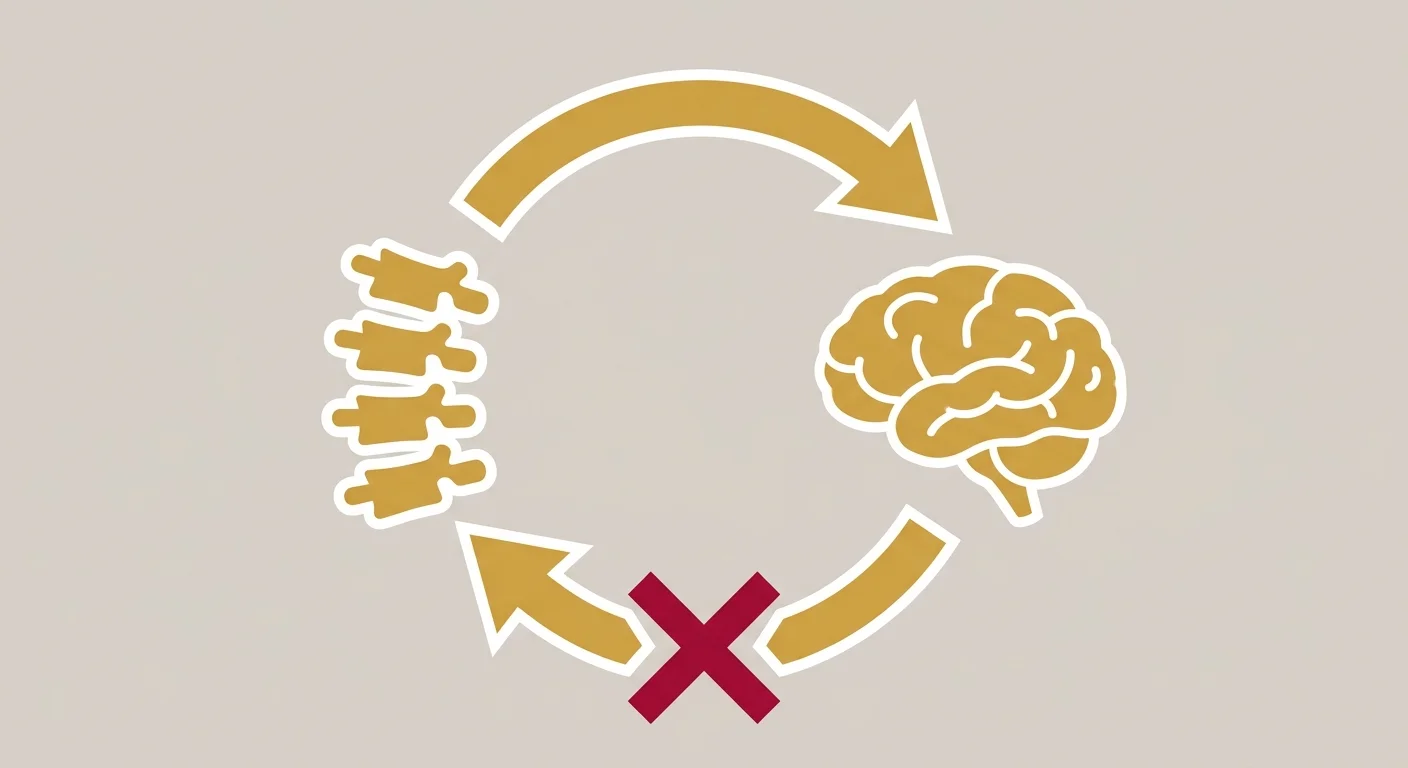
Pain isn't a malfunction. It's a message — your nervous system flagging a structural problem it cannot resolve without a response.
That signal travels through a proprioceptive feedback loop — your spine's way of knowing where it sits in space, how much force your muscles should generate, and how your joints distribute load without tipping into dysfunction. Chronic back pain disrupts that loop. Passive pain management keeps it suppressed. Once it goes dark, your entire coordination system starts operating without its primary data source.
The feedback loop isn't a detail inside the recovery plan. It's what the entire plan is working backward from.
Proprioception: The Body's Internal GPS
Proprioception is your body's internal GPS. It's the continuous, real-time sense of position, movement, and load your nervous system uses to keep you upright, balanced, and mechanically stable. You're not consciously running it. It recalibrates with every step, every weight shift, every transition from seated to standing — below the threshold of awareness, constantly.
Chronic low back pain doesn't just hurt. It measurably degrades that GPS. Research shows chronic low back pain patients can exhibit up to a 40% deficit in lumbar proprioceptive accuracy. That's not a minor calibration error. That's the navigational system misfiring on nearly half its inputs — while the patient keeps moving, loading joints, and wondering why nothing fully resolves.
And when that signal gets chemically muted without correcting the underlying biomechanics, the deficit doesn't hold steady — it gets worse. The GPS doesn't recalibrate because the alarm went quiet. It recalibrates when the structural fault causing the interference is actually fixed.
What Breaks Down When the Loop Goes Silent
So here's what actually breaks down. When the feedback loop goes silent — through chemical suppression, passive management, or bracing through the pain long enough — the brain stops receiving accurate positional data from the affected spinal segments. Movement patterns compensate. Adjacent joints absorb load they weren't built to carry. The body adapts to the dysfunction instead of resolving it.
That compensation becomes structural over time. Muscles that should stabilize the lumbar spine start underloading. Others overwork to cover the gap. The joint that originally misfired keeps doing it — quietly, below the pain threshold — while the dysfunction spreads into tissue that had no role in starting it.
That's where this model breaks from symptom management. Targeted chiropractic adjustments stimulate mechanoreceptors — the sensory receptors embedded in spinal joints and surrounding tissue — which helps reset neuropathic feedback loops and normalize motor output, according to NIH-published research. That's not quieting the alarm. That's finding where the wiring failed and restoring the signal.
Most patients who've been through the cycle — medication, passive therapy, temporary improvement, relapse — haven't had the loop itself addressed. The smoke detector got covered. The smoke kept coming. What real functional recovery actually requires is tracing that smoke back to what's still burning — not managing the smell.
This Isn't the Right Fit for Everyone
This isn't the right fit for everyone. That's worth saying plainly.
If you're coming in expecting the same sequence your last provider ran, this won't be that. The assessment drives everything here. If your previous provider used the same protocol on you regardless of what you reported — and you need that replicated before you'll try something different — we're probably not the right fit. The assessment comes first. That's not a preference. It's the whole point of finding the source instead of covering it.
But if you're dealing with chronic back pain and sciatica and you're willing to start with an honest clinical picture instead of a predetermined protocol — that's the conversation this practice is built for. If the goal is a quick adjustment that quiets the pain for a few days without touching the proprioceptive breakdown sustaining it, the model here won't deliver that. And it wouldn't be honest to say otherwise.
| Feedback Loop Function | Healthy Loop Behavior | Chemically Suppressed Loop Behavior | Clinical Consequence |
|---|---|---|---|
| Positional awareness | Spinal joints continuously report their position, load, and movement to the brain in real time | Chemical suppression quiets the afferent signal — the brain receives partial or absent positional data from affected segments | Movement patterns compensate for the missing data, loading adjacent joints and tissue beyond their designed capacity |
| Load distribution | Muscles surrounding the lumbar spine activate in coordinated sequence, sharing load evenly across joint surfaces | Without accurate feedback, stabilizing muscles underload while compensatory muscles overwork to fill the gap | Uneven mechanical loading accelerates wear on joint surfaces and sustains the original structural fault |
| Movement correction | When a joint begins to move outside its optimal range, the nervous system detects the deviation and triggers a corrective response | Suppressed signals mean deviation goes undetected — the corrective trigger never fires | The joint continues misfiring below the threshold of conscious pain, deepening the dysfunction with every movement cycle |
| Tissue repair signaling | Accurate proprioceptive feedback guides appropriate muscle tension and joint positioning during the tissue remodeling process | Without position feedback, remodeling occurs against a backdrop of compensatory tension patterns — tissue rebuilds around dysfunction rather than correcting it | Structural healing stalls or produces scar tissue oriented to the compensation pattern, not the original fault |
| Motor output calibration | The brain continuously calibrates force, speed, and direction of movement based on live feedback from spinal mechanoreceptors | Muted mechanoreceptor signals produce uncalibrated motor output — movements are executed without accurate positional grounding | Chronic instability and re-injury risk increase as the motor system operates on outdated or absent sensory data |
The Hidden Cost of Passive Pain Management
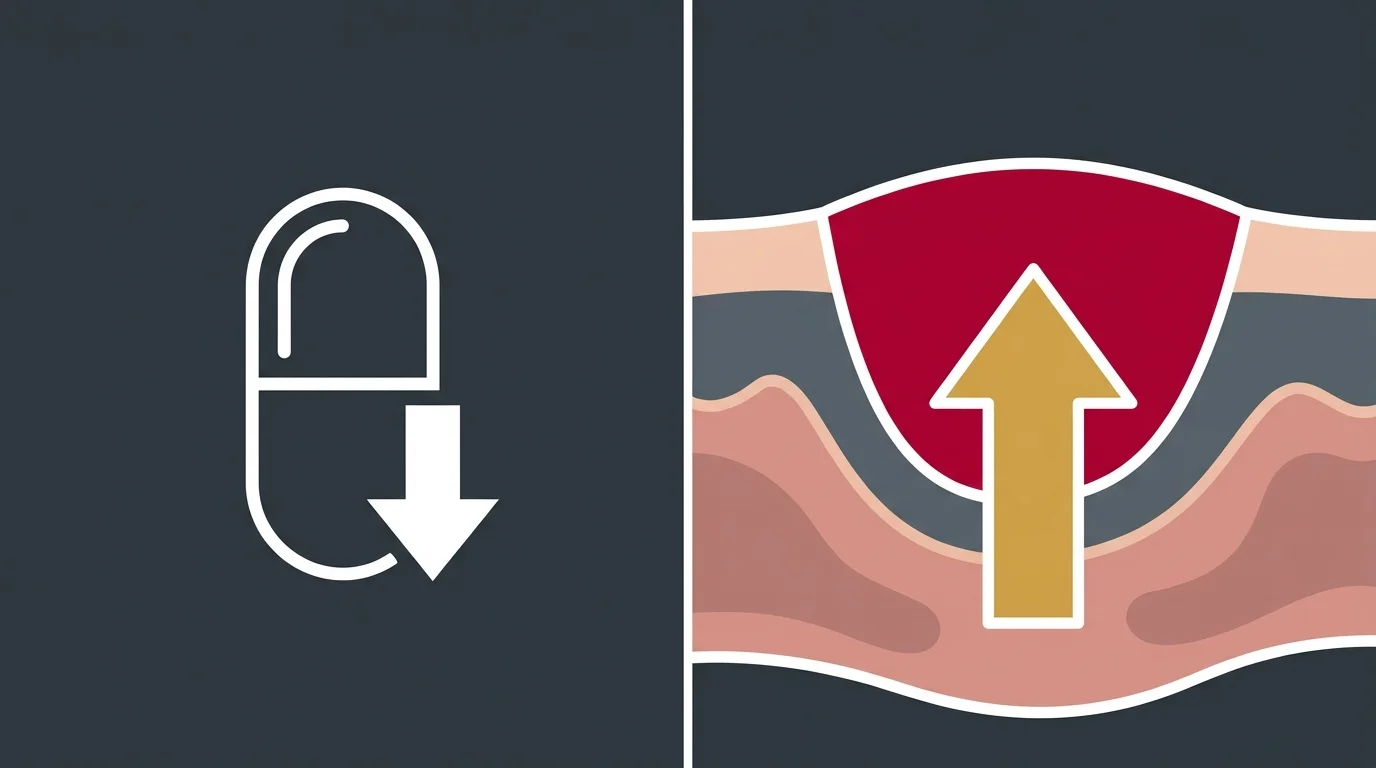
Nobody says this when they hand you the prescription: the medication isn't treating your back. It's treating your awareness of it.
That distinction isn't semantic. It's clinical.
Passive pain management — anti-inflammatories, injections, any protocol built around quieting the signal rather than correcting the source — carries a real, measurable cost. Not a risk you might encounter someday. A documented pattern that starts from the first dose.
The smoke detector doesn't stop screaming because the fire went out. It stops screaming because you covered it.
And covering it costs you something: you lose the ability to track how much damage is still happening while you can't hear the alarm.
What NSAIDs Do to Tissue Healing
Here's what NSAIDs are actually doing inside the tissue. They block COX pathways — the same early inflammatory signals your body uses to kick off structural repair.
That's not a side effect. That's the mechanism. Inhibit the signal, you stall the proliferation stage of muscle and tendon rebuilding. The repair process doesn't wait politely while you finish the bottle. It stops.
So you've silenced two things at once: the warning and the work order.
The tissue that needs to rebuild has no signal driving it. The movement pattern that would have accelerated that rebuild has already been switched off. Neither failure announces itself. Both happen quietly, behind a symptom score that says you're doing fine.
That's the exact fork in the road that functional recovery vs. standard physical therapy forces you to face.
One approach works with the body's repair mechanisms. The other interferes with them — while the patient feels good enough to keep loading the same damaged structure. That's not a difference in philosophy. That's the difference between the fire going out and the fire spreading.
The FDA's Warning Is Not a Footnote
The FDA's warning on non-aspirin NSAIDs isn't buried in fine print. It's a black box warning.
Cardiovascular risks — heart attacks and strokes — can occur within the first weeks of taking daily prescription-strength NSAIDs. Not after years. Weeks.
Most people taking daily anti-inflammatories for back pain aren't managing a short-term injury. They're managing an ongoing structural problem with a drug class that carries serious systemic risk from the first weeks of continuous use.
That's a trade-off most of them never consciously agreed to. Because nobody clearly offered it.
The hidden cost of passive pain management isn't only that it delays healing. It's that it substitutes a drug risk for a structural one — and neither problem gets resolved.
The fire keeps burning. The tissue keeps waiting. And the nervous system that was supposed to guide the whole recovery process is still running blind.
| Pain Management Approach | Short-Term Effect | Documented Long-Term Risk | Impact on Tissue Healing |
|---|---|---|---|
| Daily prescription-strength NSAIDs | Reduces pain signal awareness, allows continued activity | Cardiovascular events including heart attacks and strokes can occur within the first weeks of continuous use | Inhibits COX pathways, slowing the proliferation stage of muscle and tendon regeneration — delaying structural repair while the patient feels better |
| Daily prescription-strength NSAIDs (cardiovascular risk) | Pain suppression enables continued loading of damaged structures | Black box FDA warning — cardiovascular risks like heart attacks or strokes can occur within the first weeks of taking daily prescription-strength NSAIDs | Structural tissue damage continues unaddressed while systemic drug risk accumulates from week one |
| Passive pain management (general — injections, anti-inflammatories) | Temporary reduction in perceived pain intensity | No documented resolution of underlying structural fault; ongoing tissue loading without repair signals | Early inflammatory pathways essential for structural healing are suppressed, halting the body's own regenerative sequence |
| Ongoing NSAID use for chronic (non-acute) back pain | Maintains tolerable daily function without addressing the source | Substitutes a systemic drug risk for an unresolved structural one — neither problem is eliminated | COX inhibition interrupts the remodeling cascade; damaged musculoskeletal tissue does not receive the inflammatory signals required to initiate repair |
What Genuine Functional Recovery Actually Requires
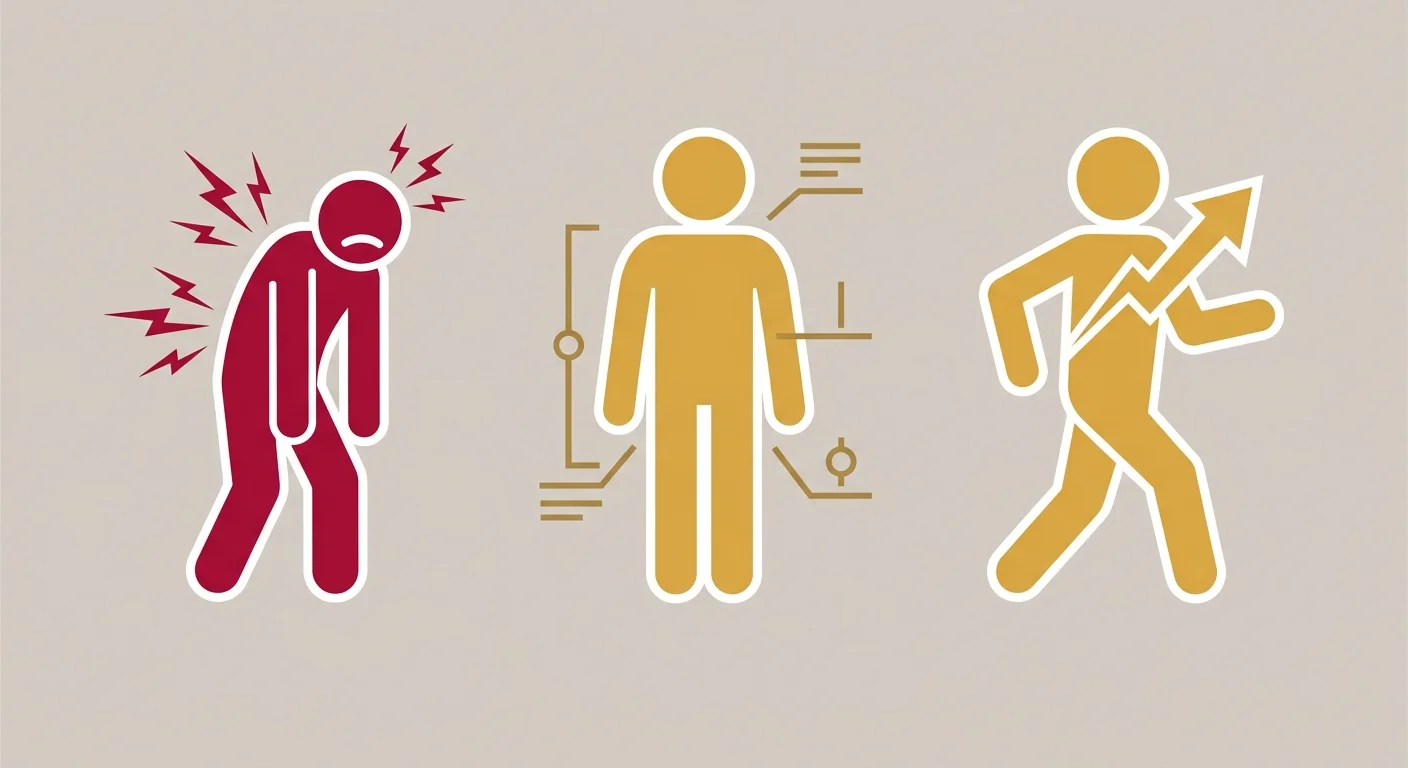
Here's what real functional recovery actually means. Your nervous system is accurately reading load, position, and movement. And your body is responding correctly to what it reads. That's the target — not 'less pain.' Not 'manageable.'
That's a different target than pain reduction. Pain reduction tells you the alarm is quieter. Functional recovery tells you the fire is out.
Getting there requires two things running at the same time. First: structural correction that removes the mechanical fault disrupting the feedback loop. Second: active rehabilitation that rebuilds the motor patterns that compensated around it.
Passive management addresses neither. That's not opinion. That's what the outcome data shows.
Active Rehabilitation vs. Passive Management: The Measurable Gap
The gap between active rehabilitation and passive symptom management isn't subtle. Active therapy structures yield a 30% greater improvement on the Oswestry Disability Index at 12 months than passive alternatives.
That's a validated, standardized measure of how much back pain limits your ability to function — not just how much it hurts.
Passive modalities — rest, anti-inflammatory cycles, injections, heat and electrical stimulation — can reduce pain scores short-term. But they don't rebuild the proprioceptive accuracy that chronic pain eroded.
The Oswestry Disability Index gap exists because functional capacity and pain intensity aren't the same measurement. Quieting one doesn't move the other. You can feel less pain and still be unable to carry groceries, sit through a workday, or walk without bracing.
And there's another layer passive management never touches. When movement hurts, people stop moving. The muscles and joints that need load to recover stay unloaded. The nervous system's ability to gauge position and force keeps degrading.
That's the pain-fear cycle — and it becomes its own structural problem on top of the original one. The rehabilitation plan only works if you can actually execute it. How specialized care interrupts that fear-avoidance pattern matters because the fear response can shut the entire recovery process down before it starts.
How a Systems-Based Care Plan Addresses the Root Cause
So a systems-based care plan starts with a different question. Not 'where does it hurt?' — but where has the feedback loop broken down, and what structural correction will restore it?
That's why targeted chiropractic adjustments aren't just about joint mobility. They stimulate mechanoreceptors in the spinal joints and surrounding tissue — helping to reset neuropathic feedback loops and normalize motor output.
The adjustment is the structural correction. It's the signal sent back into a system that had stopped receiving accurate data.
Once the loop starts recalibrating, the active rehabilitation work can actually land. Stability exercises, movement pattern retraining, load progression — none of those are effective when the feedback system guiding them is still misfiring.
Sequence matters. You can't rebuild a coordination system that's still running blind. That's not a philosophical position. It's why doing the right exercises in the wrong order — or before the structural correction — produces so little return.
That's the clinical model behind functional recovery vs. standard physical therapy for chronic pain. The difference isn't effort. It's whether the care plan is targeting the structural source of the feedback disruption — or working around it.
One follows the smoke back to the source. The other keeps covering the detector and calling it progress.
| Recovery Marker | Passive Pain Management Outcome | Active Systems-Based Rehab Outcome | Source |
|---|---|---|---|
| Functional disability improvement at 12 months | Limited — pain scores may drop but functional capacity scores lag significantly | 30% greater improvement on the Oswestry Disability Index | PubMed / NCBl PMC6441810 |
| Proprioceptive accuracy restoration | Not addressed — passive modalities reduce pain intensity but do not rebuild proprioceptive accuracy eroded by chronic pain | Targeted structural correction begins restoring accurate sensory feedback to the central nervous system | PubMed / NCBI PMC8464644 |
| Neuropathic feedback loop reset | Not achieved — chemical signal suppression leaves misfiring feedback loops intact | Mechanoreceptor stimulation via targeted adjustment helps reset neuropathic feedback loops and normalize motor output | PubMed / NCBI PMC8464644 |
| Pain score vs. functional capacity gap | Pain scores improve short-term; functional capacity does not follow — the two variables move independently under passive care | Active rehabilitation closes the gap — functional capacity tracks alongside pain reduction because the structural source is being corrected | PubMed / NCBI PMC6441810 |
Frequently Asked Questions
The picture is clear. The questions usually aren't.
These are the questions worth asking when you're not sure if your current path is leading somewhere — or just making the waiting feel manageable.
How long does it realistically take to transition from temporary symptom relief to true functional recovery?
No honest clinician gives you a single number here. But the direction is fixed — and the two paths don't arrive at the same place.
Symptom relief can happen fast. Days, sometimes. Cut the load, add an anti-inflammatory, the signal quiets. Functional recovery is slower because it's rebuilding something — not just quieting something.
The feedback loop that chronic pain disrupts doesn't recalibrate on its own. Structural correction has to happen first. Then active rehabilitation rebuilds the motor patterns that compensated around the fault. Skip the sequence, and the result doesn't last.
The CDC is direct about this: opioid therapy doesn't produce sustained long-term functional recovery compared to non-pharmacological alternatives. That's not a preference. That's a sequencing reality.
How long the process takes depends on how long the structural fault has been running — and how much compensation has layered on top of it. Longer history means more to unwind. But follow structural correction with active work, and the recovery is real.
What are the common failure points when trying to resolve chronic back pain without daily anti-inflammatories?
It's not willpower. It's sequencing.
Patients stop the anti-inflammatories and don't replace passive management with structural correction. The pain comes back — because the fault generating the signal was never touched.
The second failure point is proprioceptive drift. Chronic back pain patients can show up to a 40% deficit in lumbar proprioceptive accuracy. Remove the chemical dampening without restoring that accuracy, and the nervous system is still running blind. It's guessing at load and position. Not reading them.
Movement patterns built on that guesswork reinforce the compensation. Not the correction.
The third failure point is fear-avoidance. Without structural correction restoring confidence in movement, patients protect the area instead of rehabilitating it. Protection preserves the problem. It doesn't fix the fault.
If standard physical therapy hasn't restored my mobility, how does a systems-based chiropractic care plan differ?
Standard physical therapy works the muscles and joints around the problem. A systems-based care plan works the feedback loop driving the dysfunction.
That's not a minor distinction. It's a different clinical target entirely.
If mobility hasn't returned after physical therapy, the right question is whether the structural fault disrupting the nervous system's feedback loop was ever addressed — or whether the therapy was building strength on a foundation that was never corrected.
Active rehabilitation yields a 30% greater improvement on the Oswestry Disability Index at 12 months when it's paired with structural correction rather than passive modalities alone. The therapy isn't the problem. It just needs the right starting point.
A systems-based plan identifies the specific mechanical fault first. Targeted chiropractic adjustments restore the feedback loop. Then active rehabilitation can actually land — because the system guiding it isn't misfiring anymore.
What is the real cost comparison between ongoing pain-masking medications and a structured corrective care plan?
Most people frame this wrong. They compare the monthly cost of a structured care plan against the monthly cost of a prescription. That's not the real comparison.
The real comparison is years of ongoing medication — with no clinical destination — against a structured plan that has one.
Daily prescription-strength NSAIDs don't just carry a financial cost. The FDA's black box warning documents cardiovascular risks, including heart attack and stroke, that can appear within the first weeks of continuous use. That's a systemic risk layered on top of a structural problem that still hasn't been resolved.
A corrective care plan has a cost. It also has an endpoint — a point where the feedback loop is restored and the active work is complete.
Pain-masking management has no endpoint. It has a renewal cycle. Those aren't equivalent options. The cost comparison only becomes visible when you account for how long that cycle actually runs.
How do I know if my current treatment plan is addressing the root cause or just suppressing my nervous system?
Ask one question: is your function improving, or just your pain score?
Those aren't the same variable.
A care plan addressing the root cause produces changes in what you can do — not just changes in how much it hurts. If you're moving better, loading better, and sleeping better as care progresses, the structural work is landing.
If the pain quiets between sessions but your functional capacity isn't expanding, the signal is being managed. Not corrected.
The proprioceptive deficit that chronic pain creates doesn't resolve when pain is suppressed. It resolves when the mechanical fault is corrected and the nervous system starts receiving accurate feedback again.
A root-cause care plan has a structural target, an active rehabilitation component, and a clear progression. If your current plan doesn't have all three — or if the only measure of progress is a pain number — that's a question worth asking directly.
The Smoke Clears When You Stop Covering the Detector
The smoke detector was never the problem.
It was doing exactly what it was built to do — signal that something was burning. Every prescription that quieted it, every passive protocol that dampened the signal, every care plan that opened with 'here's what we'll do' before finishing 'here's what's actually wrong' — all of it covered the detector.
None of it followed the smoke.
Most chronic pain patients don't hear that until they've already lost years to it.
The nervous system doesn't forget a disrupted feedback loop just because the pain got quieter. The structural fault that triggered the alarm is still there. And a body that's been compensating around it for months — or years — has built movement patterns on a foundation that was never corrected.
At Touch of Wellness Chiropractic, the work starts by finding where the feedback broke down. Then correcting it structurally. Everything else in the recovery builds from that — not a template, not a diagnosis code. What you actually report. Where the loop actually failed. What correction will actually restore it.
Functional rebirth isn't a marketing term. It's what happens when structural correction restores the feedback loop, active rehabilitation rebuilds the coordination patterns, and the nervous system can finally read load and position accurately again.
The fire goes out. The alarm goes quiet — because it has a reason to.
That's a different outcome than pain reduction. Pain reduction tells you the alarm is quieter. Functional rebirth tells you the source was found and corrected. One covers the detector. The other follows the smoke all the way back.
If you've been managing long enough that you've stopped expecting anything different, that expectation is worth confronting — because removing the alarm never puts out the fire.
That's the difference between managing a number and fixing a problem. At Touch of Wellness Chiropractic, the assessment starts with what's actually driving the alarm — not the symptom score. Removing the alarm never puts out the fire.
Copyright Touch of Wellness Chiropractic 2026
1101 W Jackson St, Suite A Morton, IL 61550
Web Design by iTech Valet