
(309) 321-8412 | 1101 W Jackson St, Suite A, Morton, IL 61550
(309) 321-8412 | 1101 W Jackson St, Suite A, Morton, IL 61550
Why the Brain Still 'Feels' Pain After Medical Clearance
Your MRI is clean. Your nervous system is not.
That is the gap medical clearance cannot close. When imaging confirms that peripheral tissues have healed, it is reporting on structure. It says nothing about whether the central nervous system has returned to a normal baseline. Those are two different reports — and treating one as the other is why so many people with clean scans still wake up in pain every morning.
When pain persists beyond tissue healing, the clinical term for what is happening is central sensitization. The central nervous system becomes functionally hyperexcitable — amplifying pain signals even when the original injury source is gone. Neurons in the pain pathways fire with increased intensity and frequency, not because something is structurally wrong at the injury site, but because the brain's pain maps have been reorganized and locked in.
The fire is out. The alarm is still screaming.
Research confirms that chronic pain states physically reorganize brain structures, producing a measurable 5% to 11% reduction in gray matter density in specific regions. The transition from acute to chronic pain involves central neuroimmune activation — not continued peripheral tissue damage. The problem has moved upstream. It's neurological, not structural.
The scale of this isn't small. In 2021, approximately 20.9% of U.S. adults — an estimated 51.6 million people — reported living with chronic pain. Of those, roughly 6.9%, or 17.1 million people, experienced high-impact chronic pain that limited major life or work activities. For many of them, the structural injury resolved. The nervous system never did.
Resolving it requires a clinical approach that evaluates the nervous system directly — not one that repeats the structural assessment that already came back negative.
Last Updated: July 20, 2026
- • What 'Medical Clearance' Actually Tells You (And What It Doesn't)
- • How the Brain Gets Stuck in a Chronic Pain Loop
- • What Happens to the Brain's Pain Map Over Time
- • Breaking the Neurological Pain-Fear Cycle
-
• Frequently Asked Questions
- • If my MRI and X-rays are clean, why does my body still hurt?
- • What is central sensitization, and how does it keep the brain feeling pain?
- • Can the nervous system get stuck in a chronic pain loop after an injury heals?
- • How does specialized chiropractic care break the neurological pain-fear cycle?
- • What steps can I take to retrain my brain and quiet overactive nerve pathways?
- • The Alarm Is Still Screaming — But That's Fixable
What 'Medical Clearance' Actually Tells You (And What It Doesn't)
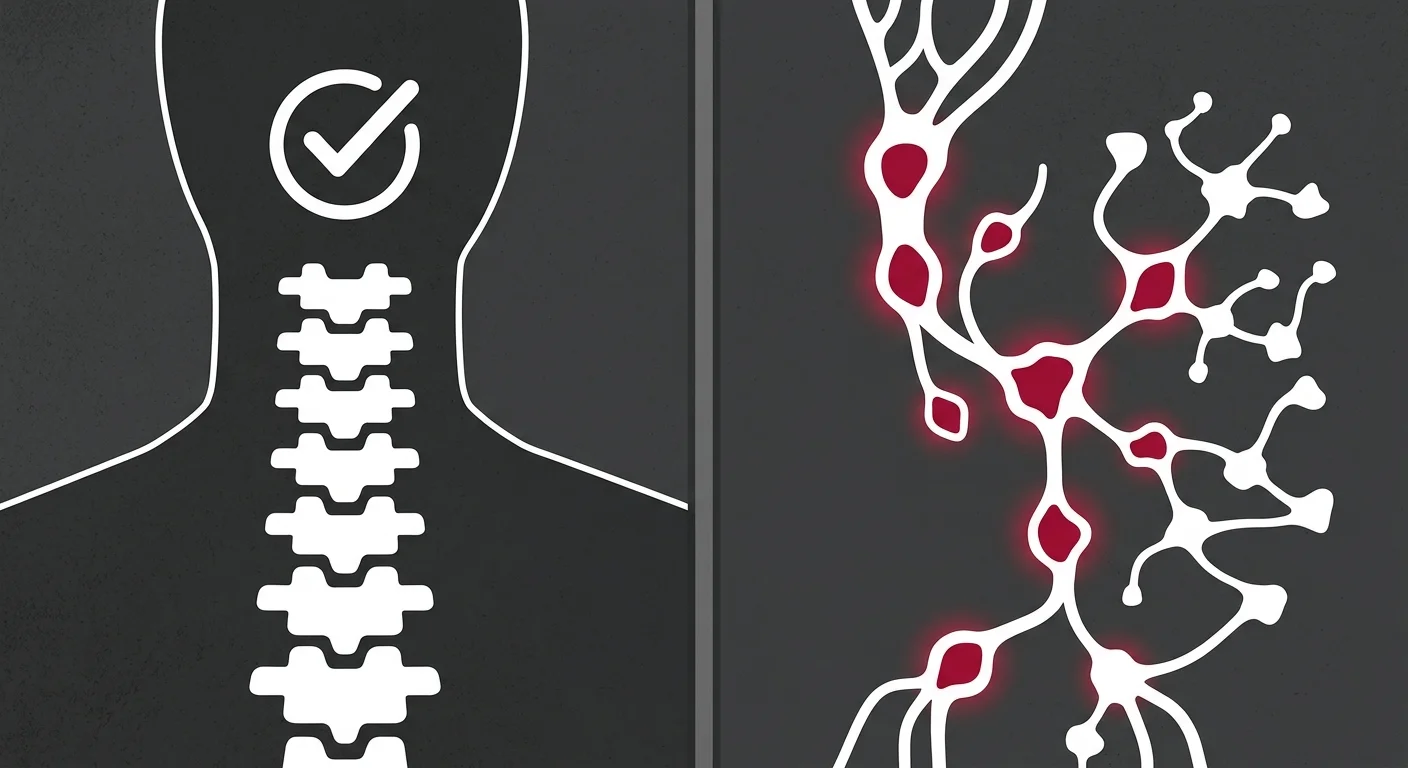
'Everything looks fine.'
Those three words end the appointment. They don't end the pain.
Medical clearance is a structural report. Bones intact. Disc not herniated. Tissue healed. That's the whole job — and it does that job well.
But it was never built to evaluate what your central nervous system is doing. That's not a flaw in the test. It's the wrong test for the wrong question.
And the gap matters — at scale. CDC data from 2021 puts chronic pain at 20.9% of U.S. adults — roughly 51.6 million people.
A significant portion of them had clean imaging. The structural story checked out. But the neurological story was a different document entirely — and nobody handed them that one.
The Tissue Report vs. The Nervous System Report
A tissue report and a nervous system report are not the same document.
Using one as a substitute for the other isn't a clinical conclusion. It's a diagnostic gap.
Imaging is exceptional at finding structural damage: fractures, disc herniations, torn ligaments, inflamed joints. That's the job it was built for, and it does it reliably.
But it can't tell you whether your brain's pain-processing architecture has been rewired by months of persistent signaling. A clean MRI confirms your tissues healed. It says nothing about whether your central nervous system ever returned to a non-amplified baseline. Those are two completely different questions.
That's what standard clearance leaves unanswered. And it's exactly the question specialized chiropractic care is built to ask when the structural workup has already run out of road.
The tissue report closes one chapter. The nervous system report is a different book.
Why Most Standard Clearance Protocols Miss the Nervous System Entirely
Standard clearance runs on one assumption: pain equals tissue damage. Fix the tissue, the pain goes with it.
For acute injuries, that logic holds. For chronic pain, it's the wrong map entirely — and following it keeps people stuck.
Here's what that looks like at scale. Roughly 6.9% of U.S. adults — 17.1 million people — experience high-impact chronic pain that limits major life or work activities.
Many of them have been cleared. Told their scans are normal. Sent home with nothing left to offer from the structural model. Because the problem was never structural to begin with.
What standard protocols miss is everything happening above the injury site. The central nervous system changes that determine whether a pain signal gets amplified or quieted — those don't show on imaging. They don't resolve because a follow-up appointment went well.
That gap is where chronic pain lives. And it's the starting point for any clinical approach that actually addresses what's driving it — not just what the scan can see.
| Diagnostic Tool | What It Measures | What It Cannot Detect | Clinical Limitation |
|---|---|---|---|
| X-Ray | Bone density, fractures, and gross skeletal alignment | Central nervous system excitability, neural pathway reorganization, or pain map entrenchment | Confirms structural integrity only — a normal result rules out fracture, not neurological hypersensitivity |
| MRI | Soft tissue integrity, disc herniation, joint inflammation, and ligament tears | Functional changes in pain-processing brain regions or synaptic hyperexcitability along nociceptive pathways | A clean MRI means peripheral tissues have healed — it does not mean the brain's pain architecture has reset |
| CT Scan | Bone and soft tissue density, internal organ structure, and gross anatomical abnormalities | Neuroimmune activation, central sensitization states, or disrupted pain-modulation circuits | Resolves structural questions only — central pain pathway dysfunction is invisible to cross-sectional imaging |
| Orthopedic Physical Exam | Joint range of motion, muscle strength, reflexes, and localized soft tissue tenderness | Diffuse nervous system hypersensitivity, allodynia driven by central mechanisms, or pain amplification originating above the injury site | A normal exam rules out acute mechanical dysfunction — it does not assess whether the central nervous system remains in a sensitized state |
| Standard Blood Panel | Systemic inflammation markers, autoimmune indicators, and broad metabolic function | Neuroplastic changes in pain-processing regions, altered synaptic signaling, or central neuroimmune activation specific to chronic pain | Normal labs confirm the absence of systemic disease — they provide no information about the nervous system's functional pain threshold |
| Physician 'Medical Clearance' | Absence of acute structural pathology that requires medical intervention | Whether the central nervous system has returned to a non-amplified, pre-injury baseline after tissue healing | Clearance closes the structural chapter — it does not open, evaluate, or resolve the neurological one |
How the Brain Gets Stuck in a Chronic Pain Loop
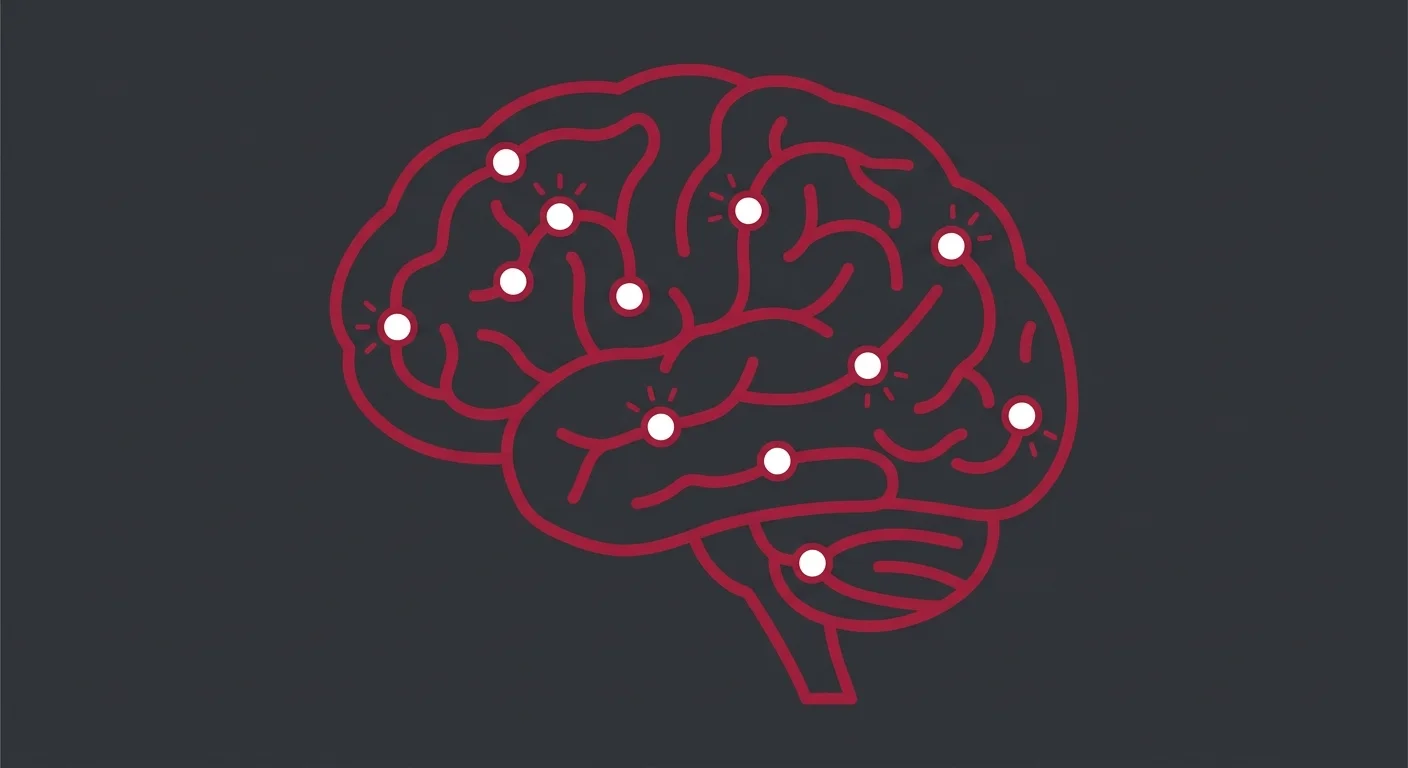
So what is happening in there?
While the structural tests keep coming back clean, the nervous system is running a completely different process — one that has nothing to do with tissue damage and everything to do with how the brain has reorganized itself around pain.
Chronic pain isn't acute pain that stuck around too long. It's a different neurological event entirely.
The brain reorganizes. The pain circuitry rewires. Once that shift happens, the original injury becomes almost beside the point — because what you're feeling is no longer coming from the injury site.
That's the actual mechanism behind why chronic pain persists well past the point of tissue healing. Not a mystery. Not a psychological quirk.
A structural rewiring of the central nervous system — one that keeps the alarm screaming long after the fire is out.
Central Sensitization: When the Alarm Keeps Screaming
Central sensitization is not a metaphor. It's a measurable physiological state.
The neurons inside your pain pathways become hyperexcitable — firing harder, firing faster, and firing in response to things that never triggered pain before. Touch that used to feel neutral now registers as threat. Movement that was once effortless now reads as danger.
According to NIH clinical definitions, central sensitization involves a functional increase in the excitability and synaptic efficacy of neurons in nociceptive pathways of the central nervous system.
In plain terms: the volume knob on your pain system gets turned all the way up. And the system forgets how to turn it back down.
And that's exactly what a clean MRI cannot see.
The disc is fine. The joint is stable. The imaging report says nothing is wrong. But the alarm has been screaming long enough that the brain now treats quiet as the abnormal state. The nervous system has recalibrated around a pain baseline that has nothing to do with the actual condition of your tissues.
That's the gap. Clean imaging, real pain. Both things are true at the same time.
The Neuroplasticity Problem — Pain Pathways That Don't Switch Off
Neuroplasticity gets sold as a good thing. And it is — until the brain starts learning the wrong lesson.
When pain signals fire repeatedly over weeks and months, the brain does exactly what it was built to do: it strengthens those pathways. They get faster. More efficient. And significantly harder to quiet.
The brain isn't malfunctioning. It's adapting. The problem is what it's adapting to.
That's pain-loop reinforcement. Neuroplasticity permanently alters synaptic pathways, keeping pain maps active long after peripheral tissues clear of inflammation.
The brain has learned pain. And what the brain learns, it protects.
NIH-published research has confirmed that chronic pain states physically reorganize brain structures — producing a measurable 5% to 11% reduction in gray matter density in specific regions.
That's not a figure of speech. That's a quantified structural change inside the brain itself, driven entirely by the persistence of pain signaling. The nervous system isn't just behaving differently. It has physically become different.
Why Cookie-Cutter Protocols Fail Sensitized Nervous Systems
Here's the thing about a sensitized nervous system: a generic adjustment sequence doesn't recalibrate it.
It can make it worse.
The cookie-cutter protocol was built for a structural model of pain. Apply force to the right segment, restore alignment, reduce local irritation. That logic works when the problem is mechanical.
It fails badly when the problem is neurological. Same sequence, same depth, same frequency, regardless of what the patient is actually reporting — that's not a care plan. That's a template applied to the wrong diagnosis.
A sensitized nervous system doesn't need more of the same input delivered on a fixed schedule. It needs assessment. It needs a clinician who reads how the system is actually responding — and who stops, reassesses, and changes course the moment the response signals something different.
Repeating a protocol that isn't producing results isn't persistence. It's the clinical definition of failure.
At Touch of Wellness Chiropractic, care plans aren't built from a template. They're built from what the patient actually reports — visit by visit, adjustment by adjustment.
That responsiveness isn't a selling point. For a nervous system stuck in a chronic pain loop, it's the only clinical approach that has any real chance of breaking it.
| Pain State | Primary Driver | Standard Treatment Response | Why It Persists |
|---|---|---|---|
| Acute pain | Active peripheral tissue damage — fracture, tear, inflammation at the injury site | Structural intervention addresses root cause; pain resolves as tissue heals | It doesn't — acute pain resolves when the tissue repairs and the nervous system resets normally |
| Transitional pain | Peripheral signals persisting beyond initial healing window, beginning to sensitize central pathways | Standard clearance protocols report structural resolution and close the case | Central pathways continue receiving input during the transition window; sensitization begins even as tissue heals |
| Centrally sensitized pain | Hyperexcitable neurons in nociceptive pathways firing without proportional peripheral input | Repeated structural assessments return negative; patient is told imaging is clean | The driver is now neurological — structural clearance cannot detect or address synaptic hyperexcitability |
| Maladaptive neuroplastic pain | Synaptic pathways permanently strengthened around a pain baseline through repeated firing | Cookie-cutter adjustment protocols apply mechanical input to a neurologically reorganized system | The brain has learned pain as a default state; fixed-sequence protocols don't recalibrate learned pathways |
| High-impact chronic pain | Entrenched central sensitization limiting major daily, work, and identity-defining activities | Patient cycles through providers; each runs the structural model that has already failed | No protocol designed for structural damage can reset a nervous system that has reorganized around persistent pain signals |
What Happens to the Brain's Pain Map Over Time
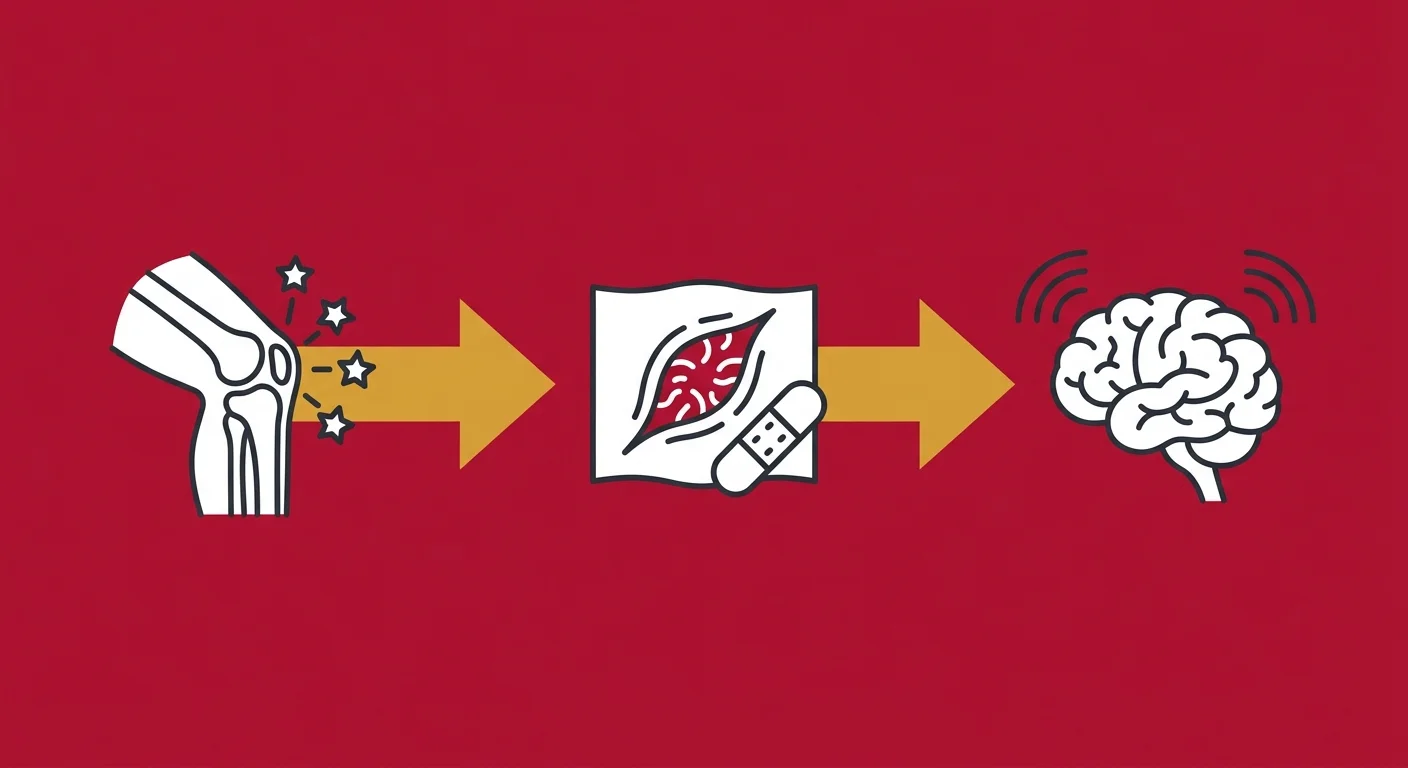
The brain doesn't just feel pain. It maps it.
And the longer that map stays active, the harder it is to erase.
Chronic pain doesn't just feel like it's rewiring the brain. It actually does.
Research has confirmed a measurable 5% to 11% reduction in gray matter density in specific brain regions driven entirely by sustained pain signaling. That's not a figure of speech. It's a quantified structural change — inside the brain itself, caused by nothing more than the persistence of a loop that was never interrupted.
Time is not neutral here.
The longer the pain loop runs uncorrected, the more deeply the nervous system commits to it. What started as a protective response to injury becomes the brain's new operating baseline. Reversing that takes more than a clean scan.
Structural Changes the Standard Imaging Won't Show
Here's what standard imaging actually does: it finds herniated discs, fractured vertebrae, torn soft tissue.
That's it. It was built to rule out macro-structural failure — not to assess whether your brain's pain-processing regions have been reorganized by months of persistent signaling. That question never made it onto the order form.
A 5% to 11% reduction in gray matter density doesn't appear on an MRI ordered to rule out disc pathology. The imaging is looking at the wrong layer.
It confirms tissue health. It says nothing about neurological function, pain pathway calibration, or whether the alarm has any reason to still be screaming.
That gap is why clearance feels like abandonment.
Patients were told everything looks fine. What they weren't told is that the assessment never looked at the system still generating their symptoms.
The Transition From Acute Injury to Systemic Hypersensitivity
Acute pain and chronic pain aren't the same condition at different intensities.
They run on different mechanisms entirely. And when the shift happens, the nature of the problem changes — not in degree, but in kind. That distinction is the one most treatment plans miss completely.
The transition isn't about the injury getting worse. It's about the nervous system taking over as the primary driver.
Central neuroimmune activation. Endocrine disruption. The original injury site has cleared — but the program it started is still running. Nothing in the periphery is generating these symptoms anymore. The central nervous system is doing it on its own now, and it doesn't need permission from a tissue injury to keep going.
Understanding how to break the pain-fear cycle starts here — with recognizing that this transition isn't psychological.
It's a measurable shift in neuroimmune and endocrine function. One that keeps the central nervous system locked in a threat response long after the structural threat is gone. Calling it anxiety, or catastrophizing, or a failure to heal — misses the mechanism entirely.
Who This Is Not For
This approach isn't for everyone.
That's not a disclaimer. It's a clinical reality worth saying out loud before we go any further.
If you arrive expecting the exact sequences your previous provider used — unwilling to follow a new clinical lead before assessment is even complete — this isn't the right fit.
Assessment drives the care plan here. Not prior habit. Not a preferred protocol. Not what felt familiar somewhere else.
And if the mind is already closed before the first evaluation — if the skepticism toward chiropractic care is non-negotiable no matter what an assessment turns up — that's information we both need to have early.
A sensitized nervous system needs a clinician willing to look hard, track the response, and course-correct when something isn't working. But it also needs a patient willing to let that process happen. One without the other doesn't get anyone anywhere.
| Timeline | What Is Happening Neurologically | What Standard Care Typically Does | What the Gap Costs |
|---|---|---|---|
| Acute phase (days to weeks) | Peripheral nociceptors signal injury; the nervous system responds appropriately and proportionally to tissue damage | Imaging and assessment identify structural damage; treatment targets the injury site directly | Minimal — the structural model fits the problem at this stage |
| Subacute phase (weeks to months) | Central sensitization begins; pain pathways in the brain start amplifying signals beyond what the tissue damage warrants | Follow-up imaging confirms structural healing; patient is cleared and often discharged from active care | The neurological shift goes undetected — clearance is issued while the pain system is actively reorganizing |
| Chronic phase (months and beyond) | Pain maps become embedded in brain architecture; the nervous system now generates pain independently of peripheral tissue status | Repeat imaging returns normal; patient is referred onward or told symptoms are unexplained | The patient is medically cleared but neurologically untreated — the alarm keeps screaming with no one addressing it |
| Entrenched chronic phase | Neuroimmune and endocrine disruption reinforce the pain loop; the threat response runs as the nervous system's new baseline | Standard protocols are repeated or discontinued; pain is reclassified as chronic without a neurological intervention plan | The longer the loop runs uncorrected, the more deeply the nervous system commits to it — reversing it requires a fundamentally different approach |
| Recovery — with nervous system intervention | Targeted clinical input begins recalibrating overactive pain pathways; the brain receives new, differentiated signals that interrupt the established loop | Individualized care plan built from patient-reported response, adjusted when findings shift — not repeated on a fixed template | When the neurological driver is addressed directly, the gap between structural clearance and functional recovery finally starts to close |
Breaking the Neurological Pain-Fear Cycle
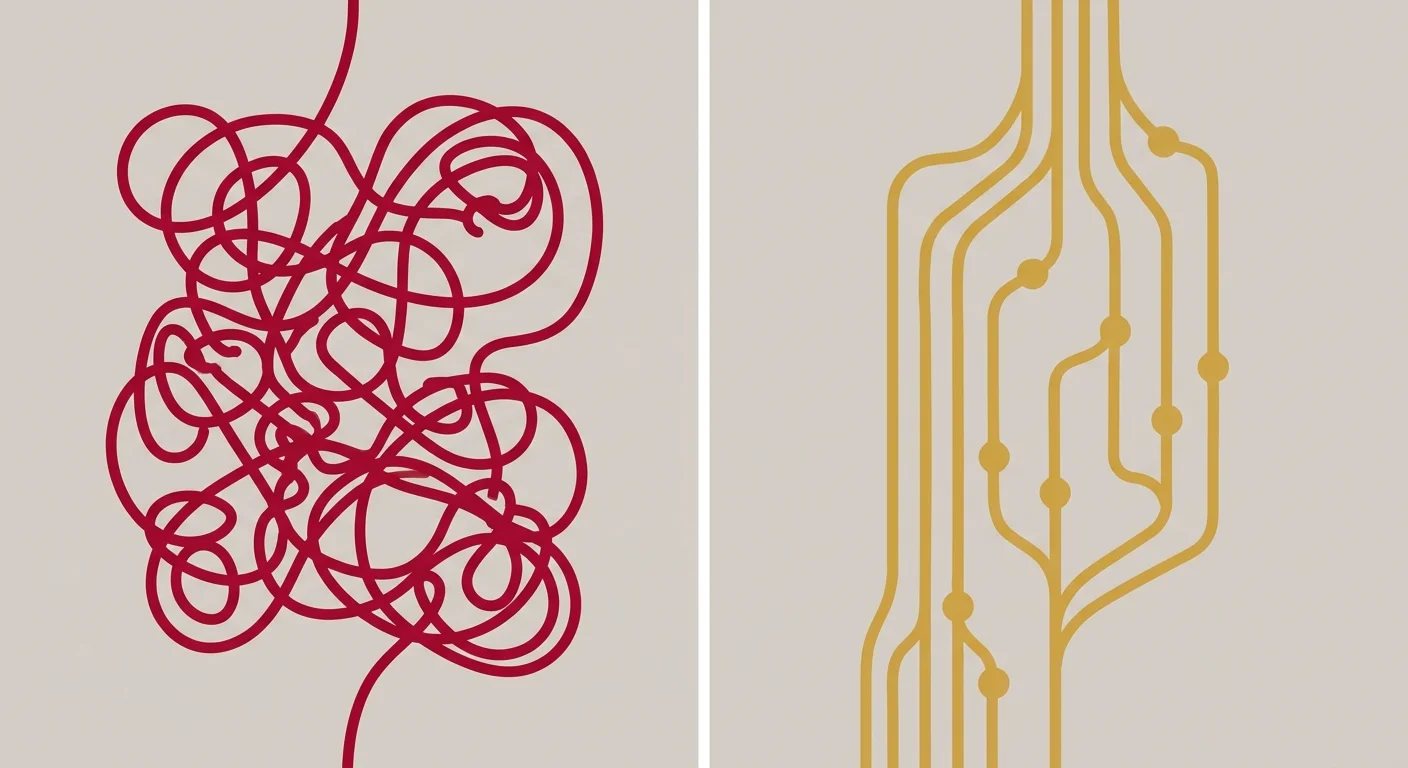
The loop doesn't break on its own.
Central sensitization doesn't resolve because time passes. It doesn't resolve because a scan came back clean. It resolves when the nervous system receives the right input — consistently, from a clinician who is actually tracking how it responds.
Treating a structure and treating a system are not the same clinical act.
Structures respond to mechanical intervention. Systems respond to feedback.
The shift from acute to chronic pain isn't about damage accumulating. It's driven by central neuroimmune activation and endocrine disruption — a systemic transition that has nothing to do with whether the original tissue is still injured.
Once that transition completes, the injury site is no longer running the show. The nervous system is. And you can't reset a system that's crossed that line by treating it like a structural problem.
What a Real Clinical Reset Requires
A genuine clinical reset starts with one non-negotiable: the provider has to be looking at the right thing.
Not the disc. Not the joint space. The nervous system — how it's responding, what's amplifying, and whether the current approach is quieting it or making it worse. That's the layer that matters. Most care never reaches it.
Maladaptive neuroplasticity keeps pain maps active long after the peripheral tissues have cleared. Reversing that requires input the nervous system doesn't already have a catalogued answer to.
Generic, repetitive adjustment sequences — same order, same depth, same schedule — are exactly the kind of input a sensitized system has already filed away. They don't interrupt the loop. They get absorbed into it. The brain doesn't register them as new information. It confirms what it already knows.
A real reset requires the willingness to stop and reassess when something isn't working.
That sounds obvious. But most care models aren't built for it — because course-correction disrupts the billing rhythm that volume-first practices depend on. Changing the plan mid-treatment cuts into predictable visit counts. So the plan doesn't change. It repeats.
Honest, outcome-based care — the kind that rewrites the approach when the approach isn't producing results — is the rarer model. It's also the only one with any real shot at interrupting a pain loop operating at the neurological level.
How Individualized Adjustments Target Neural Pathway Recalibration
Individualized chiropractic adjustments don't operate on a sensitized nervous system the same way they operate on a mechanical complaint.
The objective isn't to restore joint mobility. It's to deliver precise, calibrated input the brain can use to begin recalibrating its threat response. That's a different clinical act. It requires a different clinical standard.
Synaptic hyperexcitability means the pain threshold has been artificially lowered. Stimuli that should register as neutral are being flagged as threats. The brain isn't misreading the signal — it's running a pattern it learned.
An adjustment approach targeting neural pathway recalibration introduces a specific mechanical signal at the right spinal segment, at the right intensity — new information, instead of another confirmation of the threat pattern already running.
That distinction is the whole separation between outcome-driven functional recovery and protocols that address the pain experience without ever touching what's generating it.
At Touch of Wellness Chiropractic, the goal isn't symptom management. It's interrupting the loop producing the symptoms.
Practical Steps Toward Quieting Overactive Nerve Pathways
Quieting overactive nerve pathways isn't a single-visit event.
It's a process built around what the patient actually reports at every stage. Not what a standard protocol assumes they should be experiencing by now.
Pain-loop reinforcement happened because the brain strengthened the pathways carrying the pain signal. They got faster and more efficient through repetition. That's not a metaphor — that's how neural consolidation works.
Interrupting those pathways requires the opposite: varied, precisely dosed input that doesn't fit the pattern the brain has already automated. Adjustments calibrated to where the nervous system actually is right now — not where it was at the first visit, not where it was when the last image was taken.
The fire is out. The alarm is still screaming.
It doesn't stop because someone shows it the fire report. It stops when someone reaches the panel and resets it.
That reset — applied to the nervous system rather than a wall-mounted box — is what resolving chronic back pain at a neurological level actually demands. A provider looking at the right layer. A plan that changes when the system's response says it should.
| Clinical Approach | Target Mechanism | What It Addresses | What It Leaves Untouched |
|---|---|---|---|
| Imaging and structural diagnostics (MRI, X-ray) | Peripheral tissue integrity | Disc pathology, fractures, torn soft tissue | Neurological excitability, pain pathway calibration, central sensitization |
| Standard pharmacological pain management | Symptom intensity at the peripheral level | Short-term reduction in pain signal awareness | The neuroimmune and endocrine drivers sustaining the chronic pain state |
| Generic, repetitive adjustment protocols | Joint mobility and local mechanical restriction | Segmental range of motion, localized tissue irritation | Maladaptive pain mapping, synaptic hyperexcitability, loop reinforcement |
| Individualized chiropractic adjustments (nervous system-targeted) | Neural pathway input and threat-response recalibration | The central sensitization loop — what the brain is signaling, not just where | Structural disc pathology requiring surgical or orthopedic intervention |
| Ongoing clinical reassessment and plan modification | The nervous system's evolving response at each stage of care | Course corrections when the current input is provoking rather than quieting the system | Volume-first visit counts; billing-calendar-driven treatment timelines |
Frequently Asked Questions
These aren't theoretical questions. They're the ones people bring in after the scan comes back clean and the pain doesn't follow it out the door. Real people. Normal reports. Bodies that didn't get the memo.
They deserve straight answers. Not reassurances. Not 'it depends.' Here's what's actually happening — and what to do about it.
If my MRI and X-rays are clean, why does my body still hurt?
Because imaging is a tissue report. It confirms that bones and discs and soft tissue have structurally resolved. It was never built to evaluate your central nervous system.
Central sensitization means the pain circuitry is still firing — hyperexcitable, amplified, treating ordinary input as a threat — long after the original structural problem cleared. The scan confirmed the fire went out. It never looked at the alarm.
Those are two different instruments. You only received one of them.
What is central sensitization, and how does it keep the brain feeling pain?
Central sensitization is a measurable physiological state — not a metaphor, not anxiety. The neurons in your pain pathways become functionally hyperexcitable. The threshold drops. Signals that should register as neutral start flagging as dangerous.
The brain isn't broken. It adapted. It did exactly what it was designed to do when pain signals fired repeatedly — it strengthened those pathways, made them faster, made them more efficient.
The problem is it adapted in a direction that keeps generating pain long after the original reason for that adaptation is gone.
Can the nervous system get stuck in a chronic pain loop after an injury heals?
Yes. That is exactly what happens.
Neuroplasticity permanently alters synaptic pathways — keeping pain maps active long after peripheral tissues have cleared. The brain strengthened those signal routes through repetition. They became faster and more efficient. Now the loop runs on its own.
It doesn't dissolve because time passes. It doesn't dissolve because a scan came back clean. It runs until something interrupts it.
How does specialized chiropractic care break the neurological pain-fear cycle?
By delivering input the nervous system doesn't already have a scripted answer to. That's the distinction that matters.
Generic, repetitive sequences — same order, same depth, same schedule every visit — don't interrupt the threat pattern the brain is running. They get absorbed into it. The loop keeps going.
Individualized chiropractic adjustments, targeted to the right spinal segment at the right intensity and tracked against how the system actually responds, give the nervous system new information. That's what changes the signal. Not repetition. New input, calibrated to what the patient is reporting right now — and adjusted when the response says it should be. That's the clinical standard at Touch of Wellness Chiropractic.
What steps can I take to retrain my brain and quiet overactive nerve pathways?
Start with the right provider. One who's actually evaluating the nervous system — not repeating the structural assessment that already came back negative.
The shift from acute to chronic pain is driven by central neuroimmune activation and endocrine disruption. Not ongoing tissue damage. That changes what the recovery path has to target. And it means the clinical input has to change when it isn't producing a response.
There's no shortcut around that feedback loop. What works is consistent, responsive care — adjusted to what the system is actually doing, not what a fixed protocol assumes it should be doing. Stay in it long enough, with a clinician who's tracking the response, and the alarm can be reached.
The Alarm Is Still Screaming — But That's Fixable
The fire is out. The alarm is still screaming.
That gap — between what imaging confirms and what the nervous system is doing — is the whole story. A clean scan is a tissue report. It was never a nervous system report. Those are two different documents. Most patients only ever get handed one.
Central sensitization doesn't resolve because time passes. It doesn't resolve because the disc healed or the inflammation marker came back clean.
It resolves when the nervous system gets the right input — calibrated, responsive, delivered by a clinician who is actually tracking how the system reacts. Not running the same sequence on Tuesday that didn't work on Friday.
That's the reset. Not a scan. Not a new diagnosis. A functional interruption of a loop the nervous system has been running long enough to call normal.
If your imaging is clean and your pain isn't, the story isn't over. It's just been told by the wrong instrument.
At Touch of Wellness Chiropractic, the starting point is the nervous system — not a protocol, not a template, not a billing calendar built around visit counts. The assessment looks at the right layer. The care plan changes when the system's response says it should.
The fire is out. The alarm is still screaming. The only question left is whether you're talking to someone who knows where the panel is.
The fire is out. The alarm is still screaming. If your scan came back clean and your pain didn't go with it, the assessments you've had so far were looking at the wrong layer. Touch of Wellness Chiropractic starts with the right one.
Copyright Touch of Wellness Chiropractic 2026
1101 W Jackson St, Suite A Morton, IL 61550
Web Design by iTech Valet