
(309) 321-8412 | 1101 W Jackson St, Suite A, Morton, IL 61550
(309) 321-8412 | 1101 W Jackson St, Suite A, Morton, IL 61550
Why 'Unexplained' Fatigue Is Often a Nervous System Distress Signal
Unexplained fatigue is not a mystery. It is the autonomic nervous system stuck in a state it was never designed to hold — and the circuit breaker that never resets is almost always structural.
The autonomic nervous system runs two operating modes: sympathetic activation, which burns energy during high-alert states, and parasympathetic activation, which governs rest, repair, and recovery. Spinal interference disrupts the signaling pathways that allow the nervous system to shift between those modes. When that shift is blocked, the body stays locked in sympathetic overdrive — burning energy continuously, never entering the restoration phase required to rebuild it.
This is measurable. Research tracking autonomic function in chronic fatigue cohorts documents a statistically significant reduction in heart rate variability, confirming a persistent shift toward sympathetic dominance. Prolonged activation of the stress response disrupts the hormonal systems that regulate cellular energy production, compounding fatigue at a physiological level. When vagal nerve activity is insufficient, neuroinflammation intensifies the exhaustion further — and none of that appears in standard bloodwork.
The scale is significant. Up to 2.5 million Americans are estimated to live with systemic exertion intolerance disease. Between 84% and 91% of those individuals never receive a formal clinical diagnosis. The CDC classifies profound, unexplained exhaustion persisting for at least six consecutive months — accompanied by unrefreshing sleep and post-exertional worsening — as a primary diagnostic indicator of this condition.
Spinal correction produces immediate, measurable neurophysiological responses, including documented shifts in cortical activity and autonomic tone following treatment. Addressing the spinal interference that locks the nervous system in overdrive is a clinically distinct approach to fatigue that does not respond to rest, lifestyle changes, or standard medical care.
Last Updated: June 22, 2026
- • When 'Normal' Bloodwork Isn't the Whole Answer
- • What the Autonomic Nervous System Has to Do With Your Energy
- • The Physical Signs of a Nervous System Running on Empty
- • How Spinal Alignment Affects the Nervous System's Recovery Mode
-
• Frequently Asked Questions About Fatigue and the Nervous System
- • How does nervous system overload cause unexplained fatigue?
- • Can chiropractic care help restore energy levels?
- • What are the physical signs of a chronically stressed nervous system?
- • How does spinal alignment affect the autonomic nervous system?
- • Why doesn't standard medical testing explain my chronic fatigue?
- • How long does it take to see improvement in fatigue after starting chiropractic care?
- • If Your Energy Has Been Gone Long Enough, It's Time to Ask Why
When 'Normal' Bloodwork Isn't the Whole Answer
Here's the thing about normal bloodwork: it's built to find what's missing. Low iron. Sluggish thyroid. Depleted B12. What it can't do is tell you whether your nervous system is locked in a state it doesn't know how to exit.
That gap is where chronic fatigue lives. Between 84% and 91% of people with systemic exhaustion syndromes never get a formal clinical diagnosis. The labs come back clean. The doctor says everything looks fine. The patient drives home just as depleted as when they arrived.
So the exhaustion gets a new name. Stress. Poor sleep hygiene. Anxiety. The label changes. The fatigue doesn't. And none of those explanations account for a nervous system running the body at emergency output, around the clock, burning through energy reserves it's not getting back.
Why the Cookie-Cutter Medical Workup Misses the Real Source
Standard medical workups run on a deficiency model. Find what's missing. Replace it. Move on. That logic works for a lot of conditions. It breaks down completely when the problem isn't a deficiency — it's something that won't turn off.
The CDC diagnostic criteria are specific: profound, unexplained exhaustion persisting for at least six consecutive months — and not relieved by rest — meets the threshold for systemic exertion intolerance disease. Post-exertional worsening and unrefreshing sleep aren't secondary complaints. They're required diagnostic features. Most standard workups never ask about either one.
Getting that diagnosis requires a provider asking the right questions first. Most don't. A standard workup runs a metabolic panel, checks thyroid function, maybe orders a sleep study. None of those tests measure autonomic function. None of them detect whether the circuit between sympathetic overdrive and parasympathetic recovery has jammed shut. That's the starting point for nervous system stress recovery — and it's where most diagnostic paths stop cold. People arriving at Touch of Wellness Chiropractic have often run every standard test already, with nothing actionable to show for it.
Up to 2.5 million Americans are estimated to be living with this condition. NIH research on ME/CFS confirms that the vast majority never receive a diagnosis that matches what they're actually experiencing. That's not a failure of patient effort. That's a failure of the diagnostic framework. And individualized chiropractic care starts exactly where that framework stops.
| Standard Medical Test | What It Measures | What It Misses | Why This Matters for Fatigue |
|---|---|---|---|
| Complete Metabolic Panel | Blood glucose, kidney function, liver enzymes, electrolyte balance | Whether the nervous system can shift out of sympathetic overdrive into recovery mode | A body burning through energy reserves without entering restoration will show normal chemistry — the panel was never designed to detect that failure |
| Thyroid Panel (TSH, T3, T4) | Thyroid hormone output and feedback loop regulation | Autonomic signaling disruptions that mimic thyroid-related fatigue without any hormonal deficiency | Patients with normal thyroid results still experience exhaustion when spinal interference keeps the stress response locked on — the thyroid panel cannot see that |
| Complete Blood Count (CBC) | Red blood cell count, hemoglobin, white cell distribution, platelet levels | Neurological or autonomic drivers of fatigue that leave no signature in the blood | Anemia-related fatigue resolves when iron is corrected — nervous system fatigue does not, because the cause isn't in the blood at all |
| Sleep Study (Polysomnography) | Sleep stage cycling, breathing interruptions, oxygen saturation during sleep | Unrefreshing sleep caused by sustained sympathetic activation rather than structural airway obstruction | A sleep study can rule out apnea; it cannot explain why rest never restores energy when the nervous system won't downshift into parasympathetic recovery |
| Inflammatory Markers (CRP, ESR) | Acute systemic inflammation and immune activation levels | Low-grade neuroinflammation driven by insufficient vagal tone and chronic parasympathetic suppression | Standard inflammatory markers track immune events — they don't capture the central fatigue pathways that fire when vagus nerve regulation breaks down |
| Heart Rate Assessment (Resting ECG) | Rhythm, conduction patterns, and gross cardiac electrical activity | Heart rate variability — the measure most directly tied to autonomic balance and fatigue severity | A standard ECG tells you whether the heart is beating correctly; it tells you nothing about whether the autonomic system governing that heart has lost its ability to recover |
What the Autonomic Nervous System Has to Do With Your Energy
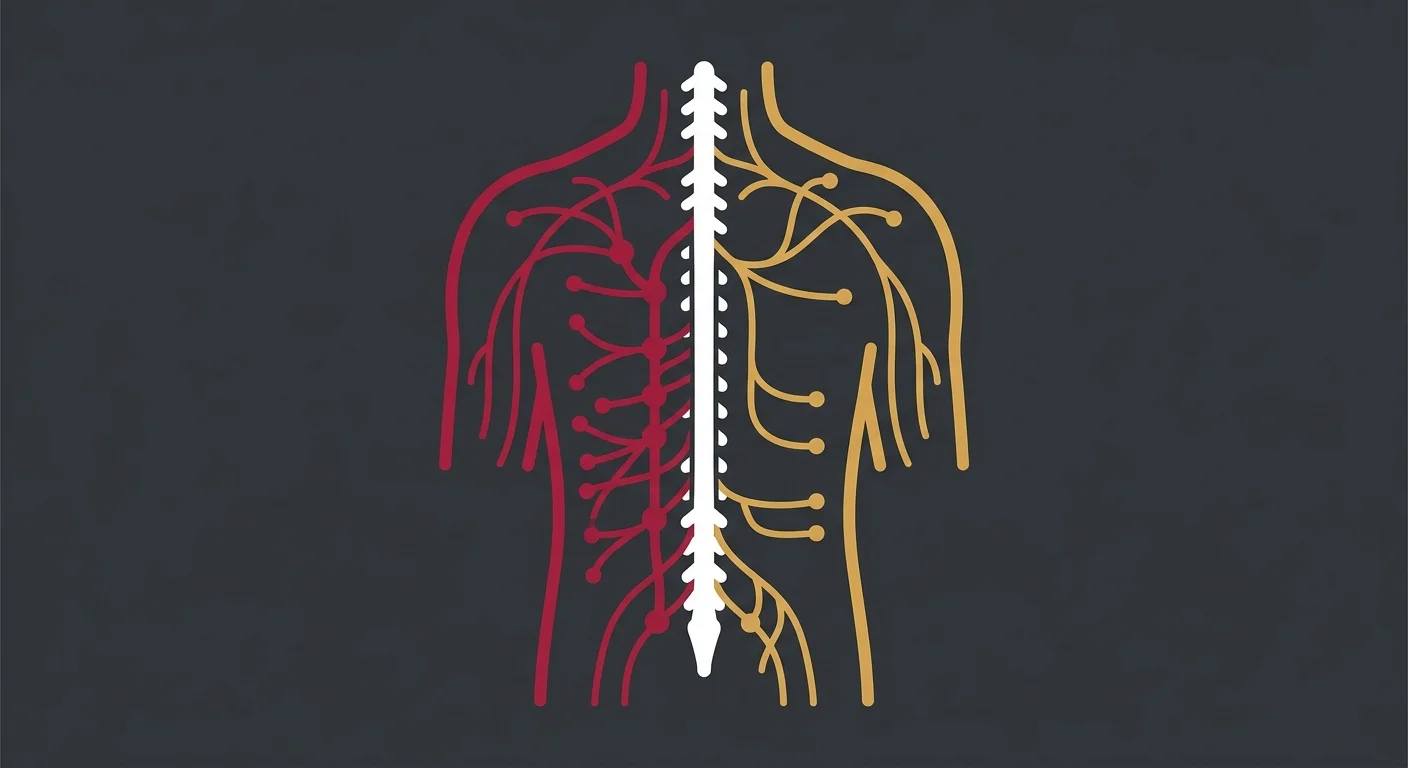
Here's the thing about energy: it's not just something your body makes. It's something your nervous system decides how to spend. And if the nervous system is locked in the wrong mode, more sleep won't fix it.
The autonomic nervous system runs two modes. Sympathetic is high-alert — heart rate up, cortisol climbing, muscles ready to go. Parasympathetic is the opposite: repair, immune regulation, actual recovery. Your body is built to shift between them. Most people in chronic fatigue aren't shifting. They're stuck.
But that transition depends on clean signaling. When spinal interference disrupts the neural pathways that tell the body it's safe to shift into recovery mode, the circuit breaker jams. The physical warning signs of chronic nervous system overload aren't random — they're the body broadcasting that it hasn't been able to exit the emergency state in a very long time.
How Sympathetic Overdrive Drains the Body's Energy Reserves
Sympathetic overdrive doesn't feel like panic. It feels like running on fumes. Wired but exhausted. Awake but never restored.
Research tracking autonomic function in chronic fatigue cohorts documents a statistically significant reduction in heart rate variability — a persistent shift toward sympathetic dominance that correlates directly with subjective fatigue severity. That's not a personality trait. That's not a sleep hygiene problem. That's a measurable, physiological pattern with a traceable mechanism.
And the longer it runs, the deeper the damage goes. Sustained stress-response signaling disrupts the hormonal systems that govern cellular energy production. The body isn't just tired. It's biochemically depleted — burning through reserves the recovery state it can't reach was supposed to replenish. That's not burnout in the pop-psychology sense. That's a system running in the red with no path back to baseline.
The Role of the Vagus Nerve in Recovery and Restoration
The vagus nerve is the body's primary downshift mechanism. It carries parasympathetic signals that slow the heart, activate digestion, and tell the inflammatory response to stand down. It's the off switch the system needs — and in a chronically overloaded nervous system, it's barely firing.
When vagal tone is insufficient, that stand-down signal never fully arrives. Inflammatory markers stay elevated. Central neuroinflammation compounds the exhaustion at a neurological level. So the fatigue isn't just physical depletion. The nervous system is actively running a process that makes recovery harder with every passing day — not as a metaphor, but as a measurable biological loop.
Restoring parasympathetic tone interrupts those central fatigue pathways. That's the reset the body needs. Not supplements. Not a better sleep routine. Structural interference is what's keeping the breaker jammed — and that's what has to be addressed first.
| Autonomic State | Nervous System Branch | Energy Effect | Fatigue Outcome When Stuck |
|---|---|---|---|
| Active / Alert | Sympathetic | Burns energy reserves to fuel high-alert functions — elevated heart rate, heightened cortisol, muscles primed for immediate response | Body cannot enter restoration mode; energy is continuously depleted without replenishment |
| Rest / Repair | Parasympathetic | Conserves and restores energy by activating tissue repair, immune regulation, and metabolic recovery processes | Without access to this state, the body accumulates a physiological debt it cannot pay back |
| Transition Between States | Both branches — balanced signaling | Fluid movement between alert and recovery allows energy to be allocated appropriately based on actual demand | Disrupted transition means the body defaults to the higher-cost state regardless of whether the threat is real |
| Sympathetic Dominance (Stuck On) | Sympathetic — locked | Body treats every moment as an emergency; energy allocation is permanently skewed toward survival output | Fatigue deepens progressively — the system burns more than it can recover, producing exhaustion that rest alone cannot resolve |
| Parasympathetic Suppression (Stuck Off) | Parasympathetic — suppressed | Recovery signals — including the stand-down command to inflammatory processes — never fully arrive | Neuroinflammation compounds physical depletion; the nervous system actively works against recovery rather than supporting it |
| Restored Autonomic Balance | Both branches — regulated | The circuit resets — energy expenditure matches demand, and restoration cycles operate as designed | Fatigue patterns normalize once the nervous system can exit the emergency state and complete the recovery process |
The Physical Signs of a Nervous System Running on Empty
These symptoms aren't random. They follow a pattern — and once you've seen it, you recognize it immediately.
Wired but exhausted. Alert but never rested. A cognitive fog so thick that basic concentration feels like effort it never used to.
That fog isn't a separate issue from the fatigue. It's the same circuit.
When the autonomic nervous system can't shift into parasympathetic recovery mode, the brain doesn't get the cellular restoration it runs on. The relationship between spinal interference, autonomic dysregulation, and cognitive clarity and focus traces back to the same failure point. One system. One problem. Two names for it.
So what does that look like in the body? Sleep that doesn't restore. Post-exertional crashes after mild activity. Muscle tension that never fully releases between sessions. A resting heart rate that stays elevated when nothing is happening.
The CDC classifies unrefreshing sleep and post-exertional worsening as mandatory diagnostic features — not secondary complaints — for systemic exertion intolerance disease. These aren't lifestyle problems. They're structural signals the body has been broadcasting for a long time.
Who This Approach Is and Is Not Right For
This isn't a general wellness offering. It's built for a specific kind of patient.
Someone who's run the standard workup — more than once — and gotten the same answer every time: everything looks normal. Someone whose fatigue doesn't move with more sleep, better nutrition, or stress reduction. Someone ready to follow a care plan built from what they actually report — not a protocol carried over from a previous provider.
But it's not right for everyone.
If you're looking for a single-visit fix, this isn't that. If you need the care plan to replicate what a previous provider did before any assessment has been completed, this isn't the right fit. And if you've already decided nothing here will change your mind regardless of what the clinical findings show — that's important information. The assessment drives the plan. Inherited expectations don't.
Here's what makes the depletion dangerous: it doesn't plateau. Sustained sympathetic activation compounds over time. Each cycle the body can't exit erodes the hormonal systems that govern cellular energy production a little further.
The patients who respond best have recognized that what they're experiencing is progressive, not stable — and that waiting it out isn't producing results. At Touch of Wellness Chiropractic, the starting point is always what the patient actually reports. The care plan is built from that. And when the data changes, the plan changes.
| Physical Sign | Body System Involved | What the Nervous System Is Doing | Common Misattribution |
|---|---|---|---|
| Unrefreshing sleep regardless of hours logged | Autonomic nervous system | Parasympathetic recovery mode never fully activates — the body stays in low-level alert through the night, preventing deep restorative cycles | Poor sleep hygiene or insomnia diagnosis |
| Post-exertional crash after mild activity | Metabolic and endocrine systems | Depleted energy reserves can't be replenished because the hormonal systems governing cellular recovery remain suppressed by sustained sympathetic output | Deconditioning or low fitness level |
| Persistent muscle tension that won't release between sessions | Musculoskeletal and neuromuscular systems | Sympathetic dominance keeps muscle tissue primed for threat response — the stand-down signal from the parasympathetic system never fully arrives | Stress or poor posture |
| Elevated resting heart rate with no cardiac explanation | Cardiovascular and autonomic systems | Heart rate variability drops as the body locks into sympathetic overdrive — the regulatory toggle between high-alert and recovery states becomes impaired | Anxiety or caffeine sensitivity |
| Cognitive fog and difficulty concentrating | Central nervous system | The brain doesn't receive the cellular restoration it needs when autonomic recovery mode is blocked — neuroinflammatory signaling compounds the impairment | Depression, burnout, or attention disorder |
| Wired but unable to rest — fatigue without the ability to relax | Autonomic nervous system | Sustained cortisol and sympathetic output keep the system in emergency mode even when the body is exhausted — recovery and alertness become decoupled | Generalized anxiety or overwork |
How Spinal Alignment Affects the Nervous System's Recovery Mode
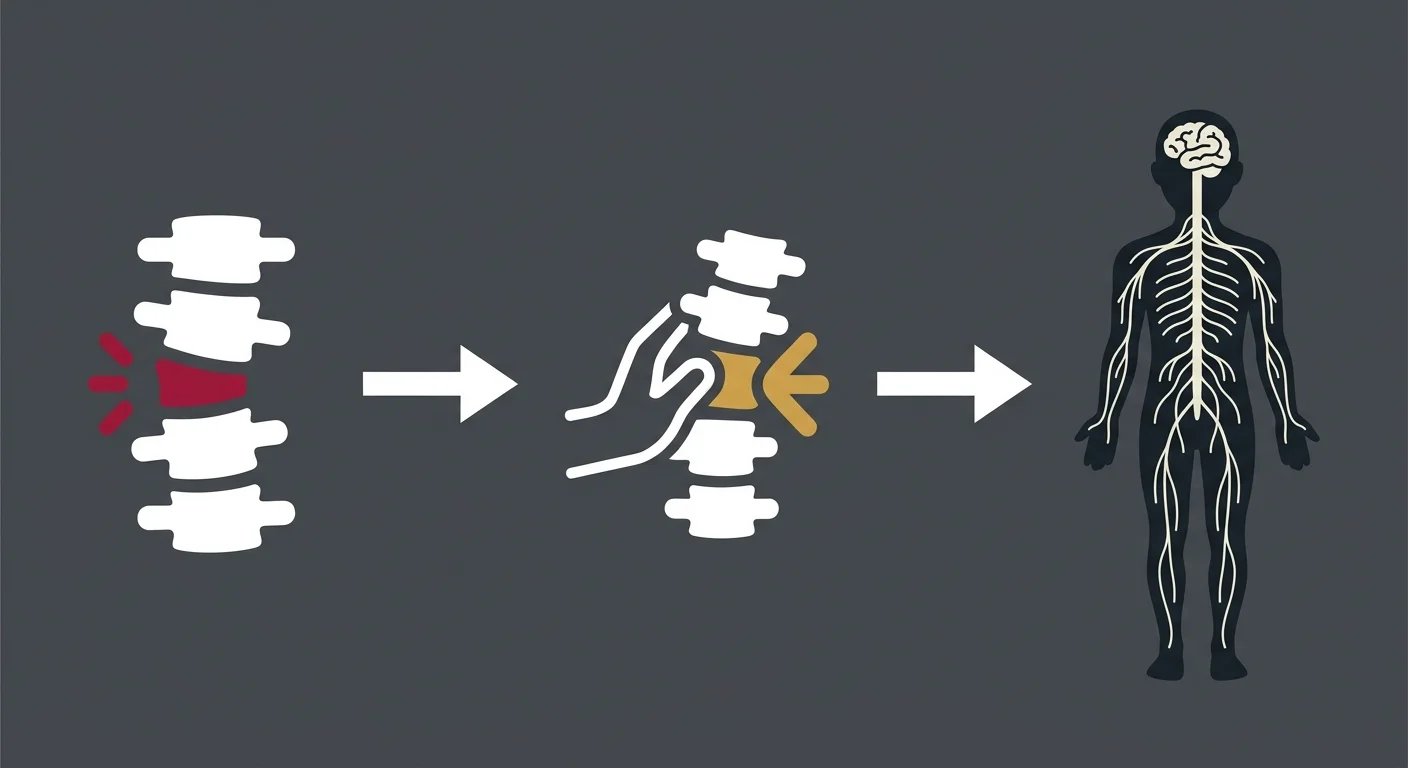
The spine isn't just holding you upright. It's the primary signaling conduit between the brain and the rest of the nervous system — and when that conduit is compromised, the stand-down signal never fully arrives.
That's the part most providers skip over. NIH-published research documents that spinal corrections generate immediate, measurable neurophysiological reactions — including documented shifts in cortical activity and a move toward parasympathetic modulation. The adjustment isn't just mechanical. It's a neurological input that the nervous system responds to in real time.
And it matters where that input lands. The vagus nerve — the body's primary parasympathetic highway — runs in close proximity to the cervical spine. When spinal imbalances compress or irritate the structures around it, vagal tone drops. Inflammatory cytokines stay elevated. The central fatigue pathway keeps firing. Correcting the structural interference isn't a workaround. It's targeting the source. For patients already asking about what sustained recovery actually feels like in daily life, that's exactly the right question.
What an Individualized Care Assessment Actually Looks Like
Here's the thing: an assessment at Touch of Wellness Chiropractic doesn't begin with a protocol. It begins with what you report.
That means the clinical picture is built from your actual presentation — where the tension lives, how the fatigue patterns across the week, what worsens it. The structural evaluation maps those reports to spinal function and autonomic indicators. The care plan comes from that picture. Not a template carried over from the last patient. Depending on what the assessment reveals, that plan may bring in Cold Laser Therapy to address tissue-level inflammation, or therapeutic massage to support the nervous system's ability to downshift between sessions.
And it changes. If something isn't producing results after a handful of visits, the plan changes. Repeating a protocol that isn't working isn't care — it's a template. The goal is to get the autonomic circuit breaker out of the jammed position, measurably and progressively. That requires a provider willing to follow the data instead of a predetermined sequence. Not a fixed timeline. Not a visit count. A plan that reflects what's actually happening in your nervous system — and gets updated when that changes.
| Assessment Stage | What Is Evaluated | Why It Matters for Fatigue | How It Differs From a Standard Visit |
|---|---|---|---|
| Patient History Review | Fatigue patterns across the week, what worsens or improves symptoms, prior treatments and their outcomes, sleep quality and post-exertional responses | Establishes whether fatigue is structural and progressive rather than lifestyle-driven — separates autonomic dysfunction from generic deconditioning | Standard visits typically skip detailed pattern mapping; this stage treats patient-reported experience as primary clinical data, not a background formality |
| Spinal Structural Evaluation | Segmental alignment, restricted mobility, areas of tension or compensation that correlate with reported symptom locations | Identifies the specific spinal regions where nerve signal interference is most likely disrupting the autonomic shift from sympathetic to parasympathetic | A standard visit may address the site of pain only; this evaluation looks for structural patterns that explain systemic fatigue, not just localized discomfort |
| Autonomic Indicator Assessment | Resting muscle tension, heart rate patterns, nervous system responsiveness — observable markers of whether the body is locked in high-alert mode | Confirms whether the structural findings align with active sympathetic dominance, which is the physiological driver of unrefreshing sleep and persistent exhaustion | Standard visits rarely assess autonomic state; here it determines whether the presenting fatigue is neurological in origin and guides where care begins |
| Modality Selection | Which interventions — spinal correction, Cold Laser Therapy, therapeutic massage — best match the structural and autonomic findings from this specific patient | Targets the actual interference pattern rather than applying a generic sequence; the modality serves the clinical picture, not the other way around | Assembly-line protocols apply the same combination of interventions regardless of presentation; selection here is driven by what the assessment revealed, not by habit |
| Care Plan Construction | Visit frequency, sequencing of interventions, and the specific outcome markers that will signal whether the plan is producing results | Gives both patient and provider a shared definition of progress — so there's a real basis for continuing, adjusting, or changing course | Standard care plans are often predetermined by diagnosis code or visit package; this plan is built from the patient's actual presentation and updated when the data changes |
| Ongoing Reassessment | Patient-reported changes between visits, shifts in fatigue patterns, any new symptoms or improvements — used to update the care plan in real time | Ensures the plan stays matched to what the nervous system is actually doing, not what it was doing at intake — critical when autonomic recovery is nonlinear | Most standard workflows revisit the plan only at fixed intervals or not at all; reassessment here is a built-in clinical standard, not an exception triggered by a complaint |
Frequently Asked Questions About Fatigue and the Nervous System
These questions come from people who've already done the medical rounds. They got normal labs. They got shrugged shoulders. Now they want straight answers — not reassurances.
So that's what's here. No gentle redirects. No "it depends on your situation." Just direct responses to the real questions.
How does nervous system overload cause unexplained fatigue?
The autonomic nervous system is built to toggle. High alert when it needs to respond. Recovery mode when the threat is gone. When spinal interference disrupts the signaling pathways that allow that transition, the toggle jams.
The body stays locked in sympathetic overdrive — burning energy continuously, unable to enter the restoration phase it needs to rebuild what it spent. Research tracking autonomic function in chronic fatigue cohorts documents a statistically significant reduction in heart rate variability, confirming that persistent sympathetic dominance correlates directly with subjective fatigue severity.
That's not a mood problem. It's a physiological pattern with a structural driver. And it won't resolve until that driver is addressed.
Can chiropractic care help restore energy levels?
Yes — but the mechanism isn't stimulation. It's regulation.
Spinal corrections produce immediate, measurable neurophysiological reactions, including a documented shift toward parasympathetic modulation. That shift is what the exhausted body needs to move out of survival mode and into actual restoration.
Energy doesn't come back in a single visit. But when the autonomic circuit stops running on high-alert continuously, the recovery process can finally begin. That's when patients start noticing the difference — not because something was added, but because something that was jammed finally moved.
What are the physical signs of a chronically stressed nervous system?
Sleep that logs eight hours and still leaves you wrecked. Crashes after mild activity that shouldn't cost you anything. Muscle tension that won't let go between sessions. A resting heart rate that stays elevated when you're just sitting.
The CDC doesn't classify unrefreshing sleep and post-exertional worsening as secondary complaints. They're mandatory diagnostic features for systemic exertion intolerance disease. That distinction matters.
These aren't lifestyle inconveniences. They're structural signals. The body has been broadcasting them for a long time. The question is whether anyone is listening to what they're actually pointing at.
How does spinal alignment affect the autonomic nervous system?
The spine is the primary conduit for the signals that tell the nervous system whether to stay on high alert or stand down. Structural imbalances — especially in the cervical region — compress or irritate the surrounding tissues and disrupt those signals before they arrive.
The result is reduced vagal tone, elevated inflammatory cytokines, and a nervous system stuck in a state it was never designed to sustain indefinitely. NIH-published research confirms that spinal corrections produce measurable changes in autonomic cortical activity and an immediate shift toward parasympathetic modulation.
That's not a side effect of treatment. That's the mechanism it's working through.
Why doesn't standard medical testing explain my chronic fatigue?
Standard panels aren't built to measure autonomic function. They check thyroid markers, iron levels, inflammatory indicators. All of it can look completely normal while the nervous system is locked in sustained sympathetic overdrive. The test isn't finding anything wrong because it's not looking at the right system.
That gap is bigger than most people realize. An estimated 84% to 91% of people with chronic fatigue syndrome never receive a formal clinical diagnosis. Up to 2.5 million Americans are living with it right now — without a name for what they're experiencing.
Unexplained doesn't mean undetectable. It means the right system hasn't been evaluated yet.
How long does it take to see improvement in fatigue after starting chiropractic care?
There's no honest single number — and any provider who hands you one before an assessment is finished is running a model this practice doesn't use.
What the assessment reveals shapes the trajectory. How long the nervous system has been locked in overdrive, where the structural interference is concentrated, and how the patient responds in the first handful of visits all factor into what realistic progress looks like. That picture doesn't exist until the evaluation is done.
What doesn't change: if something isn't producing results, the plan changes. Repeating a protocol that isn't working isn't care. The goal is measurable progress — and when that progress stalls, the approach adapts. Not on a fixed schedule. Based on what's actually happening.
If Your Energy Has Been Gone Long Enough, It's Time to Ask Why
The circuit breaker isn't going to reset on its own.
That's the assumption that buries people. Rest more. Manage stress. Wait it out. But if spinal interference is keeping the autonomic nervous system locked in high-alert, none of those things touch the source. They're managing symptoms while the underlying pattern keeps running — and it will keep running until something addresses the structural reason it can't stop.
Unexplained doesn't mean untreatable. It means no one has asked the right question yet.
At Touch of Wellness Chiropractic, Dr. Karen Hannah's assessment starts with what the nervous system is actually doing — not what a standard panel says it should be doing. The structural evaluation maps spinal function to autonomic indicators. The care plan is built from that picture. When the plan needs to change, it changes. That's not a promise. That's the standard.
If your energy has been gone long enough that you've stopped expecting it back, that's not acceptance. That's the nervous system still broadcasting the same signal — and nobody's answered it yet.
The fatigue you can't explain is a circuit breaker that never resets. Resetting it is a clinical act. It starts with an assessment that finally looks at the right system.
The fatigue won't lift. The sleep doesn't restore. And somewhere along the way, you stopped expecting your energy back. That's not aging. That's a circuit breaker that never resets — and it doesn't reset on its own. Touch of Wellness Chiropractic starts with an assessment that actually looks at the right system.
Copyright Touch of Wellness Chiropractic 2026
1101 W Jackson St, Suite A Morton, IL 61550
Web Design by iTech Valet